




CBSE Class 12 Business Studies Question Paper 2026 Set - 2 (66/3/2) is now available for download. CBSE conducted the Class 12 Business Studies examination on March 28, 2026, from 10:30 AM to 1:30 PM. The Business Studies theory paper is of 80 marks, while 20 marks are allocated for the project work. The question paper contains:
Also Check: CBSE Class 12 Question Paper 2026 (All Subjects)
- 20% MCQ-based questions
- 40% competency-based questions
- 40% short and long answer type questions
CBSE Class 12 Business Studies Set 2- (66/3/2) Question Paper 2026 with Solution PDF
| CBSE Official PDF | CD PDF | CD PDF with Solutions |
|---|---|---|
| Download official PDF 0.59 MB | Download Collegedunia PDF 1.17 MB | Download solutions PDF 0.93 MB |
CBSE Class 12 Business Studies 2026 Set 2 (66/3/2) Questions with Solutions
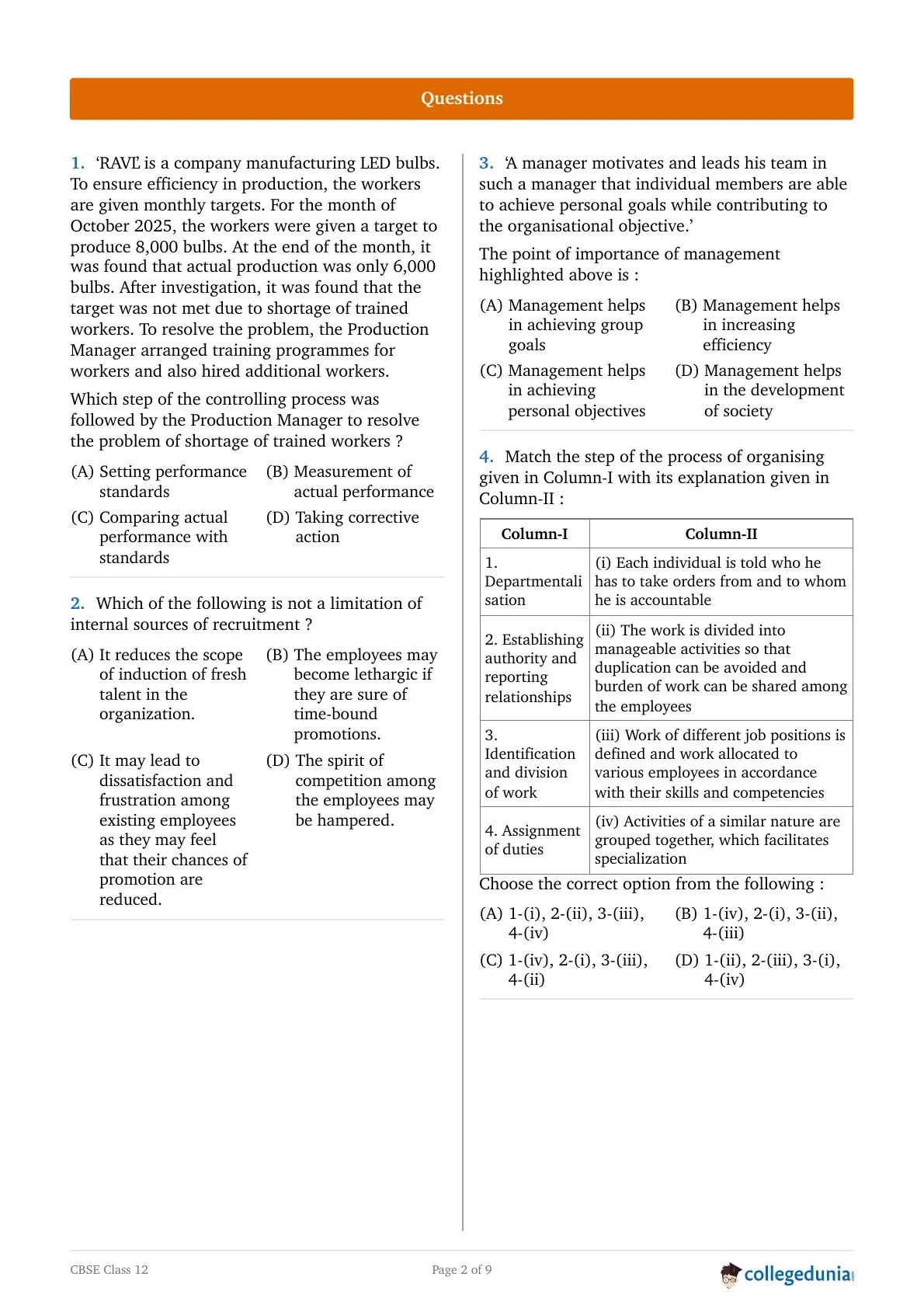
‘RAVL’ is a company manufacturing LED bulbs. To ensure efficiency in production, the workers are given monthly targets. For the month of October 2025, the workers were given a target to produce 8,000 bulbs. At the end of the month, it was found that actual production was only 6,000 bulbs. After investigation, it was found that the target was not met due to shortage of trained workers. To resolve the problem, the Production Manager arranged training programmes for workers and also hired additional workers.
Which step of the controlling process was followed by the Production Manager to resolve the problem of shortage of trained workers ?
Which of the following is not a limitation of internal sources of recruitment ?
‘A manager motivates and leads his team in such a manager that individual members are able to achieve personal goals while contributing to the organisational objective.’
The point of importance of management highlighted above is :
Match the step of the process of organising given in Column-I with its explanation given in Column-II :
| Column-I | Column-II |
|---|---|
| 1. Departmentalisation | (i) Each individual is told who he has to take orders from and to whom he is accountable |
| 2. Establishing authority and reporting relationships | (ii) The work is divided into manageable activities so that duplication can be avoided and burden of work can be shared among the employees |
| 3. Identification and division of work | (iii) Work of different job positions is defined and work allocated to various employees in accordance with their skills and competencies |
| 4. Assignment of duties | (iv) Activities of a similar nature are grouped together, which facilitates specialization |
Choose the correct option from the following :
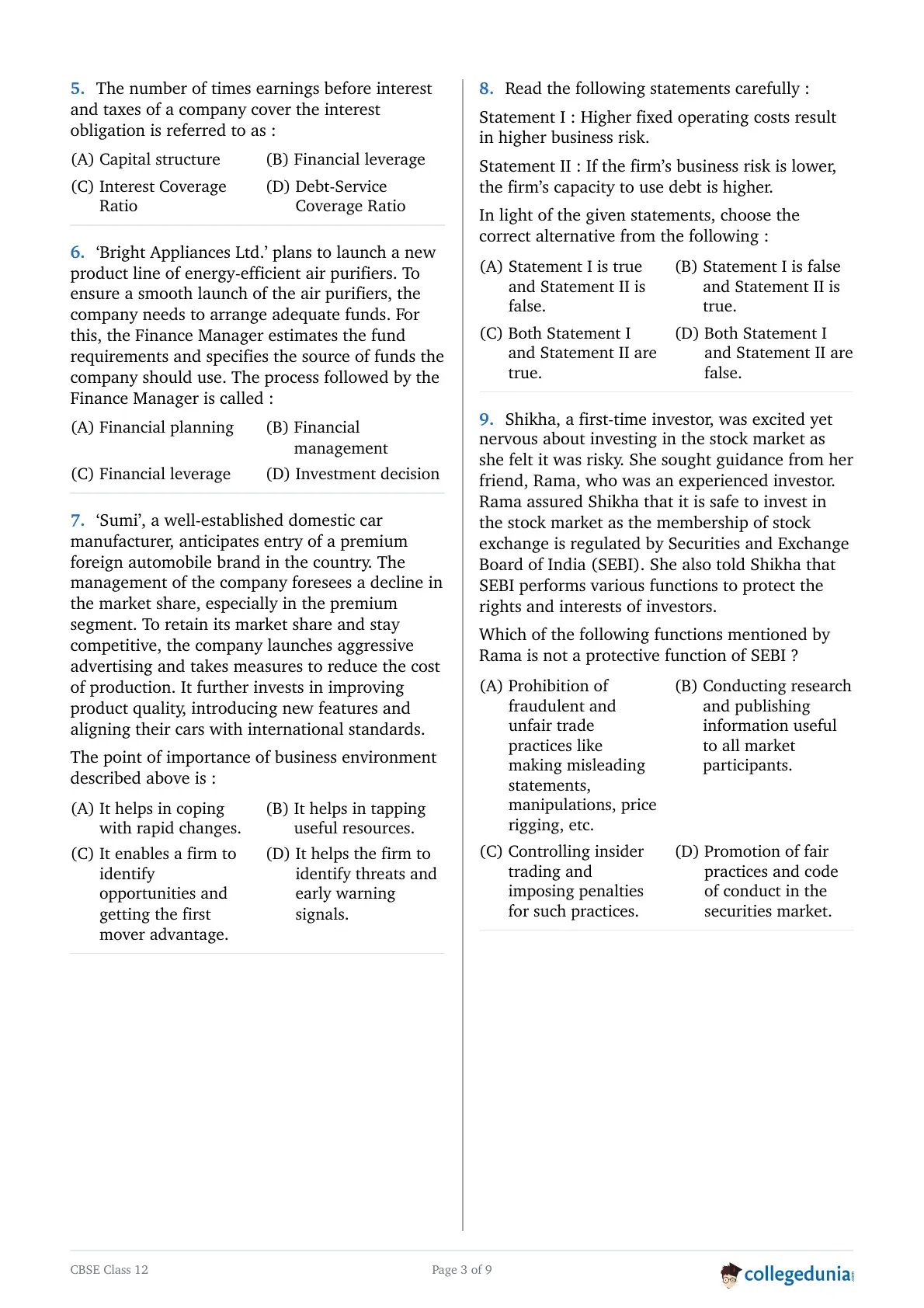
The number of times earnings before interest and taxes of a company cover the interest obligation is referred to as :
‘Bright Appliances Ltd.’ plans to launch a new product line of energy-efficient air purifiers. To ensure a smooth launch of the air purifiers, the company needs to arrange adequate funds. For this, the Finance Manager estimates the fund requirements and specifies the source of funds the company should use. The process followed by the Finance Manager is called :
‘Sumi’, a well-established domestic car manufacturer, anticipates entry of a premium foreign automobile brand in the country. The management of the company foresees a decline in the market share, especially in the premium segment. To retain its market share and stay competitive, the company launches aggressive advertising and takes measures to reduce the cost of production. It further invests in improving product quality, introducing new features and aligning their cars with international standards.
The point of importance of business environment described above is :
Read the following statements carefully :
Statement I : Higher fixed operating costs result in higher business risk.
Statement II : If the firm’s business risk is lower, the firm’s capacity to use debt is higher.
In light of the given statements, choose the correct alternative from the following :
Shikha, a first-time investor, was excited yet nervous about investing in the stock market as she felt it was risky. She sought guidance from her friend, Rama, who was an experienced investor. Rama assured Shikha that it is safe to invest in the stock market as the membership of stock exchange is regulated by Securities and Exchange Board of India (SEBI). She also told Shikha that SEBI performs various functions to protect the rights and interests of investors.
Which of the following functions mentioned by Rama is not a protective function of SEBI ?
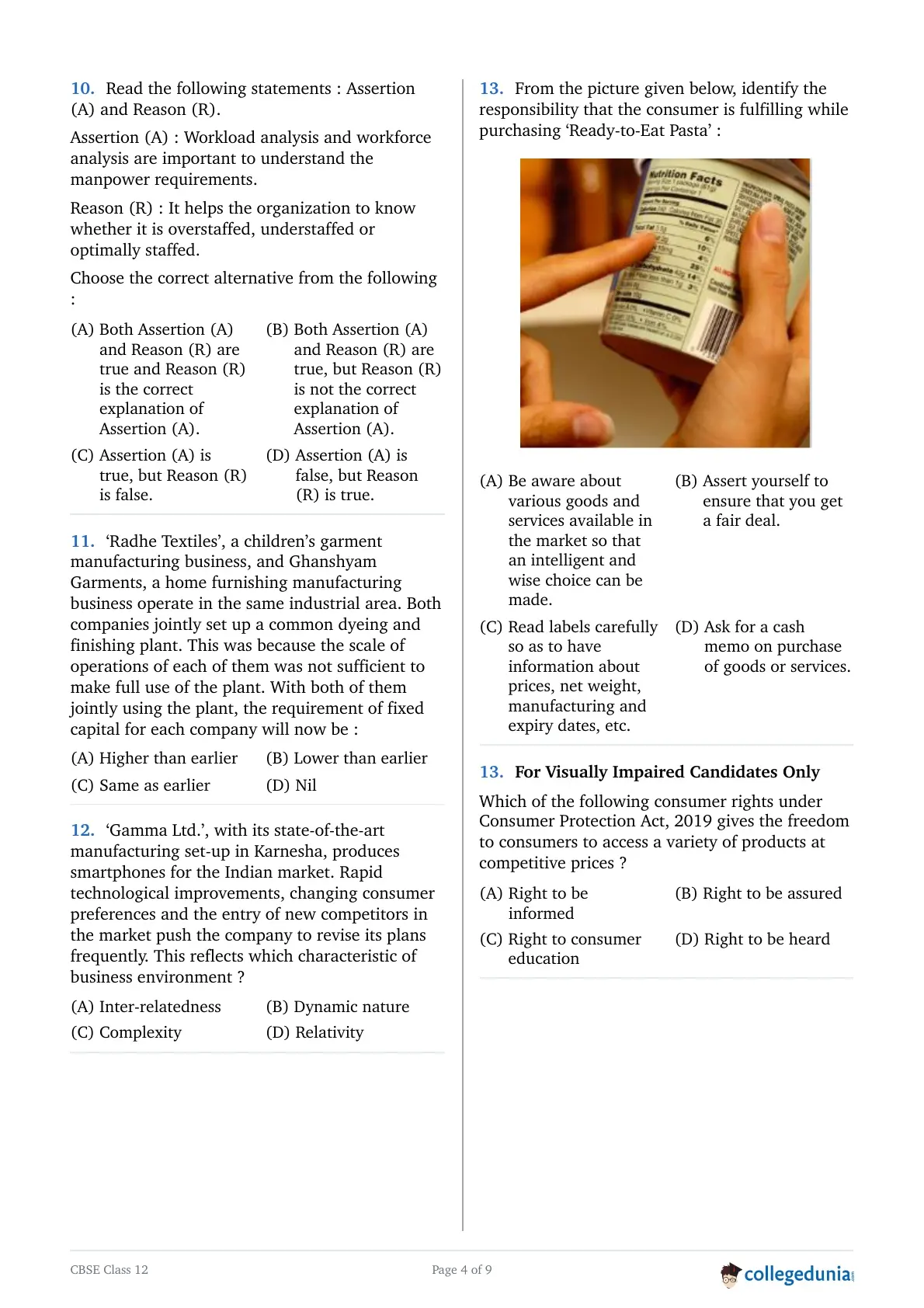
Read the following statements : Assertion (A) and Reason (R).
Assertion (A) : Workload analysis and workforce analysis are important to understand the manpower requirements.
Reason (R) : It helps the organization to know whether it is overstaffed, understaffed or optimally staffed.
Choose the correct alternative from the following :
‘Radhe Textiles’, a children’s garment manufacturing business, and Ghanshyam Garments, a home furnishing manufacturing business operate in the same industrial area. Both companies jointly set up a common dyeing and finishing plant. This was because the scale of operations of each of them was not sufficient to make full use of the plant. With both of them jointly using the plant, the requirement of fixed capital for each company will now be :
‘Gamma Ltd.’, with its state-of-the-art manufacturing set-up in Karnesha, produces smartphones for the Indian market. Rapid technological improvements, changing consumer preferences and the entry of new competitors in the market push the company to revise its plans frequently. This reflects which characteristic of business environment ?
From the picture given below, identify the responsibility that the consumer is fulfilling while purchasing ‘Ready-to-Eat Pasta’ :

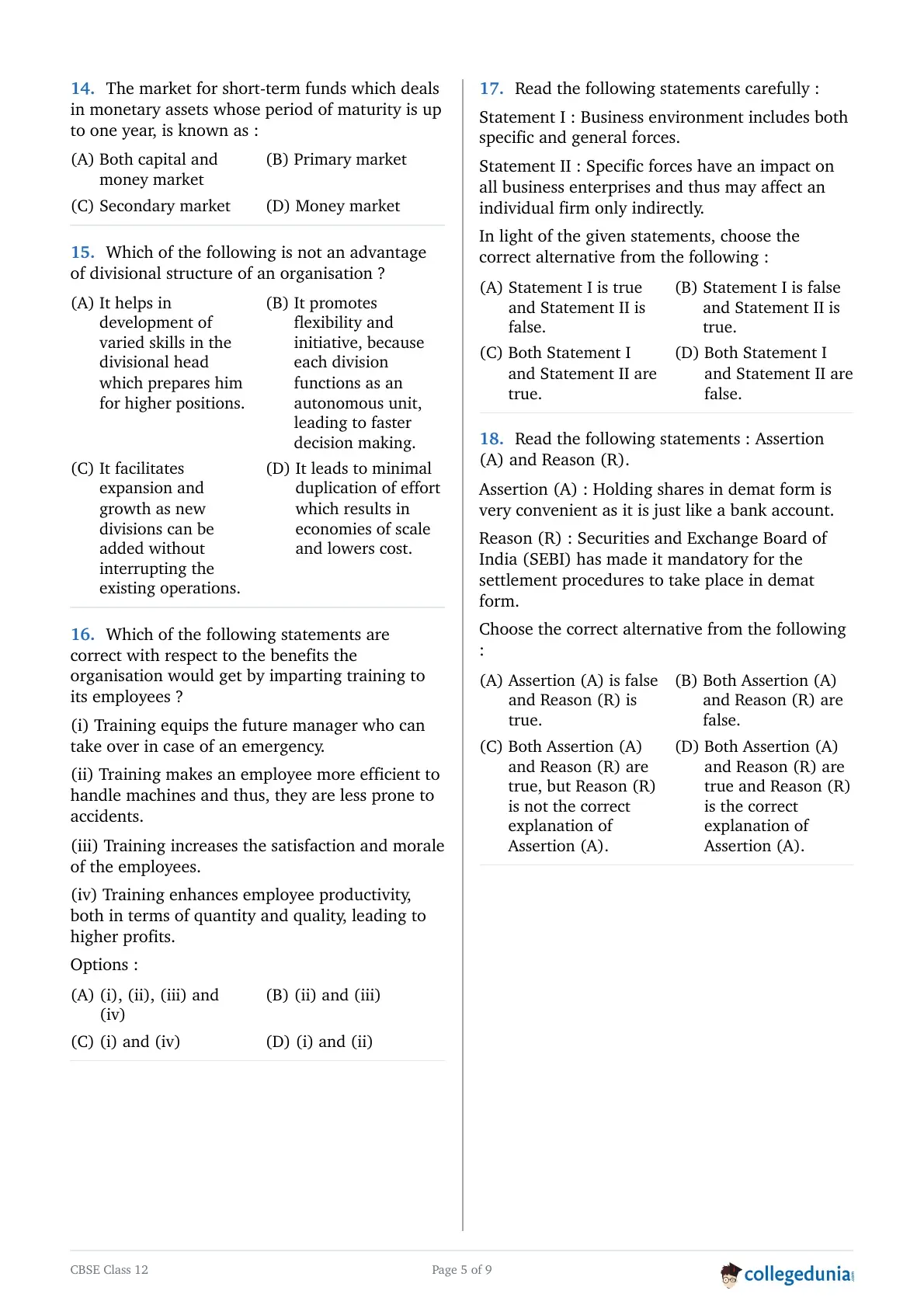
The market for short-term funds which deals in monetary assets whose period of maturity is up to one year, is known as :
Which of the following is not an advantage of divisional structure of an organisation ?
Which of the following statements are correct with respect to the benefits the organisation would get by imparting training to its employees ?
(i) Training equips the future manager who can take over in case of an emergency.
(ii) Training makes an employee more efficient to handle machines and thus, they are less prone to accidents.
(iii) Training increases the satisfaction and morale of the employees.
(iv) Training enhances employee productivity, both in terms of quantity and quality, leading to higher profits.
Options :
Read the following statements carefully :
Statement I : Business environment includes both specific and general forces.
Statement II : Specific forces have an impact on all business enterprises and thus may affect an individual firm only indirectly.
In light of the given statements, choose the correct alternative from the following :
Read the following statements : Assertion (A) and Reason (R).
Assertion (A) : Holding shares in demat form is very convenient as it is just like a bank account.
Reason (R) : Securities and Exchange Board of India (SEBI) has made it mandatory for the settlement procedures to take place in demat form.
Choose the correct alternative from the following :
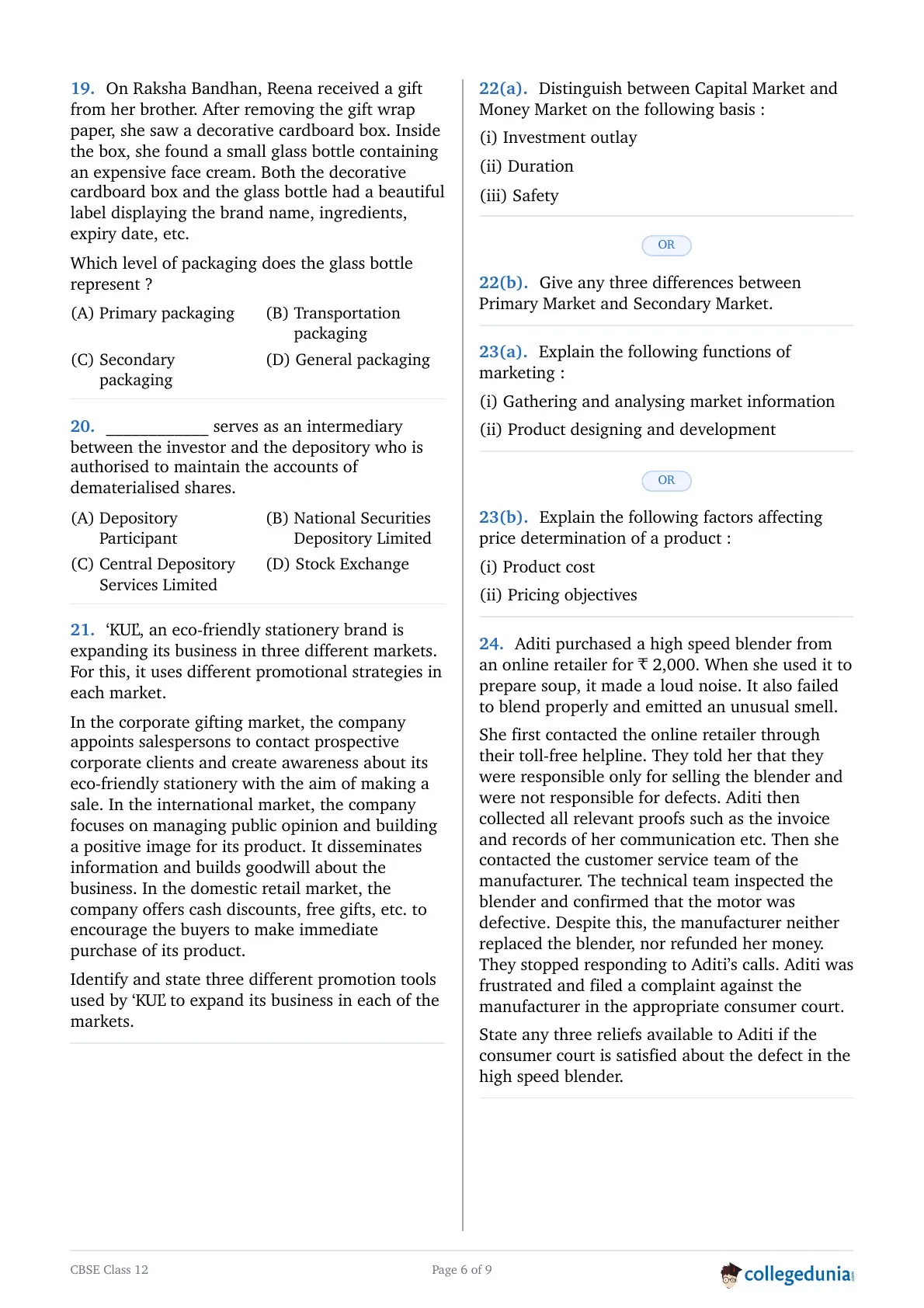
On Raksha Bandhan, Reena received a gift from her brother. After removing the gift wrap paper, she saw a decorative cardboard box. Inside the box, she found a small glass bottle containing an expensive face cream. Both the decorative cardboard box and the glass bottle had a beautiful label displaying the brand name, ingredients, expiry date, etc.
Which level of packaging does the glass bottle represent ?
____________ serves as an intermediary between the investor and the depository who is authorised to maintain the accounts of dematerialised shares.
‘KUL’, an eco-friendly stationery brand is expanding its business in three different markets. For this, it uses different promotional strategies in each market.
In the corporate gifting market, the company appoints salespersons to contact prospective corporate clients and create awareness about its eco-friendly stationery with the aim of making a sale. In the international market, the company focuses on managing public opinion and building a positive image for its product. It disseminates information and builds goodwill about the business. In the domestic retail market, the company offers cash discounts, free gifts, etc. to encourage the buyers to make immediate purchase of its product.
Identify and state three different promotion tools used by ‘KUL’ to expand its business in each of the markets.
Distinguish between Capital Market and Money Market on the following basis :
(i) Investment outlay
(ii) Duration
(iii) Safety
Give any three differences between Primary Market and Secondary Market.
Explain the following functions of marketing :
(i) Gathering and analysing market information
(ii) Product designing and development
Explain the following factors affecting price determination of a product :
(i) Product cost
(ii) Pricing objectives
Aditi purchased a high speed blender from an online retailer for ₹ 2,000. When she used it to prepare soup, it made a loud noise. It also failed to blend properly and emitted an unusual smell.
She first contacted the online retailer through their toll-free helpline. They told her that they were responsible only for selling the blender and were not responsible for defects. Aditi then collected all relevant proofs such as the invoice and records of her communication etc. Then she contacted the customer service team of the manufacturer. The technical team inspected the blender and confirmed that the motor was defective. Despite this, the manufacturer neither replaced the blender, nor refunded her money. They stopped responding to Aditi’s calls. Aditi was frustrated and filed a complaint against the manufacturer in the appropriate consumer court.
State any three reliefs available to Aditi if the consumer court is satisfied about the defect in the high speed blender.
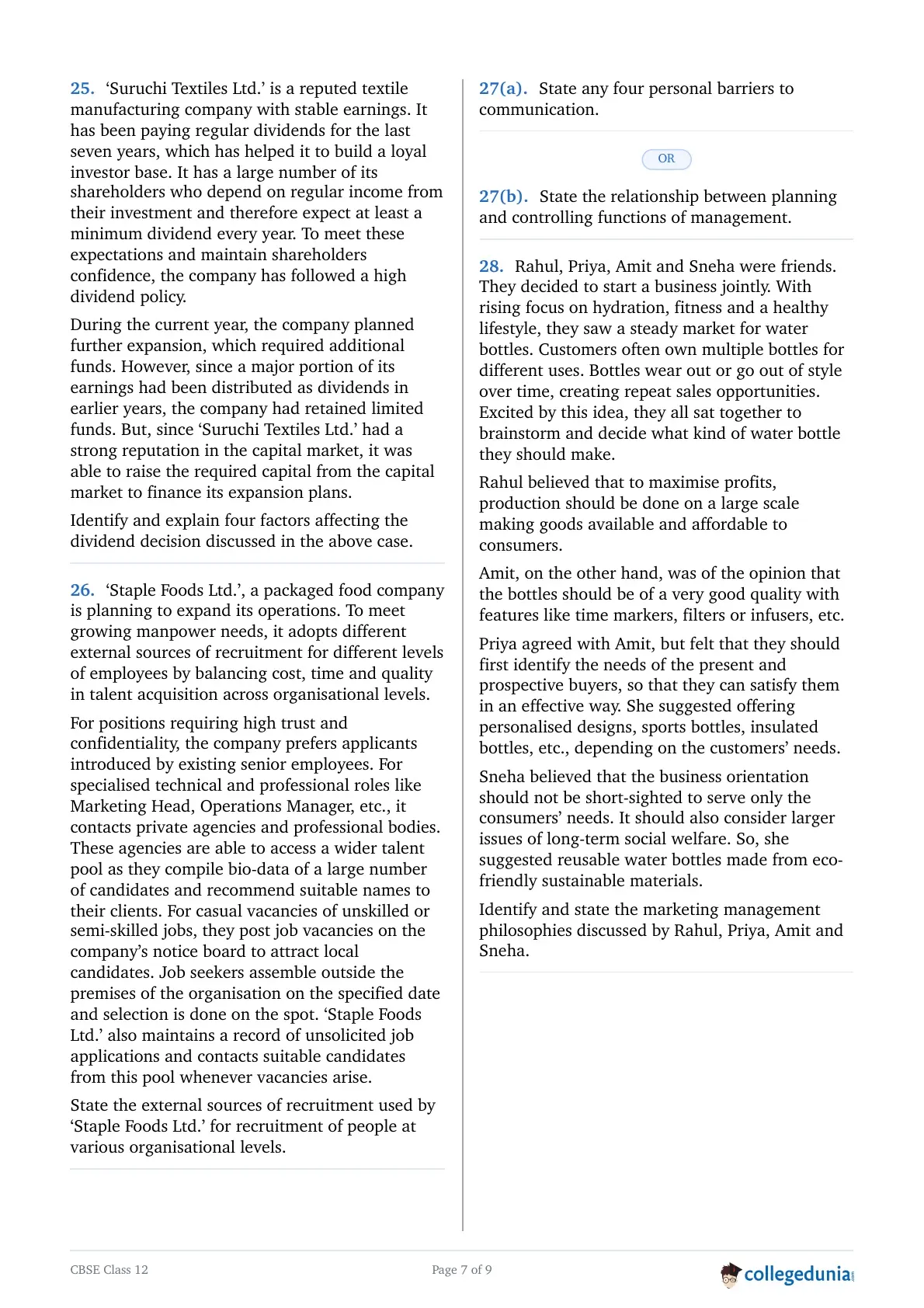
‘Suruchi Textiles Ltd.’ is a reputed textile manufacturing company with stable earnings. It has been paying regular dividends for the last seven years, which has helped it to build a loyal investor base. It has a large number of its shareholders who depend on regular income from their investment and therefore expect at least a minimum dividend every year. To meet these expectations and maintain shareholders confidence, the company has followed a high dividend policy.
During the current year, the company planned further expansion, which required additional funds. However, since a major portion of its earnings had been distributed as dividends in earlier years, the company had retained limited funds. But, since ‘Suruchi Textiles Ltd.’ had a strong reputation in the capital market, it was able to raise the required capital from the capital market to finance its expansion plans.
Identify and explain four factors affecting the dividend decision discussed in the above case.
‘Staple Foods Ltd.’, a packaged food company is planning to expand its operations. To meet growing manpower needs, it adopts different external sources of recruitment for different levels of employees by balancing cost, time and quality in talent acquisition across organisational levels.
For positions requiring high trust and confidentiality, the company prefers applicants introduced by existing senior employees. For specialised technical and professional roles like Marketing Head, Operations Manager, etc., it contacts private agencies and professional bodies. These agencies are able to access a wider talent pool as they compile bio-data of a large number of candidates and recommend suitable names to their clients. For casual vacancies of unskilled or semi-skilled jobs, they post job vacancies on the company’s notice board to attract local candidates. Job seekers assemble outside the premises of the organisation on the specified date and selection is done on the spot. ‘Staple Foods Ltd.’ also maintains a record of unsolicited job applications and contacts suitable candidates from this pool whenever vacancies arise.
State the external sources of recruitment used by ‘Staple Foods Ltd.’ for recruitment of people at various organisational levels.
State the relationship between planning and controlling functions of management.
Rahul, Priya, Amit and Sneha were friends. They decided to start a business jointly. With rising focus on hydration, fitness and a healthy lifestyle, they saw a steady market for water bottles. Customers often own multiple bottles for different uses. Bottles wear out or go out of style over time, creating repeat sales opportunities. Excited by this idea, they all sat together to brainstorm and decide what kind of water bottle they should make.
Rahul believed that to maximise profits, production should be done on a large scale making goods available and affordable to consumers.
Amit, on the other hand, was of the opinion that the bottles should be of a very good quality with features like time markers, filters or infusers, etc.
Priya agreed with Amit, but felt that they should first identify the needs of the present and prospective buyers, so that they can satisfy them in an effective way. She suggested offering personalised designs, sports bottles, insulated bottles, etc., depending on the customers’ needs.
Sneha believed that the business orientation should not be short-sighted to serve only the consumers’ needs. It should also consider larger issues of long-term social welfare. So, she suggested reusable water bottles made from eco-friendly sustainable materials.
Identify and state the marketing management philosophies discussed by Rahul, Priya, Amit and Sneha.
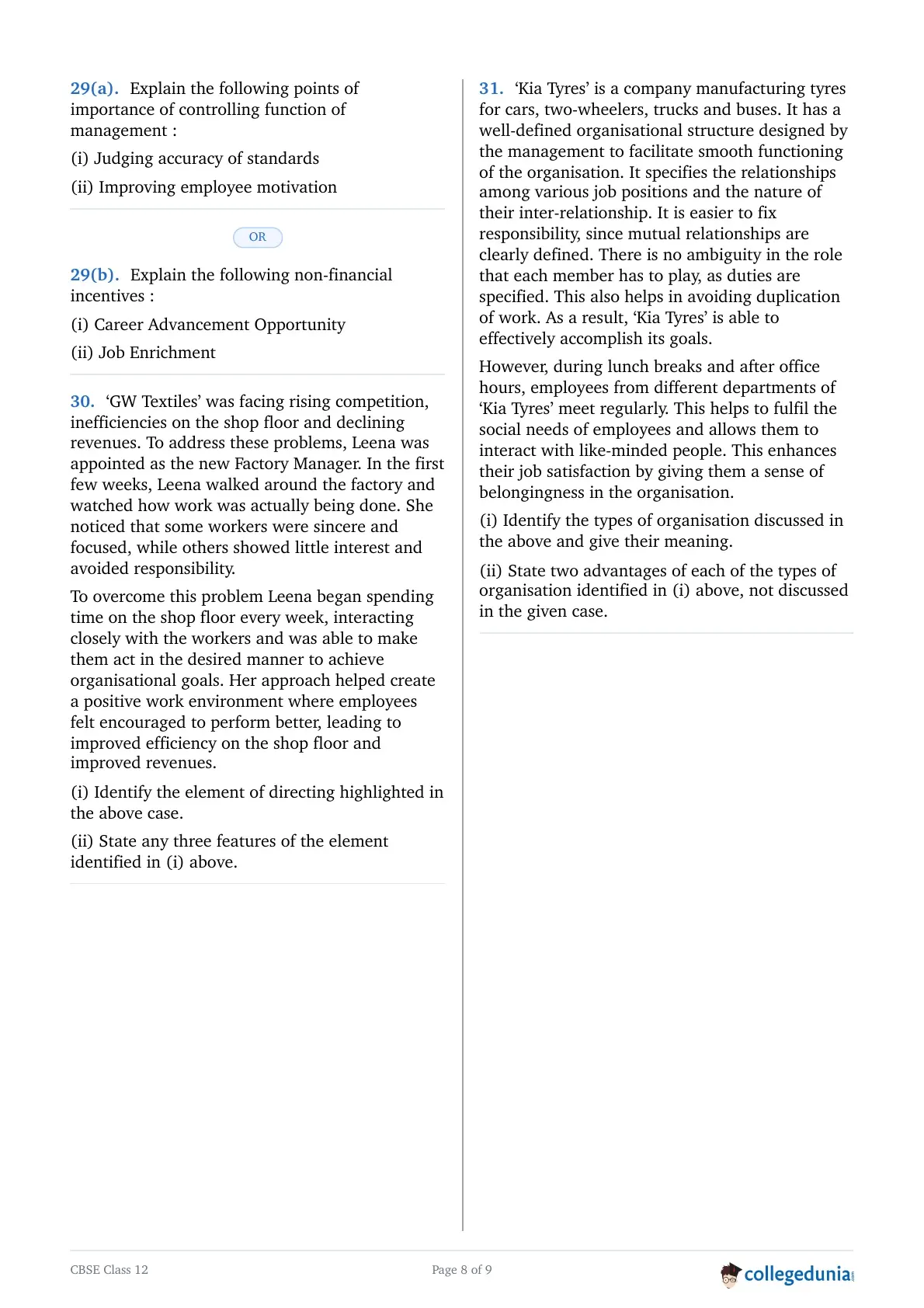
Explain the following points of importance of controlling function of management :
(i) Judging accuracy of standards
(ii) Improving employee motivation
Explain the following non-financial incentives :
(i) Career Advancement Opportunity
(ii) Job Enrichment
‘GW Textiles’ was facing rising competition, inefficiencies on the shop floor and declining revenues. To address these problems, Leena was appointed as the new Factory Manager. In the first few weeks, Leena walked around the factory and watched how work was actually being done. She noticed that some workers were sincere and focused, while others showed little interest and avoided responsibility.
To overcome this problem Leena began spending time on the shop floor every week, interacting closely with the workers and was able to make them act in the desired manner to achieve organisational goals. Her approach helped create a positive work environment where employees felt encouraged to perform better, leading to improved efficiency on the shop floor and improved revenues.
(i) Identify the element of directing highlighted in the above case.
(ii) State any three features of the element identified in (i) above.
‘Kia Tyres’ is a company manufacturing tyres for cars, two-wheelers, trucks and buses. It has a well-defined organisational structure designed by the management to facilitate smooth functioning of the organisation. It specifies the relationships among various job positions and the nature of their inter-relationship. It is easier to fix responsibility, since mutual relationships are clearly defined. There is no ambiguity in the role that each member has to play, as duties are specified. This also helps in avoiding duplication of work. As a result, ‘Kia Tyres’ is able to effectively accomplish its goals.
However, during lunch breaks and after office hours, employees from different departments of ‘Kia Tyres’ meet regularly. This helps to fulfil the social needs of employees and allows them to interact with like-minded people. This enhances their job satisfaction by giving them a sense of belongingness in the organisation.
(i) Identify the types of organisation discussed in the above and give their meaning.
(ii) State two advantages of each of the types of organisation identified in (i) above, not discussed in the given case.
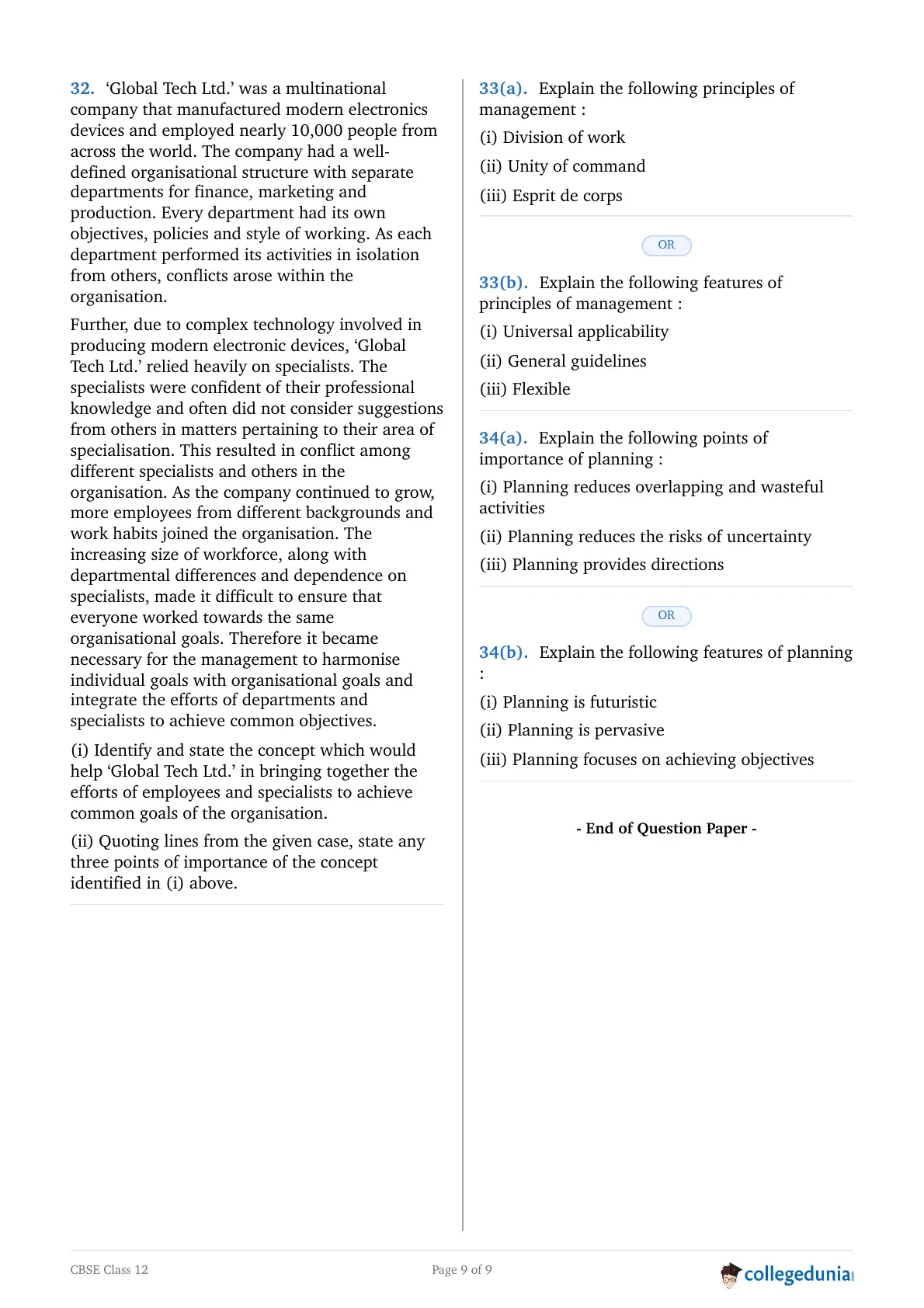
‘Global Tech Ltd.’ was a multinational company that manufactured modern electronics devices and employed nearly 10,000 people from across the world. The company had a well-defined organisational structure with separate departments for finance, marketing and production. Every department had its own objectives, policies and style of working. As each department performed its activities in isolation from others, conflicts arose within the organisation.
Further, due to complex technology involved in producing modern electronic devices, ‘Global Tech Ltd.’ relied heavily on specialists. The specialists were confident of their professional knowledge and often did not consider suggestions from others in matters pertaining to their area of specialisation. This resulted in conflict among different specialists and others in the organisation. As the company continued to grow, more employees from different backgrounds and work habits joined the organisation. The increasing size of workforce, along with departmental differences and dependence on specialists, made it difficult to ensure that everyone worked towards the same organisational goals. Therefore it became necessary for the management to harmonise individual goals with organisational goals and integrate the efforts of departments and specialists to achieve common objectives.
(i) Identify and state the concept which would help ‘Global Tech Ltd.’ in bringing together the efforts of employees and specialists to achieve common goals of the organisation.
(ii) Quoting lines from the given case, state any three points of importance of the concept identified in (i) above.
Explain the following principles of management :
(i) Division of work
(ii) Unity of command
(iii) Esprit de corps
Explain the following features of principles of management :
(i) Universal applicability
(ii) General guidelines
(iii) Flexible
Explain the following points of importance of planning :
(i) Planning reduces overlapping and wasteful activities
(ii) Planning reduces the risks of uncertainty
(iii) Planning provides directions
Explain the following features of planning :
(i) Planning is futuristic
(ii) Planning is pervasive
(iii) Planning focuses on achieving objectives
CBSE Class 12 Business Studies Question Paper Pattern and Marking Scheme
The CBSE Class 12 Business Studies 2026 theory paper is of 80 marks and has 34 questions, all compulsory; six questions carry an internal choice (OR). The tables below give the paper pattern and the marking rules from the official CBSE question paper and marking scheme.
CBSE Class 12 Business Studies Question Paper Pattern 2026
| Questions | Question Type | Marks per Question | Marks |
|---|---|---|---|
| Q1 - Q20 | Multiple choice questions (MCQs) | 1 | 20 |
| Q21 - Q24 | Short answer type questions (50 to 75 words) | 3 | 12 |
| Q25 - Q30 | Answer type questions (about 150 words) | 4 | 24 |
| Q31 - Q34 | Long answer type questions (about 200 words) | 6 | 24 |
| Total | 34 questions | 80 |
CBSE Class 12 Business Studies Marking Scheme 2026
| Marking point | How it is applied |
|---|---|
| Value-point marking | Marks are awarded against the value points (steps) given in the official marking scheme; the marks of an answer are split across its parts and value points. |
| Own expression | The marking scheme carries suggested value points only. A correct answer in the student's own words is awarded due marks. |
| Competency-based questions | If a competency-based answer is not from the marking scheme but shows the correct competency, due marks are awarded. |
| Errors | An error is penalised only once; no marks are deducted for its cumulative effect. |
| Incorrect answer | A totally incorrect answer is awarded zero (0) marks. |
| Choice (OR) questions | If both options of a question with internal choice are attempted, marks are awarded for both and the higher score is taken; if only one option is attempted, the other is marked NA (not attempted). |
| Scale of marks | The full scale of 0 to 80 marks is used and full marks are awarded whenever the answer deserves them. |
CBSE Class 12 Business Studies Chapter-Wise Weightage
| Unit No. | Unit Name | Marks |
|---|---|---|
| Part A: Principles and Functions of Management | ||
| 1. | Nature and Significance of Management | 16 Marks |
| 2. | Principles of Management | |
| 3. | Business Environment | |
| 4. | Planning | 14 Marks |
| 5. | Organizing | |
| 6. | Staffing | 20 Marks |
| 7. | Directing | |
| 8. | Controlling | |
| Total | 50 Marks | |
| Part B: Business Finance and Marketing | ||
| 9. | Financial Management | 15 Marks |
| 10. | Financial Markets | |
| 11. | Marketing Management | 15 Marks |
| 12. | Consumer Protection | |
| Total | 30 Marks | |
| Part C: Project Work | ||
| 1. | Project (One) | 20 Marks |
| Grand Total | 100 Marks | |



Comments