




CBSE Class 12 Chemistry Question Paper 2025 (Set 3 - 56/6/3) with Solutions is now available here for download. CBSE conducted the Class 12 Chemistry examination on February 27, 2025, from 10:30 AM to 1:30 PM.
CBSE Class 12 Chemistry paper is of total 100 marks out of which 70 marks are allocated to the theory paper and 30 marks are for practical examination.
Also Check: CBSE Class 12 Question Paper 2025 (All Subjects)
The theory paper consists of 33 questions divided into five sections:
- Section A contains Multiple Choice Questions (MCQs),
- Section B contains Very Short Answer Type (VSA) Questions,
- Section C contains Short Answer Type (SA) Questions,
- Section D contains Case-Study based Questions,
- Section E contains Long Answer (LA) Type Questions.
All sections are compulsory.
CBSE Class 12 Chemistry Question Paper 2025 (Set 3 - 56/6/3) with Solution PDF
| CBSE Official PDF | CD PDF | CD PDF with Solutions |
|---|---|---|
| Download official PDF 0.58 MB | Download Collegedunia PDF 0.47 MB | Download solutions PDF 0.59 MB |
CBSE Class 12 Chemistry 2025 Set 3 (56/6/3) Questions with Solutions
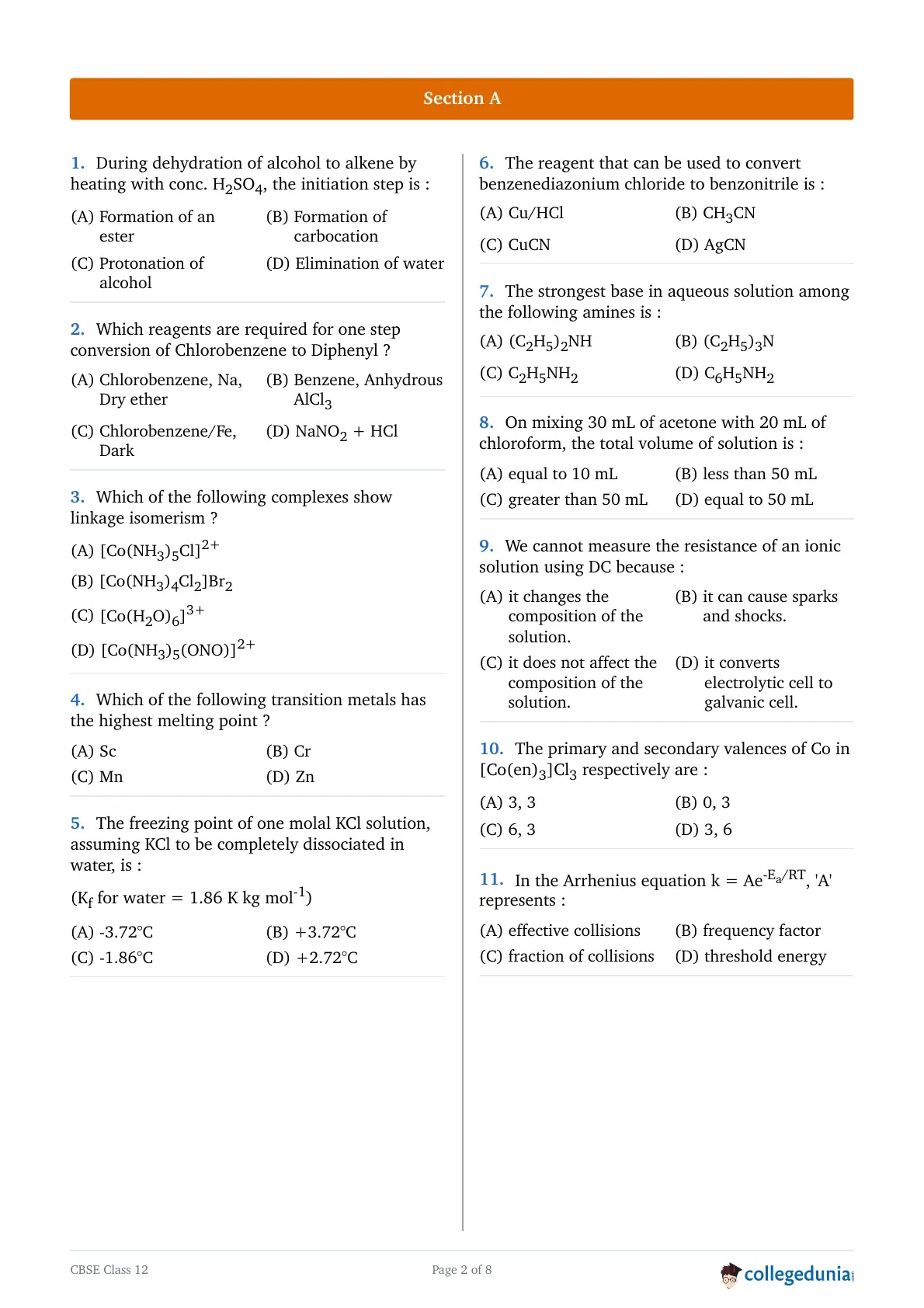
During dehydration of alcohol to alkene by heating with conc. H\(_2\)SO\(_4\), the initiation step is:
Which reagents are required for one step conversion of Chlorobenzene to Diphenyl?
Which of the following complexes show linkage isomerism?
Which of the following transition metals has the highest melting point?
The freezing point of one molal KCl solution, assuming KCl to be completely dissociated in water, is: (\(K_f\) for water = 1.86 K kg mol\(^{-1}\))
The reagent that can be used to convert benzenediazonium chloride to benzonitrile is :
The strongest base in aqueous solution among the following amines is:
On mixing 30 mL of acetone with 20 mL of chloroform, the total volume of solution is:
We cannot measure the resistance of an ionic solution using DC because:
The primary and secondary valences of Co in [Co(en)₃]Cl₃ respectively are:
In the Arrhenius equation \( k = Ae^{-E_a/RT} \), ‘A’ represents:
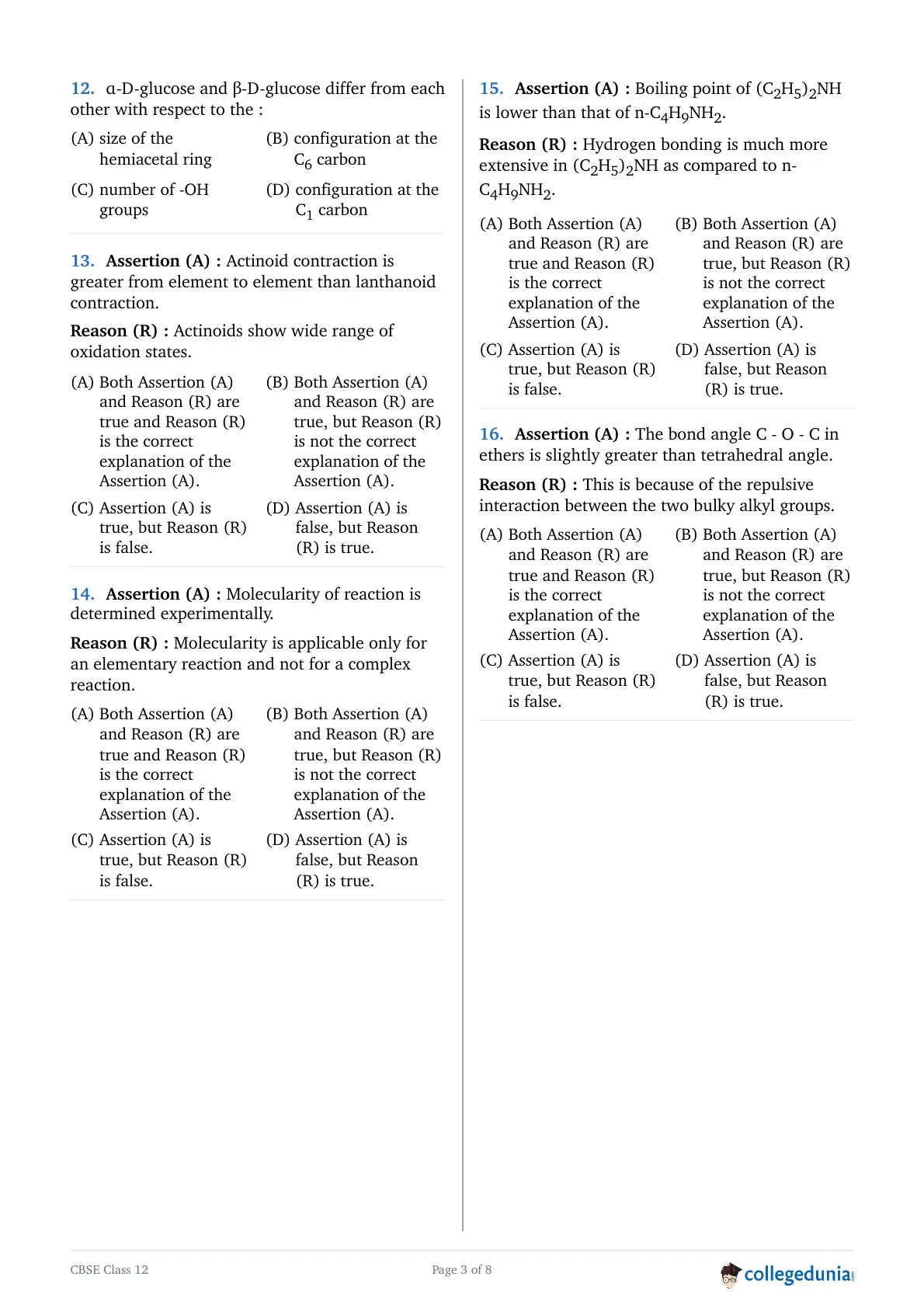
\(\alpha\)-D-glucose and \(\beta\)-D-glucose differ from each other with respect to the:
Assertion (A) : Actinoid contraction is greater from element to element than lanthanoid contraction.
Reason (R) : Actinoids show wide range of oxidation states.
Assertion (A): Molecularity of reaction is determined experimentally. Reason (R): Molecularity is applicable only for an elementary reaction and not for a complex reaction.
Assertion (A) : Boiling point of (C2H5)2NH is lower than that of n-C4H9NH2.
Reason (R) : Hydrogen bonding is much more extensive in (C2H5)2NH as compared to n-C4H9NH2.
Assertion (A): The bond angle C-O-C in ethers is slightly greater than tetrahedral angle. Reason (R): This is because of the repulsive interaction between the two bulky alkyl groups.
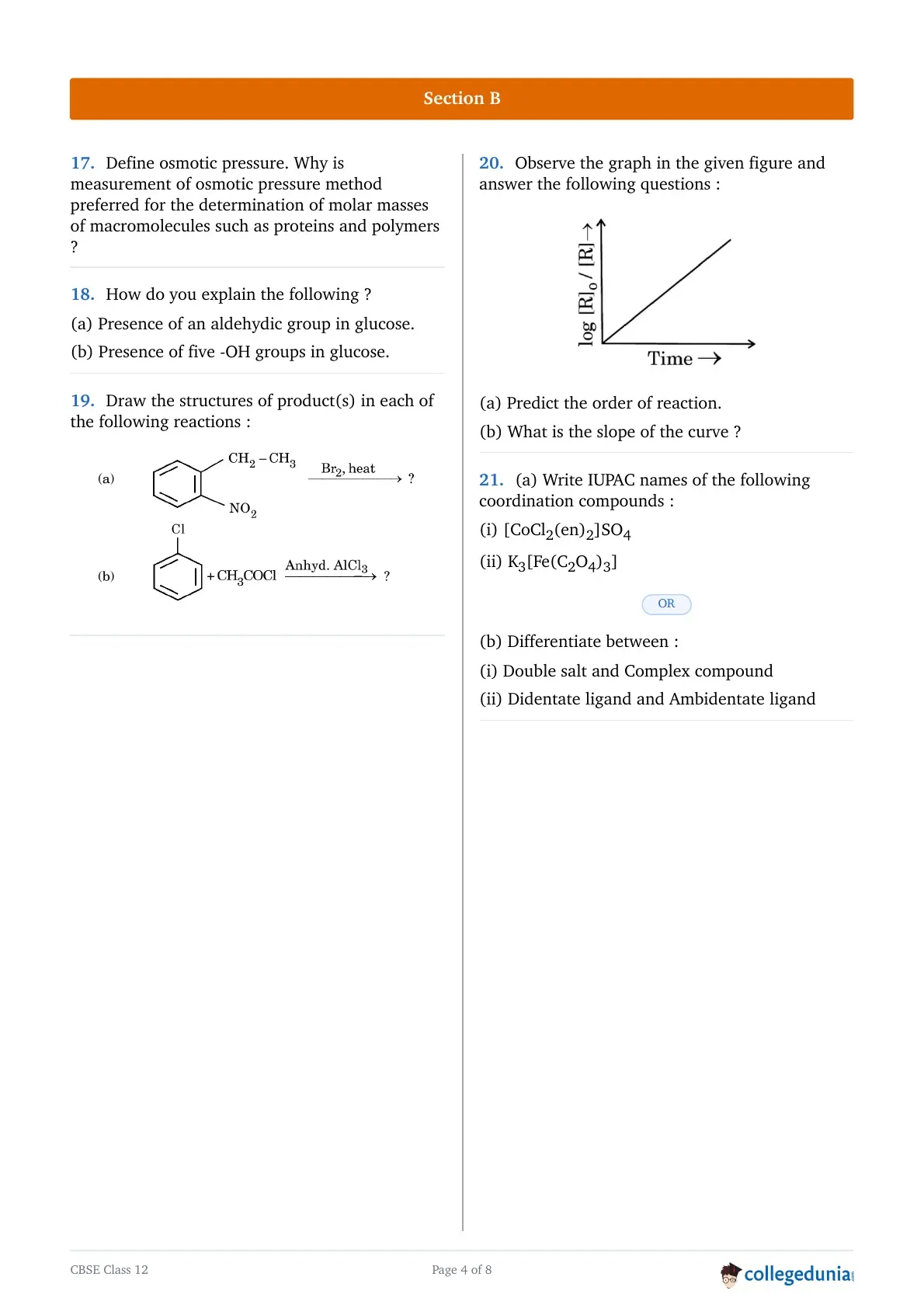
Define osmotic pressure. Why is measurement of osmotic pressure method preferred for the determination of molar masses of macromolecules such as proteins and polymers ?
How do you explain the following ?
(a) Presence of an aldehydic group in glucose.
(b) Presence of five -OH groups in glucose.
Draw the structures of product(s) in each of the following reactions :
(a)
(b)
Observe the graph in the given figure and answer the following questions :
(a) Predict the order of reaction.
(b) What is the slope of the curve ?
Write IUPAC names of the following coordination compounds :
[CoCl2(en)2]SO4
Write IUPAC names of the following coordination compounds :
K3[Fe(C2O4)3]
Differentiate between:
(i) Double salt and Complex compound
(ii) Didentate ligand and Ambidentate ligand
Differentiate between:
(i) Double salt and Complex compound
(ii) Didentate ligand and Ambidentate ligand
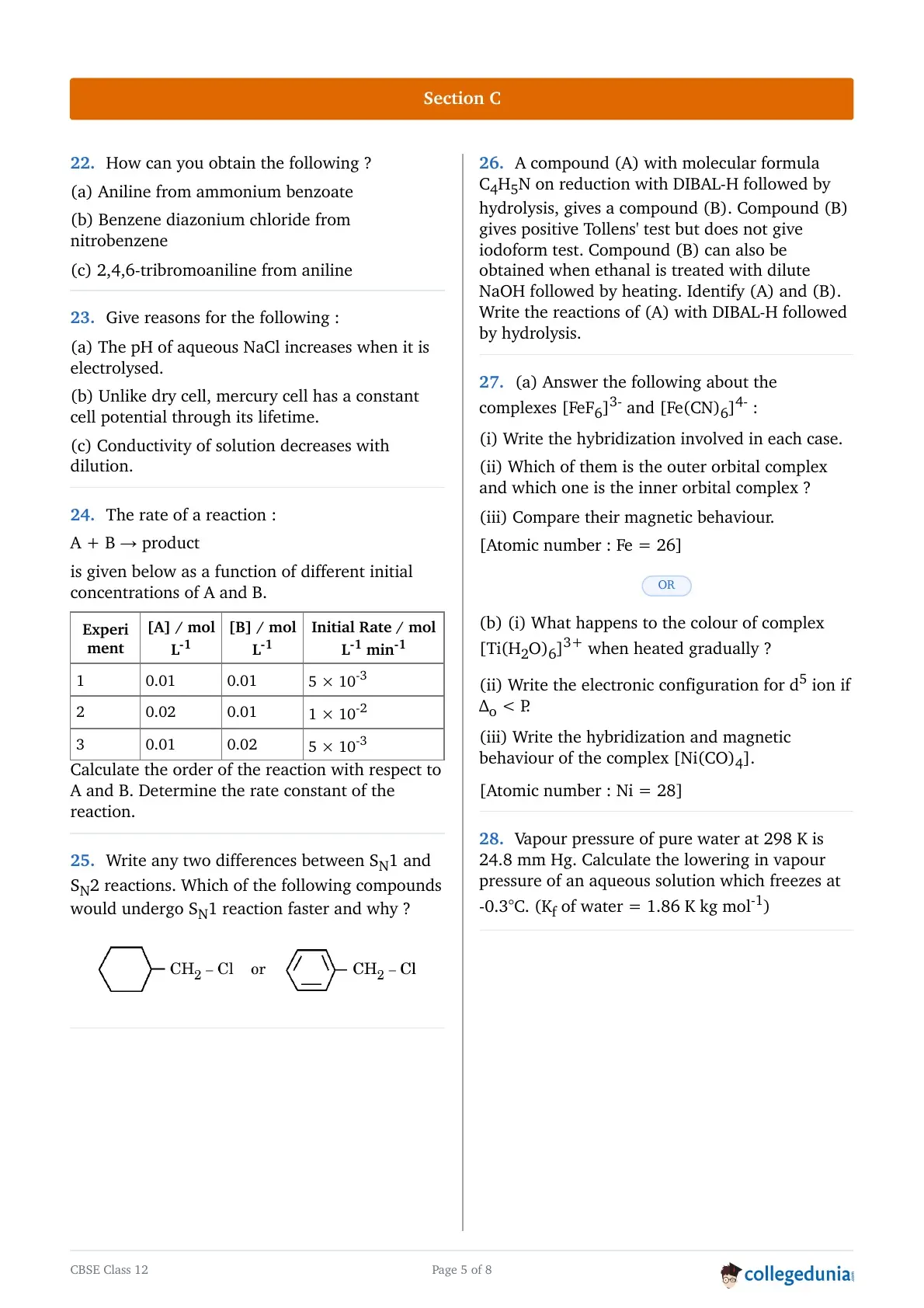
How can you obtain the following ?
(a) Aniline from ammonium benzoate
(b) Benzene diazonium chloride from nitrobenzene
(c) 2,4,6-tribromoaniline from aniline
Give reasons for the following :
(a) The pH of aqueous NaCl increases when it is electrolysed.
(b) Unlike dry cell, mercury cell has a constant cell potential through its lifetime.
(c) Conductivity of solution decreases with dilution.
The rate of a reaction:
A + B \(\to\) product
is given below as a function of different initial concentrations of A and B.
| Experiment | \([A]\) / mol L\(^{-1}\) | \([B]\) / mol L\(^{-1}\) | Initial Rate / mol L\(^{-1}\) min\(^{-1}\) |
|---|---|---|---|
| 1 | 0.01 | 0.01 | \(5 \times 10^{-3}\) |
| 2 | 0.02 | 0.01 | \(1 \times 10^{-2}\) |
| 3 | 0.01 | 0.02 | \(5 \times 10^{-3}\) |
Calculate the order of the reaction with respect to A and B. Determine the rate constant of the reaction.
Write any two differences between SN1 and SN2 reactions. Which of the following compounds would undergo SN1 reaction faster and why ?
A compound (A) with molecular formula C4H5N on reduction with DIBAL-H followed by hydrolysis, gives a compound (B). Compound (B) gives positive Tollens' test but does not give iodoform test. Compound (B) can also be obtained when ethanal is treated with dilute NaOH followed by heating. Identify (A) and (B). Write the reactions of (A) with DIBAL-H followed by hydrolysis.
Answer the following about the complexes
\([ \text{FeF}_6]^{3-} \text{ and } [\text{Fe(CN)}_6]^{4-}\):
(i) Write the hybridization involved in each case.
(ii) Which of them is the outer orbital complex and which one is the inner orbital complex?
(iii) Compare their magnetic behaviour.
[Atomic number: Fe = 26]
Answer the following:
(i) What happens to the colour of the complex \([ \text{Ti(H}_2\text{O)}_6 ]^{3+}\) when heated gradually?
(ii) Write the electronic configuration for a \(d^5\) ion if \(\Delta_o < P\).
(iii) Write the hybridization and magnetic behaviour of the complex \([ \text{Ni(CO)}_4 ]\).
(Atomic number: Ni = 28)
Vapour pressure of pure water at 298 K is 24.8 mm Hg. Calculate the lowering in vapour pressure of an aqueous solution which freezes at -0.3°C. (Kf of water = 1.86 K kg mol-1)
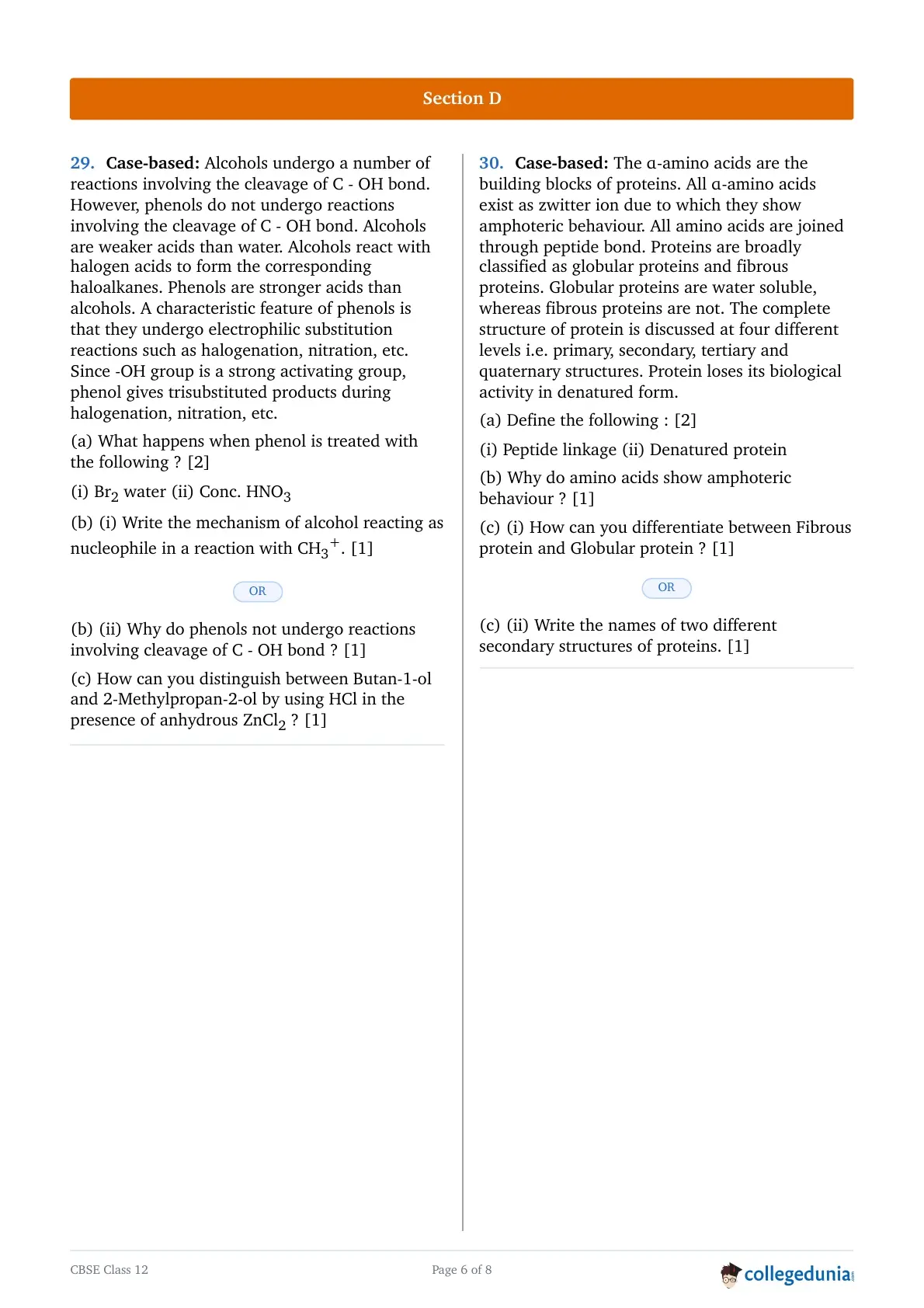
Case-based: Alcohols undergo a number of reactions involving the cleavage of C - OH bond. However, phenols do not undergo reactions involving the cleavage of C - OH bond. Alcohols are weaker acids than water. Alcohols react with halogen acids to form the corresponding haloalkanes. Phenols are stronger acids than alcohols. A characteristic feature of phenols is that they undergo electrophilic substitution reactions such as halogenation, nitration, etc. Since -OH group is a strong activating group, phenol gives trisubstituted products during halogenation, nitration, etc.
What happens when phenol is treated with the following ? [2]
(i) Br2 water (ii) Conc. HNO3
Write the mechanism of alcohol reacting as nucleophile in a reaction with CH3+. [1]
Why do phenols not undergo reactions involving cleavage of C - OH bond ? [1]
How can you distinguish between Butan-1-ol and 2-Methylpropan-2-ol by using HCl in the presence of anhydrous ZnCl2 ? [1]
Case-based: The α-amino acids are the building blocks of proteins. All α-amino acids exist as zwitter ion due to which they show amphoteric behaviour. All amino acids are joined through peptide bond. Proteins are broadly classified as globular proteins and fibrous proteins. Globular proteins are water soluble, whereas fibrous proteins are not. The complete structure of protein is discussed at four different levels i.e. primary, secondary, tertiary and quaternary structures. Protein loses its biological activity in denatured form.
Define the following : [2]
(i) Peptide linkage (ii) Denatured protein
Why do amino acids show amphoteric behaviour ? [1]
How can you differentiate between Fibrous protein and Globular protein ? [1]
(c) (ii) Write the names of two different secondary structures of proteins. [1]
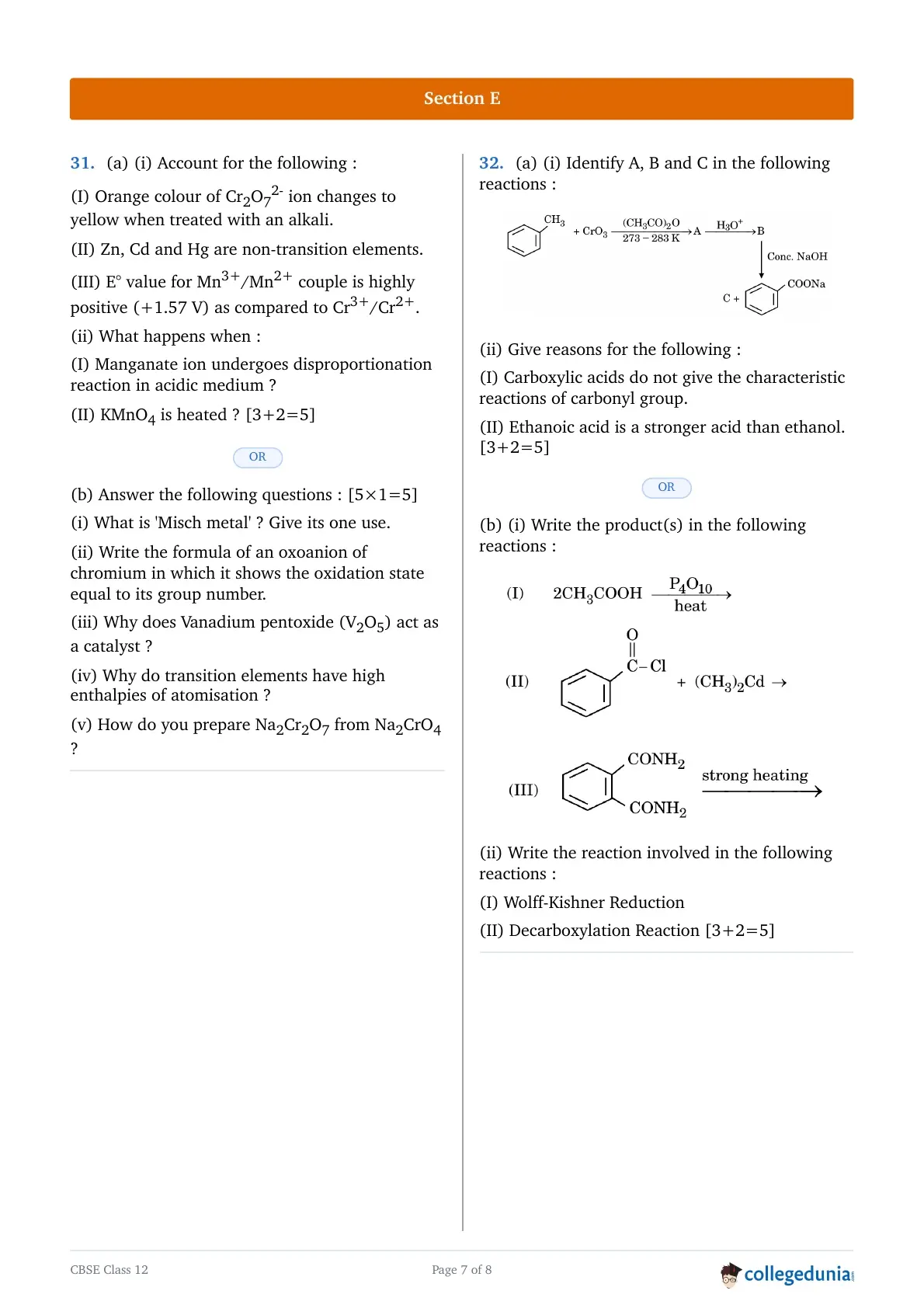
Account for the following :
(I) Orange colour of Cr2O72- ion changes to yellow when treated with an alkali.
(II) Zn, Cd and Hg are non-transition elements.
(III) E° value for Mn3+/Mn2+ couple is highly positive (+1.57 V) as compared to Cr3+/Cr2+.
What happens when :
(I) Manganate ion undergoes disproportionation reaction in acidic medium ?
(II) KMnO4 is heated ?
What is 'Misch metal' ? Give its one use.
Write the formula of an oxoanion of chromium in which it shows the oxidation state equal to its group number.
Why does Vanadium pentoxide (V2O5) act as a catalyst ?
Why do transition elements have high enthalpies of atomisation ?
How do you prepare Na2Cr2O7 from Na2CrO4 ?
Identify A, B and C in the following reactions :
Give reasons for the following :
(I) Carboxylic acids do not give the characteristic reactions of carbonyl group.
(II) Ethanoic acid is a stronger acid than ethanol.

Write the reaction involved in the following reactions :
(I) Wolff-Kishner Reduction
(II) Decarboxylation Reaction
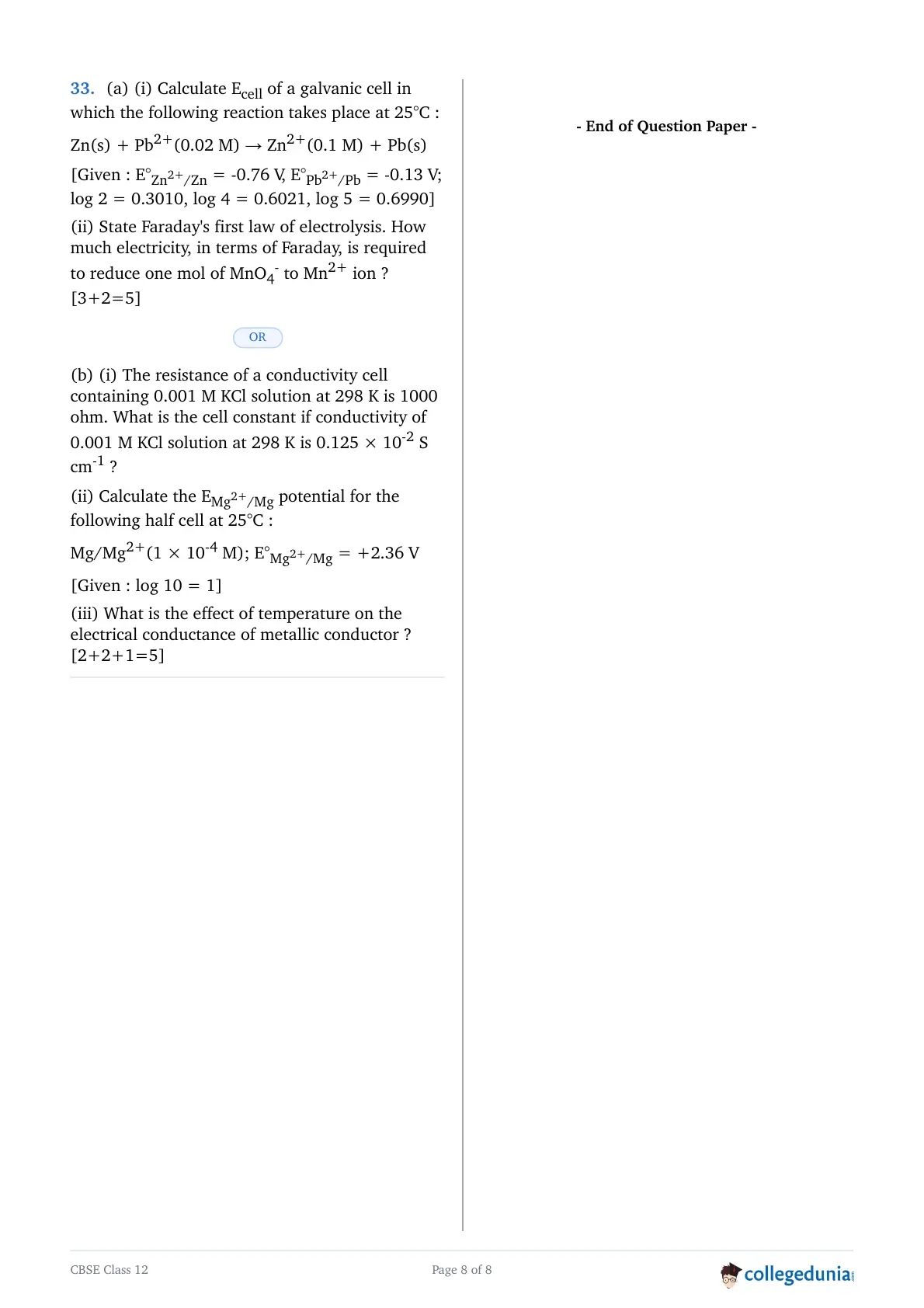
Calculate \( E_{\text{cell}} \) of a galvanic cell in which the following reaction takes place at 25°C:
\[
\text{Zn(s)} + \text{Pb}^{2+}(0.02M) \longrightarrow \text{Zn}^{2+}(0.1M) + \text{Pb(s)} \quad \text{[Given: } E^0_{\text{Zn}^{2+}/\text{Zn}} = -0.76V, \; E^0_{\text{Pb}^{2+}/\text{Pb}} = -0.13V, \; \log 2 = 0.3010, \; \log 4 = 0.6021, \; \log 5 = 0.6990 \text{]}
\]
State Faraday's first law of electrolysis. How much electricity, in terms of Faraday, is required to reduce one mol of MnO4- to Mn2+ ion ?
The resistance of a conductivity cell containing 0.001 M KCl solution at 298 K is 1000 ohm. What is the cell constant if conductivity of 0.001 M KCl solution at 298 K is 0.125 × 10⁻² S cm-1 ?
Calculate the \( E_{Mg^{2+}/Mg} \) potential for the following half cell at 25°C :
Mg/Mg2+(1 × 10−4 M); E°Mg2+/Mg = +2.36 V
[Given : log 10 = 1]
What is the effect of temperature on the electrical conductance of metallic conductor ?
CBSE Class 12 Chemistry Question Paper Pattern 2025
The CBSE Class 12 Chemistry 2025 question paper is of 70 marks and has 33 questions in five sections, A to E, all compulsory, with internal choice in some questions of Sections B to E. The time allowed is 3 hours, with 15 minutes of extra reading time. The table below gives the section-wise paper pattern from the official CBSE question paper.
| Section | Questions | Question Type | Marks per Question | Marks |
|---|---|---|---|---|
| A | Q1 - Q16 | Multiple choice questions | 1 | 16 |
| B | Q17 - Q21 | Very short answer questions | 2 | 10 |
| C | Q22 - Q28 | Short answer questions | 3 | 21 |
| D | Q29 - Q30 | Case study-based questions | 4 | 8 |
| E | Q31 - Q33 | Long answer questions | 5 | 15 |
| Total | 33 questions | 70 |
CBSE Class 12 Chemistry Unit-Wise Weightage
| Unit No. | Unit Name | Marks |
|---|---|---|
| 1 | Solutions | 7 |
| 2 | Electrochemistry | 9 |
| 3 | Chemical Kinetics | 7 |
| 4 | d- and f-Block Elements | 7 |
| 5 | Coordination Compounds | 7 |
| 6 | Haloalkanes and Haloarenes | 6 |
| 7 | Alcohols, Phenols and Ethers | 6 |
| 8 | Aldehydes, Ketones and Carboxylic Acids | 8 |
| 9 | Amines | 6 |
| 10 | Biomolecules | 7 |
| Total | — | 70 |



Comments