




CBSE Class 12 Chemistry Compartment Set 2 - (56/7/2) Question Paper 2026 is available for download here. CBSE conducted the Class 12 Chemistry Compartment (supplementary) examination on July 28, 2026, from 10:30 AM to 1:30 PM. The Chemistry paper is of 70 marks and the time allowed is 3 hours. This paper carries the Q.P. code 56/7/2 and is of Set 2. The question paper was handed out at 10:15 AM, and the first 15 minutes were given for reading it.
Also Check: CBSE Class 12 Question Paper 2026 (All Subjects)
The paper has 33 questions in five sections, A to E, and all questions are compulsory:
- Section A has 16 multiple choice questions of 1 mark each
- Section B has 5 very short answer questions of 2 marks each
- Section C has 7 short answer questions of 3 marks each
- Section D has 2 case-based questions of 4 marks each
- Section E has 3 long answer questions of 5 marks each
- There is no overall choice, but an internal choice is given in a few questions of all the sections except Section A
- Use of a calculator is not allowed
CBSE Class 12 Chemistry Compartment Set 2 - (56/7/2) Question Paper 2026 PDF
| CBSE Official PDF | CD PDF | CD PDF with Solutions |
|---|---|---|
| Download official PDF 0.60 MB | Download Collegedunia PDF 0.4 MB | Download solutions PDF 0.58 MB |
CBSE Class 12 Chemistry Compartment 2026 Set 2 (56/7/2) Questions with Solutions
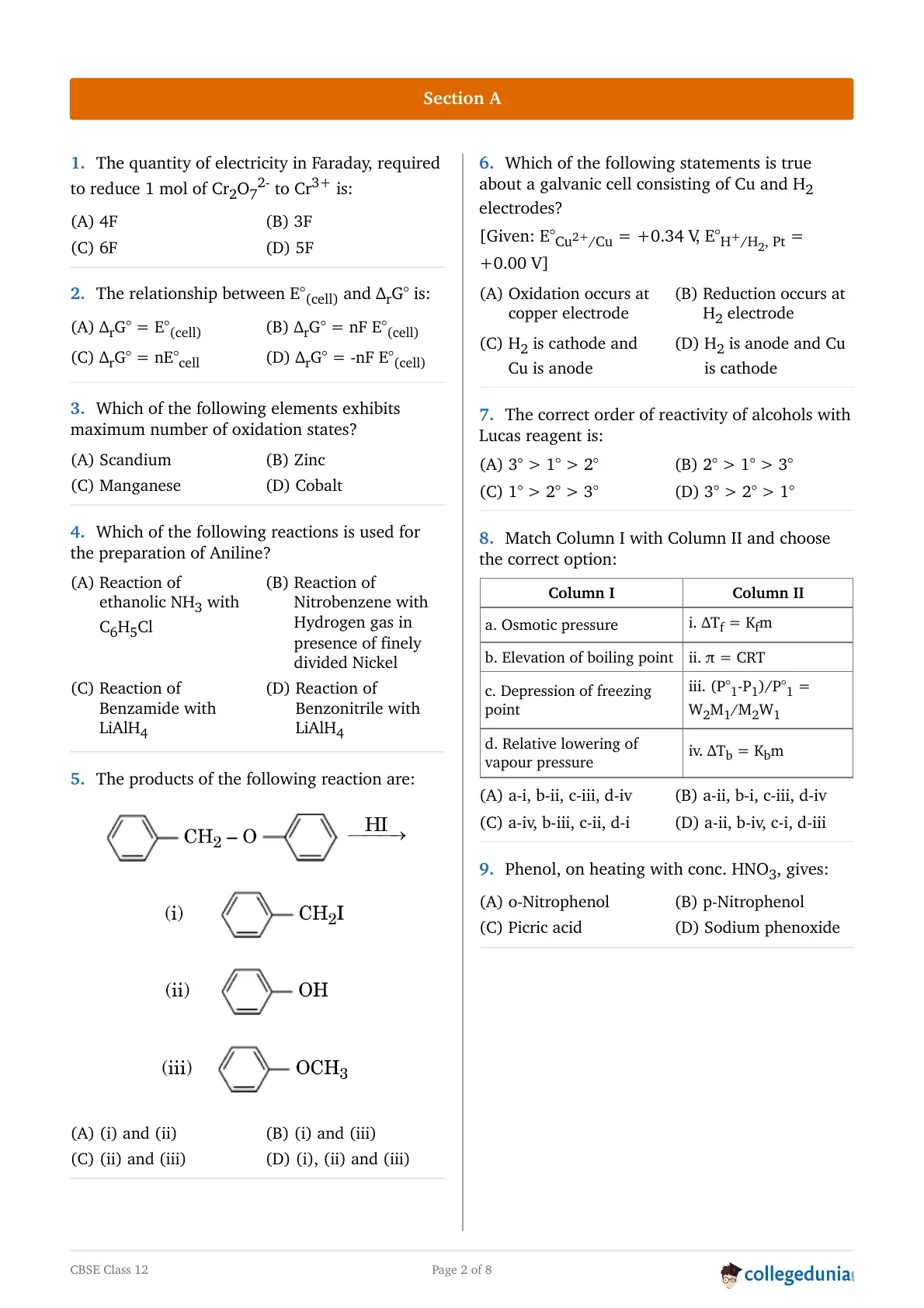
The quantity of electricity in Faraday, required to reduce 1 mol of \( \mathrm{Cr_2O_7^{2-}} \) to \( \mathrm{Cr^{3+}} \) is :
The relationship between \( E^{o}_{(cell)} \) and \( \Delta_rG^{\ominus} \) is :
Which of the following elements exhibits maximum number of oxidation states ?
Which of the following reactions is used for the preparation of Aniline ?
The products of the following reaction are :
\( \mathrm{C_6H_5CH_2OC_6H_5} \xrightarrow{\mathrm{HI}} \)
(i) \( \mathrm{C_6H_5CH_2I} \)
(ii) \( \mathrm{C_6H_5OH} \)
(iii) \( \mathrm{C_6H_5OCH_3} \)
Which of the following statements is true about a galvanic cell consisting of Cu and \( \mathrm{H_2} \) electrodes ?
[Given : \( E^{o}_{\mathrm{Cu^{2+}/Cu}} = +0.34\ \mathrm{V},\ E^{o}_{\mathrm{H^{+}/H_2,\ Pt}} = 0.00\ \mathrm{V} \)]
Match Column I with Column II and choose the correct option :
| Column I | Column II |
|---|---|
| a. Osmotic pressure | i. \( \Delta T_f = K_f m \) |
| b. Elevation of boiling point | ii. \( \pi = CRT \) |
| c. Depression of freezing point | iii. \( \dfrac{P_1^0 - P_1}{P_1^0} = \dfrac{W_2 \times M_1}{M_2 \times W_1} \) |
| d. Relative lowering of vapour pressure | iv. \( \Delta T_b = K_b m \) |
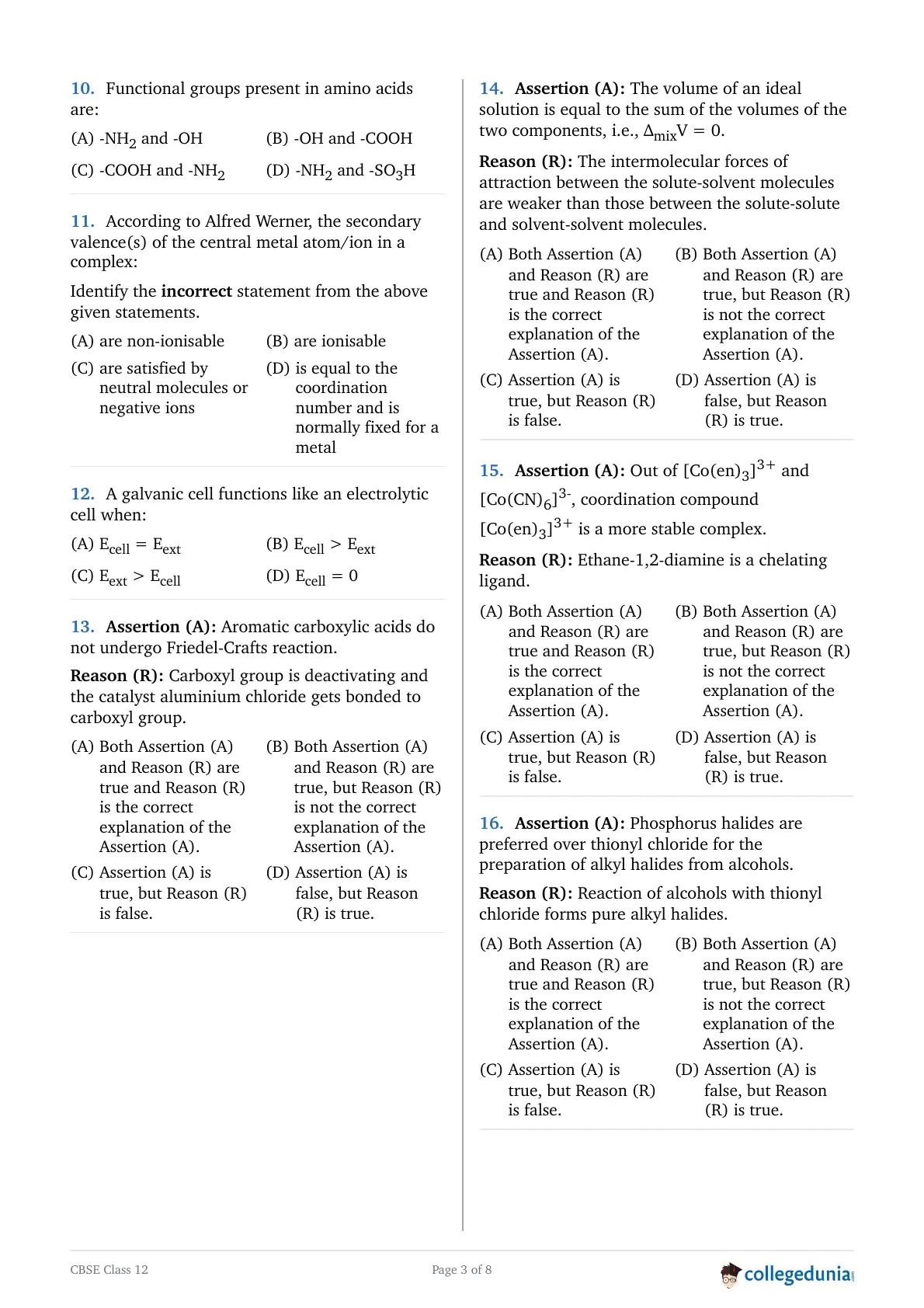
According to Alfred Werner, the secondary valence(s) of the central metal atom/ion in a complex :
Identify the incorrect statement from the given statements.
Assertion (A) : Aromatic carboxylic acids do not undergo Friedel-Crafts reaction.
Reason (R) : Carboxyl group is deactivating and the catalyst aluminium chloride gets bonded to carboxyl group.
Assertion (A) : The volume of an ideal solution is equal to the sum of the volumes of the two components, i.e., \( \Delta_{mix}V = 0 \).
Reason (R) : The intermolecular forces of attraction between the solute-solvent molecules are weaker than those between the solute-solute and solvent-solvent molecules.
Assertion (A) : Out of \( \mathrm{[Co(en)_3]^{3+}} \) and \( \mathrm{[Co(CN)_6]^{3-}} \), coordination compound \( \mathrm{[Co(en)_3]^{3+}} \) is a more stable complex.
Reason (R) : Ethane-1,2-diamine is a chelating ligand.
Assertion (A) : Phosphorus halides are preferred over thionyl chloride for the preparation of alkyl halides from alcohols.
Reason (R) : Reaction of alcohols with thionyl chloride forms pure alkyl halides.
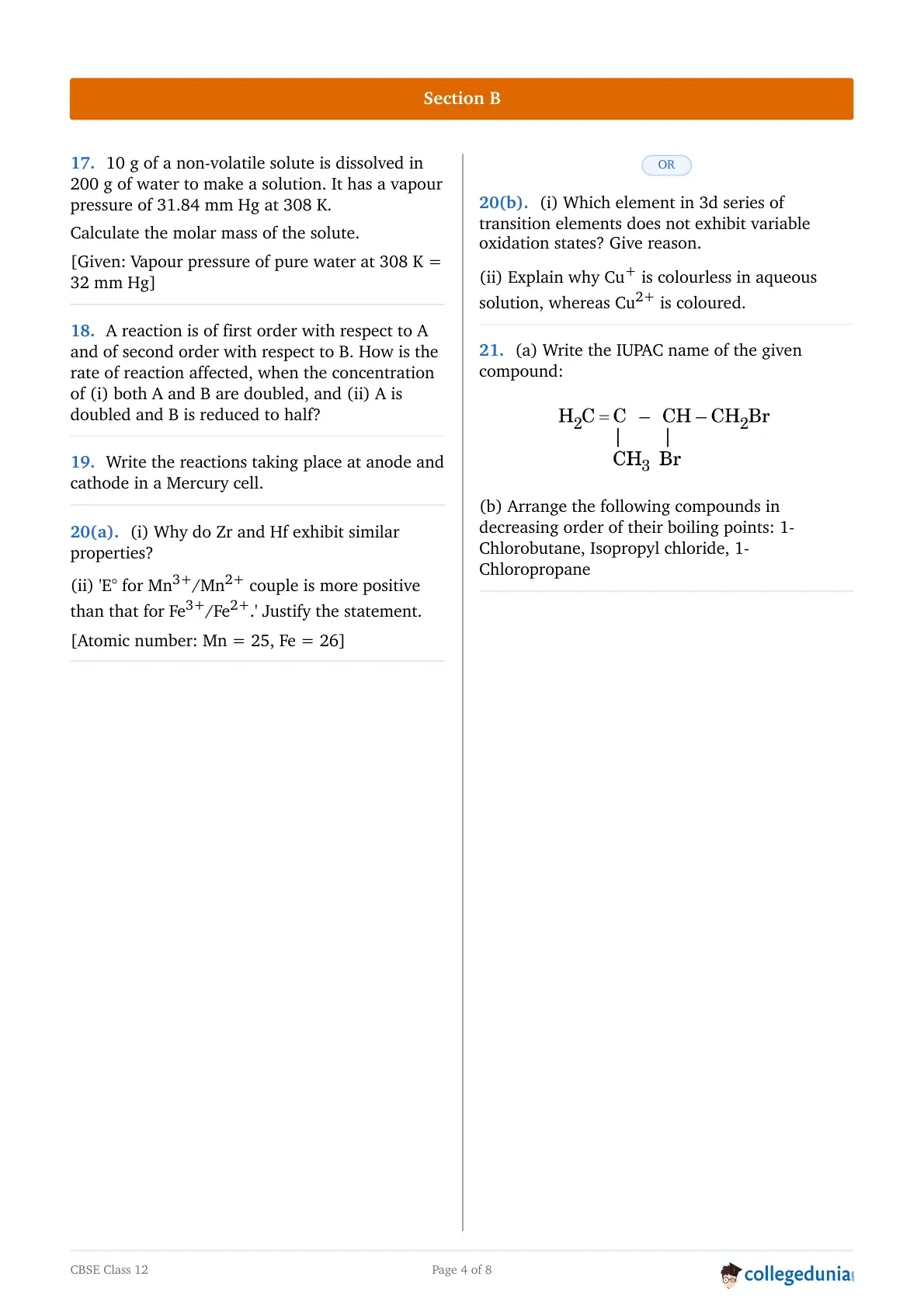
10 g of a non-volatile solute is dissolved in 200 g of water to make a solution. It has a vapour pressure of 31.84 mm Hg at 308 K.
Calculate the molar mass of the solute.
[Given : Vapour pressure of pure water at 308 K = 32 mm Hg]
A reaction is of first order with respect to A and of second order with respect to B. How is the rate of reaction affected, when the concentration of (i) both A and B are doubled, and (ii) A is doubled and B is reduced to half ?
(i) Why do Zr and Hf exhibit similar properties ?
(ii) "\( E^\circ \) for \( \mathrm{Mn^{3+}/Mn^{2+}} \) couple is more positive than that for \( \mathrm{Fe^{3+}/Fe^{2+}} \)." Justify the statement.
[Atomic number : Mn = 25, Fe = 26]
(i) Which element in 3d series of transition elements does not exhibit variable oxidation states ? Give reason.
(ii) Explain why \( \mathrm{Cu^{+}} \) is colourless in aqueous solution, whereas \( \mathrm{Cu^{2+}} \) is coloured.
(a) Write the IUPAC name of the given compound :
\( \mathrm{H_2C=C(CH_3)-CH(Br)-CH_2Br} \)
(b) Arrange the following compounds in decreasing order of their boiling points :
1-Chlorobutane, Isopropyl chloride, 1-Chloropropane
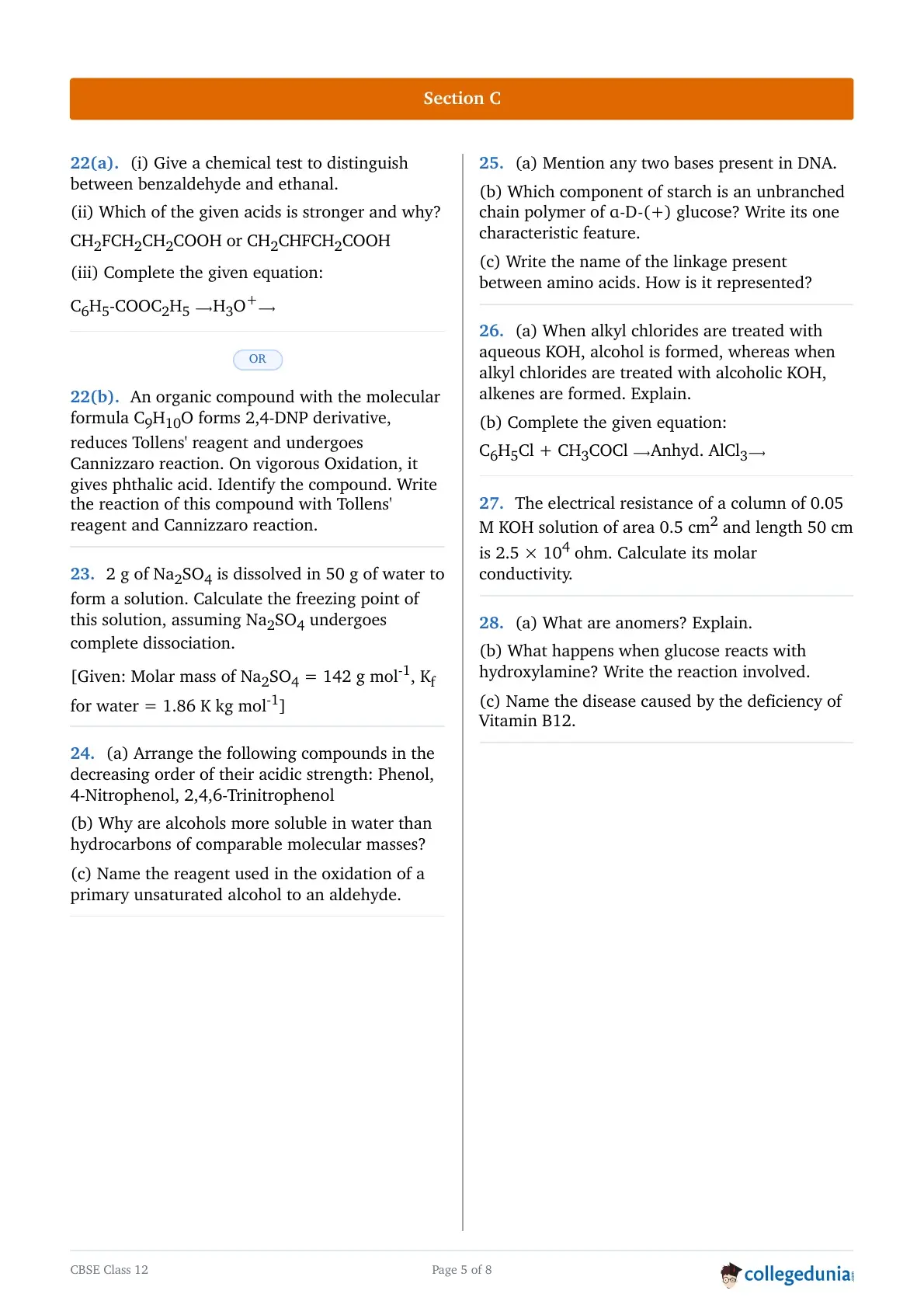
(i) Give a chemical test to distinguish between benzaldehyde and ethanal.
(ii) Which of the given acids is stronger and why ?
\( \mathrm{CH_2FCH_2CH_2COOH} \) or \( \mathrm{CH_2CHFCH_2COOH} \)
(iii) Complete the given equation :
\( \mathrm{C_6H_5COOC_2H_5} \; \overset{\mathrm{H_3O^+}}{\rightleftharpoons} \)
An organic compound with the molecular formula \( \mathrm{C_9H_{10}O} \) forms 2,4-DNP derivative, reduces Tollens' reagent and undergoes Cannizzaro reaction. On vigorous Oxidation, it gives phthalic acid. Identify the compound. Write the reaction of this compound with Tollens' reagent and Cannizzaro reaction.
2 g of \( \mathrm{Na_2SO_4} \) is dissolved in 50 g of water to form a solution. Calculate the freezing point of this solution, assuming \( \mathrm{Na_2SO_4} \) undergoes complete dissociation.
[Given : Molar mass of \( \mathrm{Na_2SO_4} \) = 142 g \( \mathrm{mol^{-1}} \), \( K_f \) for water = 1.86 K kg \( \mathrm{mol^{-1}} \)]
(a) Arrange the following compounds in the decreasing order of their acidic strength :
Phenol, 4-Nitrophenol, 2,4,6-Trinitrophenol
(b) Why are alcohols more soluble in water than hydrocarbons of comparable molecular masses ?
(c) Name the reagent used in the oxidation of a primary unsaturated alcohol to an aldehyde.
(a) Mention any two bases present in DNA.
(b) Which component of starch is an unbranched chain polymer of \( \alpha \)-D-(+) glucose ? Write its one characteristic feature.
(c) Write the name of the linkage present between amino acids. How is it represented ?
(a) When alkyl chlorides are treated with aqueous KOH, alcohol is formed, whereas when alkyl chlorides are treated with alcoholic KOH, alkenes are formed. Explain.
(b) Complete the given equation :
\( \mathrm{C_6H_5Cl} + \mathrm{CH_3COCl} \xrightarrow{\text{Anhyd. } \mathrm{AlCl_3}} \)
The electrical resistance of a column of 0.05 M KOH solution of area 0.5 cm\(^2\) and length 50 cm is 2.5 \(\times\) 10\(^4\) ohm. Calculate its molar conductivity.
(a) What are anomers ? Explain.
(b) What happens when glucose reacts with hydroxylamine ? Write the reaction involved.
(c) Name the disease caused by the deficiency of Vitamin B\(_{12}\).
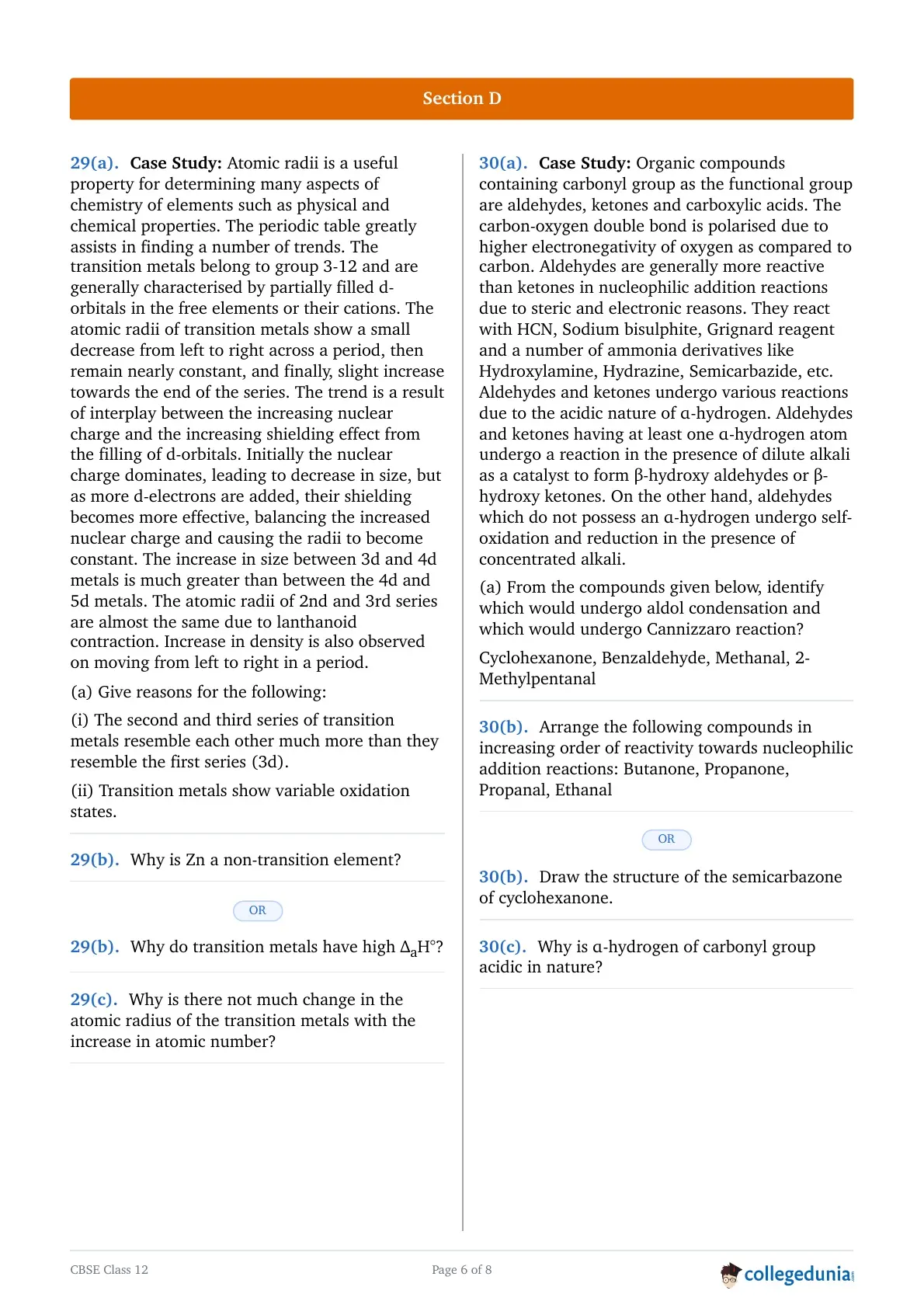
Atomic radii is a useful property for determining many aspects of chemistry of elements such as physical and chemical properties. The periodic table greatly assists in finding a number of trends. The transition metals belong to group 3 - 12 and are generally characterised by partially filled d-orbitals in the free elements or their cations. The atomic radii of transition metals show a small decrease from left to right across a period, then remain nearly constant, and finally, slight increase towards the end of the series. The trend is a result of interplay between the increasing nuclear charge and the increasing shielding effect from the filling of d-orbitals. Initially the nuclear charge dominates, leading to decrease in size, but as more d-electrons are added, their shielding becomes more effective, balancing the increased nuclear charge and causing the radii to become constant.
The increase in size between 3d and 4d metals is much greater than between the 4d and 5d metals. The atomic radii of 2nd and 3rd series are almost the same due to lanthanoid contraction. Increase in density is also observed on moving from left to right in a period.
Give reasons for the following :
(i) The second and third series of transition metals resemble each other much more than they resemble the first series (3d).
(ii) Transition metals show variable oxidation states.
Atomic radii is a useful property for determining many aspects of chemistry of elements such as physical and chemical properties. The periodic table greatly assists in finding a number of trends. The transition metals belong to group 3 - 12 and are generally characterised by partially filled d-orbitals in the free elements or their cations. The atomic radii of transition metals show a small decrease from left to right across a period, then remain nearly constant, and finally, slight increase towards the end of the series. The trend is a result of interplay between the increasing nuclear charge and the increasing shielding effect from the filling of d-orbitals. Initially the nuclear charge dominates, leading to decrease in size, but as more d-electrons are added, their shielding becomes more effective, balancing the increased nuclear charge and causing the radii to become constant.
The increase in size between 3d and 4d metals is much greater than between the 4d and 5d metals. The atomic radii of 2nd and 3rd series are almost the same due to lanthanoid contraction. Increase in density is also observed on moving from left to right in a period.
Why is Zn a non-transition element ?
Atomic radii is a useful property for determining many aspects of chemistry of elements such as physical and chemical properties. The periodic table greatly assists in finding a number of trends. The transition metals belong to group 3 - 12 and are generally characterised by partially filled d-orbitals in the free elements or their cations. The atomic radii of transition metals show a small decrease from left to right across a period, then remain nearly constant, and finally, slight increase towards the end of the series. The trend is a result of interplay between the increasing nuclear charge and the increasing shielding effect from the filling of d-orbitals. Initially the nuclear charge dominates, leading to decrease in size, but as more d-electrons are added, their shielding becomes more effective, balancing the increased nuclear charge and causing the radii to become constant.
The increase in size between 3d and 4d metals is much greater than between the 4d and 5d metals. The atomic radii of 2nd and 3rd series are almost the same due to lanthanoid contraction. Increase in density is also observed on moving from left to right in a period.
Why do transition metals have high \( \Delta_{a}H^{\circ} \) ?
Atomic radii is a useful property for determining many aspects of chemistry of elements such as physical and chemical properties. The periodic table greatly assists in finding a number of trends. The transition metals belong to group 3 - 12 and are generally characterised by partially filled d-orbitals in the free elements or their cations. The atomic radii of transition metals show a small decrease from left to right across a period, then remain nearly constant, and finally, slight increase towards the end of the series. The trend is a result of interplay between the increasing nuclear charge and the increasing shielding effect from the filling of d-orbitals. Initially the nuclear charge dominates, leading to decrease in size, but as more d-electrons are added, their shielding becomes more effective, balancing the increased nuclear charge and causing the radii to become constant.
The increase in size between 3d and 4d metals is much greater than between the 4d and 5d metals. The atomic radii of 2nd and 3rd series are almost the same due to lanthanoid contraction. Increase in density is also observed on moving from left to right in a period.
Why is there not much change in the atomic radius of the transition metals with the increase in atomic number ?
Organic compounds containing carbonyl group as the functional group are aldehydes, ketones and carboxylic acids. The carbon-oxygen double bond is polarised due to higher electronegativity of oxygen as compared to carbon. Aldehydes are generally more reactive than ketones in nucleophilic addition reactions due to steric and electronic reasons. They react with HCN, Sodium bisulphite, Grignard reagent and a number of ammonia derivatives like Hydroxylamine, Hydrazine, Semicarbazide, etc. Aldehydes and ketones undergo various reactions due to the acidic nature of \( \alpha \)-hydrogen. Aldehydes and ketones having at least one \( \alpha \)-hydrogen atom undergo a reaction in the presence of dilute alkali as a catalyst to form \( \beta \)-hydroxy aldehydes or \( \beta \)-hydroxy ketones. On the other hand, aldehydes which do not possess an \( \alpha \)-hydrogen undergo self-oxidation and reduction in the presence of concentrated alkali.
From the compounds given below, identify which would undergo aldol condensation and which would undergo Cannizzaro reaction ?
Cyclohexanone, Benzaldehyde, Methanal, 2-Methylpentanal
Organic compounds containing carbonyl group as the functional group are aldehydes, ketones and carboxylic acids. The carbon-oxygen double bond is polarised due to higher electronegativity of oxygen as compared to carbon. Aldehydes are generally more reactive than ketones in nucleophilic addition reactions due to steric and electronic reasons. They react with HCN, Sodium bisulphite, Grignard reagent and a number of ammonia derivatives like Hydroxylamine, Hydrazine, Semicarbazide, etc. Aldehydes and ketones undergo various reactions due to the acidic nature of \(\alpha\)-hydrogen. Aldehydes and ketones having at least one \(\alpha\)-hydrogen atom undergo a reaction in the presence of dilute alkali as a catalyst to form \(\beta\)-hydroxy aldehydes or \(\beta\)-hydroxy ketones. On the other hand, aldehydes which do not possess an \(\alpha\)-hydrogen undergo self-oxidation and reduction in the presence of concentrated alkali.
(i) Arrange the following compounds in increasing order of reactivity towards nucleophilic addition reactions :
Butanone, Propanone, Propanal, Ethanal
Organic compounds containing carbonyl group as the functional group are aldehydes, ketones and carboxylic acids. The carbon-oxygen double bond is polarised due to higher electronegativity of oxygen as compared to carbon. Aldehydes are generally more reactive than ketones in nucleophilic addition reactions due to steric and electronic reasons. They react with HCN, Sodium bisulphite, Grignard reagent and a number of ammonia derivatives like Hydroxylamine, Hydrazine, Semicarbazide, etc. Aldehydes and ketones undergo various reactions due to the acidic nature of \(\alpha\)-hydrogen. Aldehydes and ketones having at least one \(\alpha\)-hydrogen atom undergo a reaction in the presence of dilute alkali as a catalyst to form \(\beta\)-hydroxy aldehydes or \(\beta\)-hydroxy ketones. On the other hand, aldehydes which do not possess an \(\alpha\)-hydrogen undergo self-oxidation and reduction in the presence of concentrated alkali.
(ii) Draw the structure of the semicarbazone of cyclohexanone.
Organic compounds containing carbonyl group as the functional group are aldehydes, ketones and carboxylic acids. The carbon-oxygen double bond is polarised due to higher electronegativity of oxygen as compared to carbon. Aldehydes are generally more reactive than ketones in nucleophilic addition reactions due to steric and electronic reasons. They react with HCN, Sodium bisulphite, Grignard reagent and a number of ammonia derivatives like Hydroxylamine, Hydrazine, Semicarbazide, etc. Aldehydes and ketones undergo various reactions due to the acidic nature of \( \alpha \)-hydrogen. Aldehydes and ketones having at least one \( \alpha \)-hydrogen atom undergo a reaction in the presence of dilute alkali as a catalyst to form \( \beta \)-hydroxy aldehydes or \( \beta \)-hydroxy ketones. On the other hand, aldehydes which do not possess an \( \alpha \)-hydrogen undergo self-oxidation and reduction in the presence of concentrated alkali.
Why is \( \alpha \)-hydrogen of carbonyl group acidic in nature ?
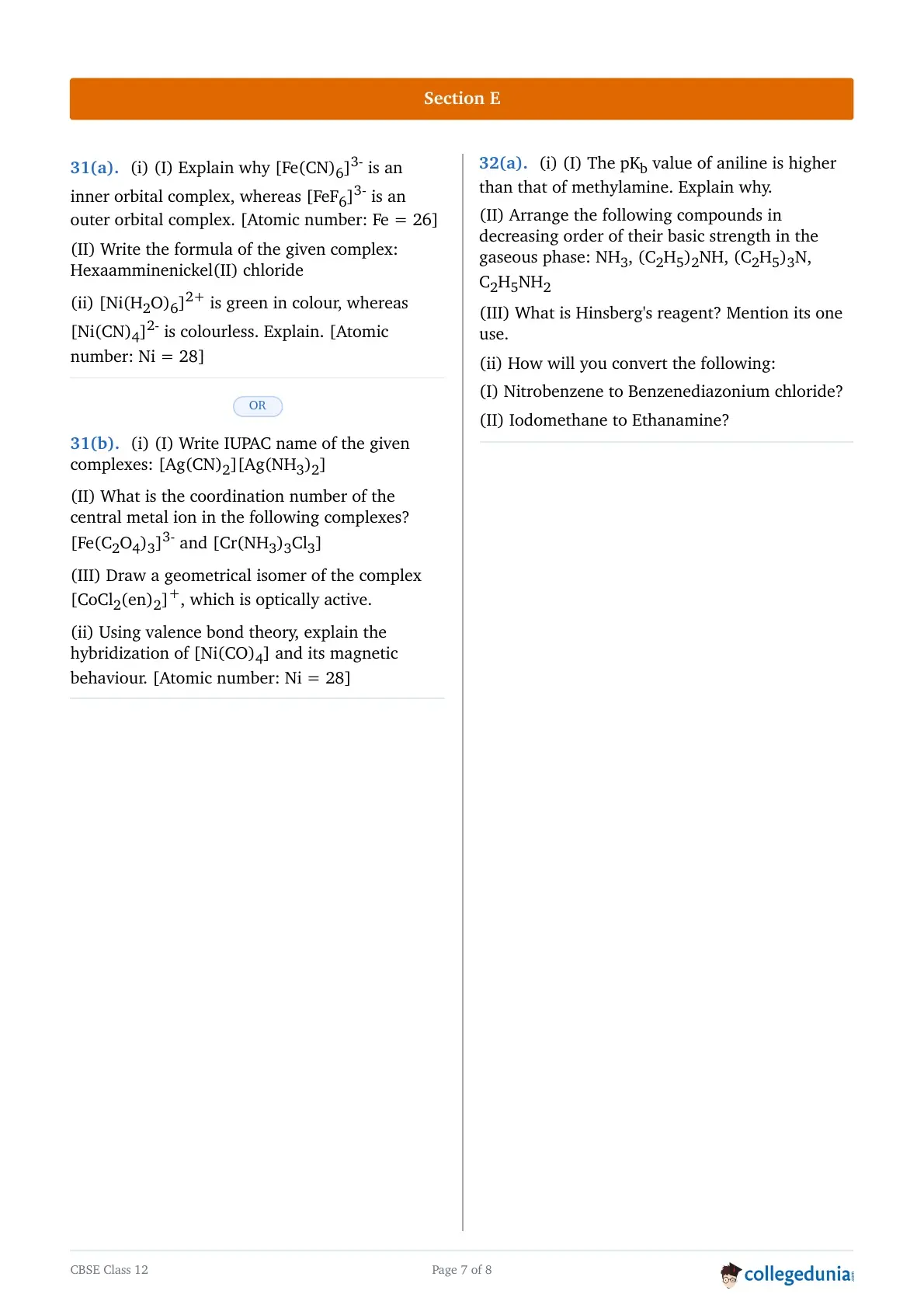
(i) (I) Explain why \( \mathrm{[Fe(CN)_6]^{3-}} \) is an inner orbital complex, whereas \( \mathrm{[FeF_6]^{3-}} \) is an outer orbital complex.
[Atomic number : Fe = 26]
(II) Write the formula of the given complex :
Hexaamminenickel (II) chloride
(ii) A solution of \( \mathrm{[Ni(H_2O)_6]^{2+}} \) is green in colour while a solution of \( \mathrm{[Ni(CN)_4]^{2-}} \) is colourless. Explain.
[Atomic number : Ni = 28]
(i) (I) Write IUPAC name of the given complexes :
\( \mathrm{[Ag(CN)_2]} \) \( \mathrm{[Ag(NH_3)_2]} \)
(II) What is the coordination number of the central metal ion in the following complexes ?
\( \mathrm{[Fe(C_2O_4)_3]^{3-}} \) and \( \mathrm{[Cr(NH_3)_3Cl_3]} \)
(III) Draw a geometrical isomer of the complex \( \mathrm{[CoCl_2(en)_2]^+} \), which is optically active.
(ii) Using valence bond theory, explain the hybridization of \( \mathrm{[Ni(CO)_4]} \) and its magnetic behaviour.
[Atomic number : Ni = 28]
(i) (I) The \(\mathrm{pK_b}\) value of aniline is higher than that of methylamine. Explain why.
(II) Arrange the following compounds in decreasing order of their basic strength in the gaseous phase :
\(\mathrm{NH_3}\), \(\mathrm{(C_2H_5)_2NH}\), \(\mathrm{(C_2H_5)_3N}\), \(\mathrm{C_2H_5NH_2}\)
(III) What is Hinsberg's reagent ? Mention its one use.
(ii) How will you convert the following :
(I) Nitrobenzene to Benzenediazonium chloride ?
(II) Iodomethane to Ethanamine ?
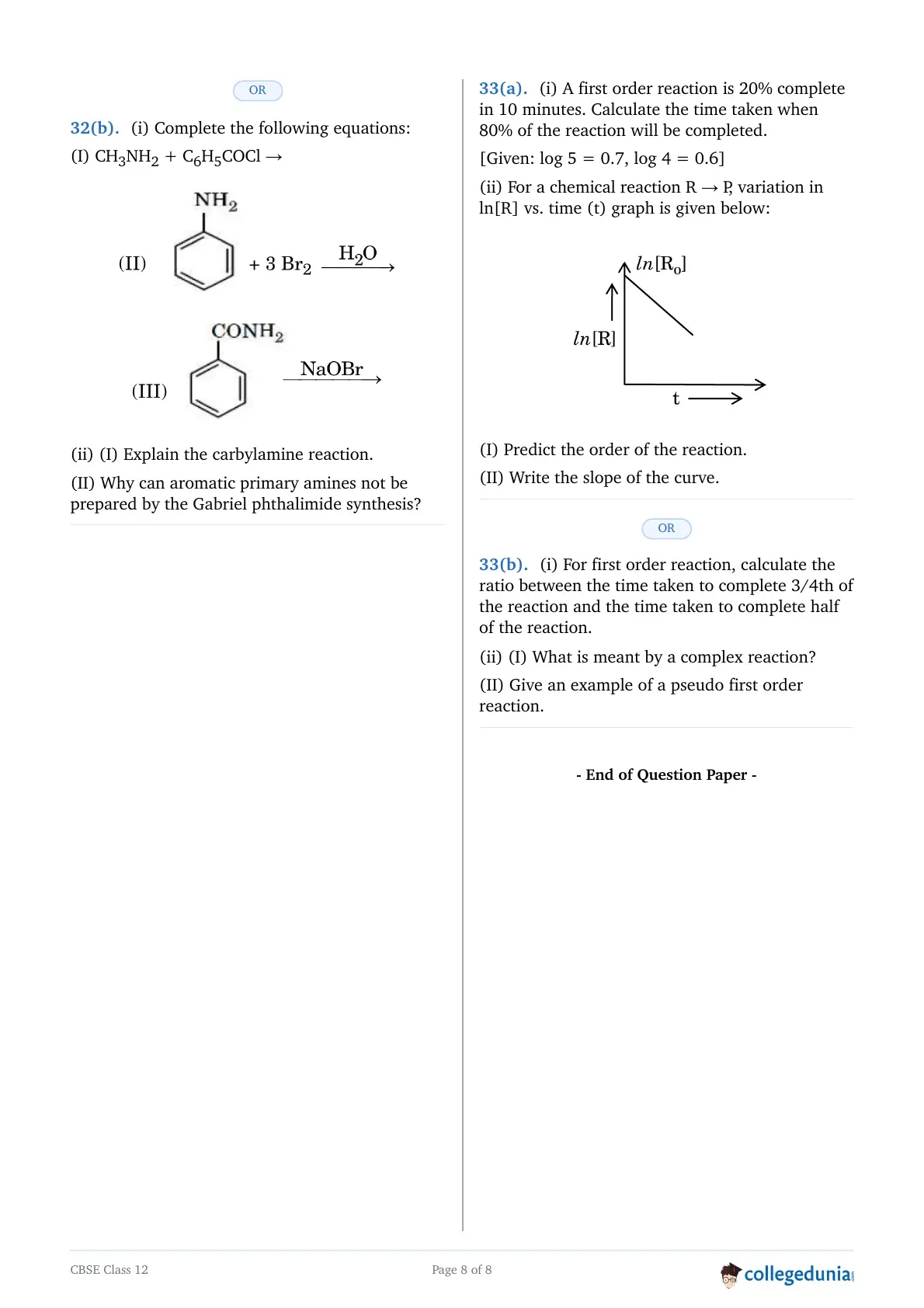
(i) Complete the following equations :
(I) \( \mathrm{CH_3NH_2 + C_6H_5COCl} \longrightarrow \)
(II) \( \mathrm{C_6H_5NH_2} \) + 3 \( \mathrm{Br_2} \) \( \xrightarrow{\mathrm{H_2O}} \)
(III) \( \mathrm{C_6H_5CONH_2} \) \( \xrightarrow{\mathrm{NaOBr}} \)
(ii) (I) Explain the carbylamine reaction.
(II) Why can aromatic primary amines not be prepared by the Gabriel phthalimide synthesis ?
(i) A first order reaction is 20% complete in 10 minutes. Calculate the time taken when 80% of the reaction will be completed.
[Given : \( \log 5 = 0.7 \), \( \log 4 = 0.6 \)]
(ii) For a chemical reaction \( \mathrm{R \rightarrow P} \), variation in \( \ln[\mathrm{R}] \) vs. time (t) graph is given below :
(I) Predict the order of the reaction.
(II) Write the slope of the curve.

(i) For first order reaction, calculate the ratio between the time taken to complete \( \frac{3}{4} \)th of the reaction and the time taken to complete half of the reaction.
(ii) (I) What is meant by a complex reaction ?
(II) Give an example of a pseudo first order reaction.
CBSE Class 12 Chemistry Compartment 2026 Set 2 - (56/7/2) Exam Pattern and Marking Scheme
| Section | Questions | Question Type | Marks per Question | Marks |
|---|---|---|---|---|
| A | Q1 - Q16 | Multiple choice questions | 1 | 16 |
| B | Q17 - Q21 | Very short answer type | 2 | 10 |
| C | Q22 - Q28 | Short answer type | 3 | 21 |
| D | Q29 - Q30 | Case-based questions | 4 | 8 |
| E | Q31 - Q33 | Long answer type | 5 | 15 |
| Total | 33 questions | 70 |
CBSE Class 12 Chemistry Compartment 2026 Set 2 - (56/7/2) Question Paper FAQs
Ques. How many questions are there in the CBSE Class 12 Chemistry Compartment 2026 paper (Set 2 - 56/7/2)?
Ans. The paper has 33 questions in five sections (A to E) and all of them are compulsory.
Ques. How are the marks divided in the Chemistry Compartment 2026 paper?
Ans. Section A carries 16 marks, Section B 10 marks, Section C 21 marks, Section D 8 marks and Section E 15 marks, for a total of 70 marks.
Ques. Is there any internal choice in the paper?
Ans. There is no overall choice. An internal choice is given in a few questions of all the sections except Section A.
Ques. Where can I download the solutions of this paper?
Ans. The table above has the Collegedunia PDF of this paper with detailed solutions.
Ques. How much time is given for the CBSE Class 12 Chemistry Compartment 2026 paper?
Ans. The paper is of 3 hours (10:30 AM to 1:30 PM). The question paper is distributed at 10:15 AM and candidates get 15 minutes to read it before they start writing.
Ques. When was the CBSE Class 12 Chemistry Compartment 2026 exam held?
Ans. The Class 12 compartment (supplementary) paper of Chemistry was held on July 28, 2026.
Ques. Where can I get the official CBSE Class 12 Chemistry Compartment question paper?
Ans. The official question papers are published on the CBSE website, cbse.gov.in.



Comments