




CBSE Class 12 Chemistry Question Paper 2025 (Set 1 - 56/1/1) with Solutions is now available here for download. CBSE conducted the Class 12 Chemistry examination on February 27, 2025, from 10:30 AM to 1:30 PM.
CBSE Class 12 Chemistry paper is of total 100 marks out of which 70 marks are allocated to the theory paper and 30 marks are for practical examination.
Also Check: CBSE Class 12 Question Paper 2025 (All Subjects)
The theory paper consists of 33 questions divided into five sections:
- Section A contains Multiple Choice Questions (MCQs),
- Section B contains Very Short Answer Type (VSA) Questions,
- Section C contains Short Answer Type (SA) Questions,
- Section D contains Case-Study based Questions,
- Section E contains Long Answer (LA) Type Questions.
All sections are compulsory.
CBSE Class 12 Chemistry Question Paper 2025 (Set 1 - 56/1/1) with Solution PDF
| CBSE Official PDF | CD PDF | CD PDF with Solutions |
|---|---|---|
| Download official PDF 3.20 MB | Download Collegedunia PDF 0.46 MB | Download solutions PDF 0.59 MB |
CBSE Class 12 Chemistry 2025 Set 1 (56/1/1) Questions with Solutions
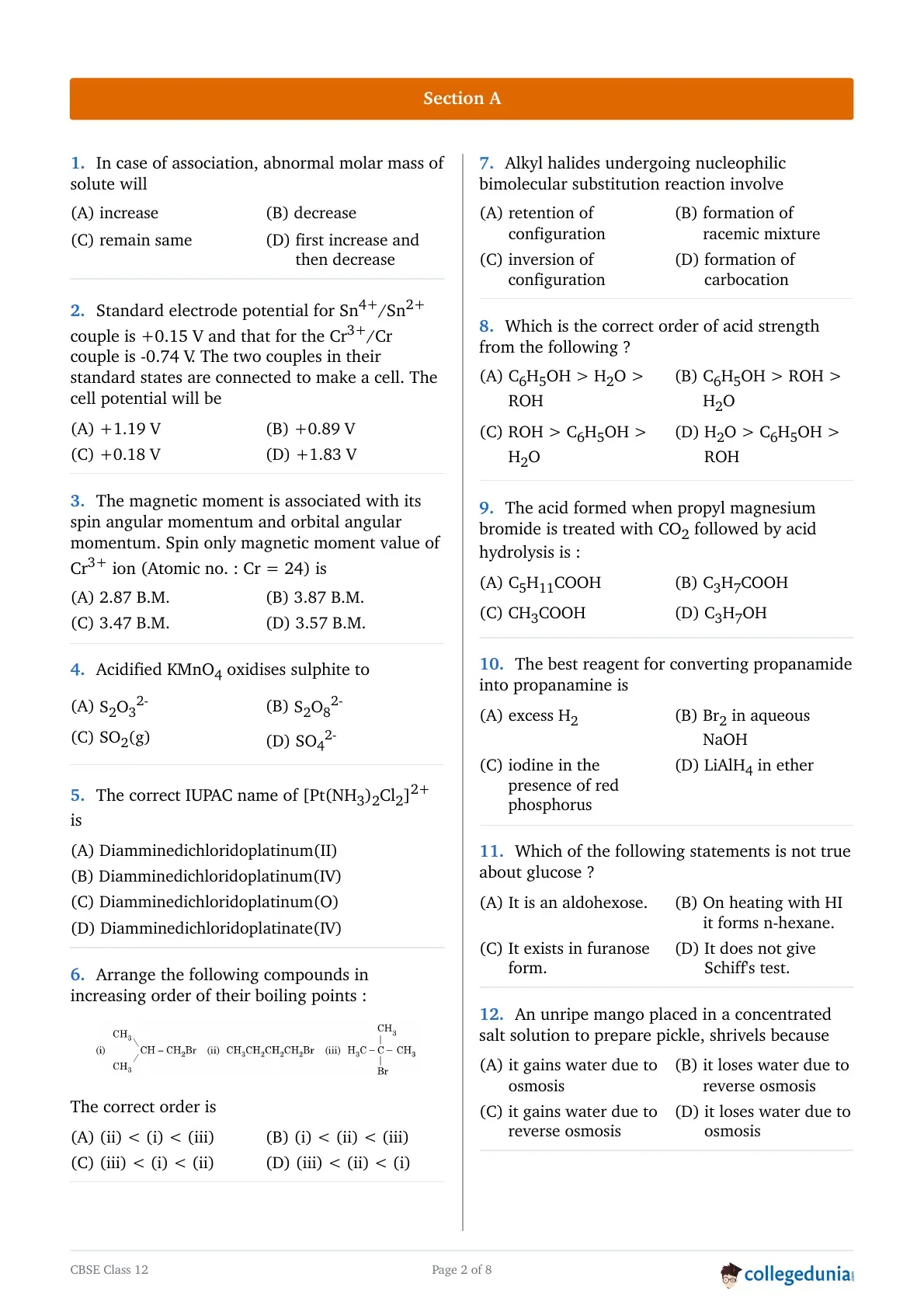
In case of association, abnormal molar mass of solute will:
Standard electrode potential for Sn4+/Sn2+ couple is +0.15 V and that for the Cr3+/Cr couple is -0.74 V. The two couples in their standard states are connected to make a cell. The cell potential will be
The magnetic moment is associated with its spin angular momentum and orbital angular momentum. Spin only magnetic moment value of Cr3+ ion (Atomic no. : Cr = 24) is
Acidified \(KMnO_4\) oxidizes sulphite to:
The correct IUPAC name of [Pt(NH3)2Cl2]2+ is
Arrange the following compounds in increasing order of their boiling points:

Alkyl halides undergoing nucleophilic bimolecular substitution reaction involve
Which is the correct order of acid strength from the following ?
The acid formed when propyl magnesium bromide is treated with CO\(_2\) followed by acid hydrolysis is:
The best reagent for converting propanamide into propanamine is
Which of the following statements is not true about glucose ?
An unripe mango placed in a concentrated salt solution to prepare pickle, shrivels because
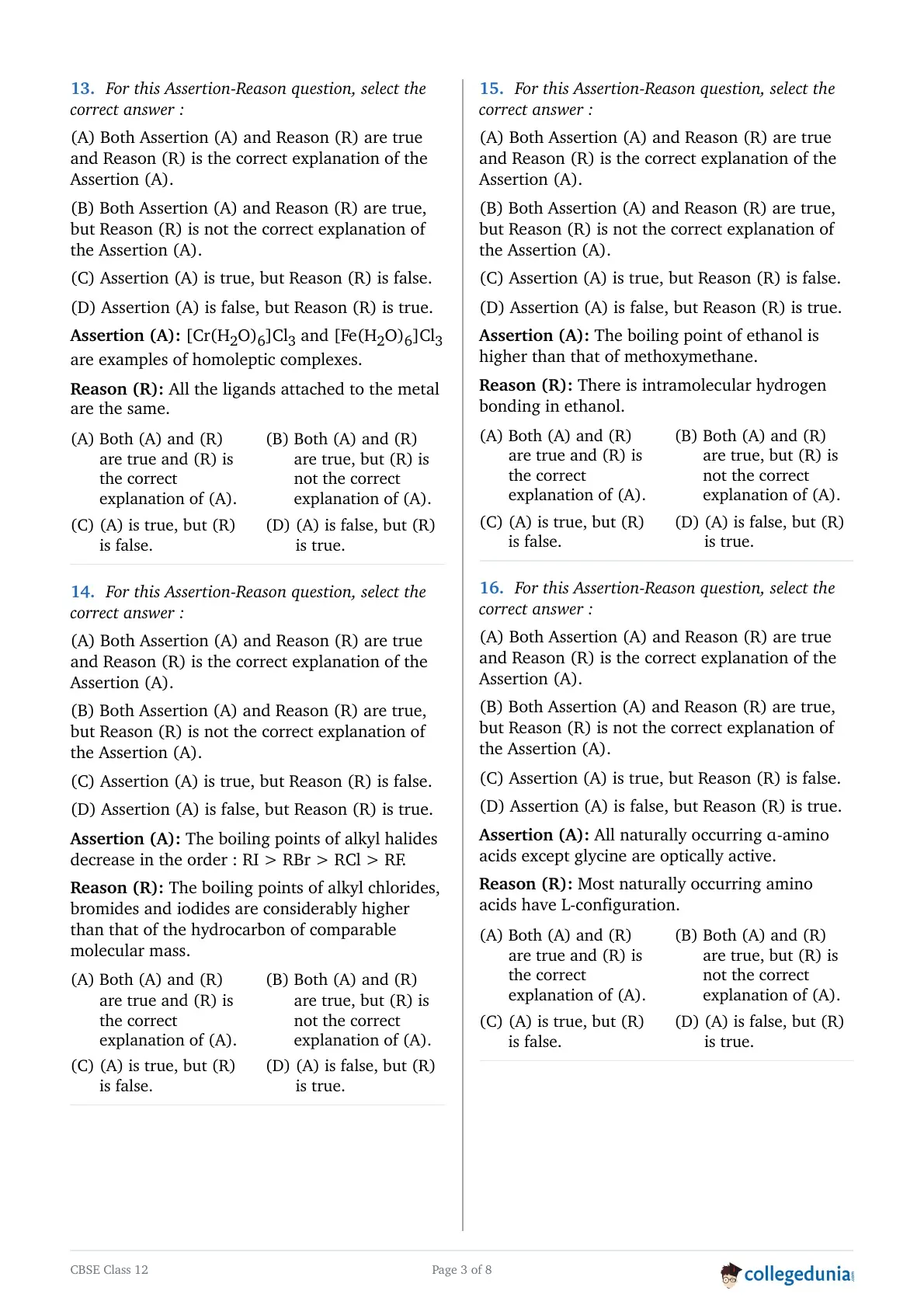
For this Assertion-Reason question, select the correct answer :
(A) Both Assertion (A) and Reason (R) are true and Reason (R) is the correct explanation of the Assertion (A).
(B) Both Assertion (A) and Reason (R) are true, but Reason (R) is not the correct explanation of the Assertion (A).
(C) Assertion (A) is true, but Reason (R) is false.
(D) Assertion (A) is false, but Reason (R) is true.
Assertion (A): [Cr(H2O)6]Cl2 and [Fe(H2O)6]Cl2 are examples of homoleptic complexes.
Reason (R): All the ligands attached to the metal are the same.
Assertion (A): The boiling points of alkyl halides decrease in the order: RI>RBr>RCl>RF.
Reason (R): The boiling points of alkyl chlorides, bromides and iodides are considerably higher than that of the hydrocarbon of comparable molecular mass.
Assertion (A): The boiling point of ethanol is higher than that of methoxymethane.
Reason (R): There is intramolecular hydrogen bonding in ethanol.
Assertion (A): All naturally occurring \(\alpha\)-amino acids except glycine are optically active. Reason (R): Most naturally occurring amino acids have L-configuration.
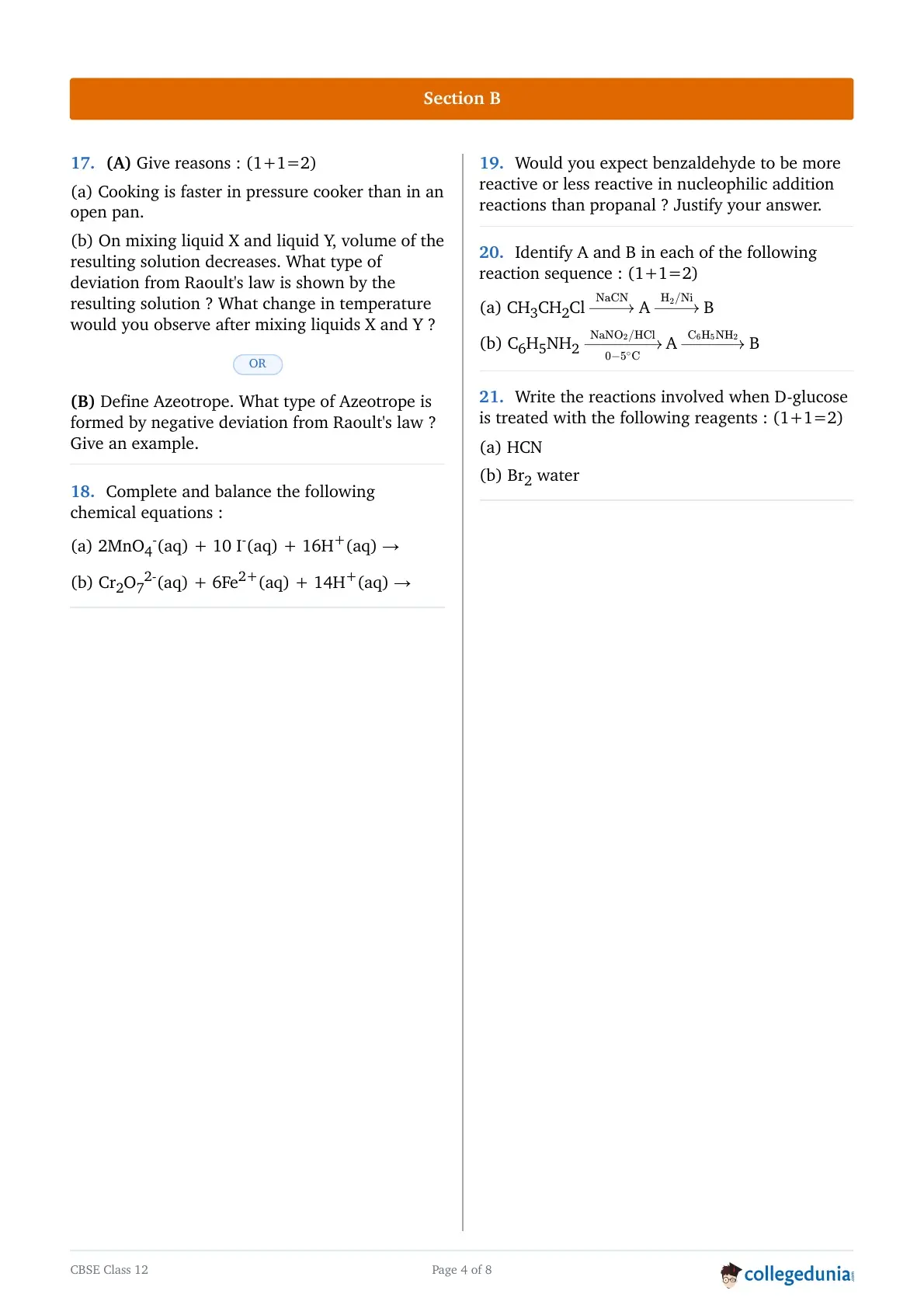
Give reasons : (1+1=2)
(a) Cooking is faster in pressure cooker than in an open pan.
(b) On mixing liquid X and liquid Y, volume of the resulting solution decreases. What type of deviation from Raoult's law is shown by the resulting solution ? What change in temperature would you observe after mixing liquids X and Y ?
Define Azeotrope. What type of Azeotrope is formed by negative deviation from Raoult's law ? Give an example.
Complete and balance the following chemical equations: (a) \[ 2MnO_4^-(aq) + 10I^-(aq) + 16H^+(aq) \rightarrow \] (b) \[ Cr_2O_7^{2-}(aq) + 6Fe^{2+}(aq) + 14H^+(aq) \rightarrow \]
Would you expect benzaldehyde to be more reactive or less reactive in nucleophilic addition reactions than propanal ? Justify your answer.
Identify A and B in each of the following reaction sequence:
(a) \[ \mathrm{CH_3CH_2Cl} \xrightarrow{\mathrm{NaCN}} \mathrm{A} \xrightarrow{\mathrm{H_2/Ni}} \mathrm{B} \]
(b) \[ \mathrm{C_6H_5NH_2} \xrightarrow[0-5^\circ \mathrm{C}]{\mathrm{NaNO_2/HCl}} \mathrm{A} \xrightarrow[\mathrm{H^+}]{\mathrm{C_6H_5NH_2}} \mathrm{B} \]
Write the reactions involved when D-glucose is treated with the following reagents : (1+1=2)
(a) HCN
(b) Br2 water
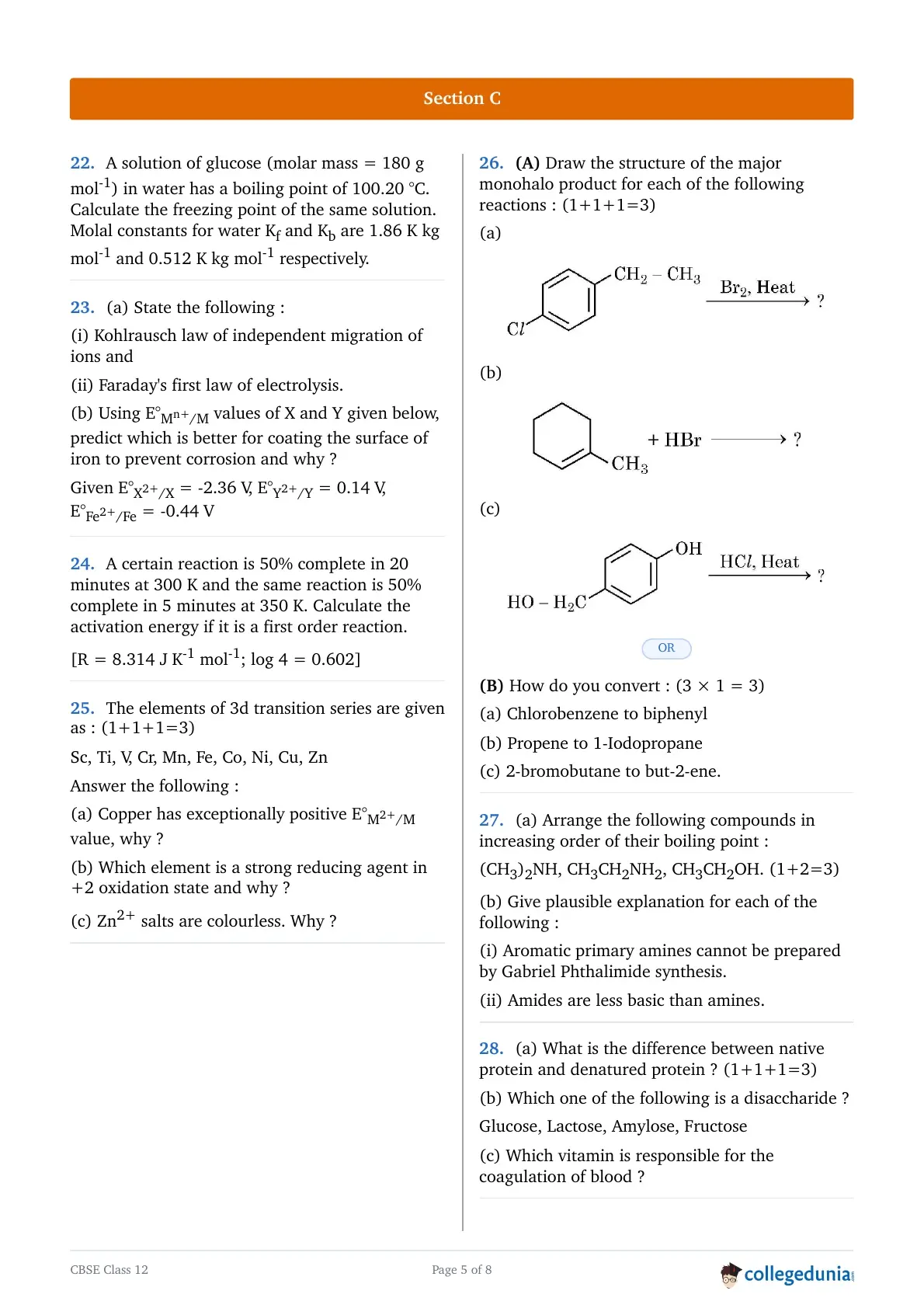
A solution of glucose (molar mass = 180 g mol-1) in water has a boiling point of 100.20 °C. Calculate the freezing point of the same solution. Molal constants for water Kf and Kb are 1.86 K kg mol-1 and 0.512 K kg mol-1 respectively.
Using \( E^\circ \) values of X and Y given below, predict which is better for coating the surface of iron to prevent corrosion and why?
Given:
\( E^\circ_{X^{2+}/X} = -2.36 \, \text{V} \)
\( E^\circ_{Y^{2+}/Y} = -0.14 \, \text{V} \)
\( E^\circ_{Fe^{2+}/Fe} = -0.44 \, \text{V} \)
A certain reaction is 50% complete in 20 minutes at 300 K and the same reaction is 50% complete in 5 minutes at 350 K. Calculate the activation energy if it is a first order reaction.
[R = 8.314 J K-1 mol-1; log 4 = 0.602]
The elements of the 3d transition series are given as: Sc, Ti, V, Cr, Mn, Fe, Co, Ni, Cu, Zn. Answer the following:
Copper has an exceptionally positive \( E^\circ_{\text{M}^{2+}/\text{M}} \) value, why?
Draw the structure of the major monohalo product for each of the following reactions : (1+1+1=3)
(a)
(b)
(c)
Arrange the following compounds in increasing order of their boiling point :
(CH3)2NH, CH3CH2NH2, CH3CH2OH.
Give plausible explanation for each of the following :
(i) Aromatic primary amines cannot be prepared by Gabriel Phthalimide synthesis.
(ii) Amides are less basic than amines.
(a) What is the difference between native protein and denatured protein ? (1+1+1=3)
(b) Which one of the following is a disaccharide ?
Glucose, Lactose, Amylose, Fructose
(c) Which vitamin is responsible for the coagulation of blood ?
Read the passage carefully and answer the questions that follow.
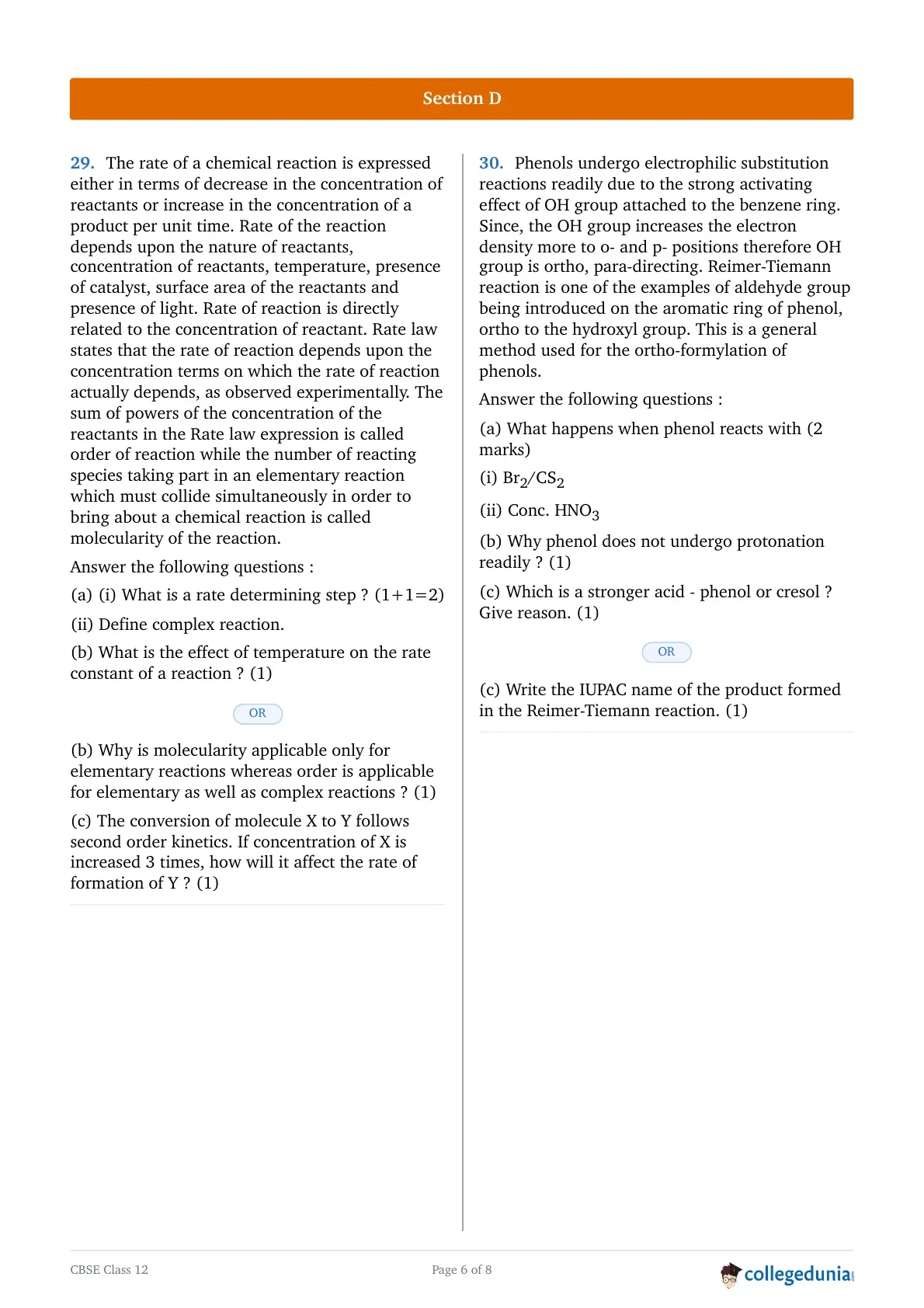
Passage: The rate of a chemical reaction is expressed either in terms of decrease in the concentration of reactants or increase in the concentration of a product per unit time. Rate of the reaction depends upon the nature of reactants, concentration of reactants, temperature, presence of catalyst, surface area of the reactants and presence of light. Rate of reaction is directly related to the concentration of reactant. Rate law states that the rate of reaction depends upon the concentration terms on which the rate of reaction actually depends, as observed experimentally. The sum of powers of the concentration of the reactants in the Rate law expression is called order of reaction while the number of reacting species taking part in an elementary reaction which must collide simultaneously in order to bring about a chemical reaction is called molecularity of the reaction.
Answer the following questions:
What is the effect of temperature on the rate constant of a reaction ? (1)
Why is molecularity applicable only for elementary reactions whereas order is applicable for elementary as well as complex reactions ? (1)
The conversion of molecule X to Y follows second order kinetics. If concentration of X is increased 3 times, how will it affect the rate of formation of Y ? (1)
Phenols undergo electrophilic substitution reactions readily due to the strong activating effect of OH group attached to the benzene ring. Since, the OH group increases the electron density more to o- and p- positions therefore OH group is ortho, para-directing. Reimer-Tiemann reaction is one of the examples of aldehyde group being introduced on the aromatic ring of phenol, ortho to the hydroxyl group. This is a general method used for the ortho-formylation of phenols.
Answer the following questions:
Why phenol does not undergo protonation readily ? (1)
Which is a stronger acid - phenol or cresol ? Give reason. (1)
(c) Write the IUPAC name of the product formed in the Reimer-Tiemann reaction. (1)
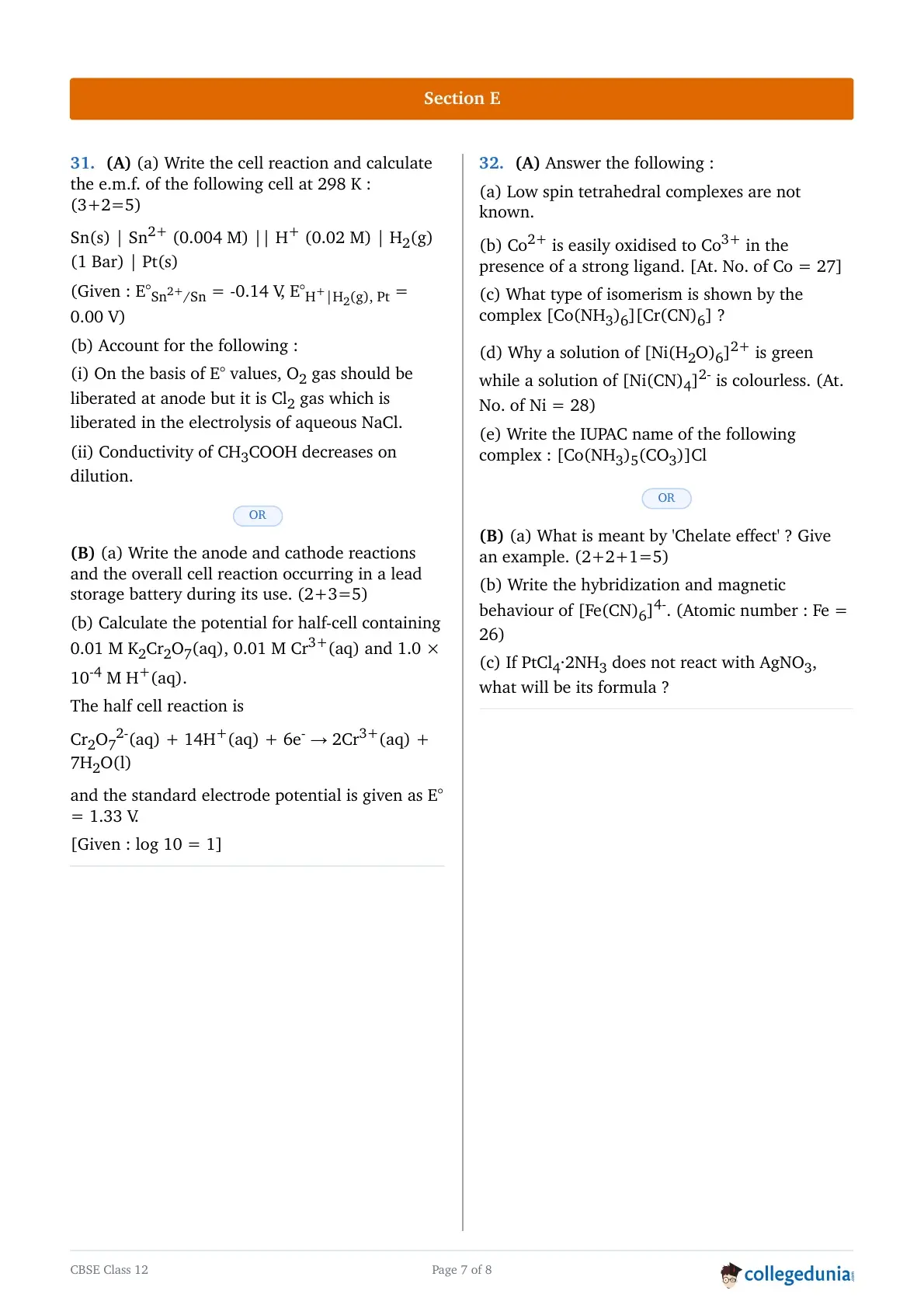
Write the cell reaction and calculate the e.m.f. of the following cell at 298 K:
\[
\text{Sn}(s) \mid \text{Sn}^{2+} (\text{0.004 M}) \parallel \text{H}^+ (\text{0.02 M}) \mid \text{H}_2 (\text{1 Bar}) \mid \text{Pt}(s)
\]
(Given: \( E^\circ_{\text{Sn}^{2+}/\text{Sn}} = -0.14 \, \text{V}, E^\circ_{\text{H}^+/\text{H}_2} = 0.00 \, \text{V} \))
Account for the following :
(i) On the basis of E° values, O2 gas should be liberated at anode but it is Cl2 gas which is liberated in the electrolysis of aqueous NaCl.
(ii) Conductivity of CH3COOH decreases on dilution.
Write the anode and cathode reactions and the overall cell reaction occurring in a lead storage battery during its use.
Calculate the potential for half-cell containing 0.01 M K2Cr2O7(aq), 0.01 M Cr3+(aq) and 1.0 × 10⁻⁴ M H+(aq).
The half cell reaction is
Cr2O72-(aq) + 14H+(aq) + 6e- → 2Cr3+(aq) + 7H2O(l)
and the standard electrode potential is given as E° = 1.33 V.
[Given : log 10 = 1]
Answer the following :
(a) Low spin tetrahedral complexes are not known.
(b) Co2+ is easily oxidised to Co3+ in the presence of a strong ligand. [At. No. of Co = 27]
(c) What type of isomerism is shown by the complex [Co(NH3)6][Cr(CN)6] ?
(d) Why a solution of [Ni(H2O)6]2+ is green while a solution of [Ni(CN)4]2- is colourless. (At. No. of Ni = 28)
(e) Write the IUPAC name of the following complex : [Co(NH3)5(CO3)]Cl
(a) What is meant by 'Chelate effect' ? Give an example. (2+2+1=5)
(b) Write the hybridization and magnetic behaviour of [Fe(CN)6]4-. (Atomic number : Fe = 26)
(c) If PtCl4·2NH3 does not react with AgNO3, what will be its formula ?
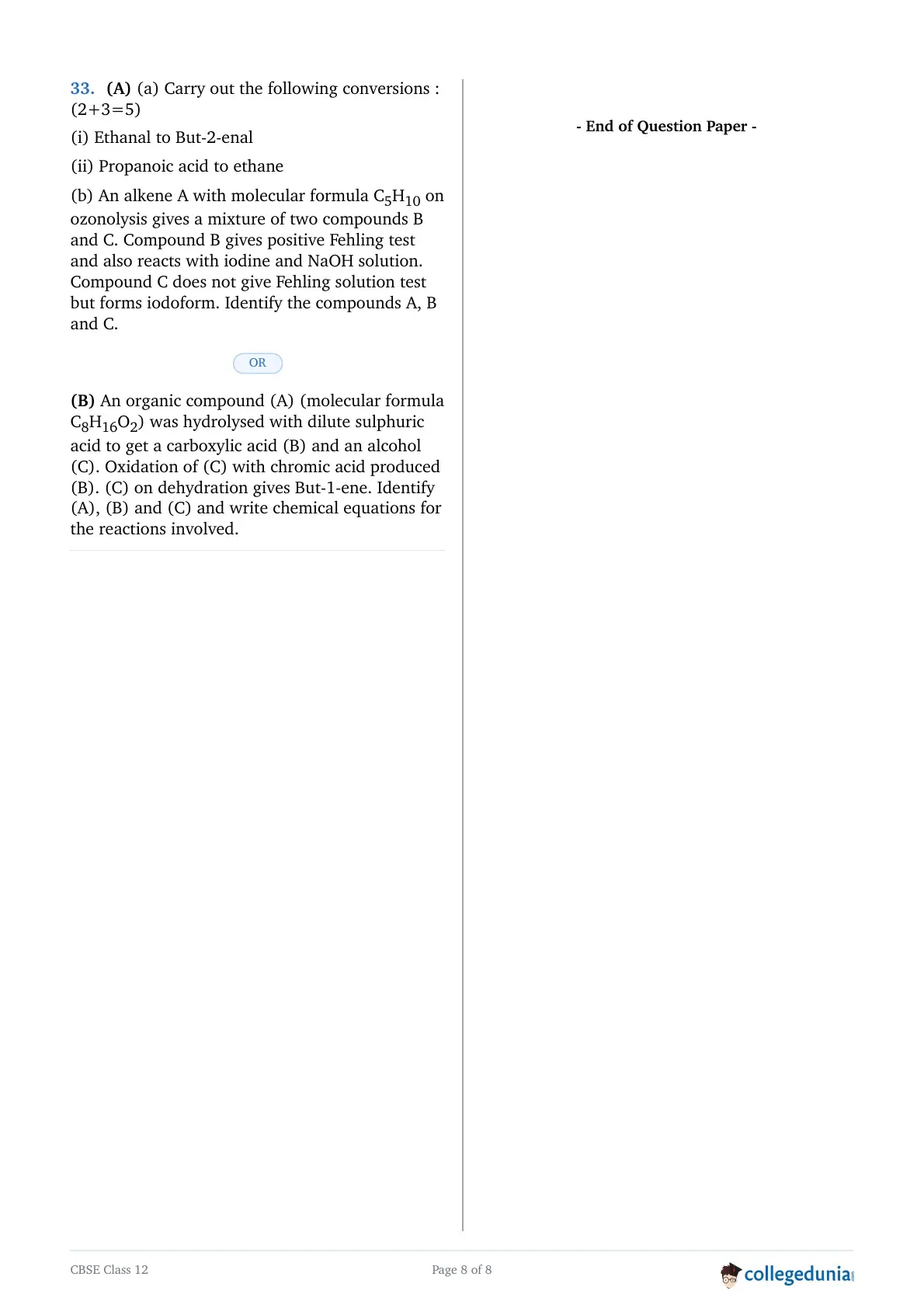
(a) Carry out the following conversions : (2+3=5)
(i) Ethanal to But-2-enal
(ii) Propanoic acid to ethane
(b) An alkene A with molecular formula C5H10 on ozonolysis gives a mixture of two compounds B and C. Compound B gives positive Fehling test and also reacts with iodine and NaOH solution. Compound C does not give Fehling solution test but forms iodoform. Identify the compounds A, B and C.
An organic compound (A) (molecular formula C8H16O2) was hydrolysed with dilute sulphuric acid to get a carboxylic acid (B) and an alcohol (C). Oxidation of (C) with chromic acid produced (B). (C) on dehydration gives But-1-ene. Identify (A), (B) and (C) and write chemical equations for the reactions involved.
CBSE Class 12 Chemistry Question Paper Pattern 2025
The CBSE Class 12 Chemistry 2025 question paper is of 70 marks and has 33 questions in five sections, A to E, all compulsory, with internal choice in some questions of Sections B to E. The time allowed is 3 hours, with 15 minutes of extra reading time. The table below gives the section-wise paper pattern from the official CBSE question paper.
| Section | Questions | Question Type | Marks per Question | Marks |
|---|---|---|---|---|
| A | Q1 - Q16 | Multiple choice questions | 1 | 16 |
| B | Q17 - Q21 | Very short answer questions | 2 | 10 |
| C | Q22 - Q28 | Short answer questions | 3 | 21 |
| D | Q29 - Q30 | Case study-based questions | 4 | 8 |
| E | Q31 - Q33 | Long answer questions | 5 | 15 |
| Total | 33 questions | 70 |
CBSE Class 12 Chemistry Unit-Wise Weightage
| Unit No. | Unit Name | Marks |
|---|---|---|
| 1 | Solutions | 7 |
| 2 | Electrochemistry | 9 |
| 3 | Chemical Kinetics | 7 |
| 4 | d- and f-Block Elements | 7 |
| 5 | Coordination Compounds | 7 |
| 6 | Haloalkanes and Haloarenes | 6 |
| 7 | Alcohols, Phenols and Ethers | 6 |
| 8 | Aldehydes, Ketones and Carboxylic Acids | 8 |
| 9 | Amines | 6 |
| 10 | Biomolecules | 7 |
| Total | — | 70 |



Comments