




CBSE Class 12 English Core Set 2 - (1/2/2) Question Paper 2026 is available for download here. CBSE conducted the Class 12 English Core exam on March 12, 2026, from 10:30 AM to 1:30 PM. The English Core theory paper is of 80 marks, and the internal assessment is of 20 marks.
Also Check: CBSE Class 12 Question Paper 2026 (All Subjects)
The paper has 13 questions, all compulsory, in three sections:
- Section A: Reading Skills (22 marks)
- Section B: Creative Writing Skills (18 marks)
- Section C: Literature (40 marks)
CBSE Class 12 English Core Set 2 - (1/2/2) Question Paper 2026 with Solution PDF
| CBSE Official PDF | CD PDF | CD PDF with Solutions |
|---|---|---|
| Download official PDF 0.85 MB | Download Collegedunia PDF 0.29 MB | – |
CBSE Class 12 English Core 2026 Set 2 (1/2/2) Questions with Solutions
Question 1 (Passage / Extract):
Read the passage carefully :
Chronobiology : The Science of Time is within Us.
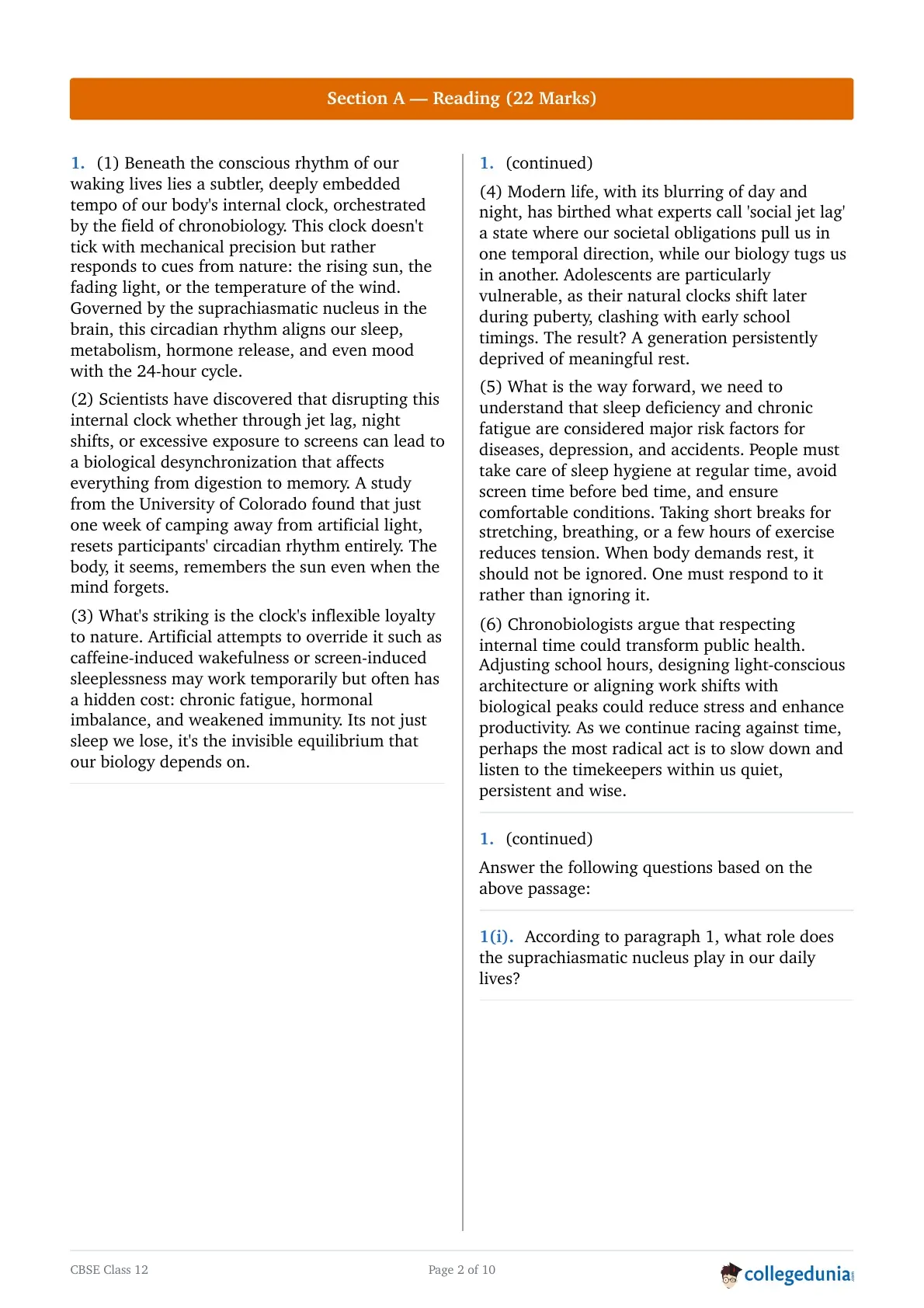
(1) Beneath the conscious rhythm of our waking lives lies a subtler, deeply embedded tempo of our body’s internal clock, orchestrated by the field of chronobiology. This clock doesn’t tick with mechanical precision but rather responds to cues from nature: the rising sun, the fading light, or the temperature of the wind. Governed by the suprachiasmatic nucleus in the brain, this circadian rhythm aligns our sleep, metabolism, hormone release, and even mood with the 24-hour cycle.
(2) Scientists have discovered that disrupting this internal clock whether through jet lag, night shifts, or excessive exposure to screens can lead to a biological desynchronization that affects everything from digestion to memory. A study from the University of Colorado found that just one week of camping away from artificial light, resets participants’ circadian rhythm entirely. The body, it seems, remembers the sun even when the mind forgets.
(3) What’s striking is the clock’s inflexible loyalty to nature. Artificial attempts to override it such as caffeine-induced wakefulness or screen-induced sleeplessness may work temporarily but often has a hidden cost : chronic fatigue, hormonal imbalance, and weakened immunity. Its not just sleep we
Read More
lose, it’s the invisible equilibrium that our biology depends on.(4) Modern life, with its blurring of day and night, has birthed what experts call ‘social jet lag’ a state where our societal obligations pull us in one temporal direction, while our biology tugs us in another. Adolescents are particularly vulnerable, as their natural clocks shift later during puberty, clashing with early school timings. The result ? A generation persistently deprived of meaningful rest.
(5) What is the way forward – we need to understand that sleep deficiency and chronic fatigue are considered major risk factors for diseases, depression, and accidents. People must take care of sleep hygiene at regular time, avoid screen time before bed time, and ensure comfortable conditions. Taking short breaks for stretching, breathing, or a few hours of exercise reduces tension. When body demands rest, it should not be ignored. One must respond to it rather than ignoring it.
(6) Chronobiologists argue that respecting internal time could transform public health. Adjusting school hours, designing light-conscious architecture or aligning work shifts with biological peaks could reduce stress and enhance productivity. As we continue racing against time, perhaps the most radical act is to slow down and listen to the timekeepers within us quiet, persistent and wise.
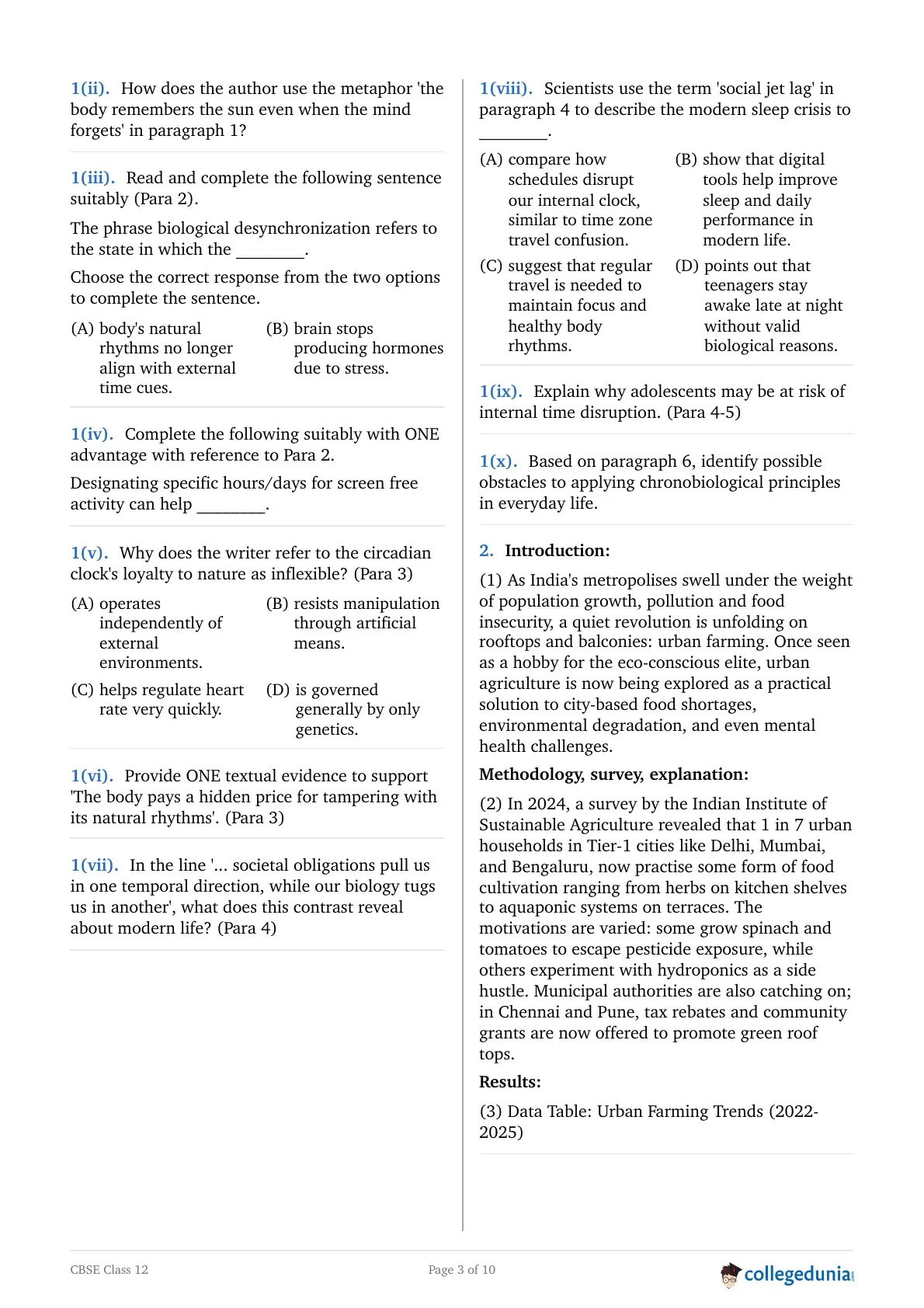
According to paragraph 1, what role does the suprachiasmatic nucleus play in our daily lives ?
How does the author use the metaphor ‘the body remembers the sun even when the mind forgets’ in paragraph 1 ?
Read and complete the following sentence suitably (Para 2).
The phrase biological desynchronization refers to the state in which the :
Choose the correct response from the two options to complete the sentence.
Complete the following suitably with ONE advantage with reference to Para 2.
Designating specific hours/days for screen free activity can help _______.
Why does the writer refer to the circadian clock’s loyalty to nature as inflexible ? (Para 3)
Provide ONE textual evidence to support ‘The body pays a hidden price for tampering with its natural rhythms’. (Para 3)
In the line ‘… societal obligations pull us in one temporal direction, while our biology tugs us in another’, what does this contrast reveal about modern life ? (Para 4)
Scientists use the term ‘social jet lag’ in paragraph 4 to describe the modern sleep crisis to _______.
Explain why adolescents may be at risk of internal time disruption. (Para 4-5)
Based on paragraph 6, identify possible obstacles to applying chronobiological principles in everyday life.
Question 2 (Passage / Extract):
Read the passage carefully:
The Rise of Urban Farming in Indian Cities: A Sustainable Future or Fleeting Trend
Introduction:
(1) As India’s metropolises swell under the weight of population growth, pollution and food insecurity, a quiet revolution is unfolding on rooftops and balconies: urban farming. Once seen as a hobby for the eco-conscious elite, urban agriculture is now being explored as a practical solution to city-based food shortages, environmental degradation, and even mental health challenges.
Methodology – survey – explanation:
(2) In 2024, a survey by the Indian Institute of Sustainable Agriculture revealed that 1 in 7 urban households in Tier-1 cities like Delhi, Mumbai, and Bengaluru, now practise some form of food cultivation ranging from herbs on kitchen shelves to aquaponic systems on terraces. The motivations are varied: some grow spinach and tomatoes to escape pesticide exposure, while others experiment with hydroponics as a side hustle. Municipal authorities are also catching on; in Chennai and Pune, tax rebates and community grants are now offered to promote green roof tops.
Results:
(3)
Read More
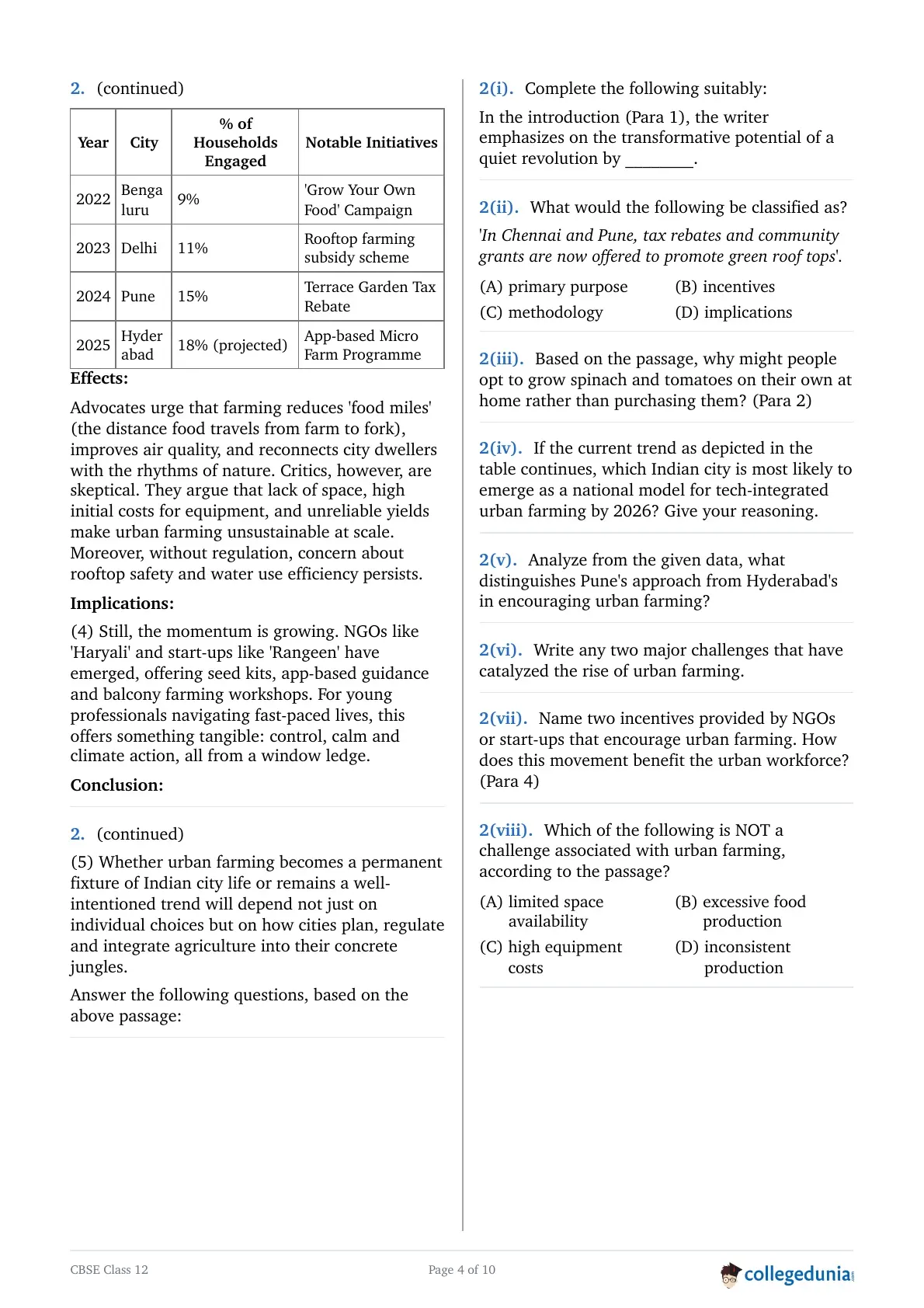
| Year | City | % of Households Engaged | Notable Initiatives |
|---|---|---|---|
| 2022 | Bengaluru | 9% | ‘Grow Your Own Food’ Campaign |
| 2023 | Delhi | 11% | Rooftop farming subsidy scheme |
| 2024 | Pune | 15% | Terrace Garden Tax Rebate |
| 2025 | Hyderabad | 18% (projected) | App-based Micro Farm Programme |
Data Table: Urban Farming Trends (2022-2025)
Effects:
Advocates urge that farming reduces ‘food miles’ (the distance food travels from farm to fork), improves air quality, and reconnects city dwellers with the rhythms of nature. Critics, however, are skeptical. They argue that lack of space, high initial costs for equipment, and unreliable yields make urban farming unsustainable at scale. Moreover, without regulation, concern about rooftop safety and water use efficiency persists.
Implications:
(4) Still, the momentum is growing. NGOs like ‘Haryali’ and start-ups like ‘Rangeen’ have emerged, offering seed kits, app-based guidance and balcony farming workshops. For young professionals navigating fast-paced lives, this offers something tangible: control, calm and climate action, all from a window ledge.
Conclusion:
(5) Whether urban farming becomes a permanent fixture of Indian city life or remains a well-intentioned trend will depend not just on individual choices but on how cities plan, regulate and integrate agriculture into their concrete jungles.
Complete the following suitably: In the introduction (Para 1), the writer emphasizes on the transformative potential of a quiet revolution by _______.
What would the following be classified as?
‘In Chennai and Pune, tax rebates and community grants are now offered to promote green roof tops’.
Based on the passage, why might people opt to grow spinach and tomatoes on their own at home rather than purchasing them? (Para 2)
If the current trend as depicted in the table continues, which Indian city is most likely to emerge as a national model for tech-integrated urban farming by 2026? Give your reasoning.
Analyze from the given data, what distinguishes Pune’s approach from Hyderabad’s in encouraging urban farming?
Write any two major challenges that have catalyzed the rise of urban farming.
Name two incentives provided by NGOs or start-ups that encourage urban farming. How does this movement benefit the urban workforce? (Para 4)
Which of the following is NOT a challenge associated with urban farming, according to the passage?
Attempt in about 50 words.
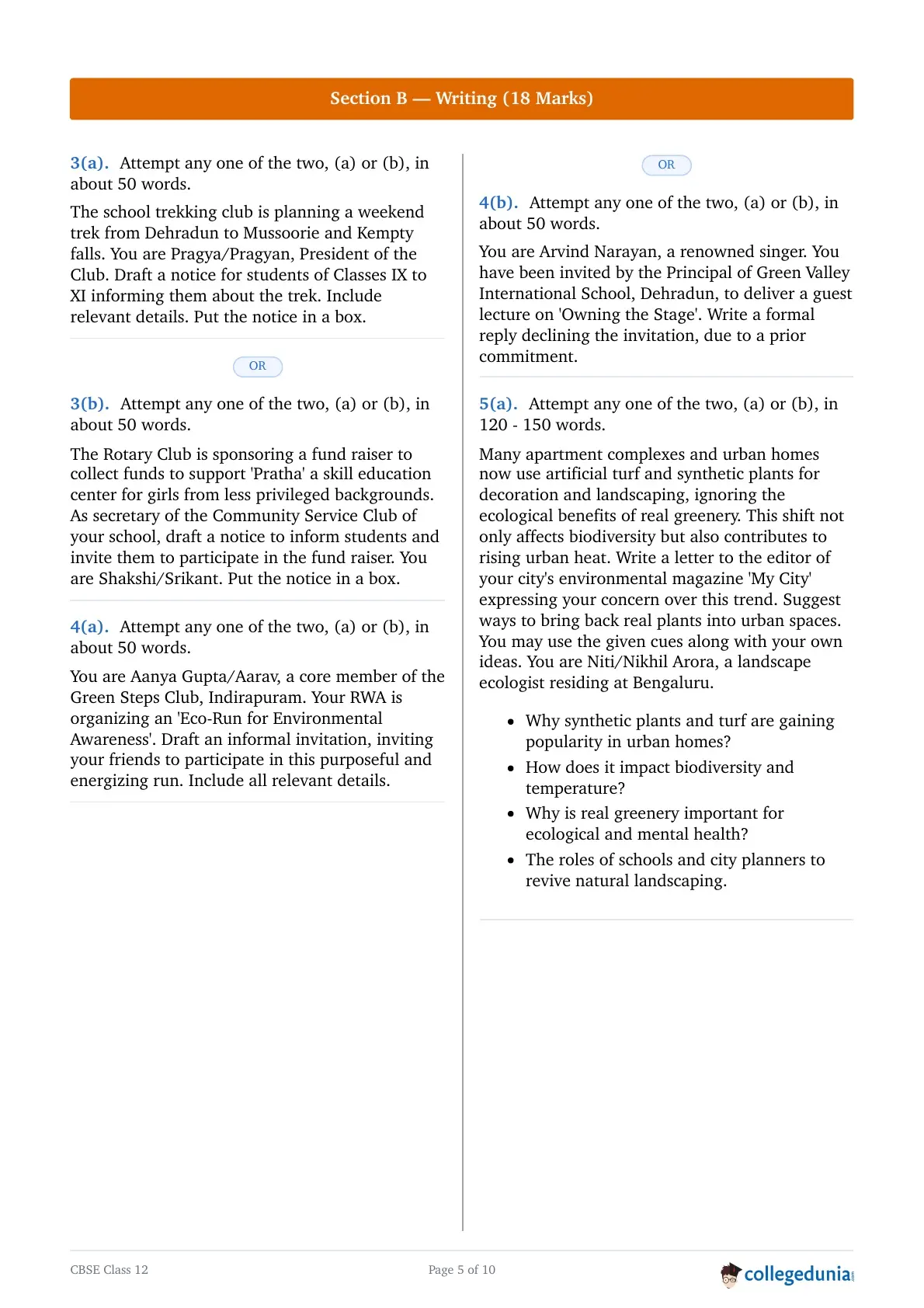
The school trekking club is planning a weekend trek from Dehradun to Mussoorie and Kempty falls. You are Pragya / Pragyan, President of the Club. Draft a notice for students of Classes IX to XI informing them about the trek. Include relevant details. Put the notice in a box.
Attempt in about 50 words.
The Rotary Club is sponsoring a fund raiser to collect funds to support ‘Pratha’ a skill education center for girls from less privileged backgrounds. As secretary of the Community Service Club of your school, draft a notice to inform students and invite them to participate in the fund raiser. You are Shakshi/Srikant. Put the notice in a box.
Attempt in about 50 words.
You are Aanya Gupta / Aarav, a core member of the Green Steps Club, Indirapuram. Your RWA is organizing an ‘Eco-Run for Environmental Awareness’. Draft an informal invitation, inviting your friends to participate in this purposeful and energizing run. Include all relevant details.
Attempt in about 50 words.
You are Arvind Narayan, a renowned singer. You have been invited by the Principal of Green Valley International School, Dehradun, to deliver a guest lecture on ‘Owning the Stage’. Write a formal reply declining the invitation, due to a prior commitment.
Attempt in 120-150 words.
Many apartment complexes and urban homes now use artificial turf and synthetic plants for decoration and landscaping, ignoring the ecological benefits of real greenery. This shift not only affects biodiversity but also contributes to rising urban heat. Write a letter to the editor of your city’s environmental magazine ‘My City’ expressing your concern over this trend. Suggest ways to bring back real plants into urban spaces. You may use the given cues along with your own ideas. You are Niti / Nikhil Arora, a landscape ecologist residing at Bengaluru.
- Why synthetic plants and turf are gaining popularity in urban homes ?
- How does it impact biodiversity and temperature ?
- Why is real greenery important for ecological and mental health ?
- The roles of schools and city planners to revive natural landscaping.
Attempt in 120-150 words.
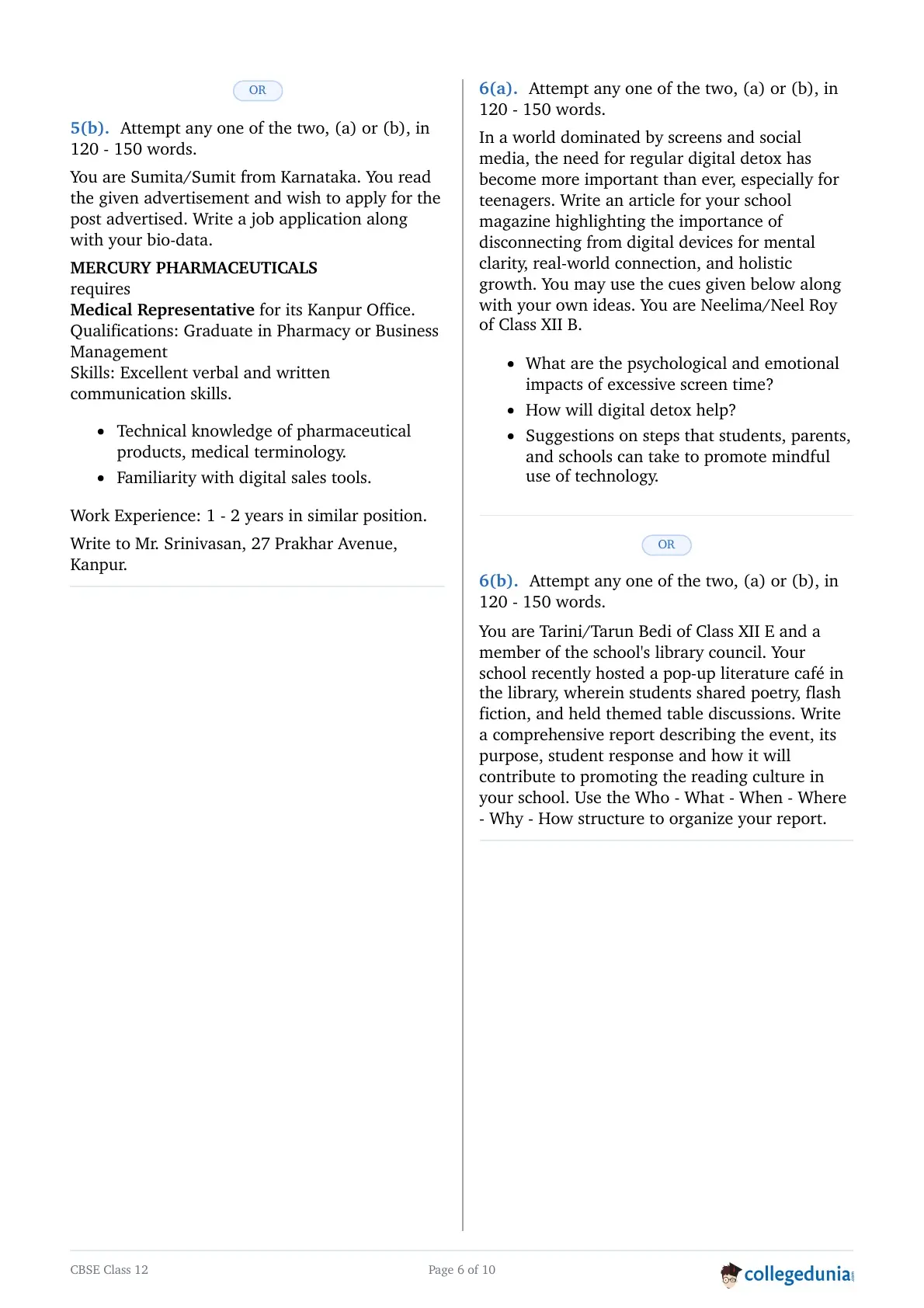
You are Sumita / Sumit from Karnataka. You read the given advertisement and wish to apply for the post advertised. Write a job application along with your bio-data.
MERCURY PHARMACEUTICALS
requires
Medical Representative for its Kanpur Office.
Qualifications : Graduate in Pharmacy or Business Management
Skills : Excellent verbal and written communication skills.
Technical knowledge of pharmaceutical products, medical terminology.
Familiarity with digital sales tools.
Work Experience : 1 – 2 years in similar position.
Write to Mr. Srinivasan, 27 Prakhar Avenue, Kanpur
In a world dominated by screens and social media, the need for regular digital detox has become more important than ever, especially for teenagers. Write an article for your school magazine highlighting the importance of disconnecting from digital devices for mental clarity, real-world connection, and holistic growth. You may use the cues given below along with your own ideas. You are Neelima / Neel Roy of Class XII B.
- What are the psychological and emotional impacts of excessive screen time ?
- How will digital detox help ?
- Suggestions on steps that students, parents, and schools can take to promote mindful use of technology.
(Write in 120-150 words.)
You are Tarini / Tarun Bedi of Class XII E and a member of the school’s library council. Your school recently hosted a pop-up literature café in the library, wherein students shared poetry, flash fiction, and held themed table discussions. Write a comprehensive report describing the event, its purpose, student response and how it will contribute to promoting the reading culture in your school. Use the Who – What – When – Where – Why – How structure to organize your report.
(Write in 120-150 words.)
Question 7(a) (Passage / Extract):
Read the following extract and answer the questions :
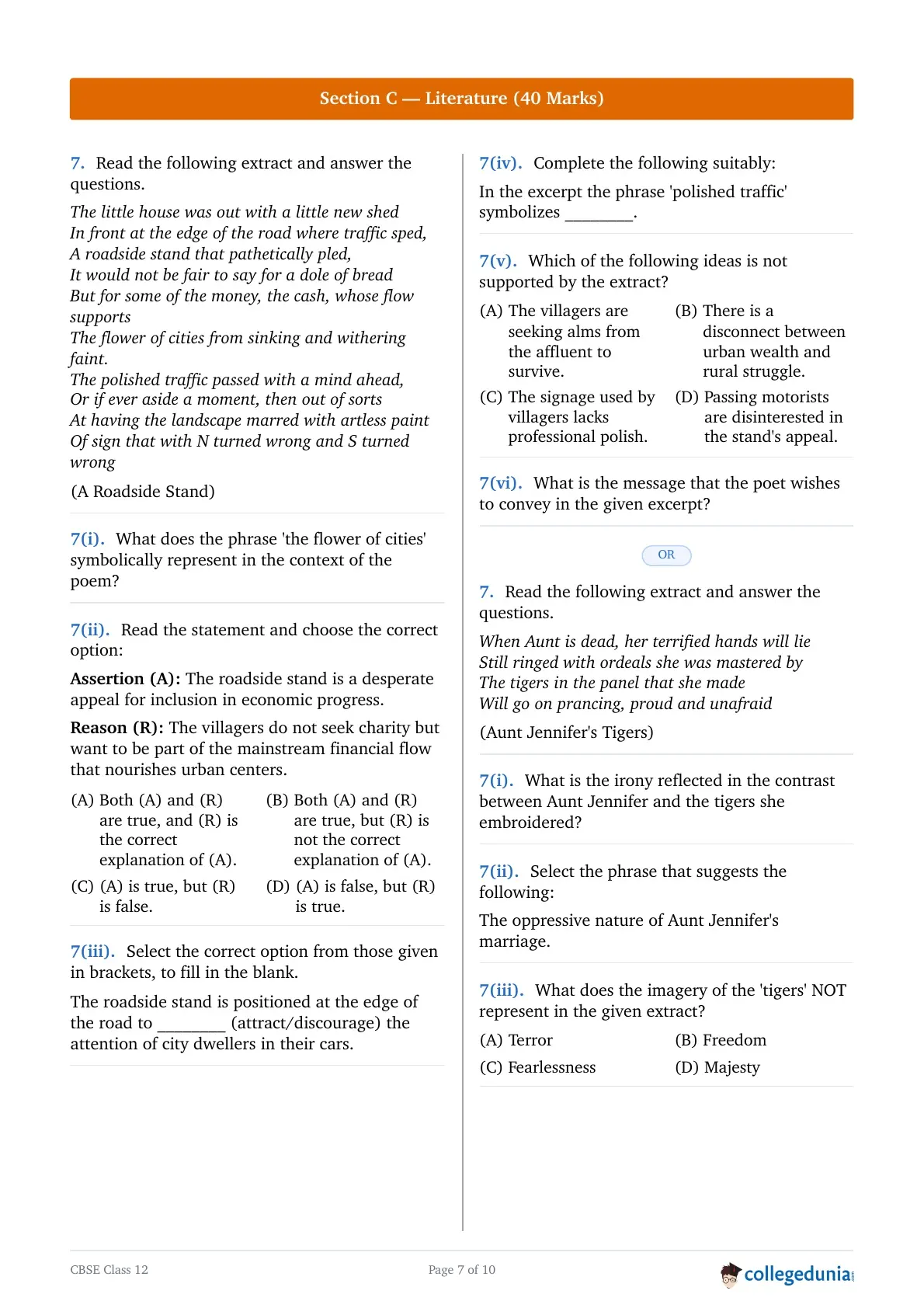
The little house was out with a little new shed
In front at the edge of the road where traffic sped,
A roadside stand that pathetically pled,
It would not be fair to say for a dole of bread
Read More
But for some of the money, the cash, whose flow supportsThe flower of cities from sinking and withering faint.
The polished traffic passed with a mind ahead,
Or if ever aside a moment, then out of sorts
At having the landscape marred with artless paint
Of sign that with N turned wrong and S turned wrong
(A Roadside Stand)
What does the phrase ‘the flower of cities’ symbolically represent in the context of the poem ?
Read the statement and choose the correct option :
Assertion (A) : The roadside stand is a desperate appeal for inclusion in economic progress.
Reason (R) : The villagers do not seek charity but want to be part of the mainstream financial flow that nourishes urban centers.
Select the correct option from those given in brackets, to fill in the blank.
The roadside stand is positioned at the edge of the road to _____ (attract / discourage) the attention of city dwellers in their cars.
Complete the following suitably :
In the excerpt the phrase ‘polished traffic’ symbolizes _______.
What is the message that the poet wishes to convey in the given excerpt ?
Question 7(b)-OR (Passage / Extract):
Read the following extract and answer the questions :
When Aunt is dead, her terrified hands will lie
Still ringed with ordeals she was mastered by
The tigers in the panel that she made
Will go on prancing, proud and unafraid
(Aunt Jennifer’s Tigers)
What is the irony reflected in the contrast between Aunt Jennifer and the tigers she embroidered ?
Select the phrase that suggests the following :
The oppressive nature of Aunt Jennifer’s marriage.
What does the imagery of the ‘tigers’ NOT represent in the given extract ?
The poet’s tone towards Aunt Jennifer can BEST be described as :
Aunt Jennifer is referred to simply as ‘Aunt’ in the end, highlighting _______.
State in one sentence, what is your advice to Aunt Jennifer with reference to the given extract and other women like her most likely to include ?
Question 8(A) (Passage / Extract):
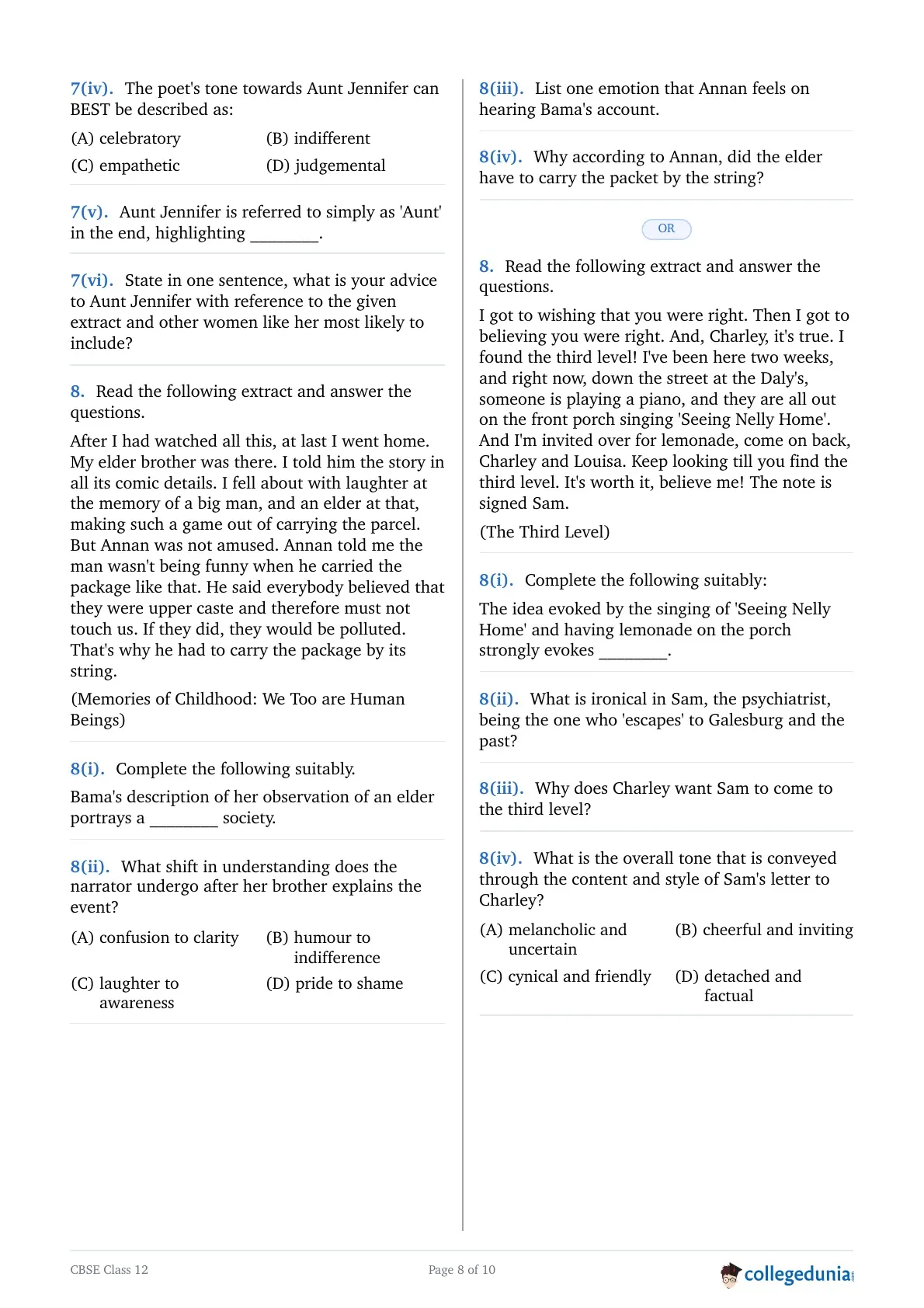
After I had watched all this, at last I went home. My elder brother was there. I told him the story in all its comic details. I fell about with laughter at the memory of a big man, and an elder at that, making such a game out of carrying the parcel. But Annan was not amused. Annan told me the man wasn’t
Read More
being funny when he carried the package like that. He said everybody believed that they were upper caste and therefore must not touch us. If they did, they would be polluted. That’s why he had to carry the package by its string.(Memories of Childhood : We Too are Human Beings)
Complete the following suitably.
Bama’s description of her observation of an elder portrays a _______ society.
What shift in understanding does the narrator undergo after her brother explains the event ?
Why according to Annan, did the elder have to carry the packet by the string ?
Question 8(B)-OR (Passage / Extract):
I got to wishing that you were right. Then I got to believing you were right. And, Charley, it’s true. I found the third level ! I’ve been here two weeks, and right now, down the street at the Daly’s, someone is playing a piano, and they are all out
Read More
on the front porch singing ‘Seeing Nelly Home’. And I’m invited over for lemonade – come on back, Charley and Louisa. Keep looking till you find the third level. It’s worth it, believe me ! – The note is signed Sam.(The Third Level)
Complete the following suitably :
The idea evoked by the singing of ‘Seeing Nelly Home’ and having lemonade on the porch strongly evokes _______.
What is ironical in Sam, the psychiatrist, being the one who ‘escapes’ to Galesburg and the past ?
What is the overall tone that is conveyed through the content and style of Sam’s letter to Charley ?
Question 9(A) (Passage / Extract):
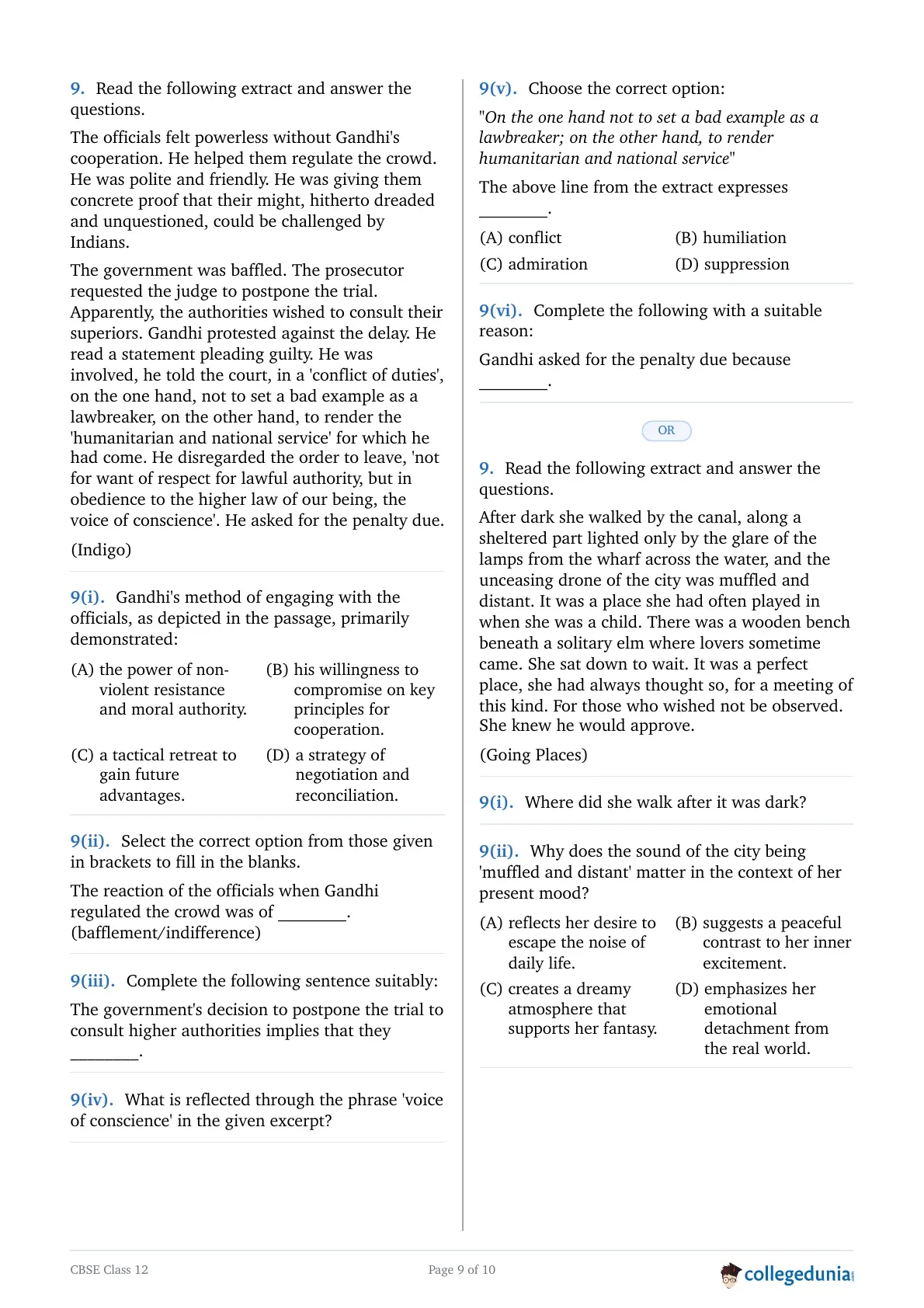
The officials felt powerless without Gandhi’s cooperation. He helped them regulate the crowd. He was polite and friendly. He was giving them concrete proof that their might, hitherto dreaded and unquestioned, could be challenged by Indians.
The government was baffled. The prosecutor requested the judge to postpone the trial. Apparently, the authorities wished to consult their superiors. Gandhi protested against the delay. He read a statement
Read More
pleading guilty. He was involved, he told the court, in a ‘conflict of duties’ – on the one hand, not to set a bad example as a lawbreaker, on the other hand, to render the ‘humanitarian and national service’ for which he had come. He disregarded the order to leave, ‘not for want of respect for lawful authority, but in obedience to the higher law of our being, the voice of conscience’. He asked for the penalty due.(Indigo)
Gandhi’s method of engaging with the officials, as depicted in the passage, primarily demonstrated :
Select the correct option from those given in brackets to fill in the blanks.
The reaction of the officials when Gandhi regulated the crowd was of ________. (bafflement/indifference)
Complete the following sentence suitably :
The government’s decision to postpone the trial to consult higher authorities implies that they _______.
What is reflected through the phrase ‘voice of conscience’ in the given excerpt ?
Choose the correct option :
“On the one hand not to set a bad example as a lawbreaker; on the other hand, to render humanitarian and national service”
The above line from the extract expresses _______.
Complete the following with a suitable reason :
Gandhi asked for the penalty due because _______.
Question 9(B)-OR (Passage / Extract):
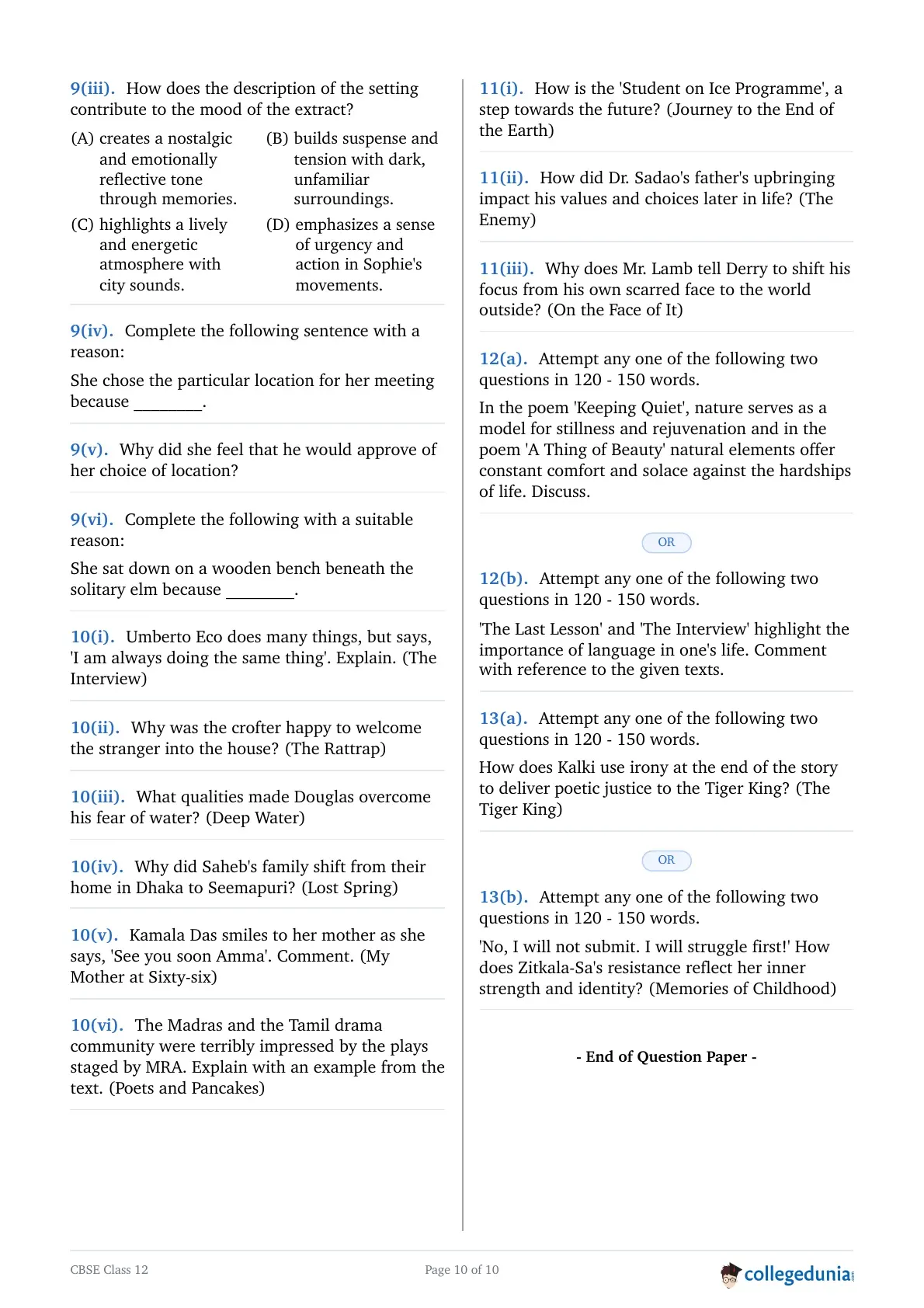
After dark she walked by the canal, along a sheltered part lighted only by the glare of the lamps from the wharf across the water, and the unceasing drone of the city was muffled and distant. It was a place she had often played in when she was a child. There
Read More
was a wooden bench beneath a solitary elm where lovers sometime came. She sat down to wait. It was a perfect place, she had always thought so, for a meeting of this kind. For those who wished not be observed. She knew he would approve.(Going Places)
Why does the sound of the city being ‘muffled and distant’ matter in the context of her present mood ?
How does the description of the setting contribute to the mood of the extract ?
Complete the following sentence with a reason :
She chose the particular location for her meeting because ____.
Why did she feel that he would approve of her choice of location ?
Complete the following with a suitable reason :
She sat down on a wooden bench beneath the solitary elm because _______.
Answer in 40-50 words.
Umberto Eco does many things, but says, ‘I am always doing the same thing’. Explain.
(The Interview)
Answer in 40-50 words.
Why was the crofter happy to welcome the stranger into the house ?
(The Rattrap)
Answer in 40-50 words.
What qualities made Douglas overcome his fear of water ?
(Deep Water)
Answer in 40-50 words.
Why did Saheb’s family shift from their home in Dhaka to Seemapuri ?
(Lost Spring)
Answer in 40-50 words.
Kamala Das smiles to her mother as says, ‘See you soon Amma’. Comment.
(My Mother at Sixty Six)
Answer in 40-50 words.
The Madras and the Tamil drama community were terribly impressed by the plays staged by MRA. Explain with an example from the text.
(Poets and Pancakes)
Answer in 40-50 words.
How is the ‘Student on Ice Programme’, a step towards the future ?
(Journey to the End of the Earth)
Answer in 40-50 words.
How did Dr. Sadao’s father’s upbringing impact his values and choices later in life ?
(The Enemy)
Answer in 40-50 words.
Why does Mr. Lamb tell Derry to shift his focus from his own scarred face to the world around him ?
(On the Face of It)
Attempt in 120-150 words.
In the poem ‘Keeping Quiet’, nature serves as a model for stillness and rejuvenation and in the poem ‘A Thing of Beauty’ natural elements offer constant comfort and solace against the hardships of life. Discuss.
Attempt in 120-150 words.
‘The Last Lesson’ and ‘The Interview’ highlight the importance of language in one’s life. Comment with reference to the given texts.
Attempt in 120-150 words.
How does Kalki use irony at the end of the story to deliver poetic justice to the Tiger King ?
(The Tiger King)
Attempt in 120-150 words.
‘No, I will not submit. I will struggle first !’ How does Zitkala – Sa’s resistance reflect her inner strength and identity ?
(Memories of Childhood)
CBSE Class 12 English Question Paper Pattern and Marking Scheme
The CBSE Class 12 English Core theory paper is of 80 marks (time allowed: 3 hours, plus 15 minutes of reading time) and the internal assessment is of 20 marks. The paper has 13 questions, all compulsory, in three sections. Choice is given in Questions 3 to 13.
CBSE Class 12 English Core Question Paper Pattern 2026
| Section | Q. No. | Type of Questions | Choice | Marks |
|---|---|---|---|---|
| Section A: Reading Skills | 1 | Unseen passage with 10 questions (MCQs, short answers and inference) | All compulsory | 12 |
| 2 | Unseen case-based passage with 8 questions | All compulsory | 10 | |
| Section B: Creative Writing Skills | 3 | Notice or invitation / reply (about 50 words) | Any one of two | 4 |
| 4 | Notice or invitation / reply (about 50 words) | Any one of two | 4 | |
| 5 | Letter or job application with bio-data (120 - 150 words) | Any one of two | 5 | |
| 6 | Article or report (120 - 150 words) | Any one of two | 5 | |
| Section C: Literature | 7 | Extract-based questions, 6 parts of 1 mark (Flamingo / Vistas) | Any one of two extracts | 6 |
| 8 | Extract-based questions, 4 parts of 1 mark | Any one of two extracts | 4 | |
| 9 | Extract-based questions, 6 parts of 1 mark | Any one of two extracts | 6 | |
| 10 | Short-answer questions, 2 marks each (40 - 50 words) | Any five of six | 10 | |
| 11 | Short-answer questions, 2 marks each (40 - 50 words) | Any two of three | 4 | |
| 12 | Long-answer question (120 - 150 words) | Any one of two | 5 | |
| 13 | Long-answer question (120 - 150 words) | Any one of two | 5 | |
| TOTAL (Section A 22 + Section B 18 + Section C 40) | 80 | |||
CBSE Class 12 English Core Marking Scheme 2026
| Type of Question | Marks | How the Marks Are Distributed |
|---|---|---|
| Reading comprehension (Q1 - Q2) | 1 or 2 per part | Marks for understanding; no mark is deducted for mistakes in grammar, spelling or word limit if the core idea is identified |
| Notice / invitation (Q3 - Q4) | 4 | Format 1 + Content 2 + Expression 1 |
| Letter / job application (Q5) | 5 | Format 1 + Content 2 + Expression 2 |
| Article / report (Q6) | 5 | Format 1 + Content 2 + Expression 2 |
| Extract-based questions (Q7 - Q9) | 1 per part | One mark for each correct answer |
| Short answers (Q10 - Q11) | 2 | Content 1 + Expression 1 |
| Long answers (Q12 - Q13) | 5 | Content 3 + Expression 2 |
CBSE Class 12 English Core Section-Wise Weightage
| Section | Marks | Expected Weightage |
|---|---|---|
| Section A: Reading Skills | 22 | 27.5% |
| Section B: Creative Writing Skills | 18 | 22.5% |
| Section C: Literature | 40 | 50% |
| TOTAL | 80 | 100% |



Comments