




CBSE Class 12 English Core Set 3 - (1/1/3) Question Paper 2026 is available for download here. CBSE conducted the Class 12 English Core exam on March 12, 2026, from 10:30 AM to 1:30 PM. The English Core theory paper is of 80 marks, and the internal assessment is of 20 marks.
Also Check: CBSE Class 12 Question Paper 2026 (All Subjects)
The paper has 13 questions, all compulsory, in three sections:
- Section A: Reading Skills (22 marks)
- Section B: Creative Writing Skills (18 marks)
- Section C: Literature (40 marks)
CBSE Class 12 English Core Set 3 - (1/1/3) Question Paper 2026 with Solution PDF
| CBSE Official PDF | CD PDF | CD PDF with Solutions |
|---|---|---|
| Download official PDF 0.86 MB | Download Collegedunia PDF 0.29 MB | – |
CBSE Class 12 English Core 2026 Set 3 (1/1/3) Questions with Solutions
Question 1 (Passage / Extract):
Read the following passage carefully :
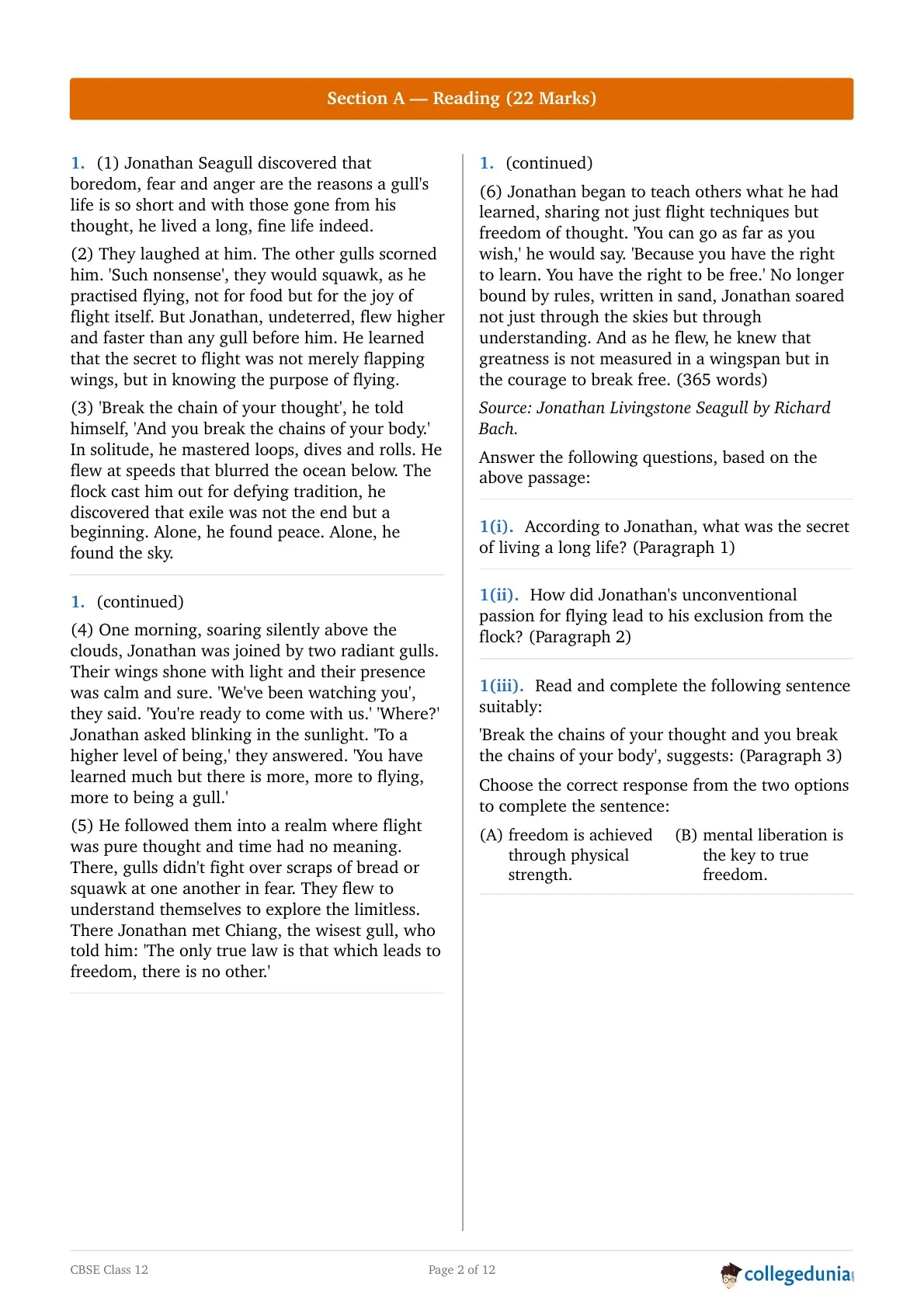
(1) Jonathan Seagull discovered that boredom, fear and anger are the reasons a gull’s life is so short and with those gone from his thought, he lived a long, fine life indeed.
(2) They laughed at him. The other gulls scorned him. ‘Such nonsense’, they would squawk, as he practised flying, not for food but for the joy of flight itself. But Jonathan, undeterred, flew higher and faster than any gull before him. He learned that the secret to flight was not merely flapping wings, but in knowing the purpose of flying.
(3) ‘Break the chain of your thought’, he told himself, ‘And you break the chains of your body.’ In solitude, he mastered loops, dives and rolls. He flew at speeds that blurred the ocean below. The flock cast him out for defying tradition, he discovered that exile was not the end but a beginning. Alone, he found peace. Alone, he found the sky.
(4) One morning, soaring silently above the clouds, Jonathan was joined by two radiant gulls. Their wings shone with light and their presence was calm and sure. ‘We’ve been watching you’, they said. ‘You’re ready to come with us.’
Read More
‘Where ?’ Jonathan asked blinking in the sunlight.‘To a higher level of being,’ they answered.
‘You have learned much but there is more – more to flying, more to being a gull.’
(5) He followed them into a realm where flight was pure thought and time had no meaning. There, gulls didn’t fight over scraps of bread or squawk at one another in fear. They flew to understand themselves to explore the limitless. There Jonathan met Chiang, the wisest gull, who told him : ‘The only true law is that which leads to freedom – there is no other.’
(6) Jonathan began to teach others what he had learned, sharing not just flight techniques but freedom of thought. ‘You can go as far as you wish,’ he would say. ‘Because you have the right to learn. You have the right to be free.’ No longer bound by rules, written in sand, Jonathan soared not just through the skies but through understanding. And as he flew, he knew that greatness is not measured in a wingspan but in the courage to break free. (365 words)
Source : Jonathan Livingstone Seagull by Richard Bach.
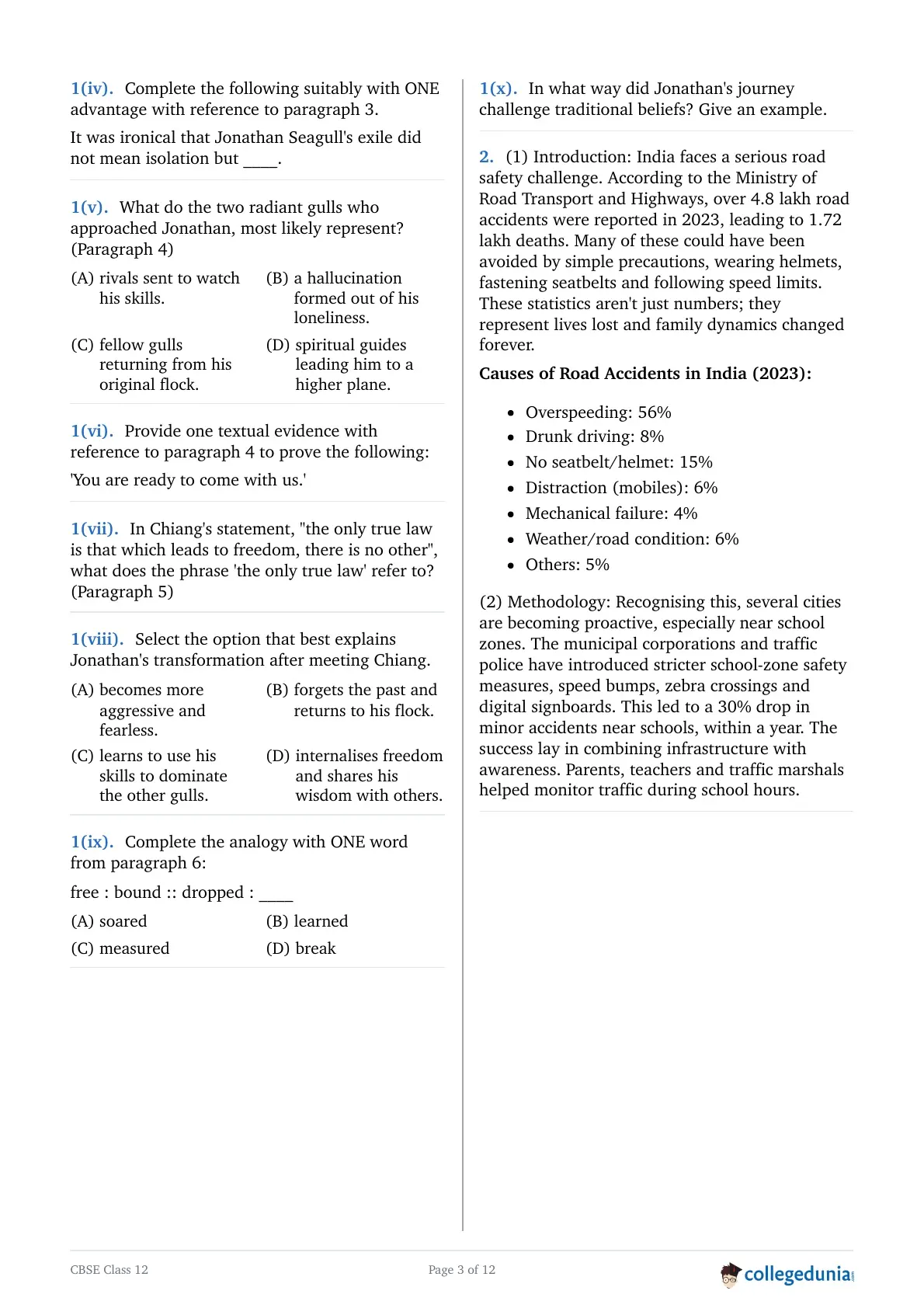
According to Jonathan, what was the secret of living a long life ? (para-1)
How did Jonathan’s unconventional passion for flying lead to his exclusion from the flock ? (para-2)
Read and complete the following sentence suitably :
‘Break the chains of your thought and you break the chains of your body’, suggests : (para-3)
Choose the correct response from the two options to complete the sentence :
Complete the following suitably with ONE advantage with reference to paragraph 3.
It was ironical that Jonathan Seagull’s exile did not mean isolation but _________.
What do the two radiant gulls who approached Jonathan, most likely represent ? (para-4)
Provide one textual evidence with reference to paragraph 4 to prove the following :
You are ready to come with us.
In Chiang’s statement, “the only true law is that which leads to freedom – there is no other”, what does the phrase ‘the only true law’ refer to ? (para-5)
Select the option that best explains Jonathan’s transformation after meeting Chiang.
Complete the analogy with ONE word from paragraph 6 :
free : bound
dropped : _________
In what way did Jonathan’s journey challenge traditional beliefs ? Give an example.
Question 2 (Passage / Extract):
Read the following passage carefully :
(1) Introduction : India faces a serious road safety challenge. According to the Ministry of Road Transport and Highways, over 4.8 lakh road accidents were reported in 2023, leading to 1.72 lakh deaths. Many of these could have been avoided by simple precautions – wearing helmets, fastening seatbelts and following speed limits. These statistics aren’t just numbers; they represent lives lost and family dynamics changed forever.
Read More
| Causes of Road Accidents in India (2023) | ||
|---|---|---|
| S. No. | Causes | % |
| 1. | Overspeeding | 56 |
| 2. | Drunk driving | 8 |
| 3. | No seatbelt/helmet | 15 |
| 4. | Distraction (mobiles) | 6 |
| 5. | Mechanical failure | 4 |
| 6. | Weather/road condition | 6 |
| 7. | Others | 5 |
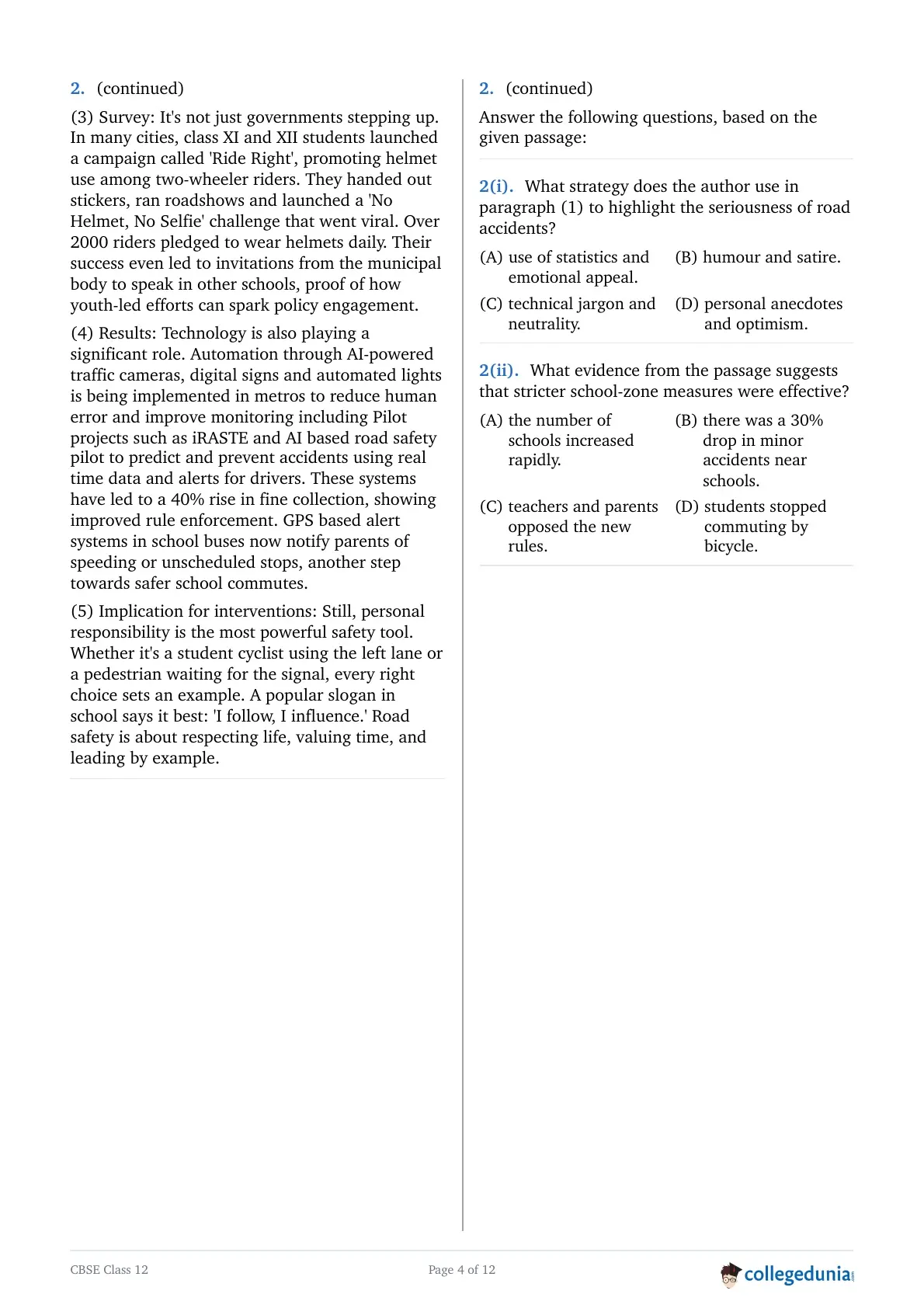
(2) Methodology : Recognising this, several cities are becoming proactive, especially near school zones. The municipal corporations and traffic police have introduced stricter school-zone safety measures – speed bumps, zebra crossings and digital signboards. This led to a 30% drop in minor accidents near schools, within a year. The success lay in combining infrastructure with awareness. Parents, teachers and traffic marshals helped monitor traffic during school hours.
(3) Survey : It’s not just governments stepping up. In many cities, class XI and XII students launched a campaign called ‘Ride Right’, promoting helmet use among two-wheeler riders. They handed out stickers, ran roadshows and launched a ‘No Helmet, No Selfie’ challenge that went viral. Over 2000 riders pledged to wear helmets daily. Their success even led to invitations from the municipal body to speak in other schools – proof of how youth-led efforts can spark policy engagement.
(4) Results : Technology is also playing a significant role. Automation through AI-powered traffic cameras, digital signs and automated lights is being implemented in metros to reduce human error and improve monitoring including Pilot projects such as iRASTE and AI based road safety pilot to predict and prevent accidents using real time data and alerts for drivers. These systems have led to a 40% rise in fine collection, showing improved rule enforcement. GPS based alert systems in school buses now notify parents of speeding or unscheduled stops – another step towards safer school commutes.
(5) Implication for interventions : Still, personal responsibility is the most powerful safety tool. Whether it’s a student cyclist using the left lane or a pedestrian waiting for the signal, every right choice sets an example. A popular slogan in school says it best : ‘I follow, I influence.’ Road safety is about respecting life, valuing time, and leading by example.
What strategy does the author use in paragraph (1) to highlight the seriousness of road accidents ?
What evidence from the passage suggests that stricter school-zone measures were effective ?
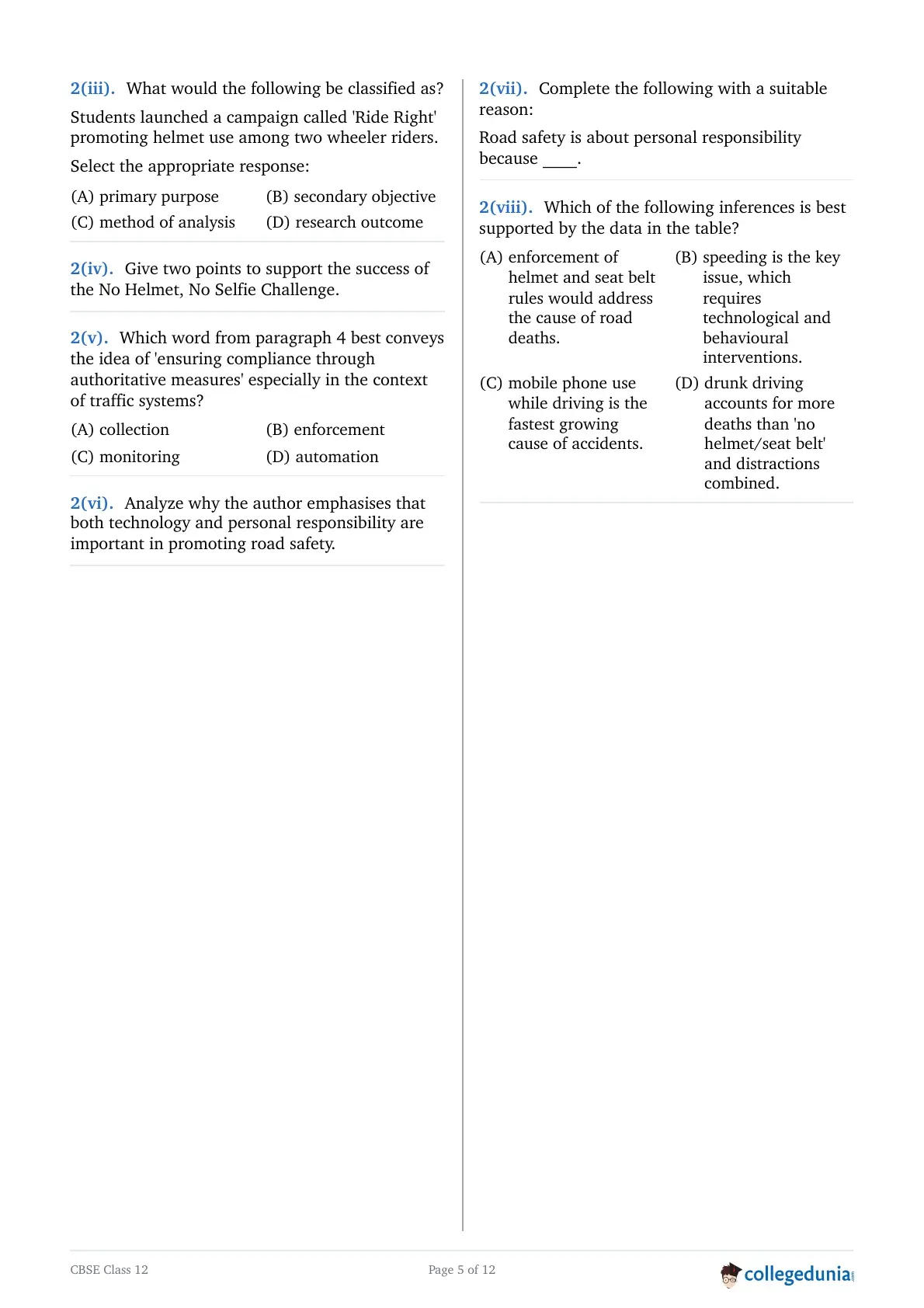
What would the following be classified as ?
Students launched a campaign called “Ride Right” promoting helmet use among two wheeler riders.
Select the appropriate response :
Give two points to support the success of the No Helmet – No Selfie Challenge.
Which word from paragraph 4 best conveys the idea of ‘ensuring compliance through authoritative measures’ especially in the context of traffic systems ?
Analyze why does the author emphasise that both technology and personal responsibility are important in promoting road safety.
Complete the following with a suitable reason :
Road safety is about personal responsibility because _________.
Which of the following inferences is best supported by the data in the table ?
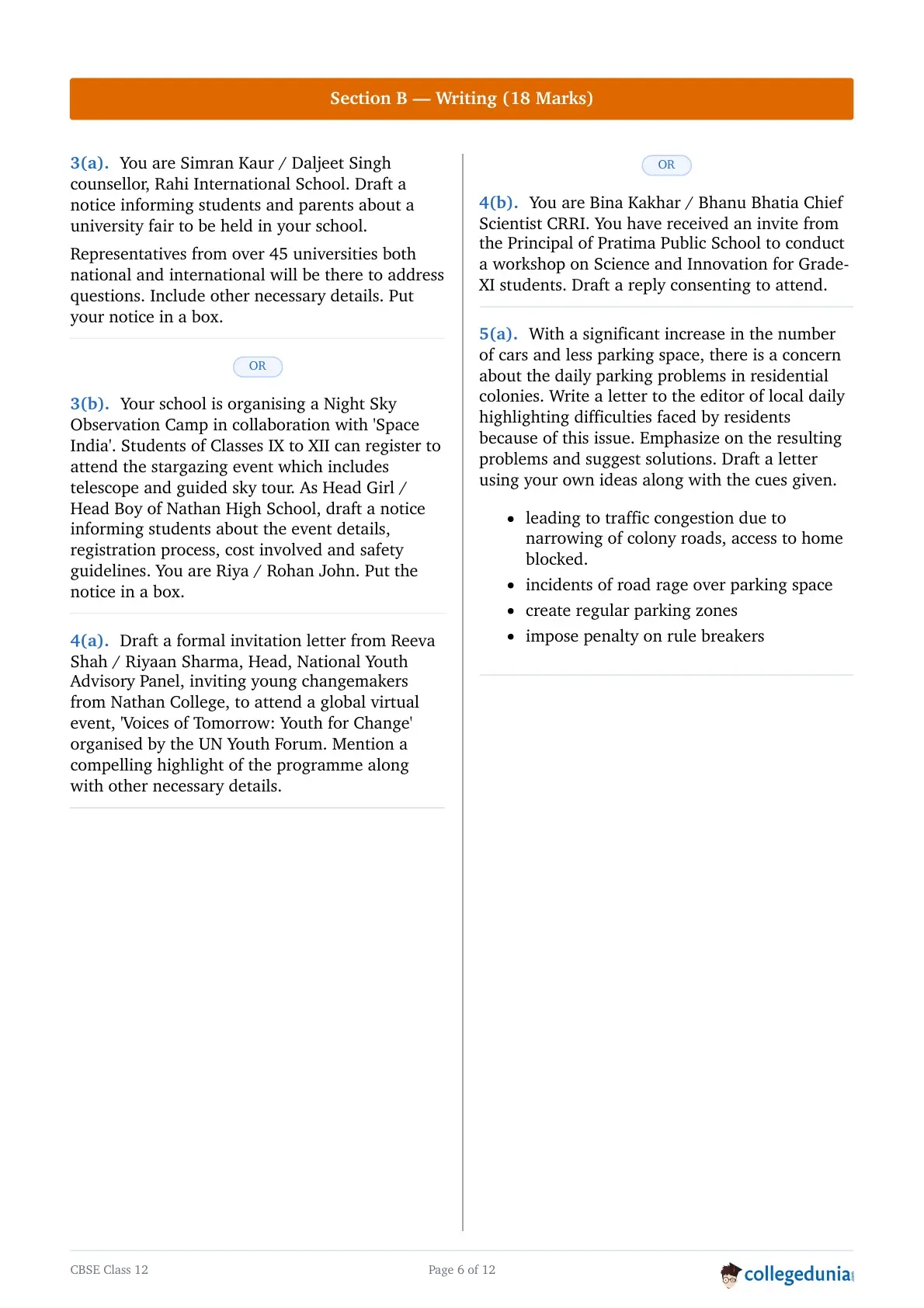
You are Simran Kaur / Daljeet Singh counsellor, Rahi International School. Draft a notice informing students and parents about a university fair to be held in your school.
Representatives from over 45 universities both national and international will be there to address questions. Include other necessary details. Put your notice in a box.
(Notice in about 50 words)
Your school is organising a Night Sky Observation Camp in collaboration with ‘Space India’. Students of Classes IX to XII can register to attend the stargazing event which includes telescope and guided sky tour. As Head Girl / Head Boy of Nathan High School, draft a notice informing students about the event details, registration process, cost involved and safety guidelines. You are Riya / Rohan John. Put the notice in a box.
(Notice in about 50 words)
Attempt ANY ONE of the two (A) or (B) in about 50 words :
(A) Draft a formal invitation letter from Reeva Shah / Riyaan Sharma, Head, National Youth Advisory Panel, inviting young changemakers from Nathan College, to attend a global virtual event, ‘Voices of Tomorrow : Youth for Change’ organised by the UN Youth Forum. Mention a compelling highlight of the programme along with other necessary details.
(B) You are Bina Kakhar / Bhanu Bhatia Chief Scientist CRRI. You have received an invite from the Principal of Pratima Public School to conduct a workshop on Science and Innovation for Grade-XI students. Draft a reply consenting to attend.
(Answer in about 50 words.)
Attempt ANY ONE of the two (A) or (B) in 120-150 words :
(A) With a significant increase in the number of cars and less parking space, there is a concern about the daily parking problems in residential colonies. Write a letter to the editor of local daily highlighting difficulties faced by residents because of this issue. Emphasize on the resulting problems and suggest solutions. Draft a letter using your own ideas along with the cues given.
- leading to traffic congestion due to narrowing of colony roads – access to home blocked.
- incidents of road rage over parking space
- create regular parking zones
- impose penalty on rule breakers
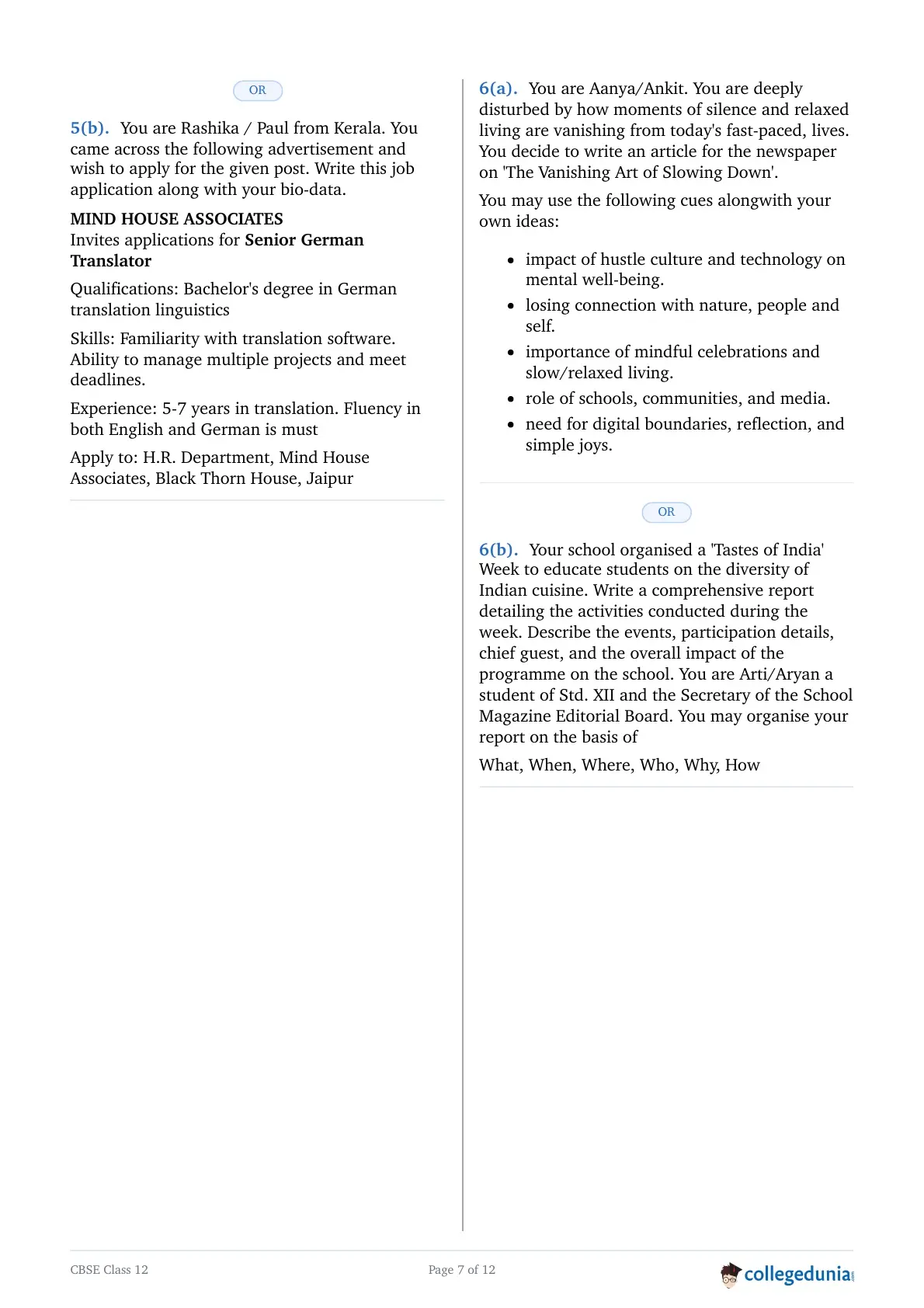
(B) You are Rashika / Paul from Kerala. You came across the following advertisement and wish to apply for the given post. Write this job application along with your bio-data.
MIND HOUSE ASSOCIATES
Invites applications for Senior German Translator
- Qualifications : Bachelor’s degree in German translation linguistics
- Skills : Familiarity with translation software; ability to manage multiple projects and meet deadlines.
- Experience : 5 – 7 years in translation
- Fluency in both English and German is must
Apply to : H.R. Department, Mind House Associates, Black Thorn House, Jaipur
(Answer in 120-150 words.)
(In 120-150 words)
You are Aanya/Ankit. You are deeply disturbed by how moments of silence and relaxed living are vanishing from today’s fast-paced, lives. You decide to write an article for the newspaper on ‘The Vanishing Art of Slowing Down’.
You may use the following cues alongwith your own ideas :
- impact of hustle culture and technology on mental well-being.
- losing connection with nature, people and self.
- importance of mindful celebrations and slow/relaxed living.
- role of schools, communities, and media.
- need for digital boundaries, reflection, and simple joys.
(In 120-150 words)
Your school organised a ‘Tastes of India’ Week to educate students on the diversity of Indian cuisine. Write a comprehensive report detailing the activities conducted during the week. Describe the events, participation details, chief guest, and the overall impact of the programme on the school. You are Arti/Aryan a student of Std. XII and the Secretary of the School Magazine Editorial Board. You may organise your report on the basis of What – When – Where – Who – Why – How
Question 7(A) (Passage / Extract):
Read the following extract and answer the questions.
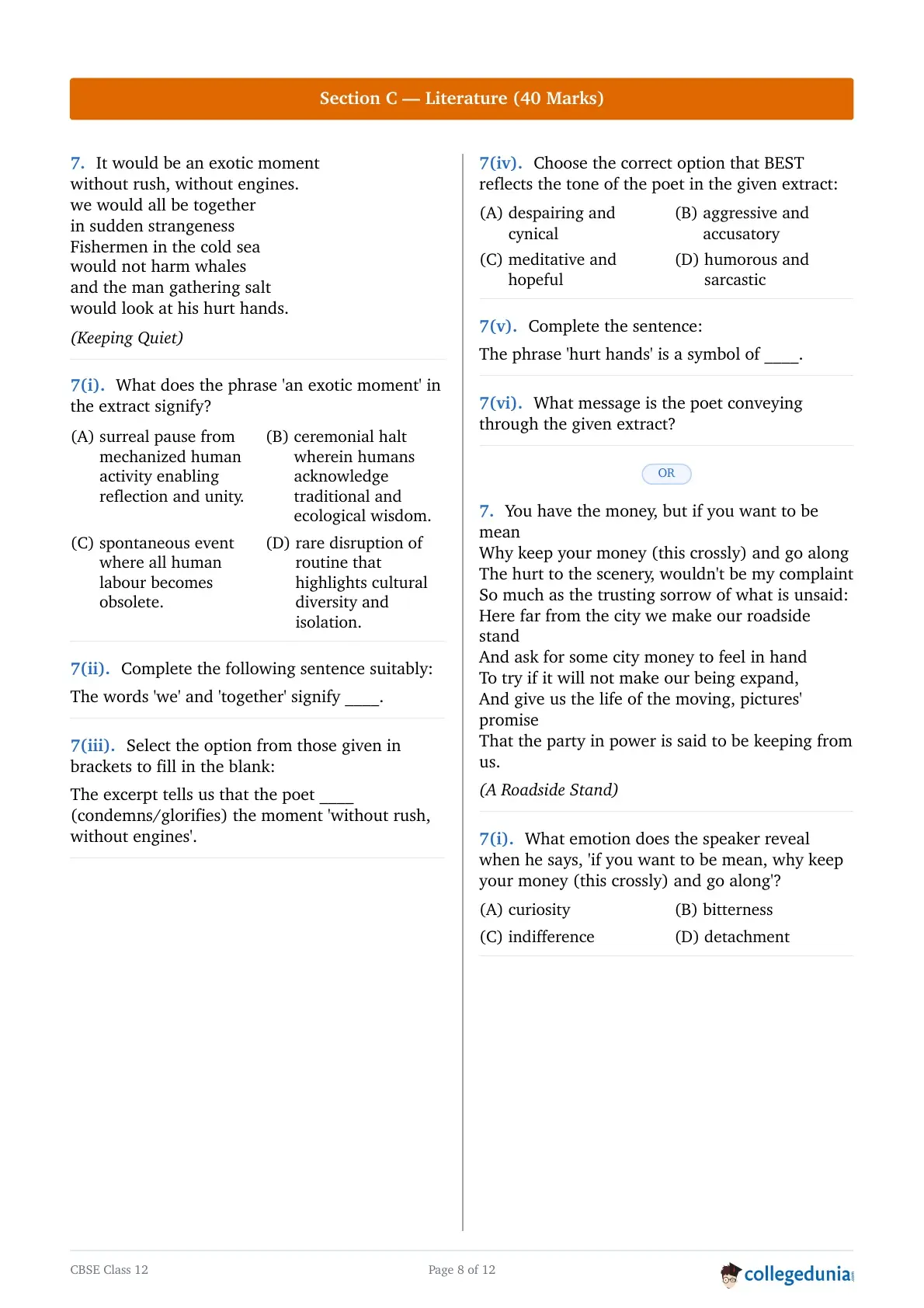
It would be an exotic moment
without rush, without engines.
we would all be together
in sudden strangeness
Fishermen in the cold sea
would not harm whales
and the man gathering salt
would look at his hurt hands.
(Keeping Quiet)
What does the phrase ‘an exotic moment’ in the extract signify ?
Complete the following sentence suitably :
The words ‘we’ and ‘together’ signify _________.
Select the option from those given in brackets to fill in the blank :
The excerpt tells us that the poet _________ (condemns/glorifies) the moment ‘without rush, without engines’.
Choose the correct option that BEST reflects the tone of the poet in the given extract :
Complete the sentence :
The phrase ‘hurt hands’ is a symbol of _________.
Question 7(B)-OR (Passage / Extract):
Read the following extract and answer the questions.
You have the money, but if you want to be mean
Why keep your money (this crossly) and go along
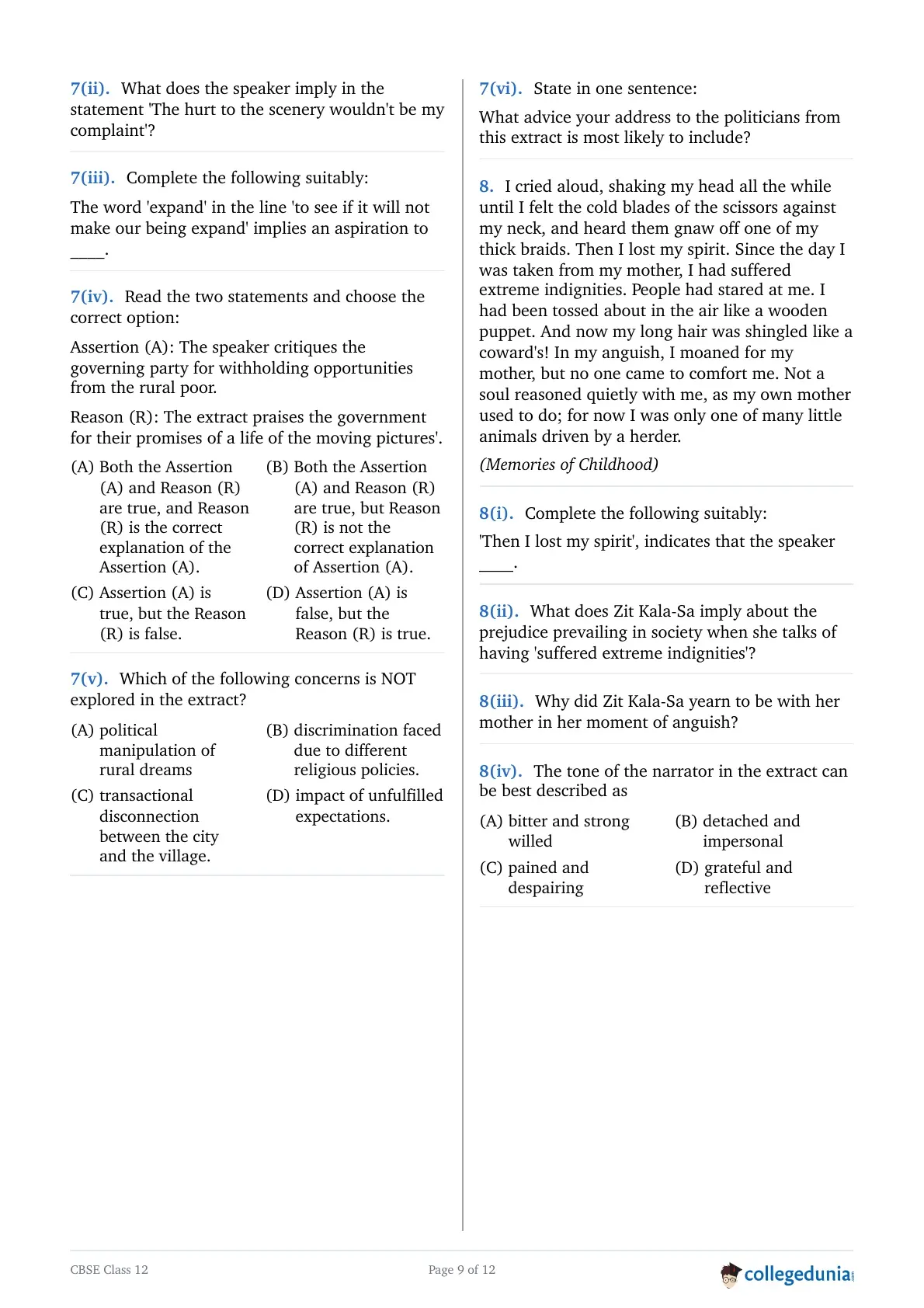
The hurt to the scenery, wouldn’t be my complaint
So much as the trusting sorrow of what is unsaid :
Read More
Here far from the city we make our roadside standAnd ask for some city money to feel in hand
To try if it will not make our being expand,
And give us the life of the moving – pictures’ promise
That the party in power is said to be keeping from us.
(A Roadside Stand)
What emotion does the speaker reveal when he says, ‘if you want to be mean, why keep your money (this crossly) and go along’ ?
What does the speaker imply in the statement ‘The hurt to the scenery wouldn’t be my complaint’ ?
Complete the following suitably :
The word ‘expand’ in the line ‘to see if it will not make our being expand’ implies an aspiration to _________.
Read the two statements and choose the correct option :
Assertion (A) : The speaker critiques the governing party for withholding opportunities from the rural poor.
Reason (R) : The extract praises the government for their promises of a life of the moving pictures’.
Which of the following concerns is NOT explored in the extract ?
State in one sentence :
What advice your address to the politicians from this extract is most likely to include ?
Question 8(A) (Passage / Extract):
Read the following extract and answer the questions that follow.
I cried aloud, shaking my head all the while until I felt the cold blades of the scissors against my neck, and heard them gnaw off one of my thick braids. Then I lost my spirit. Since the day I was taken from my mother, I had suffered extreme indignities. People had stared at
Read More
me. I had been tossed about in the air like a wooden puppet. And now my long hair was shingled like a coward’s ! In my anguish, I moaned for my mother, but no one came to comfort me. Not a soul reasoned quietly with me, as my own mother used to do; for now I was only one of many little animals driven by a herder.(Memories of Childhood)
Complete the following suitably : “Then I lost my spirit”, indicates that the speaker _________.
What does Zit Kala-Sa imply about the prejudice prevailing in society when she talks of having ‘suffered extreme indignities’ ?
Why did Zit Kala-Sa yearn to be with her mother in her moment of anguish ?
The tone of the narrator in the extract can be best described as
Question 8(B)-OR (Passage / Extract):
Read the following extract and answer the questions that follow.
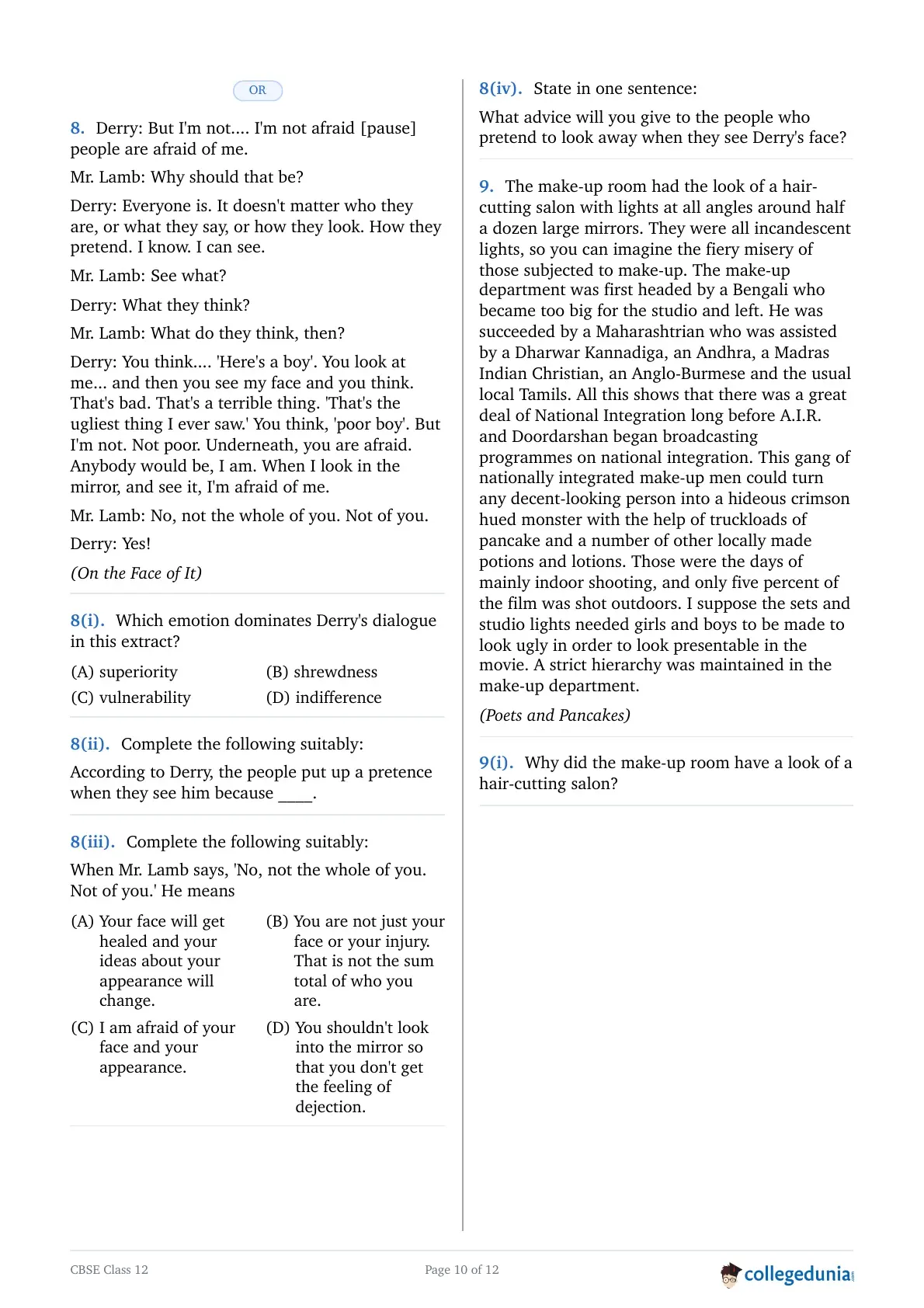
Derry : But I’m not…. I’m not afraid [pause] people are afraid of me.
Mr. Lamb : Why should that be ?
Derry : Everyone is. It doesn’t matter who they are, or what they say, or how they look. How they pretend. I know. I can see.
Mr. Lamb : See what ?
Derry : What they think ?
Mr. Lamb : What do they think, then ?
Derry
Read More
: You think…. ‘Here’s a boy’. You look at me… and then you see my face and you think. That’s bad. That’s a terrible thing. ‘That’s the ugliest thing I ever saw.’ You think, ‘poor boy’. But I’m not. Not poor. Underneath, you are afraid. Anybody would be – I am. When I look in the mirror, and see it, I’m afraid of me.Mr. Lamb : No, not the whole of you. Not of you.
Derry : Yes !
(On the Face of It)
Complete the following suitably :
According to Derry, the people put up a pretence when they see him because _________.
Complete the following suitably :
When Mr. Lamb says, ‘No, not the whole of you. Not of you.’ He means _________.
State in one sentence :
What advice will you give to the people who pretend to look away when they see Derry’s face ?
Question 9(A) (Passage / Extract):
Read the following extract and answer the questions.
The make-up room had the look of a hair-cutting salon with lights at all angles around half a dozen large mirrors. They were all incandescent lights, so you can imagine the fiery misery of those subjected to make-up. The make-up department was first headed by a Bengali who became too big for the studio and left. He was succeeded by a Maharashtrian who was assisted by a Dharwar Kannadiga, an Andhra, a Madras Indian Christian, an Anglo-Burmese and the usual local Tamils. All this shows that there was a great deal of National Integration
Read More
long before A.I.R. and Doordarshan began broadcasting programmes on national integration. This gang of nationally integrated make-up men could turn any decent-looking person into a hideous crimson hued monster with the help of truckloads of pancake and a number of other locally made potions and lotions. Those were the days of mainly indoor shooting, and only five percent of the film was shot outdoors. I suppose the sets and studio lights needed girls and boys to be made to look ugly in order to look presentable in the movie. A strict hierarchy was maintained in the make-up department.(Poets and Pancakes)
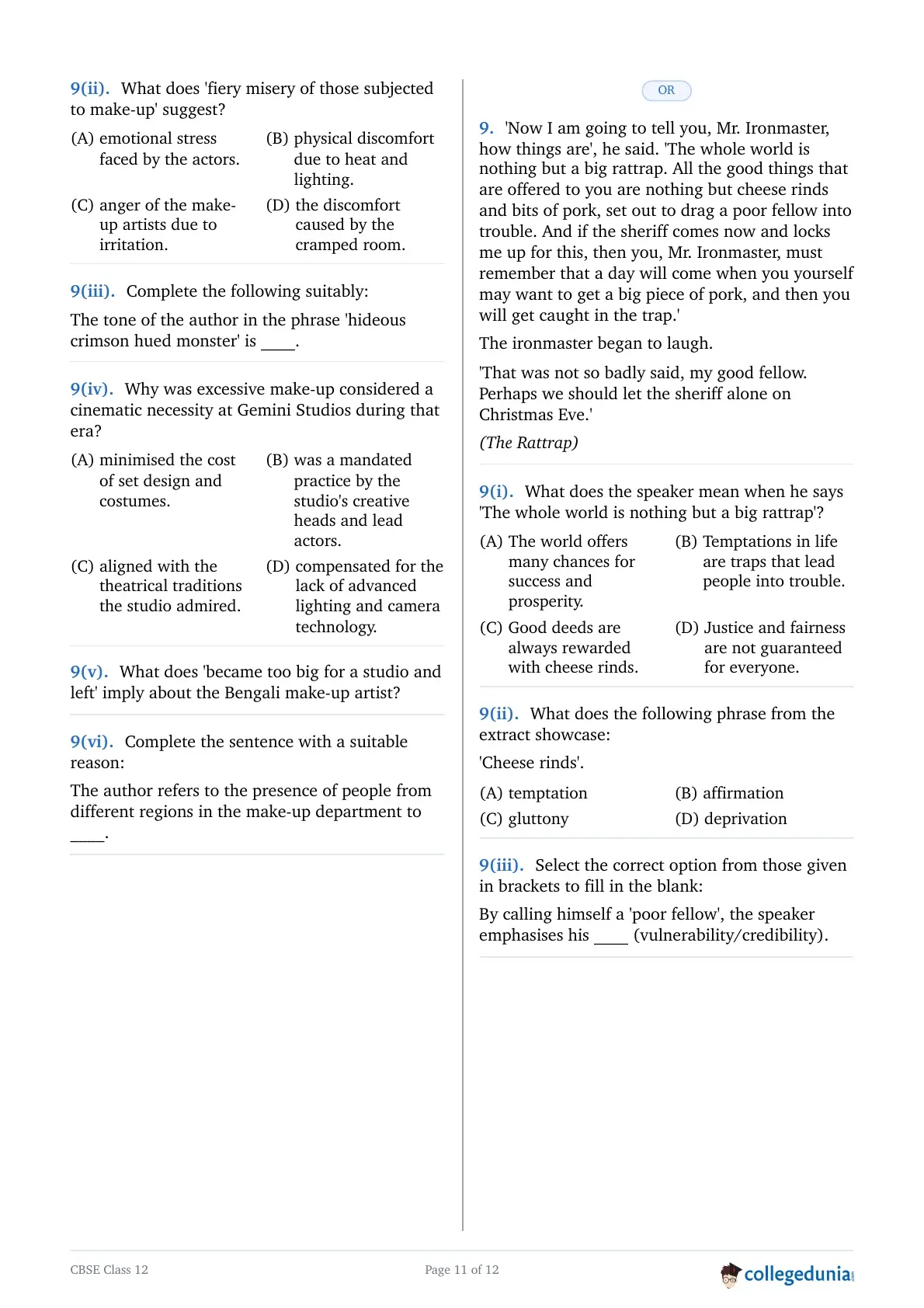
What does ‘fiery misery of those subjected to make-up’ suggest ?
Complete the following suitably : The tone of the author in the phrase ‘hideous crimson hued monster’ is _________
Why was excessive make-up considered a cinematic necessity at Gemini Studios during that era ?
What does ‘became too big for a studio and left’ imply about the Bengali make-up artist ?
Complete the sentence with a suitable reason : The author refers to the presence of people from different regions in the make-up department to _________.
Question 9(B)-OR (Passage / Extract):
Read the following extract and answer the questions.
‘Now I am going to tell you, Mr. Ironmaster, how things are’, he said. ‘The whole world is nothing but a big rattrap. All the good things that are offered to you are nothing but cheese rinds and bits of pork, set out to drag a poor fellow into trouble. And if the sheriff
Read More
comes now and locks me up for this, then you, Mr. Ironmaster, must remember that a day will come when you yourself may want to get a big piece of pork, and then you will get caught in the trap.The ironmaster began to laugh.
‘That was not so badly said, my good fellow. Perhaps we should let the sheriff alone on Christmas Eve.’
(The Rattrap)
What does the speaker mean when he says ‘The whole world is nothing but a big rattrap’ ?
What does the following phrase from the extract showcase : ‘Cheese rinds’.
Select the correct option from those given in brackets to fill in the blank : By calling himself a ‘poor fellow’, the speaker emphasises his _________. (vulnerability/credibility)
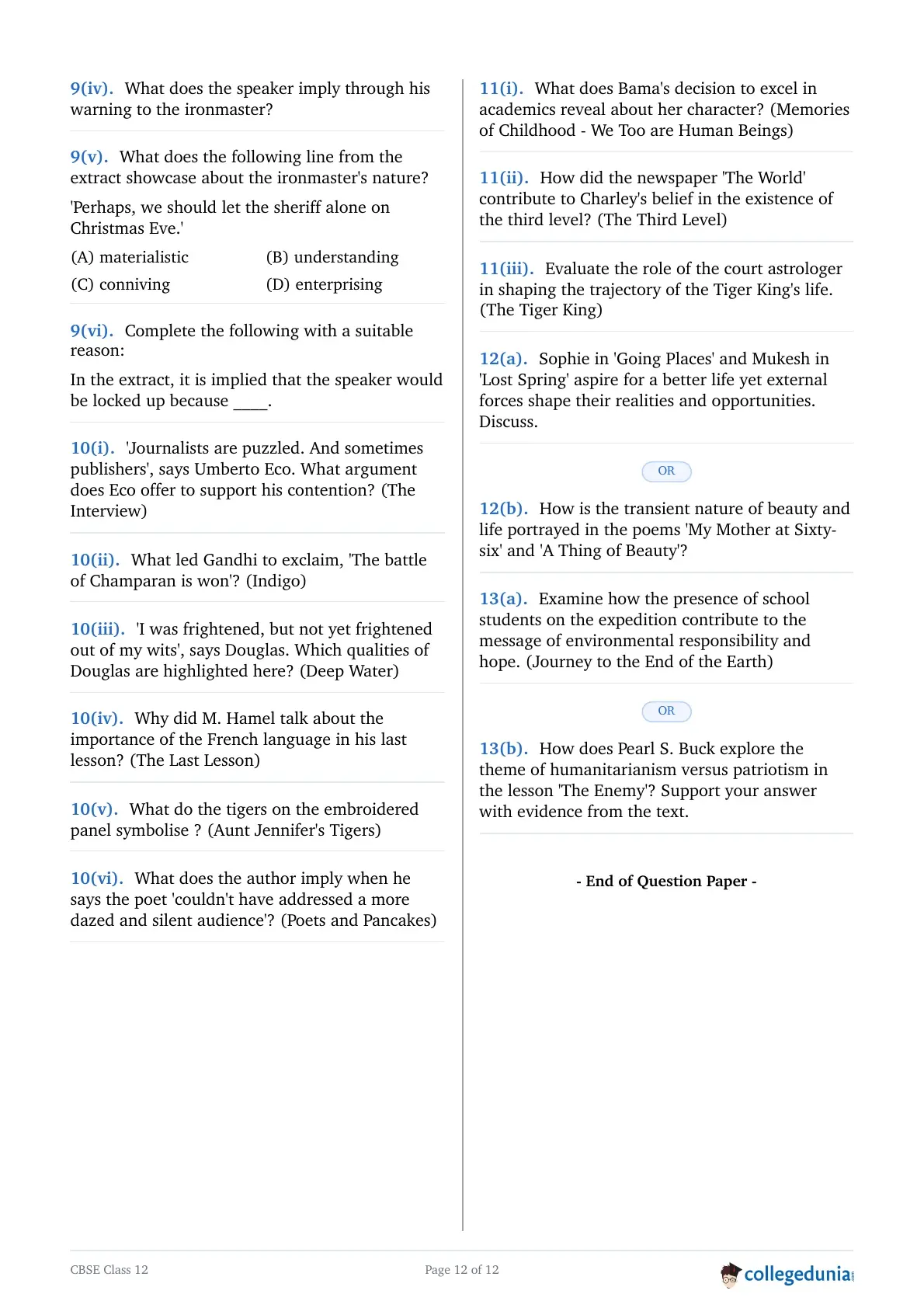
What does the speaker imply through his warning to the ironmaster ?
What does the following line from the extract showcase about the ironmaster’s nature ? ‘Perhaps, we should let the sheriff alone on Christmas Eve.’
Complete the following with a suitable reason : In the extract, it is implied that the speaker would be locked up because _____.
Answer ANY FIVE of the following six questions in 40-50 words each :
(i) “Journalists are puzzled. And sometimes publishers”, says Umberto Eco. What argument does Eco offer to support his contention? (The Interview)
(ii) What led Gandhi to exclaim, ‘The battle of Champaran is won’? (Indigo)
(iii) “I was frightened, but not yet frightened out of my wits”, says Douglas. Which qualities of Douglas are highlighted here? (Deep Water)
(iv) Why did M. Hamel talk about the importance of the French language in his last lesson? (The Last Lesson)
(v) What do the tigers on the embroidered panel symbolise? (Aunt Jennifer’s Tigers)
(vi) What does the author imply when he says the poet “couldn’t have addressed a more dazed and silent audience”? (Poets and Pancakes)
What does Bama’s decision to excel in academics reveal about her character ? (Memories of Childhood – We Too are Human Beings)
How did the newspaper ‘The World’ contribute to Charley’s belief in the existence of the third level ? (The Third Level)
Evaluate the role of the court astrologer in shaping the trajectory of the Tiger King’s life. (The Tiger King)
Answer ANY ONE of the following two questions in 120-150 words:
Sophie in ‘Going Places’ and Mukesh in ‘Lost Spring’ aspire for a better life yet external forces shape their realities and opportunities. Discuss.
Answer ANY ONE of the following two questions in 120-150 words:
How is the transient nature of beauty and life portrayed in the poems ‘My Mother at Sixty Six’ and ‘A Thing of Beauty’ ?
Answer ANY ONE of the following two questions, in 120-150 words:
Examine how the presence of school students on the expedition contribute to the message of environmental responsibility and hope. (Journey to the End of the Earth)
Answer ANY ONE of the following two questions, in 120-150 words:
How does Pearl S. Buck explore the theme of humanitarianism versus patriotism in the lesson ‘The Enemy’ ? Support your answer with evidence from the text.
CBSE Class 12 English Question Paper Pattern and Marking Scheme
The CBSE Class 12 English Core theory paper is of 80 marks (time allowed: 3 hours, plus 15 minutes of reading time) and the internal assessment is of 20 marks. The paper has 13 questions, all compulsory, in three sections. Choice is given in Questions 3 to 13.
CBSE Class 12 English Core Question Paper Pattern 2026
| Section | Q. No. | Type of Questions | Choice | Marks |
|---|---|---|---|---|
| Section A: Reading Skills | 1 | Unseen passage with 10 questions (MCQs, short answers and inference) | All compulsory | 12 |
| 2 | Unseen case-based passage with 8 questions | All compulsory | 10 | |
| Section B: Creative Writing Skills | 3 | Notice or invitation / reply (about 50 words) | Any one of two | 4 |
| 4 | Notice or invitation / reply (about 50 words) | Any one of two | 4 | |
| 5 | Letter or job application with bio-data (120 - 150 words) | Any one of two | 5 | |
| 6 | Article or report (120 - 150 words) | Any one of two | 5 | |
| Section C: Literature | 7 | Extract-based questions, 6 parts of 1 mark (Flamingo / Vistas) | Any one of two extracts | 6 |
| 8 | Extract-based questions, 4 parts of 1 mark | Any one of two extracts | 4 | |
| 9 | Extract-based questions, 6 parts of 1 mark | Any one of two extracts | 6 | |
| 10 | Short-answer questions, 2 marks each (40 - 50 words) | Any five of six | 10 | |
| 11 | Short-answer questions, 2 marks each (40 - 50 words) | Any two of three | 4 | |
| 12 | Long-answer question (120 - 150 words) | Any one of two | 5 | |
| 13 | Long-answer question (120 - 150 words) | Any one of two | 5 | |
| TOTAL (Section A 22 + Section B 18 + Section C 40) | 80 | |||
CBSE Class 12 English Core Marking Scheme 2026
| Type of Question | Marks | How the Marks Are Distributed |
|---|---|---|
| Reading comprehension (Q1 - Q2) | 1 or 2 per part | Marks for understanding; no mark is deducted for mistakes in grammar, spelling or word limit if the core idea is identified |
| Notice / invitation (Q3 - Q4) | 4 | Format 1 + Content 2 + Expression 1 |
| Letter / job application (Q5) | 5 | Format 1 + Content 2 + Expression 2 |
| Article / report (Q6) | 5 | Format 1 + Content 2 + Expression 2 |
| Extract-based questions (Q7 - Q9) | 1 per part | One mark for each correct answer |
| Short answers (Q10 - Q11) | 2 | Content 1 + Expression 1 |
| Long answers (Q12 - Q13) | 5 | Content 3 + Expression 2 |
CBSE Class 12 English Core Section-Wise Weightage
| Section | Marks | Expected Weightage |
|---|---|---|
| Section A: Reading Skills | 22 | 27.5% |
| Section B: Creative Writing Skills | 18 | 22.5% |
| Section C: Literature | 40 | 50% |
| TOTAL | 80 | 100% |



Comments