




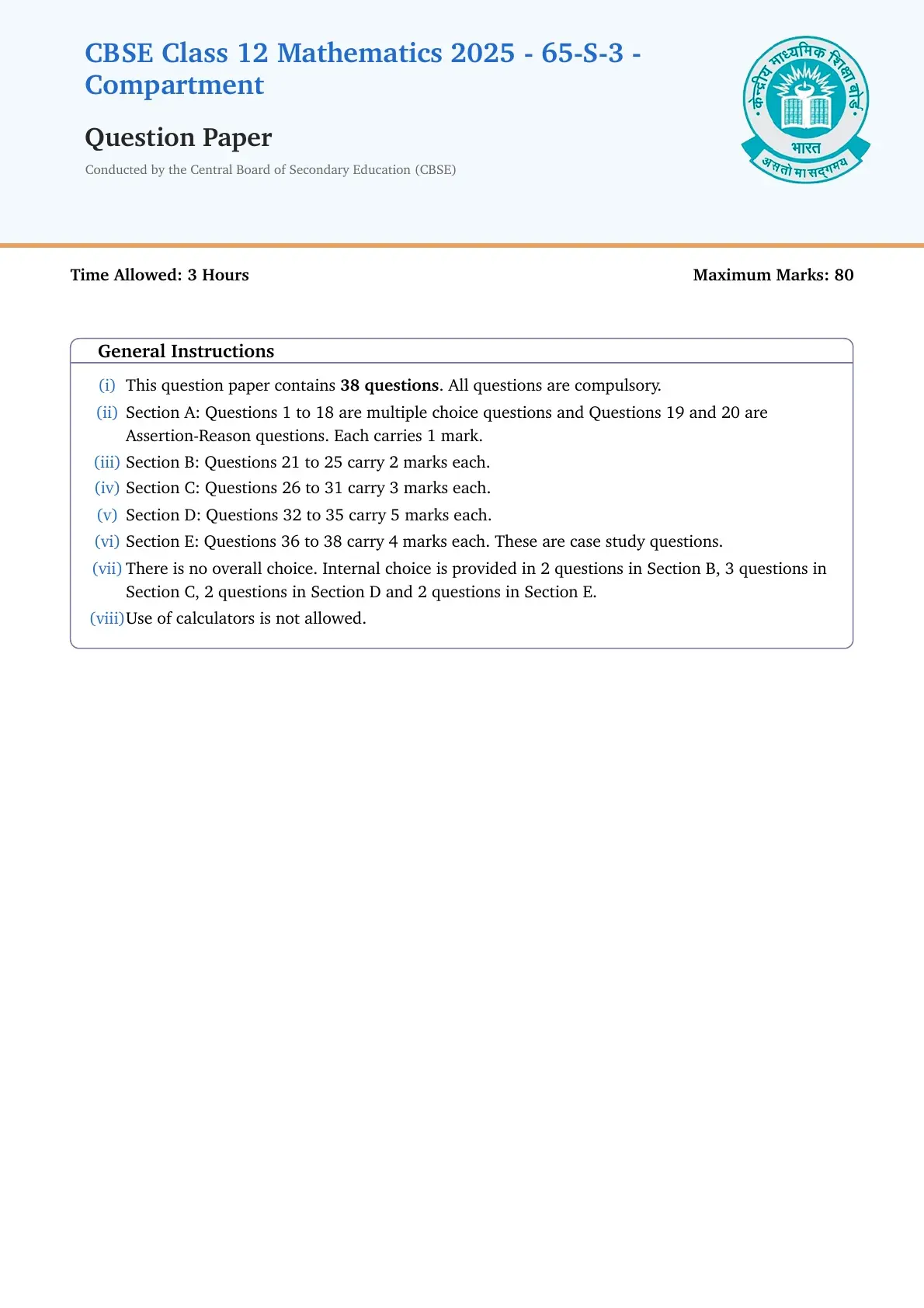
CBSE Class 12 Mathematics Question Paper 2025 Code 65/S/3 (Compartment) is available for download here. CBSE conducted the Class 12 Mathematics exam on July 15, 2025 from 10:30 AM to 1:30 PM. The Mathematics theory paper is of 80 marks.
Also Check: CBSE Class 12 Question Paper 2025 (All Subjects)
The Mathematics question paper includes the following types of questions:
- The question paper has 38 questions, all compulsory, for 80 marks in 3 hours, with 15 minutes of extra reading time
- Section A (Q1 to Q18) has 18 multiple choice questions and Q19 and Q20 are 2 assertion-reason questions, all of 1 mark each, and Section B (Q21 to Q25) has 5 very short answer questions of 2 marks each
- Section C (Q26 to Q31) has 6 short answer questions of 3 marks each, and Section D (Q32 to Q35) has 4 long answer questions of 5 marks each
- Section E (Q36 to Q38) has 3 case study based questions of 4 marks each
- There is no overall choice, but internal choice (OR) is given in 2 questions of Section B, 3 of Section C, 2 of Section D and 2 of Section E, and calculators are not allowed
CBSE Class 12 Mathematics Question Paper 2025 Code 65/S/3 (Compartment) PDF
| CBSE Official PDF | CD PDF | CD PDF with Solutions |
|---|---|---|
| Download official PDF 0.48 MB | Download Collegedunia PDF 0.26 MB | – |
CBSE Class 12 Mathematics Compartment 2025 Set 3 (65/S/3) Questions with Solutions
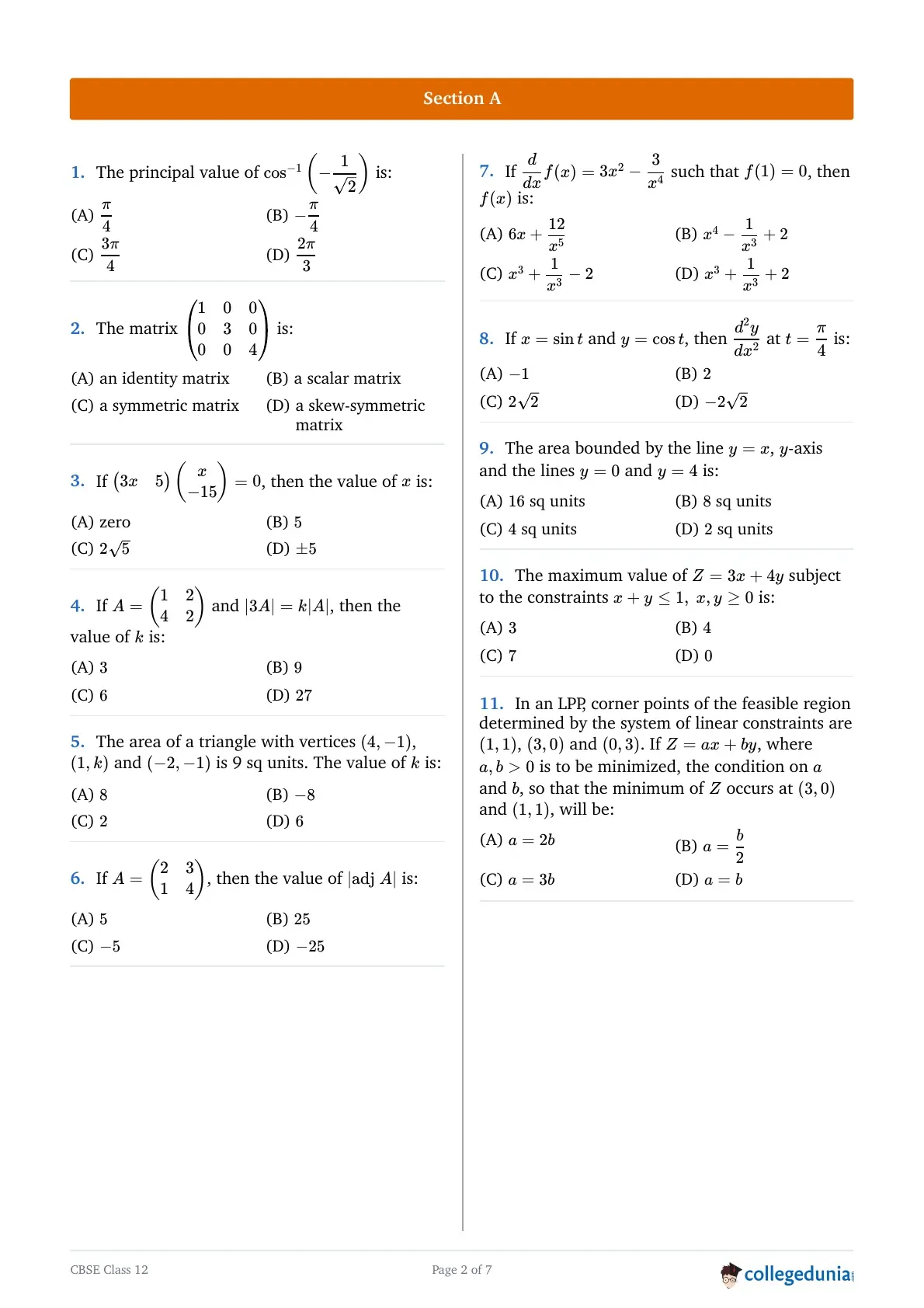
The principal value of \(\cos^{-1}\left(-\dfrac{1}{\sqrt{2}}\right)\) is:
The matrix \(\begin{pmatrix}1&0&0\\0&3&0\\0&0&4\end{pmatrix}\) is:
If \(\begin{pmatrix}3x&5\end{pmatrix}\begin{pmatrix}x\\-15\end{pmatrix}=0\), then the value of \(x\) is:
If \(A=\begin{pmatrix}1&2\\4&2\end{pmatrix}\) and \(|3A|=k|A|\), then the value of \(k\) is:
The area of a triangle with vertices \((4,-1)\), \((1,k)\) and \((-2,-1)\) is 9 sq units. The value of \(k\) is:
If \(A=\begin{pmatrix}2&3\\1&4\end{pmatrix}\), then the value of \(|\text{adj }A|\) is:
If \(\dfrac{d}{dx}f(x)=3x^{2}-\dfrac{3}{x^{4}}\) such that \(f(1)=0\), then \(f(x)\) is:
If \(x=\sin t\) and \(y=\cos t\), then \(\dfrac{d^{2}y}{dx^{2}}\) at \(t=\dfrac{\pi}{4}\) is:
The area bounded by the line \(y=x\), \(y\)-axis and the lines \(y=0\) and \(y=4\) is:
The maximum value of \(Z=3x+4y\) subject to the constraints \(x+y\le1,\ x,y\ge0\) is:
In an LPP, corner points of the feasible region determined by the system of linear constraints are \((1,1)\), \((3,0)\) and \((0,3)\). If \(Z=ax+by\), where \(a,b\gt 0\) is to be minimized, the condition on \(a\) and \(b\), so that the minimum of \(Z\) occurs at \((3,0)\) and \((1,1)\), will be:
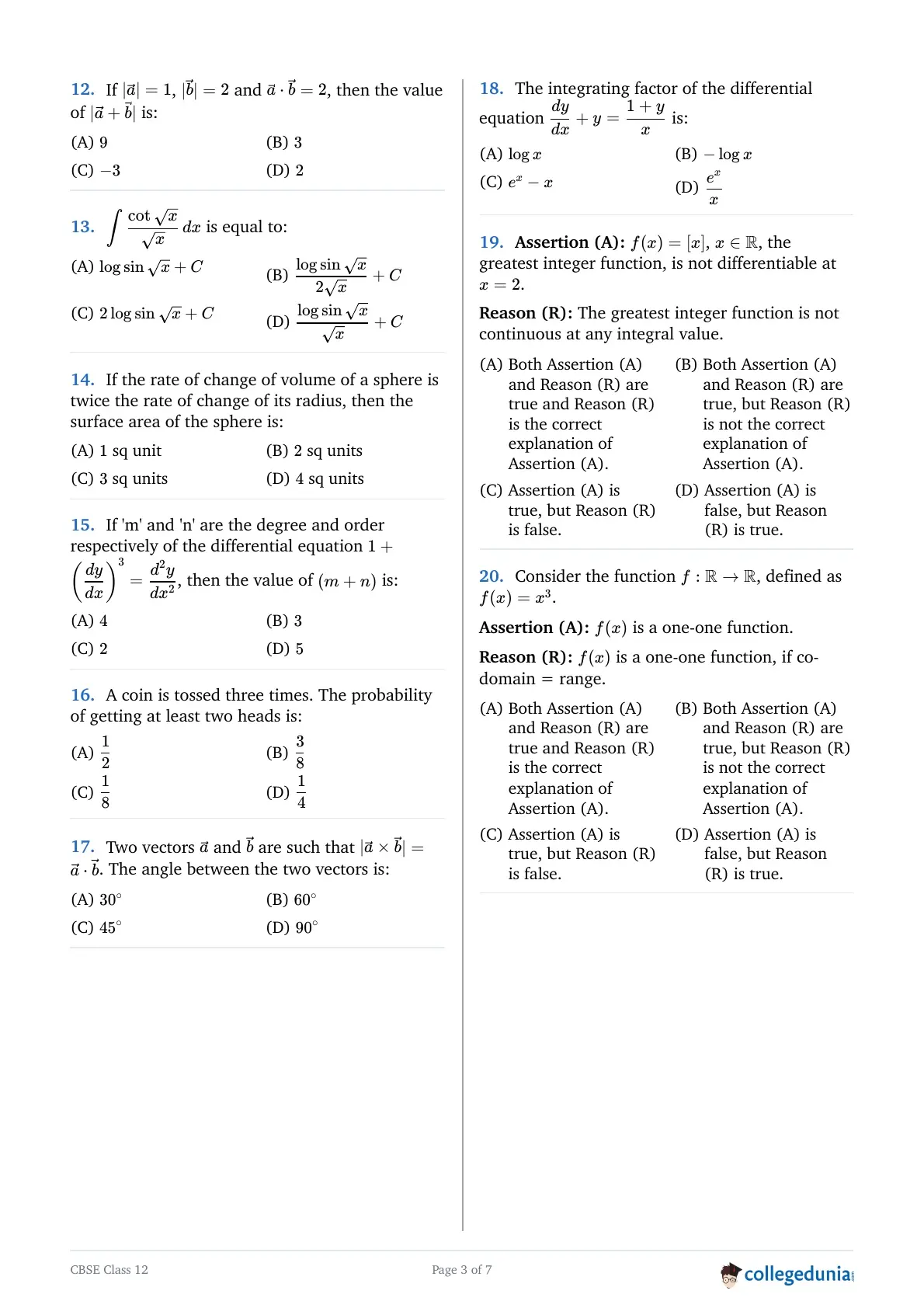
If \(|\vec{a}|=1\), \(|\vec{b}|=2\) and \(\vec{a}\cdot\vec{b}=2\), then the value of \(|\vec{a}+\vec{b}|\) is:
\(\displaystyle\int\dfrac{\cot\sqrt{x}}{\sqrt{x}}\,dx\) is equal to:
If the rate of change of volume of a sphere is twice the rate of change of its radius, then the surface area of the sphere is:
If 'm' and 'n' are the degree and order respectively of the differential equation \(1+\left(\dfrac{dy}{dx}\right)^{3}=\dfrac{d^{2}y}{dx^{2}}\), then the value of \((m+n)\) is:
A coin is tossed three times. The probability of getting at least two heads is:
Two vectors \(\vec{a}\) and \(\vec{b}\) are such that \(|\vec{a}\times\vec{b}|=\vec{a}\cdot\vec{b}\). The angle between the two vectors is:
The integrating factor of the differential equation \(\dfrac{dy}{dx}+y=\dfrac{1+y}{x}\) is:
Assertion (A): \(f(x)=[x]\), \(x\in\mathbb{R}\), the greatest integer function, is not differentiable at \(x=2\).
Reason (R): The greatest integer function is not continuous at any integral value.
Consider the function \(f:\mathbb{R}\to\mathbb{R}\), defined as \(f(x)=x^{3}\).
Assertion (A): \(f(x)\) is a one-one function.
Reason (R): \(f(x)\) is a one-one function, if co-domain = range.
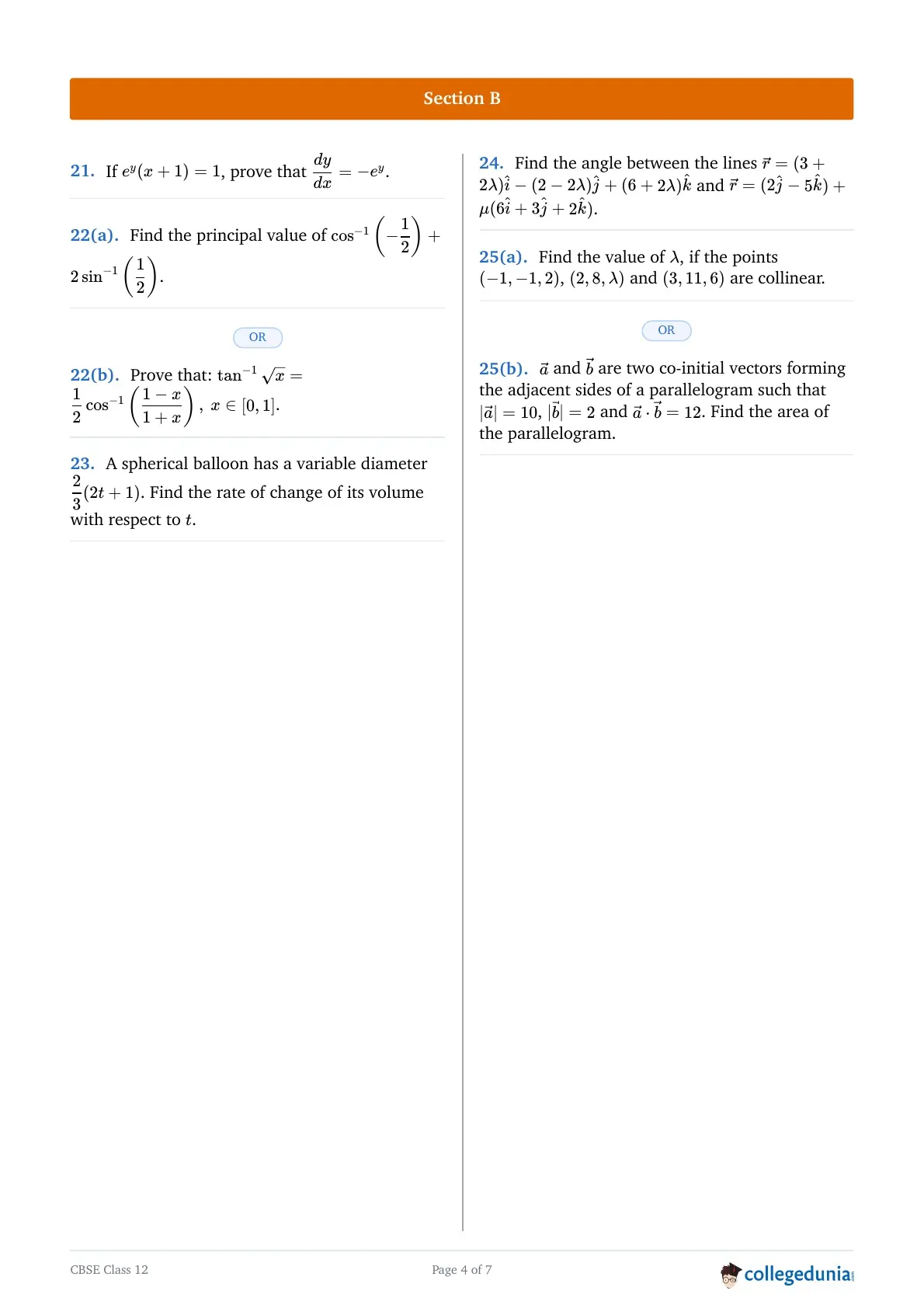
If \(e^{y}(x+1)=1\), prove that \(\dfrac{dy}{dx}=-e^{y}\).
Find the principal value of \(\cos^{-1}\left(-\dfrac{1}{2}\right)+2\sin^{-1}\left(\dfrac{1}{2}\right)\).
Prove that: \(\tan^{-1}\sqrt{x}=\dfrac{1}{2}\cos^{-1}\left(\dfrac{1-x}{1+x}\right),\ x\in[0,1]\).
A spherical balloon has a variable diameter \(\dfrac{2}{3}(2t+1)\). Find the rate of change of its volume with respect to \(t\).
Find the angle between the lines \(\vec{r}=(3+2\lambda)\hat{i}-(2-2\lambda)\hat{j}+(6+2\lambda)\hat{k}\) and \(\vec{r}=(2\hat{j}-5\hat{k})+\mu(6\hat{i}+3\hat{j}+2\hat{k})\).
Find the value of \(\lambda\), if the points \((-1,-1,2)\), \((2,8,\lambda)\) and \((3,11,6)\) are collinear.
\(\vec{a}\) and \(\vec{b}\) are two co-initial vectors forming the adjacent sides of a parallelogram such that \(|\vec{a}|=10\), \(|\vec{b}|=2\) and \(\vec{a}\cdot\vec{b}=12\). Find the area of the parallelogram.
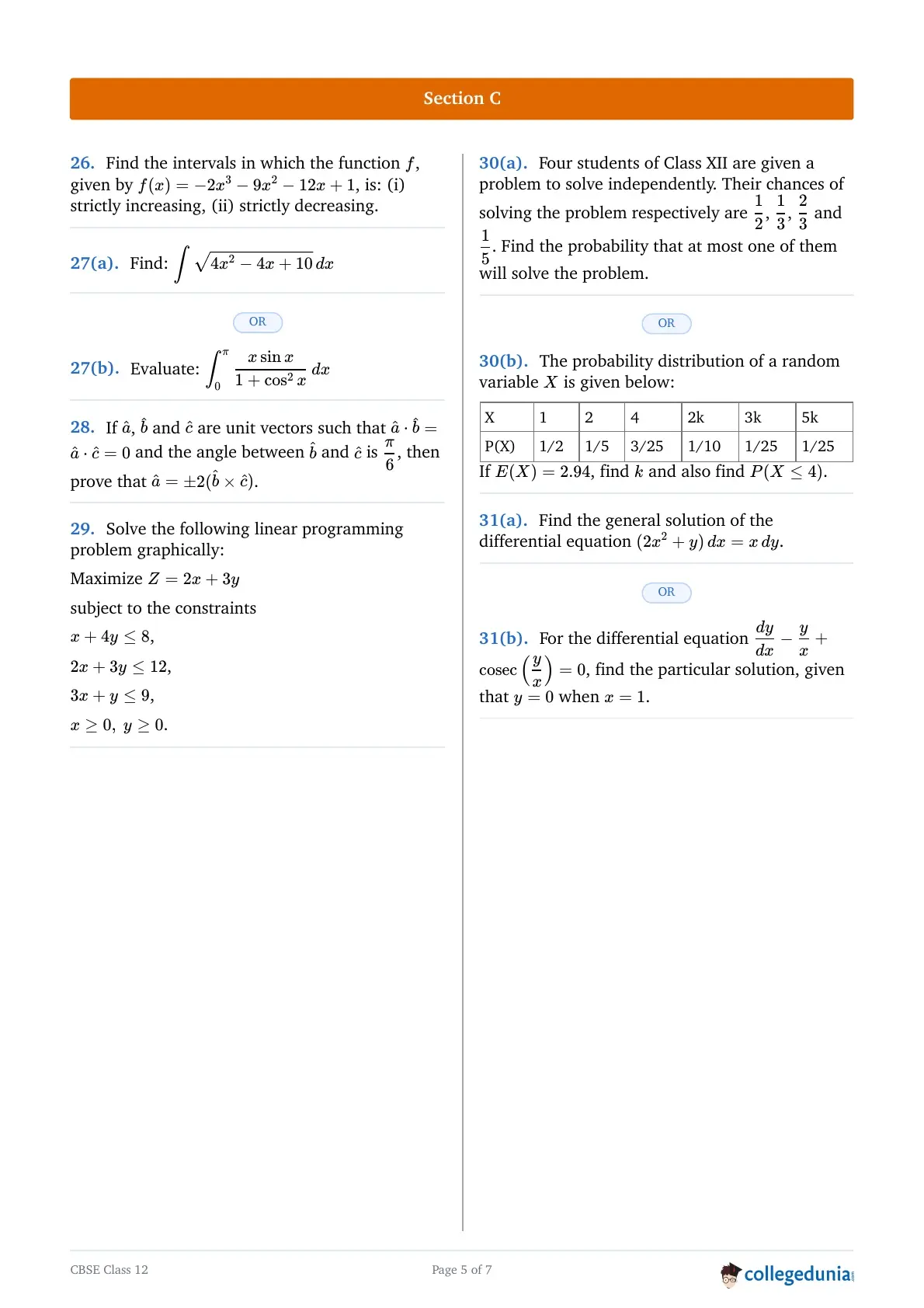
Find the intervals in which the function \(f\), given by \(f(x)=-2x^{3}-9x^{2}-12x+1\), is: (i) strictly increasing, (ii) strictly decreasing.
Find: \(\displaystyle\int\sqrt{4x^{2}-4x+10}\,dx\)
Evaluate: \(\displaystyle\int_{0}^{\pi}\dfrac{x\sin x}{1+\cos^{2}x}\,dx\)
If \(\hat{a}\), \(\hat{b}\) and \(\hat{c}\) are unit vectors such that \(\hat{a}\cdot\hat{b}=\hat{a}\cdot\hat{c}=0\) and the angle between \(\hat{b}\) and \(\hat{c}\) is \(\dfrac{\pi}{6}\), then prove that \(\hat{a}=\pm2(\hat{b}\times\hat{c})\).
Solve the following linear programming problem graphically:
Maximize \(Z=2x+3y\)
subject to the constraints
\(x+4y\le8\),
\(2x+3y\le12\),
\(3x+y\le9\),
\(x\ge0,\ y\ge0\).
Four students of Class XII are given a problem to solve independently. Their chances of solving the problem respectively are \(\dfrac{1}{2}\), \(\dfrac{1}{3}\), \(\dfrac{2}{3}\) and \(\dfrac{1}{5}\). Find the probability that at most one of them will solve the problem.
The probability distribution of a random variable \(X\) is given below:
| X | 1 | 2 | 4 | 2k | 3k | 5k |
| P(X) | 1/2 | 1/5 | 3/25 | 1/10 | 1/25 | 1/25 |
If \(E(X)=2.94\), find \(k\) and also find \(P(X\le4)\).
Find the general solution of the differential equation \((2x^{2}+y)\,dx=x\,dy\).
For the differential equation \(\dfrac{dy}{dx}-\dfrac{y}{x}+\operatorname{cosec}\left(\dfrac{y}{x}\right)=0\), find the particular solution, given that \(y=0\) when \(x=1\).
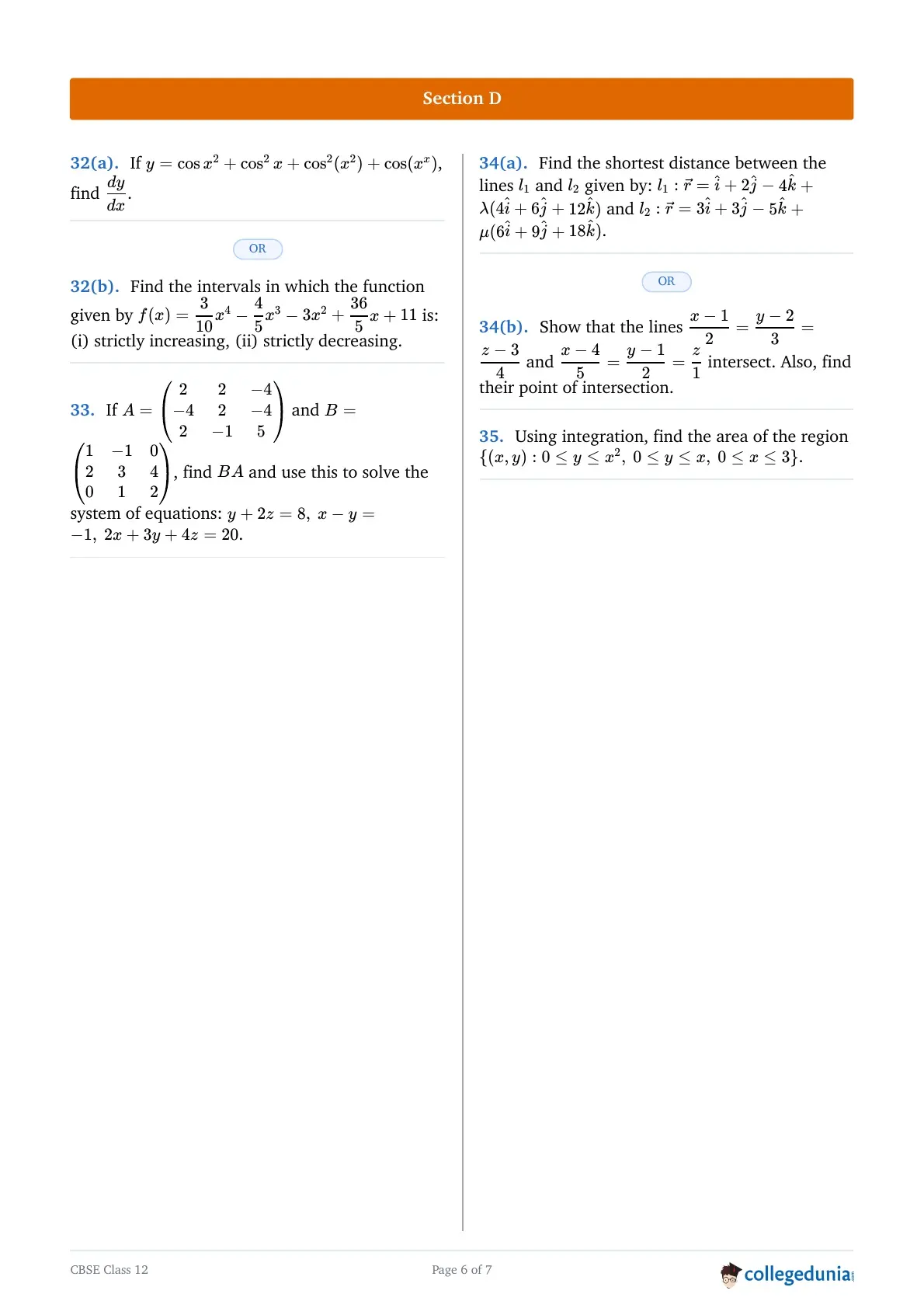
If \(y=\cos x^{2}+\cos^{2}x+\cos^{2}(x^{2})+\cos(x^{x})\), find \(\dfrac{dy}{dx}\).
Find the intervals in which the function given by \(f(x)=\dfrac{3}{10}x^{4}-\dfrac{4}{5}x^{3}-3x^{2}+\dfrac{36}{5}x+11\) is: (i) strictly increasing, (ii) strictly decreasing.
If \(A=\begin{pmatrix}2&2&-4\\-4&2&-4\\2&-1&5\end{pmatrix}\) and \(B=\begin{pmatrix}1&-1&0\\2&3&4\\0&1&2\end{pmatrix}\), find \(BA\) and use this to solve the system of equations: \(y+2z=8,\ x-y=-1,\ 2x+3y+4z=20\).
Find the shortest distance between the lines \(l_{1}\) and \(l_{2}\) given by: \(l_{1}:\vec{r}=\hat{i}+2\hat{j}-4\hat{k}+\lambda(4\hat{i}+6\hat{j}+12\hat{k})\) and \(l_{2}:\vec{r}=3\hat{i}+3\hat{j}-5\hat{k}+\mu(6\hat{i}+9\hat{j}+18\hat{k})\).
Show that the lines \(\dfrac{x-1}{2}=\dfrac{y-2}{3}=\dfrac{z-3}{4}\) and \(\dfrac{x-4}{5}=\dfrac{y-1}{2}=\dfrac{z}{1}\) intersect. Also, find their point of intersection.
Using integration, find the area of the region \(\{(x,y):0\le y\le x^{2},\ 0\le y\le x,\ 0\le x\le3\}\).
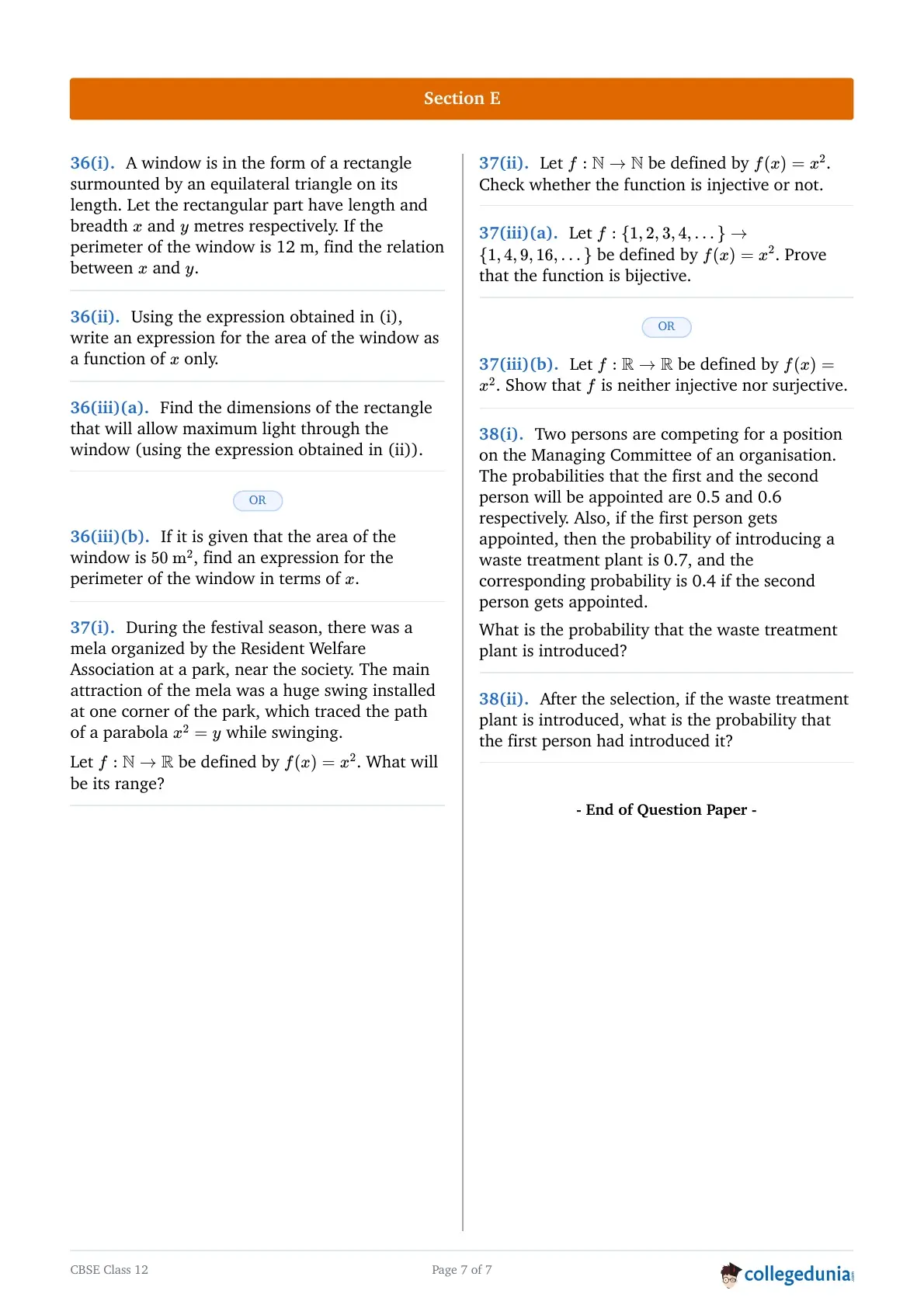
A window is in the form of a rectangle surmounted by an equilateral triangle on its length. Let the rectangular part have length and breadth \(x\) and \(y\) metres respectively. If the perimeter of the window is 12 m, find the relation between \(x\) and \(y\).
Using the expression obtained in (i), write an expression for the area of the window as a function of \(x\) only.
Find the dimensions of the rectangle that will allow maximum light through the window (using the expression obtained in (ii)).
If it is given that the area of the window is \(50\text{ m}^{2}\), find an expression for the perimeter of the window in terms of \(x\).
During the festival season, there was a mela organized by the Resident Welfare Association at a park, near the society. The main attraction of the mela was a huge swing installed at one corner of the park, which traced the path of a parabola \(x^{2}=y\) while swinging.
Let \(f:\mathbb{N}\to\mathbb{R}\) be defined by \(f(x)=x^{2}\). What will be its range?
Let \(f:\mathbb{N}\to\mathbb{N}\) be defined by \(f(x)=x^{2}\). Check whether the function is injective or not.
Let \(f:\{1,2,3,4,\dots\}\to\{1,4,9,16,\dots\}\) be defined by \(f(x)=x^{2}\). Prove that the function is bijective.
Let \(f:\mathbb{R}\to\mathbb{R}\) be defined by \(f(x)=x^{2}\). Show that \(f\) is neither injective nor surjective.
Two persons are competing for a position on the Managing Committee of an organisation. The probabilities that the first and the second person will be appointed are 0.5 and 0.6 respectively. Also, if the first person gets appointed, then the probability of introducing a waste treatment plant is 0.7, and the corresponding probability is 0.4 if the second person gets appointed.
What is the probability that the waste treatment plant is introduced?
After the selection, if the waste treatment plant is introduced, what is the probability that the first person had introduced it?
CBSE Class 12 Mathematics 2025 Question Paper Details
| Exam | CBSE Class 12 Board Examination 2025 |
| Subject | Mathematics |
| Paper code | 65/S/3 (Compartment) |
| Exam date | July 15, 2025 |
| Time allowed | 3 hours (plus 15 minutes of reading time, 10:15 AM to 10:30 AM) |
| Maximum marks | 80 |
| Total questions | 38 (attempt 38) |
CBSE Class 12 Mathematics Question Paper Pattern and Marking Scheme
The CBSE Class 12 Mathematics 2025 question paper is of 80 marks and has 38 questions, of which 38 are to be attempted. The tables below give the section-wise paper pattern and the split of marks, as printed in the official question paper.
CBSE Class 12 Mathematics Question Paper Pattern 2025
| Section | Questions | Question Type | Choice | Marks per Question | Marks |
|---|---|---|---|---|---|
| Section A | Q1-Q18 | Multiple choice questions (MCQs) | All 18 | 1 | 18 |
| Q19-Q20 | Assertion-Reason based questions | All 2 | 1 | 2 | |
| Section B | Q21-Q25 | Very short answer (VSA) questions | All 5 | 2 | 10 |
| Section C | Q26-Q31 | Short answer (SA) questions | All 6 | 3 | 18 |
| Section D | Q32-Q35 | Long answer (LA) questions | All 4 | 5 | 20 |
| Section E | Q36-Q38 | Case study based questions | All 3 | 4 | 12 |
| Total | 38 questions | Attempt 38 | 80 |
CBSE Class 12 Mathematics Marks Distribution 2025
| Question Type | Questions to Attempt | Marks per Question | Total Marks |
|---|---|---|---|
| Multiple choice questions (MCQs) (Section A) | 18 | 1 | 18 |
| Assertion-Reason based questions (Section A) | 2 | 1 | 2 |
| Very short answer (VSA) questions (Section B) | 5 | 2 | 10 |
| Short answer (SA) questions (Section C) | 6 | 3 | 18 |
| Long answer (LA) questions (Section D) | 4 | 5 | 20 |
| Case study based questions (Section E) | 3 | 4 | 12 |
| Total | 38 | 80 |



Comments