




The CBSE Class 12th Board Mathematics exam was conducted on 8th March 2025 from 10:30 AM to 1:30 PM.
Also Check: CBSE Class 12 Question Paper 2025 (All Subjects)
The Mathematics question paper includes the following types of questions:
- The question paper has 38 questions, all compulsory, for 80 marks in 3 hours, with 15 minutes of extra reading time
- Section A (Q1 to Q18) has 18 multiple choice questions and Q19 and Q20 are 2 assertion-reason questions, all of 1 mark each, and Section B (Q21 to Q25) has 5 very short answer questions of 2 marks each
- Section C (Q26 to Q31) has 6 short answer questions of 3 marks each, and Section D (Q32 to Q35) has 4 long answer questions of 5 marks each
- Section E (Q36 to Q38) has 3 case study based questions of 4 marks each
- There is no overall choice, but internal choice (OR) is given in 2 questions of Section B, 3 of Section C, 2 of Section D and 2 of Section E, and calculators are not allowed
CBSE Class 12 Mathematics Question Paper (65/2/1) with Solution PDF
| CBSE Official PDF | CD PDF | CD PDF with Solutions |
|---|---|---|
| Download official PDF 4.49 MB | Download Collegedunia PDF 0.49 MB | Download solutions PDF 0.72 MB |
CBSE Class 12 Mathematics 2025 Set 1 (65/2/1) Questions with Solutions
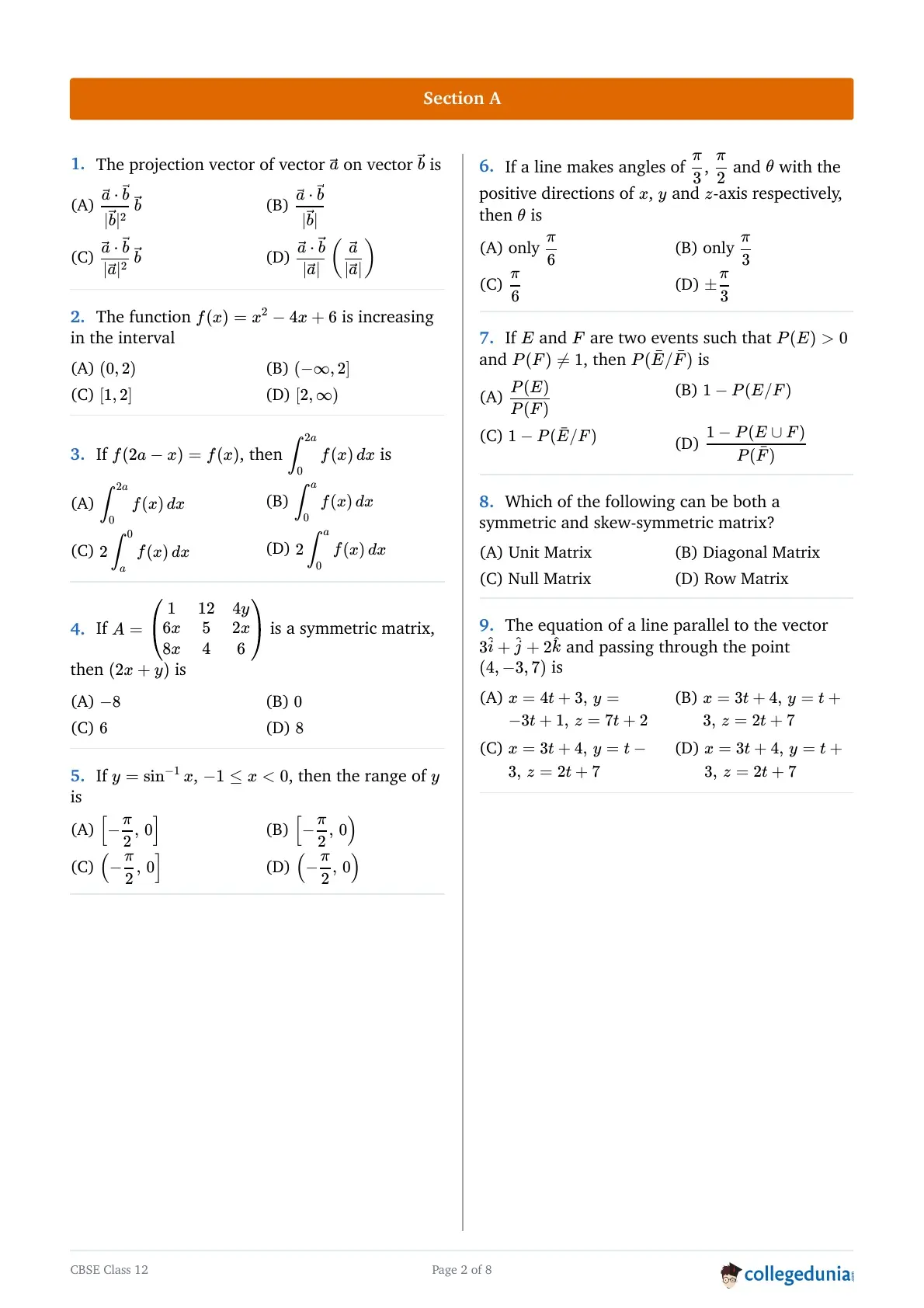
The projection vector of vector \(\vec{a}\) on vector \(\vec{b}\) is
The function \( f(x) = x^2 - 4x + 6 \) is increasing in the interval:
If \(f(2a-x)=f(x)\), then \(\displaystyle\int_{0}^{2a} f(x)\,dx\) is
If the matrix
\[
\begin{bmatrix}
1 & 12 & 4y \\
6x & 5 & 2x \\
8x & 4 & 6
\end{bmatrix}
\]
is a symmetric matrix, then the value of \( 2x + y \) is:
If \(y=\sin^{-1}x,\ -1\le x\le 0\), then the range of \(y\) is
If a line makes angles of \(\dfrac{3\pi}{4},\ \dfrac{\pi}{3}\) and \(\theta\) with the positive directions of \(x\), \(y\) and \(z\)-axis respectively, then \(\theta\) is
If \(E\) and \(F\) are two events such that \(P(E)>0\) and \(P(F)\neq 1\), then \(P(\overline{E}/\overline{F})\) is
Which of the following can be both a symmetric and skew-symmetric matrix?
The equation of a line parallel to the vector \( 3 \hat{i} + \hat{j} + 2 \hat{k} \) and passing through the point \( (4, -3, 7) \) is:
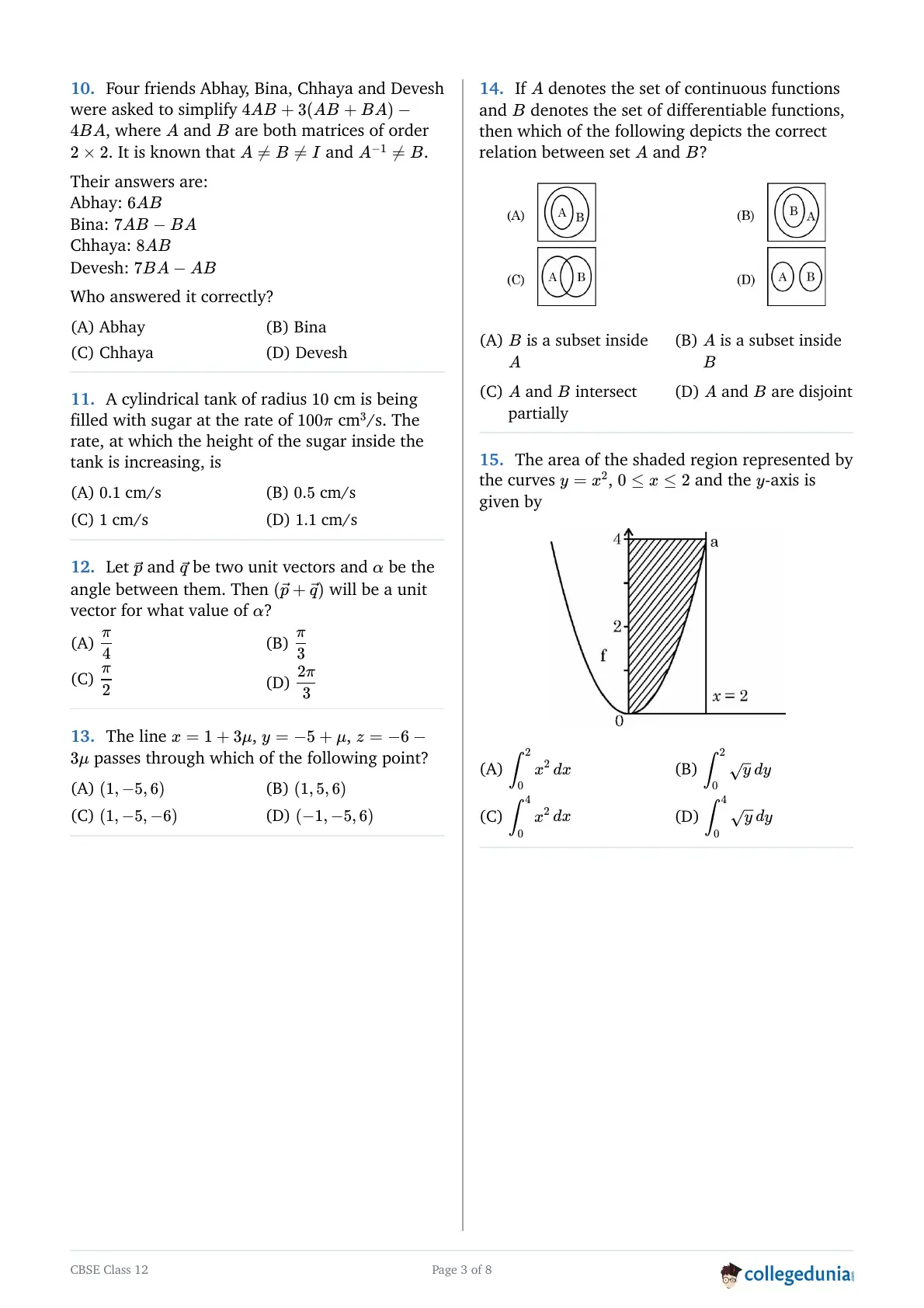
Four friends Abhay, Bina, Chhaya, and Devesh were asked to simplify \( 4 AB + 3(AB + BA) - 4 BA \), where \( A \) and \( B \) are both matrices of order \( 2 \times 2 \). It is known that \( A \neq B \) and \( A^{-1} \neq B \). Their answers are given as:
A cylindrical tank of radius 10 cm is being filled with sugar at the rate of 100π cm3/s. The rate at which the height of the sugar inside the tank is increasing is:
Let \( \vec{p} \) and \( \vec{q} \) be two unit vectors and \( \alpha \) be the angle between them. Then \( (\vec{p} + \vec{q}) \) will be a unit vector for what value of \( \alpha \)?
The line \( x = 1 + 5\mu, y = -5 + \mu, z = -6 - 3\mu \) passes through which of the following points?
If \( A \) denotes the set of continuous functions and \( B \) denotes the set of differentiable functions, then which of the following depicts the correct relation between set \( A \) and \( B \)?
- (A)
![set of continuous functions]()
- (B)
![set of continuous functions]()
- (C)
![set of continuous functions]()
- (D)
![set of continuous functions]()


The area of the shaded region (figure) represented by the curves \( y = x^2 \), \( 0 \leq x \leq 2 \), and the y-axis is given by:

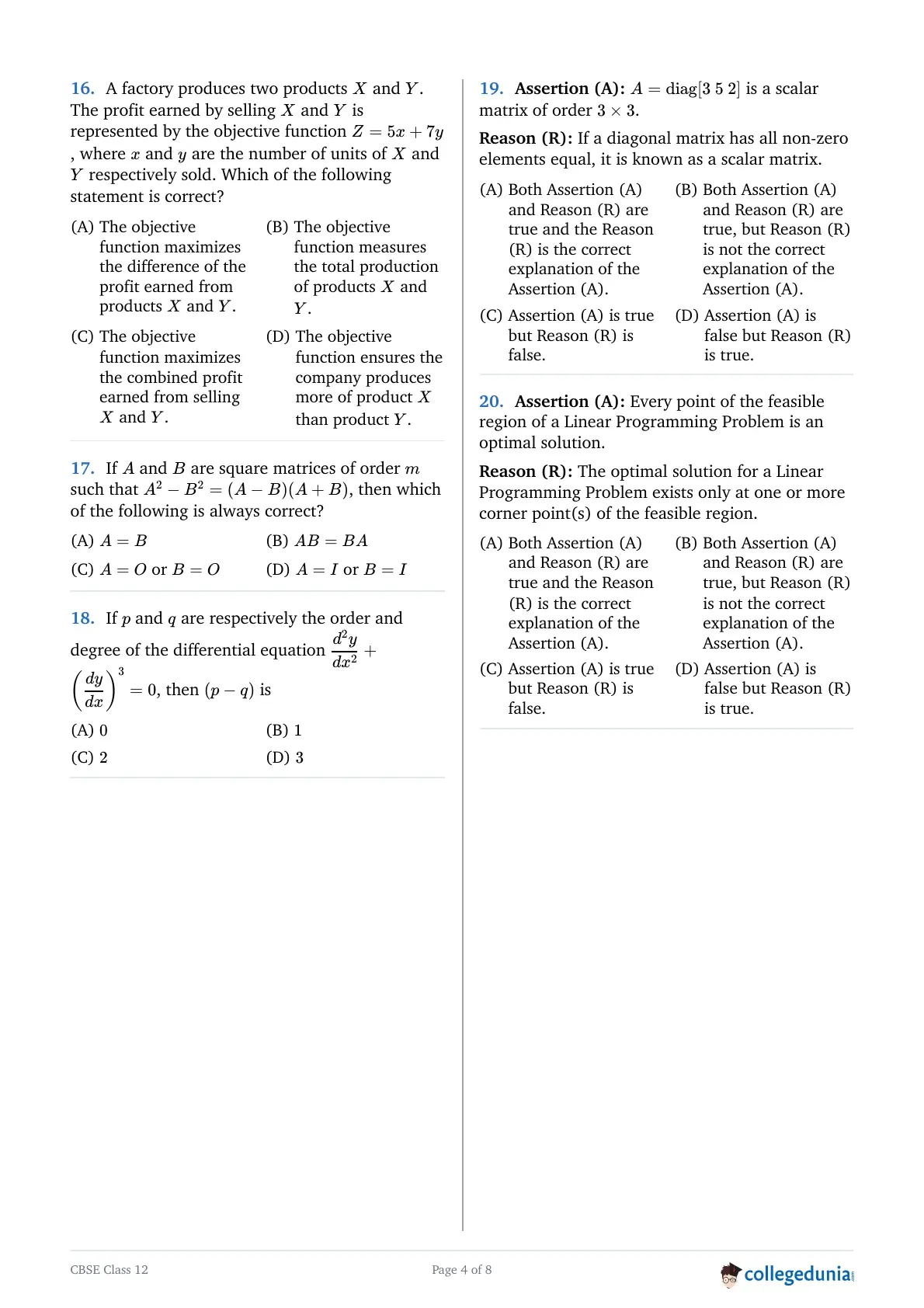
A factory produces two products X and Y. The profit earned by selling X and Y is represented by the objective function \( Z = 5x + 7y \), where \( x \) and \( y \) are the number of units of X and Y respectively sold. Which of the following statements is correct?
If \( A \) and \( B \) are square matrices of order \( m \) such that \( A^2 - B^2 = (A - B)(A + B) \), then which of the following is always correct?
If \( p \) and \( q \) are respectively the order and degree of the differential equation \( \frac{d}{dx} \left( \frac{dy}{dx} \right)^3 = 0 \), then \( (p - q) \) is:
Assertion (A): \( A = \text{diag} [3, 5, 2] \) is a scalar matrix of order \( 3 \times 3 \).
Reason (R): If a diagonal matrix has all non-zero elements equal, it is known as a scalar matrix.
Assertion (A): Every point of the feasible region of a Linear Programming Problem is an optimal solution.
Reason (R): The optimal solution for a Linear Programming Problem exists only at one or more corner point(s) of the feasible region.
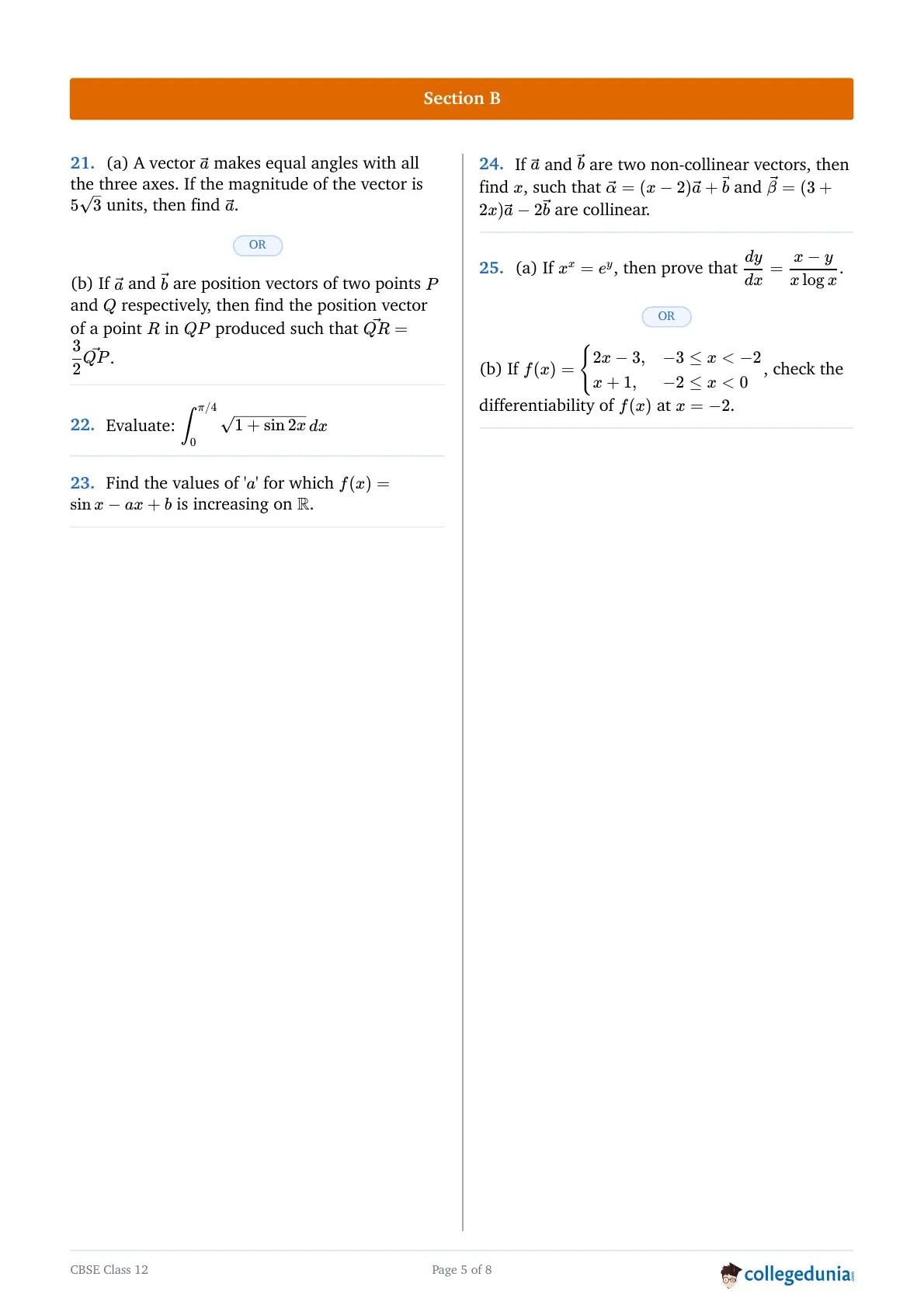
A vector \( \mathbf{a} \) makes equal angles with all the three axes. If the magnitude of the vector is \( 5\sqrt{3} \) units, then find \( \mathbf{a} \).
If \( \mathbf{a} \) and \( \mathbf{b} \) are position vectors of two points \( P \) and \( Q \) respectively, then find the position vector of a point \( R \) in \( QP \) produced such that \[ QR = \frac{3}{2} QP. \]
Evaluate: \(\displaystyle\int_{0}^{\pi/4}\sqrt{1+\sin 2x}\;dx\)
Find the values of \( a \) for which \( f(x) = \sin x - ax + b \) is increasing on \( \mathbb{R} \).
If \(\vec{a}\) and \(\vec{b}\) are two non-collinear vectors, then find \(x\), such that \(\vec{\alpha}=(x-2)\vec{a}+\vec{b}\) and \(\vec{\beta}=(3+2x)\vec{a}-2\vec{b}\) are collinear.
If \( x = e^{\frac{x}{y}} \), then prove that \( \frac{dy}{dx} = \frac{x - y}{x \log x} \).
If \( f(x) = \begin{cases} 2x - 3, & -3 \leq x \leq -2 \\x + 1, & -2<x \leq 0 \end{cases} \), check the differentiability of \( f(x) \) at \( x = -2 \).
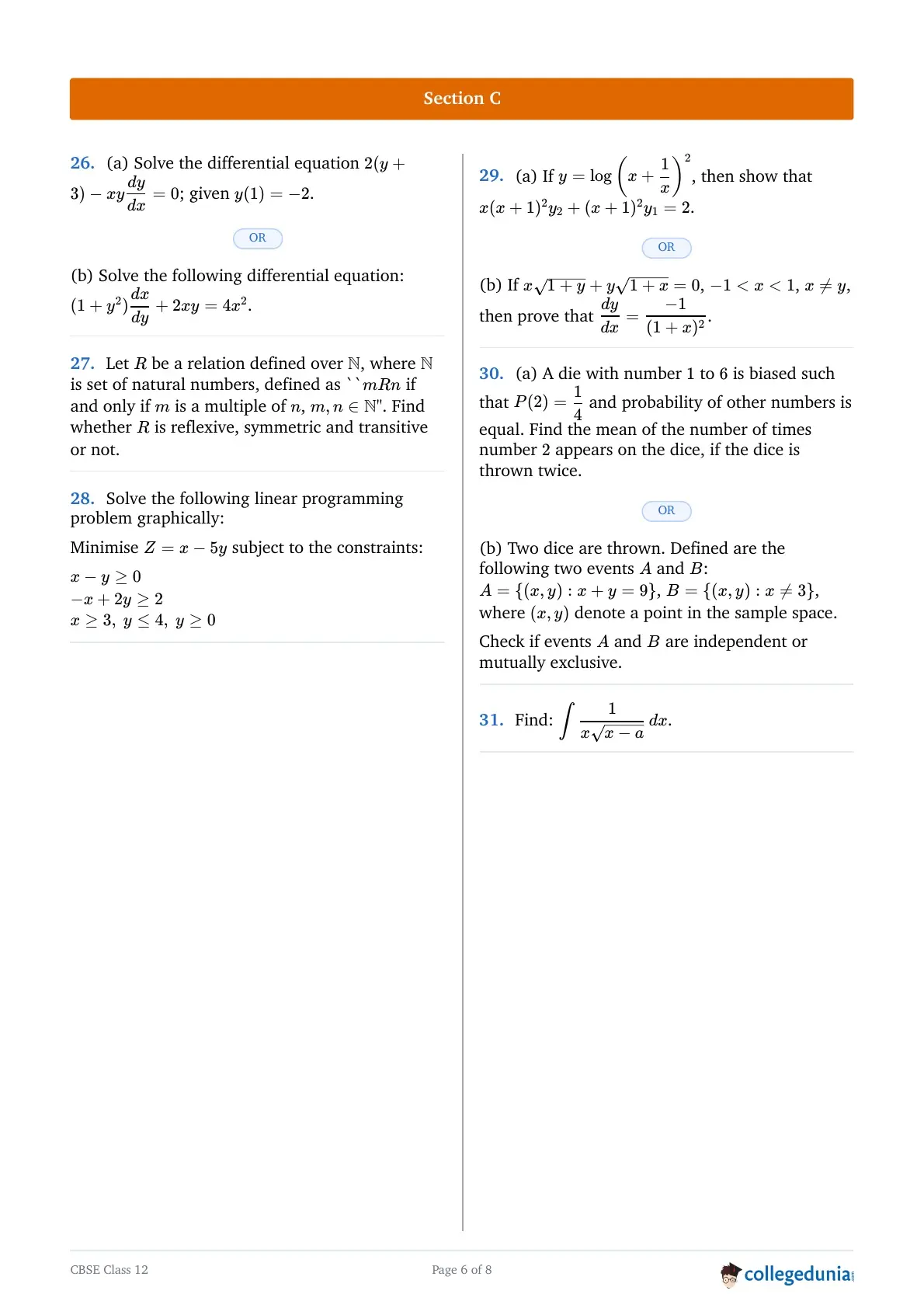
Solve the differential equation \( 2(y + 3) - xy \frac{dy}{dx} = 0 \); given \( y(1) = -2 \).
Solve the differential equation: \[ (1 + x^2) \frac{dy}{dx} + 2xy = 4x^2. \]
Let R be a relation defined over \(\mathbb{N}\), where \(\mathbb{N}\) is the set of natural numbers, defined as "mRn if and only if m is a multiple of n, \(m, n \in \mathbb{N}\)." Find whether R is reflexive, symmetric and transitive or not.
Solve the following linear programming problem graphically :
Minimise \(Z = x - 5y\)
subject to the constraints :
\(x - y \geq 0\)
\(-x + 2y \geq 2\)
\(x \geq 3, \; y \leq 4, \; y \geq 0\)
If \( y = \log \left( \sqrt{x} + \frac{1}{\sqrt{x}} \right)^2 \), then show that \( x(x + 1)^2 y_2 + (x + 1)^2 y_1 = 2 \).
If \( x\sqrt{1+y} + y\sqrt{1+x} = 0 \), for \( -1<x<1, x \neq y \), then prove that \[ \frac{dy}{dx} = \frac{-1}{(1 + x)^2}. \]
A die with numbers 1 to 6 is biased such that \( P(2) = \frac{3}{10} \) and the probability of other numbers is equal. Find the mean of the number of times number 2 appears on the die, if the die is thrown twice.
Two dice are thrown. Defined are the following two events A and B: \[ A = \{(x, y) : x + y = 9\}, \quad B = \{(x, y) : x \neq 3\}, \] where \( (x, y) \) denote a point in the sample space. Check if events \( A \) and \( B \) are independent or mutually exclusive.
Find : \(\displaystyle \int \frac{1}{x} \sqrt{\frac{x+a}{x-a}} \, dx\).
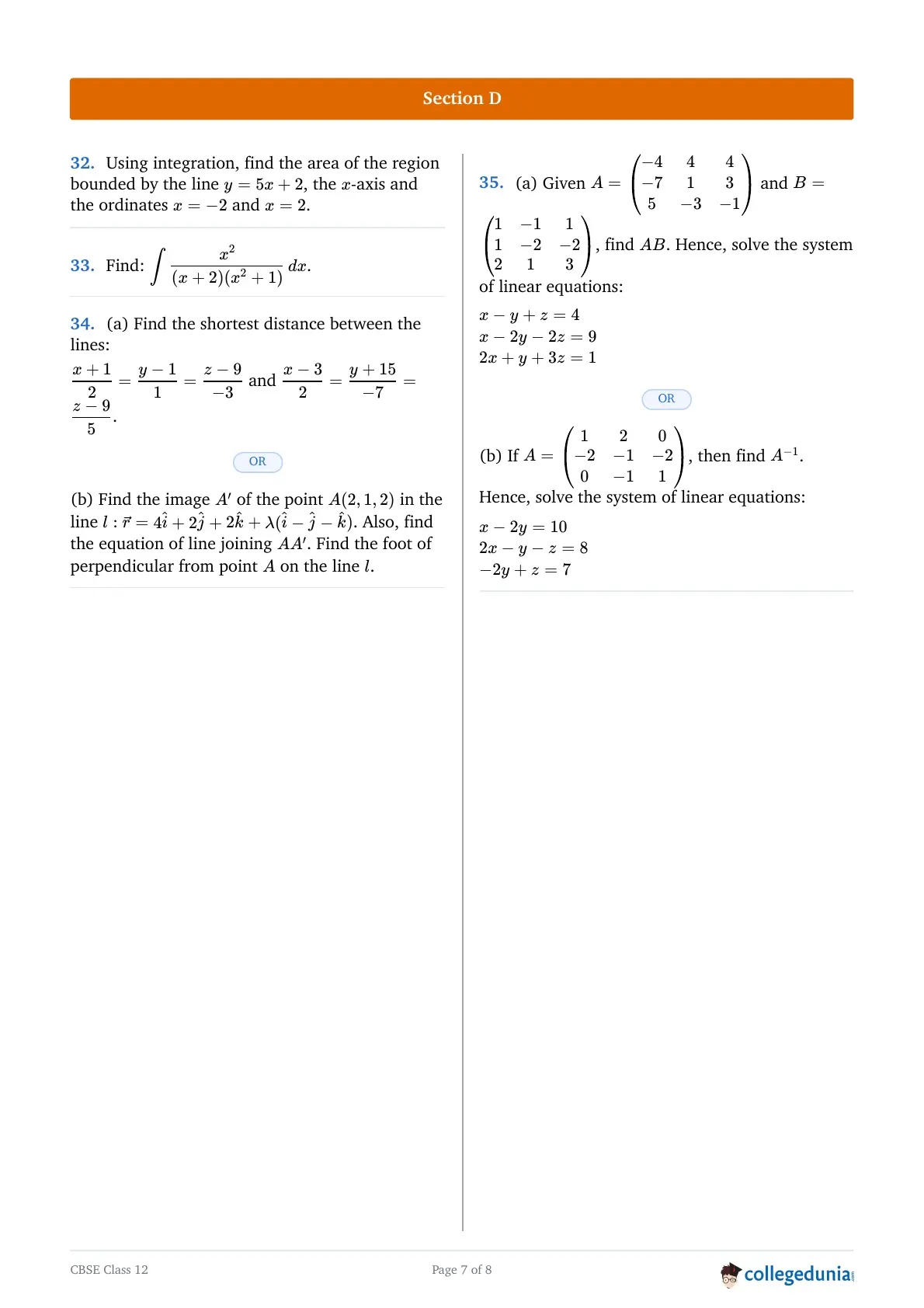
Using integration, find the area of the region bounded by the line \[ y = 5x + 2, \] the \( x \)-axis, and the ordinates \( x = -2 \) and \( x = 2 \).
Find : \(\displaystyle \int \frac{x^2+x+1}{(x+2)(x^2+1)} \, dx\).
Find the shortest distance between the lines: \[ \frac{x+1}{2} = \frac{y-1}{1} = \frac{z-9}{-3} \] and \[ \frac{x-3}{2} = \frac{y+15}{-7} = \frac{z-9}{5}. \]
Find the image \( A' \) of the point \( A(2,1,2) \) in the line \[ l: \mathbf{r} = 4\hat{i} + 2\hat{j} + 2\hat{k} + \lambda (\hat{i} - \hat{j} - \hat{k}). \] Also, find the equation of the line joining \( A A' \). Find the foot of the perpendicular from point \( A \) on the line \( l \).
Given \[ A = \begin{bmatrix} -4 & 4 & 4 \\ -7 & 1 & 3 \\ 5 & -3 & -1 \end{bmatrix}, \quad B = \begin{bmatrix} 1 & -1 & 1 \\ 1 & -2 & -2 \\ 2 & 1 & 3 \end{bmatrix} \] find \( AB \). Hence, solve the system of linear equations: \[ x - y + z = 4, \] \[ x - 2y - 2z = 9, \] \[ 2x + y + 3z = 1. \]
If \[ A = \begin{bmatrix} 1 & 2 & 0 \\ -2 & -1 & -2 \\ 0 & -1 & 1 \end{bmatrix} \] then find \( A^{-1} \). Hence, solve the system of linear equations: \[ x - 2y = 10, \] \[ 2x - y - z = 8, \] \[ -2y + z = 7. \]
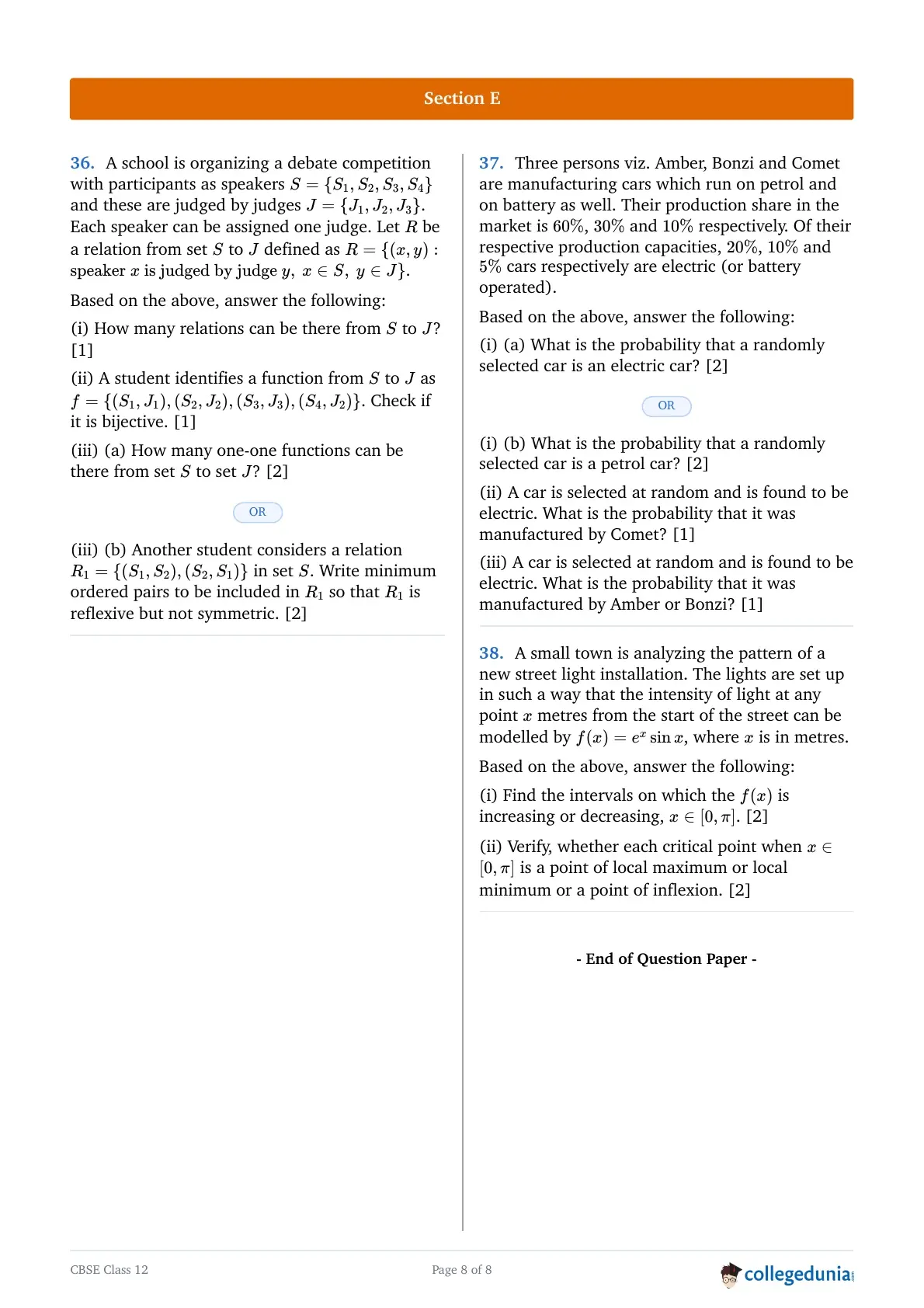
A school is organizing a debate competition with participants as speakers \(S=\{S_1,S_2,S_3,S_4\}\) and these are judged by judges \(J=\{J_1,J_2,J_3\}\). Each speaker can be assigned one judge. Let \(R\) be a relation from set \(S\) to \(J\) defined as \(R=\{(x,y): \text{speaker } x \text{ is judged by judge } y,\ x\in S,\ y\in J\}\).
Based on the above, answer the following:
How many relations can be there from \(S\) to \(J\)?
A school is organizing a debate competition with participants as speakers \(S = \{S_1, S_2, S_3, S_4\}\) and these are judged by judges \(J = \{J_1, J_2, J_3\}\). Each speaker can be assigned one judge. Let R be a relation from set S to J defined as \(R = \{(x, y) : \text{speaker } x \text{ is judged by judge } y, \; x \in S, \; y \in J\}\).
Based on the above, answer the following :
A student identifies a function from S to J as \(f = \{(S_1, J_1), (S_2, J_2), (S_3, J_2), (S_4, J_3)\}\). Check if it is bijective.
How many one-one functions can be there from set \(S\) to set \(J\)?
A school is organizing a debate competition with participants as speakers \(S = \{S_1, S_2, S_3, S_4\}\) and these are judged by judges \(J = \{J_1, J_2, J_3\}\). Each speaker can be assigned one judge. Let R be a relation from set S to J defined as \(R = \{(x, y) : \text{speaker } x \text{ is judged by judge } y, \; x \in S, \; y \in J\}\).
Based on the above, answer the following :
Another student considers a relation \(R_1 = \{(S_1, S_2), (S_2, S_4)\}\) in set S. Write minimum ordered pairs to be included in \(R_1\) so that \(R_1\) is reflexive but not symmetric.
Three persons viz. Amber, Bonzi and Comet are manufacturing cars which run on petrol and on battery as well. Their production share in the market is \(60\%\), \(30\%\) and \(10\%\) respectively. Of their respective production capacities, \(20\%\), \(10\%\) and \(5\%\) cars respectively are electric (or battery operated).
Based on the above, answer the following:
What is the probability that a randomly selected car is an electric car?
What is the probability that a randomly selected car is a petrol car?
A car is selected at random and is found to be electric. What is the probability that it was manufactured by Comet?
A car is selected at random and is found to be electric. What is the probability that it was manufactured by Amber or Bonzi?
A small town is analyzing the pattern of a new street light installation. The lights are set up in such a way that the intensity of light at any point \(x\) metres from the start of the street can be modelled by \(f(x)=e^x \sin x\), where \(x\) is in metres.
Based on the above, answer the following:
Find the intervals on which the \(f(x)\) is increasing or decreasing, \(x\in[0,\pi]\).
Verify, whether each critical point when \(x\in[0,\pi]\) is a point of local maximum or local minimum or a point of inflexion.
CBSE Class 12 Mathematics 2025 Question Paper Details
| Exam | CBSE Class 12 Board Examination 2025 |
| Subject | Mathematics |
| Paper code | 65/2/1 |
| Exam date | March 8, 2025 |
| Time allowed | 3 hours (plus 15 minutes of reading time, 10:15 AM to 10:30 AM) |
| Maximum marks | 80 |
| Total questions | 38 (attempt 38) |
CBSE Class 12 Mathematics Question Paper Pattern and Marking Scheme
The CBSE Class 12 Mathematics 2025 question paper is of 80 marks and has 38 questions, of which 38 are to be attempted. The tables below give the section-wise paper pattern and the split of marks, as printed in the official question paper.
CBSE Class 12 Mathematics Question Paper Pattern 2025
| Section | Questions | Question Type | Choice | Marks per Question | Marks |
|---|---|---|---|---|---|
| Section A | Q1-Q18 | Multiple choice questions (MCQs) | All 18 | 1 | 18 |
| Q19-Q20 | Assertion-Reason based questions | All 2 | 1 | 2 | |
| Section B | Q21-Q25 | Very short answer (VSA) questions | All 5 | 2 | 10 |
| Section C | Q26-Q31 | Short answer (SA) questions | All 6 | 3 | 18 |
| Section D | Q32-Q35 | Long answer (LA) questions | All 4 | 5 | 20 |
| Section E | Q36-Q38 | Case study based questions | All 3 | 4 | 12 |
| Total | 38 questions | Attempt 38 | 80 |
CBSE Class 12 Mathematics Marks Distribution 2025
| Question Type | Questions to Attempt | Marks per Question | Total Marks |
|---|---|---|---|
| Multiple choice questions (MCQs) (Section A) | 18 | 1 | 18 |
| Assertion-Reason based questions (Section A) | 2 | 1 | 2 |
| Very short answer (VSA) questions (Section B) | 5 | 2 | 10 |
| Short answer (SA) questions (Section C) | 6 | 3 | 18 |
| Long answer (LA) questions (Section D) | 4 | 5 | 20 |
| Case study based questions (Section E) | 3 | 4 | 12 |
| Total | 38 | 80 |



Comments