




CBSE Class 12 Political Science Question Paper 2025 Code 59/2/1 is available for download here. CBSE conducted the Class 12 Political Science exam on March 22, 2025 from 10:30 AM to 1:30 PM. The Political Science theory paper is of 80 marks.
Also Check: CBSE Class 12 Question Paper 2025 (All Subjects)
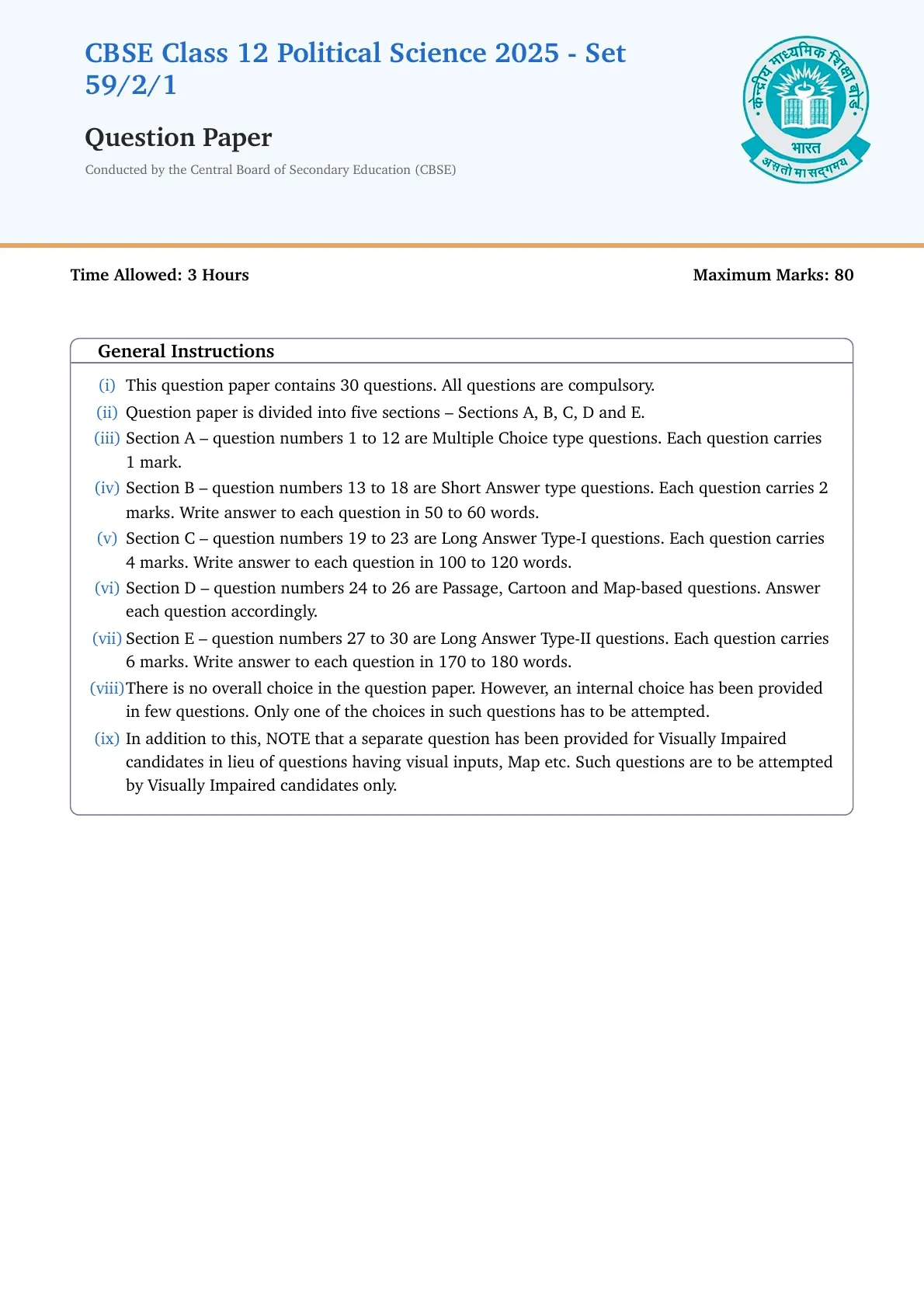
The Political Science question paper includes the following types of questions:
- The question paper has 30 questions, all compulsory, for 80 marks in 3 hours, with 15 minutes of extra reading time
- Section A (Q1 to Q12) has 12 multiple choice questions of 1 mark each (12 marks)
- Section B (Q13 to Q18) has 6 short answer questions of 2 marks each, to be answered in 50 to 60 words (12 marks)
- Section C (Q19 to Q23) has 5 long answer type-I questions of 4 marks each, to be answered in 100 to 120 words (20 marks)
- Section D (Q24 to Q26) has 3 passage, cartoon/picture and map-based questions of 4 marks each (12 marks)
- Section E (Q27 to Q30) has 4 long answer type-II questions of 6 marks each, to be answered in 170 to 180 words (24 marks)
- There is no overall choice, but internal choice (OR) is given in some questions of Sections C and E
CBSE Class 12 Political Science Question Paper 2025 Code 59/2/1 PDF
| CBSE Official PDF | CD PDF | CD PDF with Solutions |
|---|---|---|
| Download official PDF 3.78 MB | Download Collegedunia PDF 1.36 MB | – |
CBSE Class 12 Political Science 2025 Set 59/2/1 Questions with Solutions
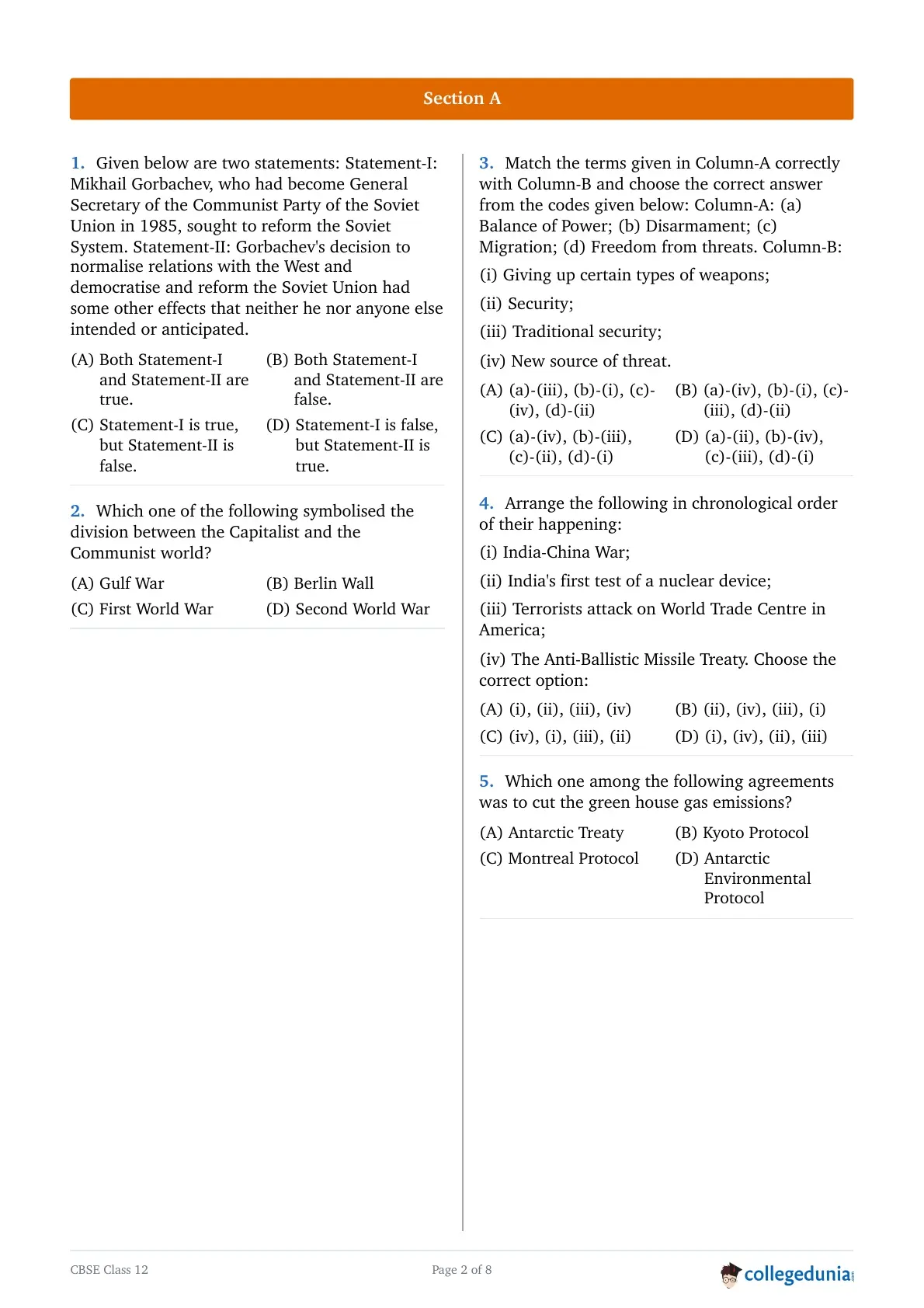
Given below are two statements :
Statement-I : Mikhail Gorbachev, who had become General Secretary of the Communist Party of the Soviet Union in 1985, sought to reform the Soviet System.
Statement-II : Gorbachev's decision to normalise relations with the West and democratise and reform the Soviet Union had some other effects that neither he nor anyone else intended or anticipated.
Option :
Which one of the following symbolised the division between the Capitalist and the Communist world ?
Match the terms given in Column-A correctly with Column-B and choose the correct answer from the codes given below :
| Column-A | Column-B | ||
| (a) | Balance of Power | (i) | Giving up certain types of weapons |
| (b) | Disarmament | (ii) | Security |
| (c) | Migration | (iii) | Traditional security |
| (d) | Freedom from threats | (iv) | New source of threat |
Codes :
(a) (b) (c) (d)
Arrange the following in chronological order of their happening :
(i) India-China War
(ii) India's first test of a nuclear device
(iii) Terrorists attack on World Trade Centre in America
(iv) The Anti-Ballistic Missile Treaty
Choose the correct option :
Which one among the following agreements was to cut the green house gas emissions ?
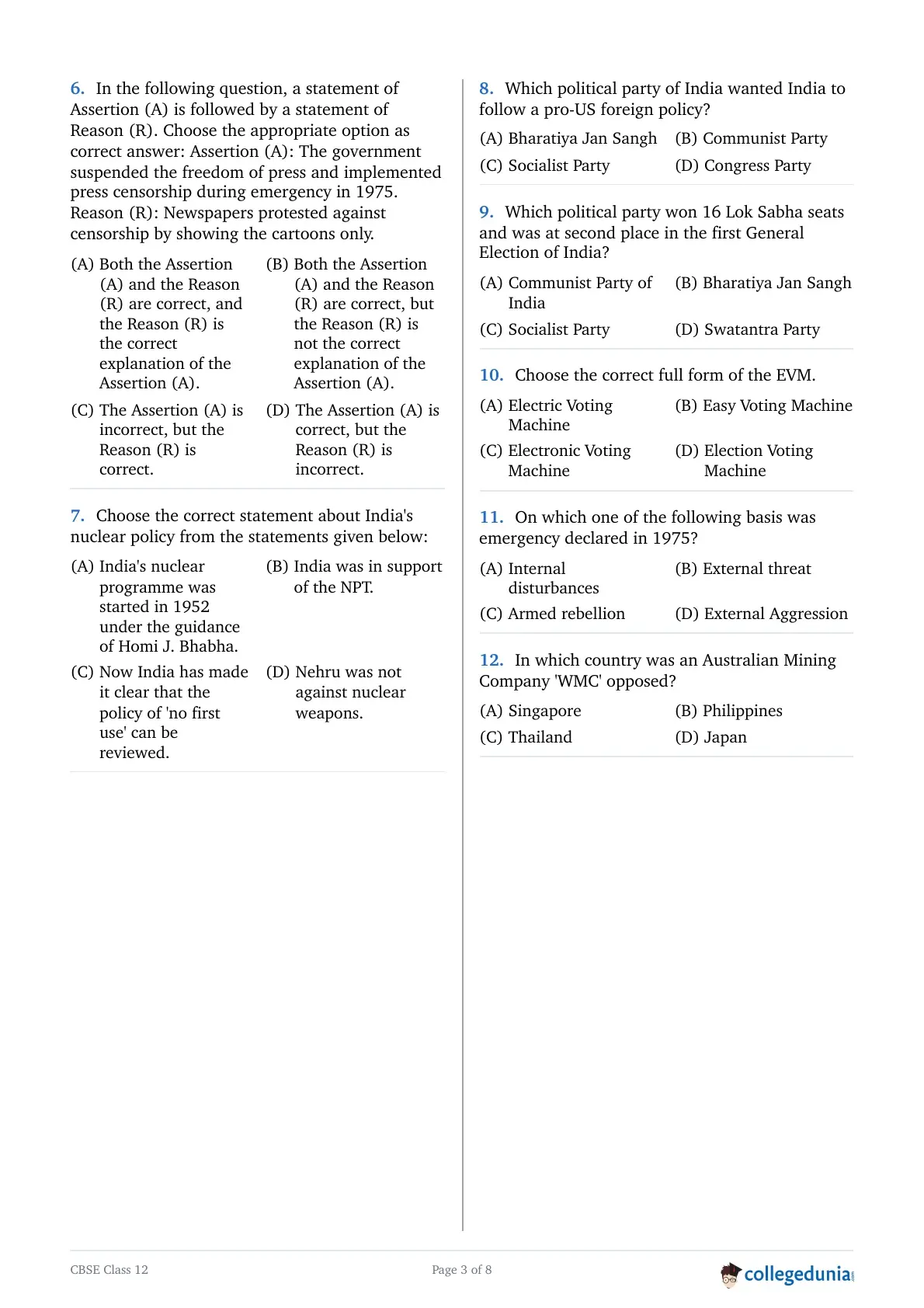
In the following question, a statement of Assertion (A) is followed by a statement of Reason (R). Choose the appropriate option as correct answer :
Assertion (A) : The government suspended the freedom of press and implemented press censorship during emergency in 1975.
Reason (R) : Newspapers protested against censorship by showing the cartoons only.
Option :
Choose the correct statement about India's nuclear policy from the statements given below :
Which political party of India wanted India to follow a pro-US foreign policy ?
Which political party won 16 Lok Sabha seats and was at second place in the first General Election of India ?
Choose the correct full form of the EVM.
On which one of the following basis was emergency declared in 1975 ?
In which country was an Australian Mining Company 'WMC' opposed ?
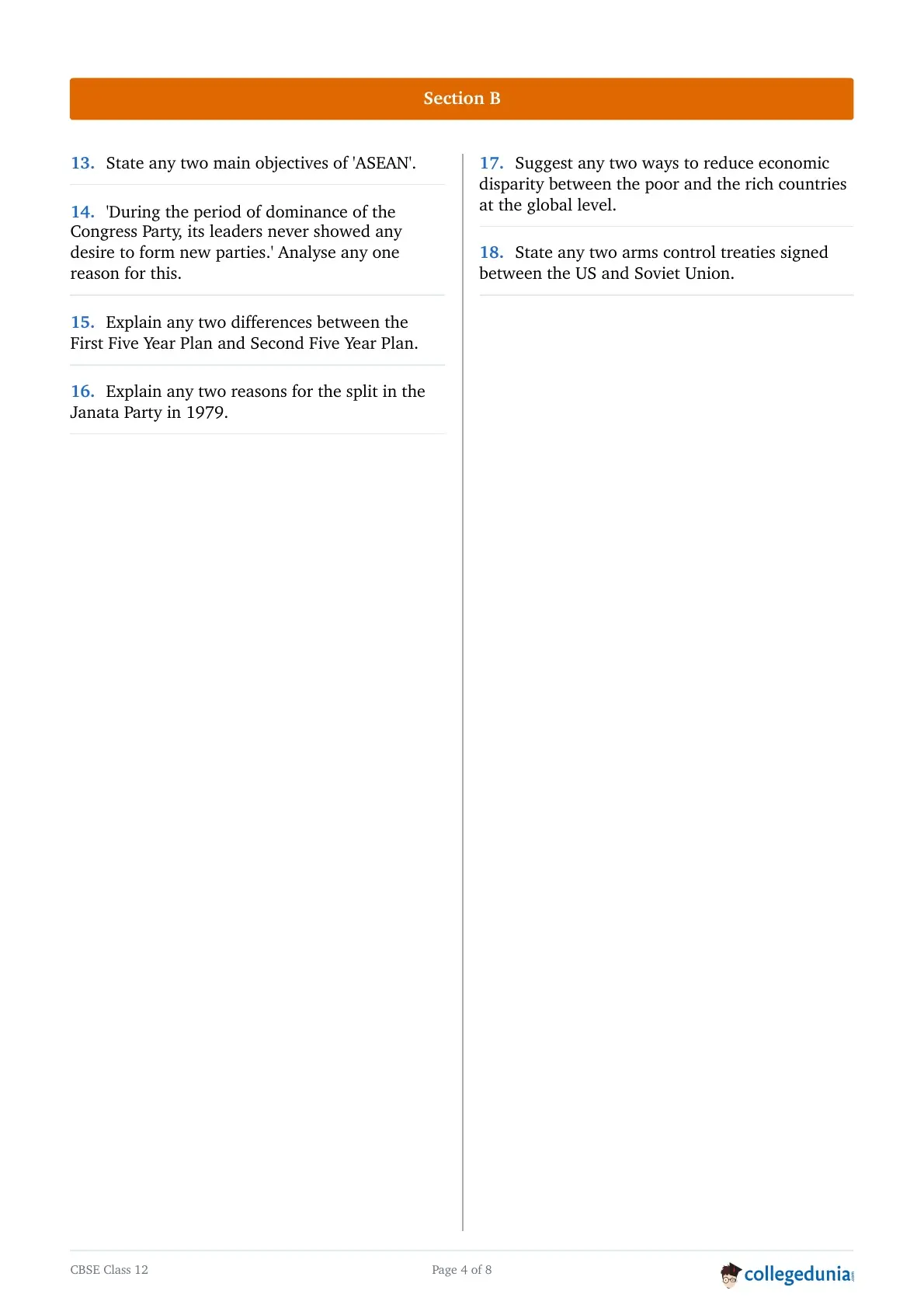
State any two main objectives of 'ASEAN'.
'During the period of dominance of the Congress Party, its leaders never showed any desire to form new parties.' Analyse any one reason for this.
Explain any two differences between the First Five Year Plan and Second Five Year Plan.
Explain any two reasons for the split in the Janta Party in 1979.
Suggest any two ways to reduce economic disparity between the poor and the rich countries at the global level.
State any two arms control treaties signed between the US and Soviet Union.
Analyse the basis of projecting China to overtake the US America to become the world's largest economy.
"While the Chinese economy has improved, not everyone in China received the benefits of the reforms." Analyse any two reasons for this.
"The 1960s were labelled as the 'dangerous decade' in India." Explain any two reasons for this.
Describe the impact of globalisation on the Indian culture.
Explain any two reasons for the beginning of a long phase of coalition politics in India since 1989.
Explain the role of 'Other Backward Classes' in the Indian politics.
Highlight any four important features of the Nuclear Policy of India.
Which ideology was adopted by the post-Soviet countries ?
Which republic among the following became the successor of the Soviet Union ?
Which one of the following is a Central Asian country ?
Which part of Soviet Union had vast hydrocarbon resources ?
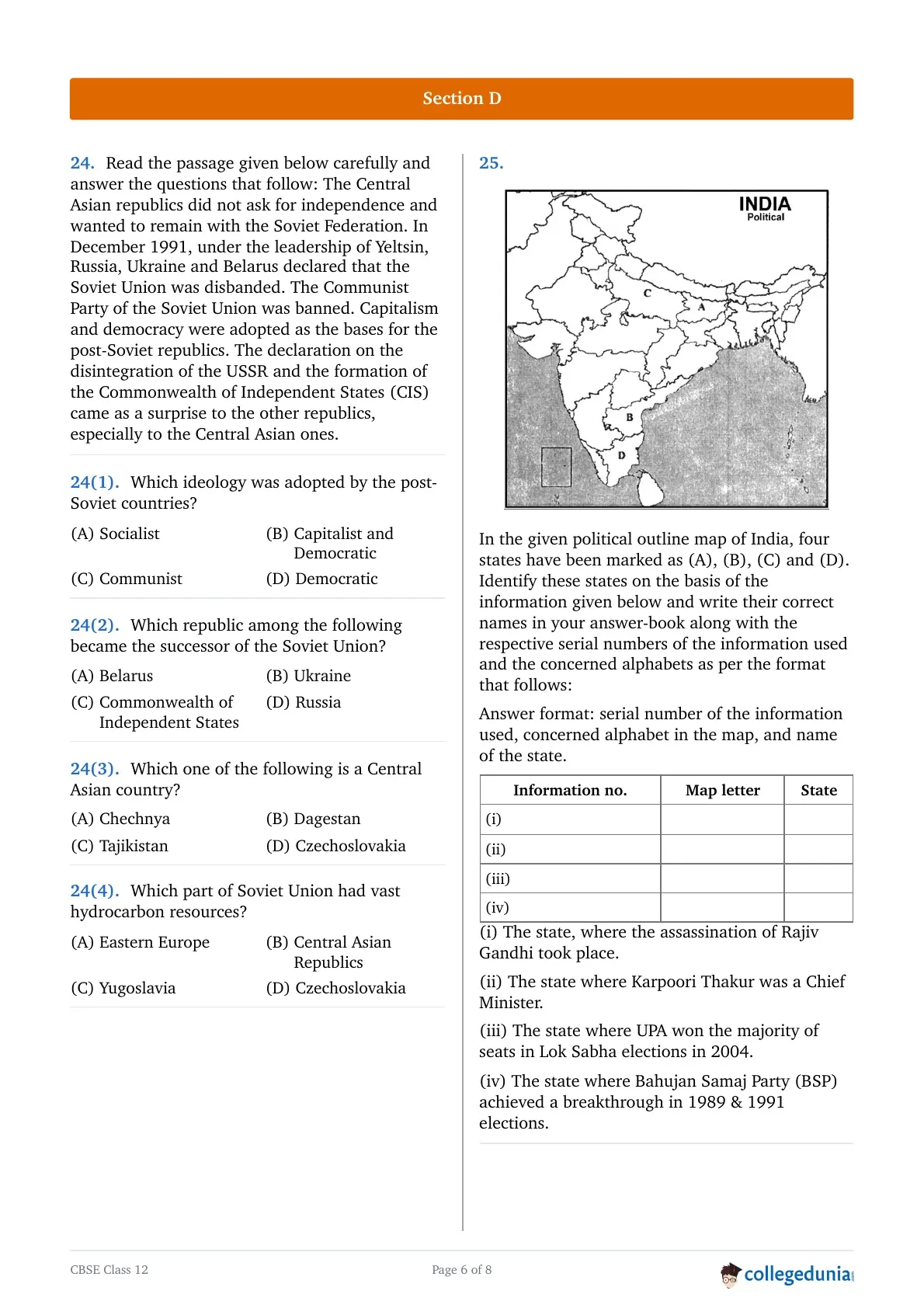
The state, where the assassination of Rajiv Gandhi took place.
The state where Karpoori Thakur was a Chief Minister.
The state where UPA won the majority of seats in Lok Sabha elections in 2004.
The state where Bahujan Samaj Party (BSP) achieved a breakthrough in 1989 & 1991 elections.
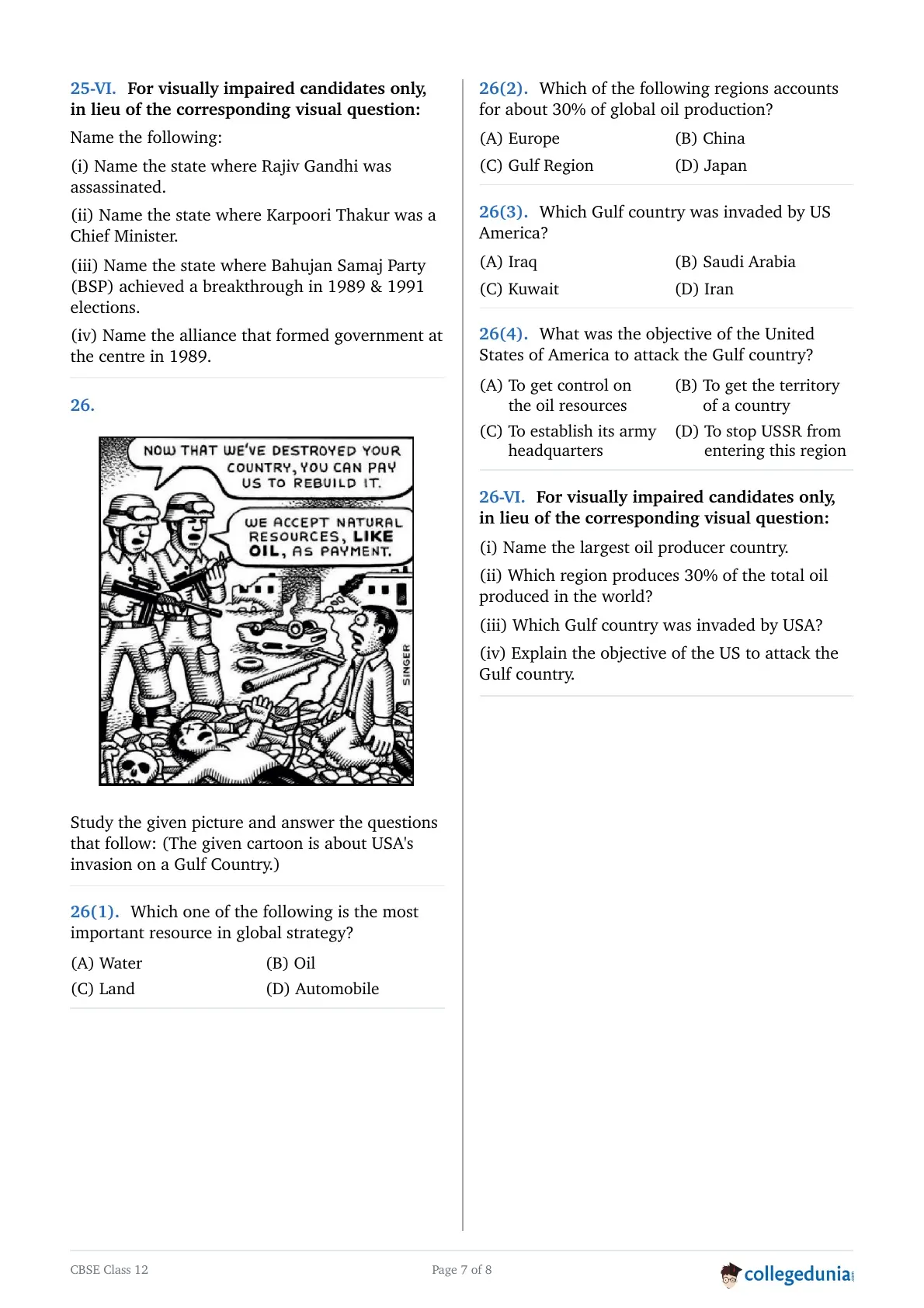
Which Gulf country was invaded by US America ?
Explain any two commonalities and two differences between Bangladesh and Pakistan in their democratic experiences.
Explain any two issues of co-operation and two issues of confrontation between India and Bangladesh.
Explain the importance of International organisations like the United Nations in the contemporary world.
Explain any four changes that have occurred after the Cold War and have affected the realities of the world politics.
"Regional demands from different parts of India show that India has adopted a democratic approach to accommodate diversity." Justify the statement.
Examine any three problems related to the Jammu and Kashmir.
Describe any three circumstances under which the State Reorganisation Commission was constituted.
Describe the circumstances and events that led to Manipur's accession to India in 1949.
CBSE Class 12 Political Science 2025 Question Paper Details
| Exam | CBSE Class 12 Board Examination 2025 |
| Subject | Political Science |
| Paper code | 59/2/1 |
| Exam date | March 22, 2025 |
| Time allowed | 3 hours (plus 15 minutes of reading time, 10:15 AM to 10:30 AM) |
| Maximum marks | 80 |
| Total questions | 30 (attempt 30) |
CBSE Class 12 Political Science Question Paper Pattern and Marking Scheme
The CBSE Class 12 Political Science 2025 question paper is of 80 marks and has 30 questions, of which 30 are to be attempted. The tables below give the section-wise paper pattern and the split of marks, as printed in the official question paper.
CBSE Class 12 Political Science Question Paper Pattern 2025
| Section | Questions | Question Type | Choice | Marks per Question | Marks |
|---|---|---|---|---|---|
| Section A | Q1-Q12 | Multiple choice questions (MCQs) | All 12 | 1 | 12 |
| Section B | Q13-Q18 | Short answer questions (50 to 60 words) | All 6 | 2 | 12 |
| Section C | Q19-Q23 | Long answer type-I questions (100 to 120 words), with internal choice (OR) in some questions | All 5 | 4 | 20 |
| Section D | Q24-Q26 | Passage, cartoon/picture and map-based questions | All 3 | 4 | 12 |
| Section E | Q27-Q30 | Long answer type-II questions (170 to 180 words), with internal choice (OR) in some questions | All 4 | 6 | 24 |
| Total | 30 questions | Attempt 30 | 80 |
CBSE Class 12 Political Science Marks Distribution 2025
| Question Type | Questions to Attempt | Marks per Question | Total Marks |
|---|---|---|---|
| Multiple choice questions (MCQs) (Section A) | 12 | 1 | 12 |
| Short answer questions (50 to 60 words) (Section B) | 6 | 2 | 12 |
| Long answer type-I questions (100 to 120 words), with internal choice (OR) in some questions (Section C) | 5 | 4 | 20 |
| Passage, cartoon/picture and map-based questions (Section D) | 3 | 4 | 12 |
| Long answer type-II questions (170 to 180 words), with internal choice (OR) in some questions (Section E) | 4 | 6 | 24 |
| Total | 30 | 80 |



Comments