




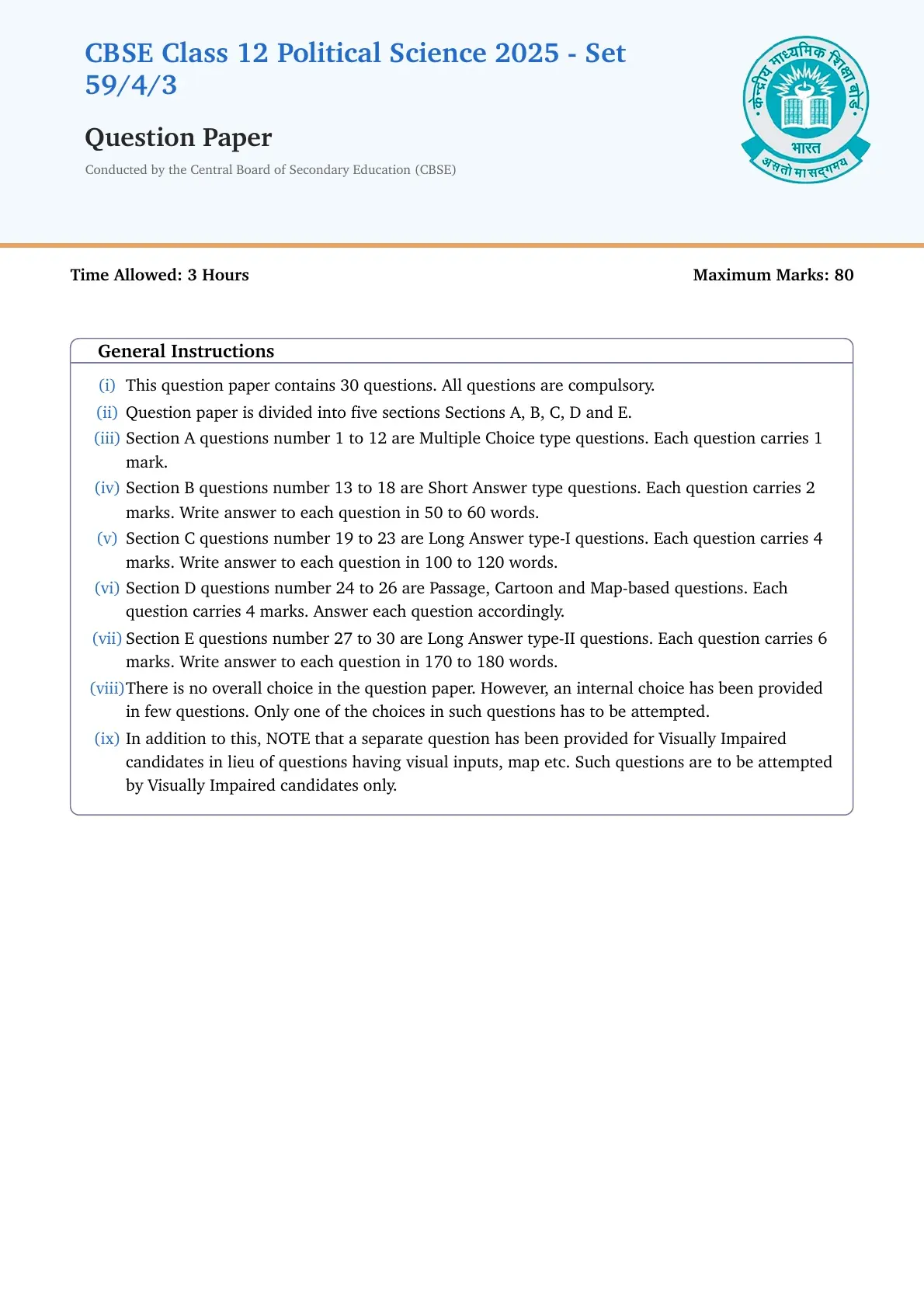
CBSE Class 12 Political Science Question Paper 2025 Code 59/4/3 is available for download here. CBSE conducted the Class 12 Political Science exam on March 22, 2025 from 10:30 AM to 1:30 PM. The Political Science theory paper is of 80 marks.
Also Check: CBSE Class 12 Question Paper 2025 (All Subjects)
The Political Science question paper includes the following types of questions:
- The question paper has 30 questions, all compulsory, for 80 marks in 3 hours, with 15 minutes of extra reading time
- Section A (Q1 to Q12) has 12 multiple choice questions of 1 mark each (12 marks)
- Section B (Q13 to Q18) has 6 short answer questions of 2 marks each, to be answered in 50 to 60 words (12 marks)
- Section C (Q19 to Q23) has 5 long answer type-I questions of 4 marks each, to be answered in 100 to 120 words (20 marks)
- Section D (Q24 to Q26) has 3 passage, cartoon/picture and map-based questions of 4 marks each (12 marks)
- Section E (Q27 to Q30) has 4 long answer type-II questions of 6 marks each, to be answered in 170 to 180 words (24 marks)
- There is no overall choice, but internal choice (OR) is given in some questions of Sections C and E
CBSE Class 12 Political Science Question Paper 2025 Code 59/4/3 PDF
| CBSE Official PDF | CD PDF | CD PDF with Solutions |
|---|---|---|
| Download official PDF 1.76 MB | Download Collegedunia PDF 1.46 MB | – |
CBSE Class 12 Political Science 2025 Set 59/4/3 Questions with Solutions
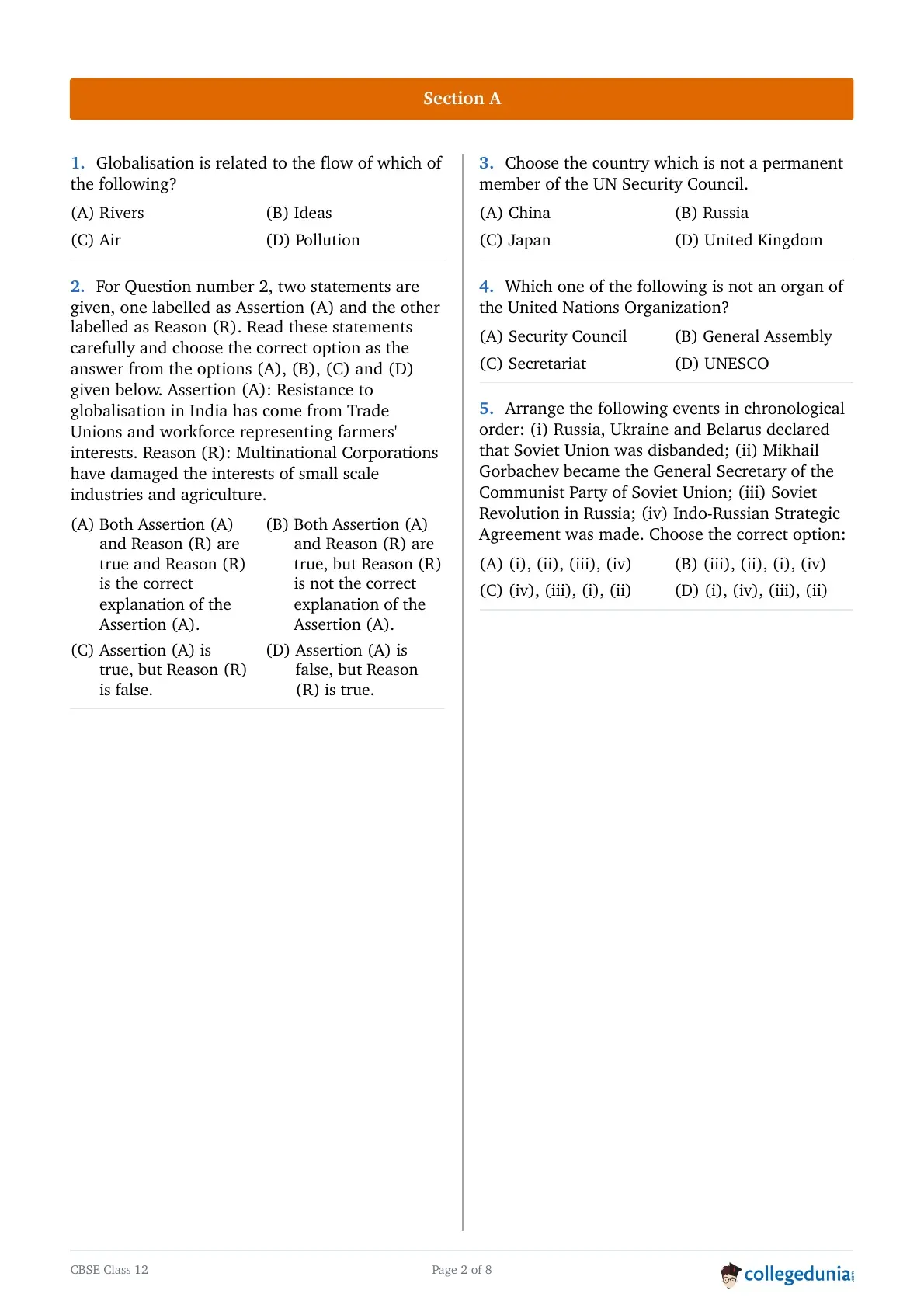
Globalisation is related to the flow of which of the following ?
For Question number 2, two statements are given - one labelled as Assertion (A) and the other labelled as Reason (R). Read these statements carefully and choose the correct option as the answer from the options (A), (B), (C) and (D) given below.
Assertion (A) : Resistance to globalisation in India has come from Trade Unions and workforce representing farmers' interests.
Reason (R) : Multinational Corporations have damaged the interests of small scale industries and agriculture.
Choose the country which is not a permanent member of the UN Security Council.
Which one of the following is not an organ of the United Nations Organization ?
Arrange the following events in chronological order :
- (i) Russia, Ukraine and Belarus declared that Soviet Union was disbanded
- (ii) Mikhail Gorbachev became the General Secretary of the Communist Party of Soviet Union
- (iii) Soviet Revolution in Russia
- (iv) Indo-Russian Strategic Agreement was made
Choose the correct option :
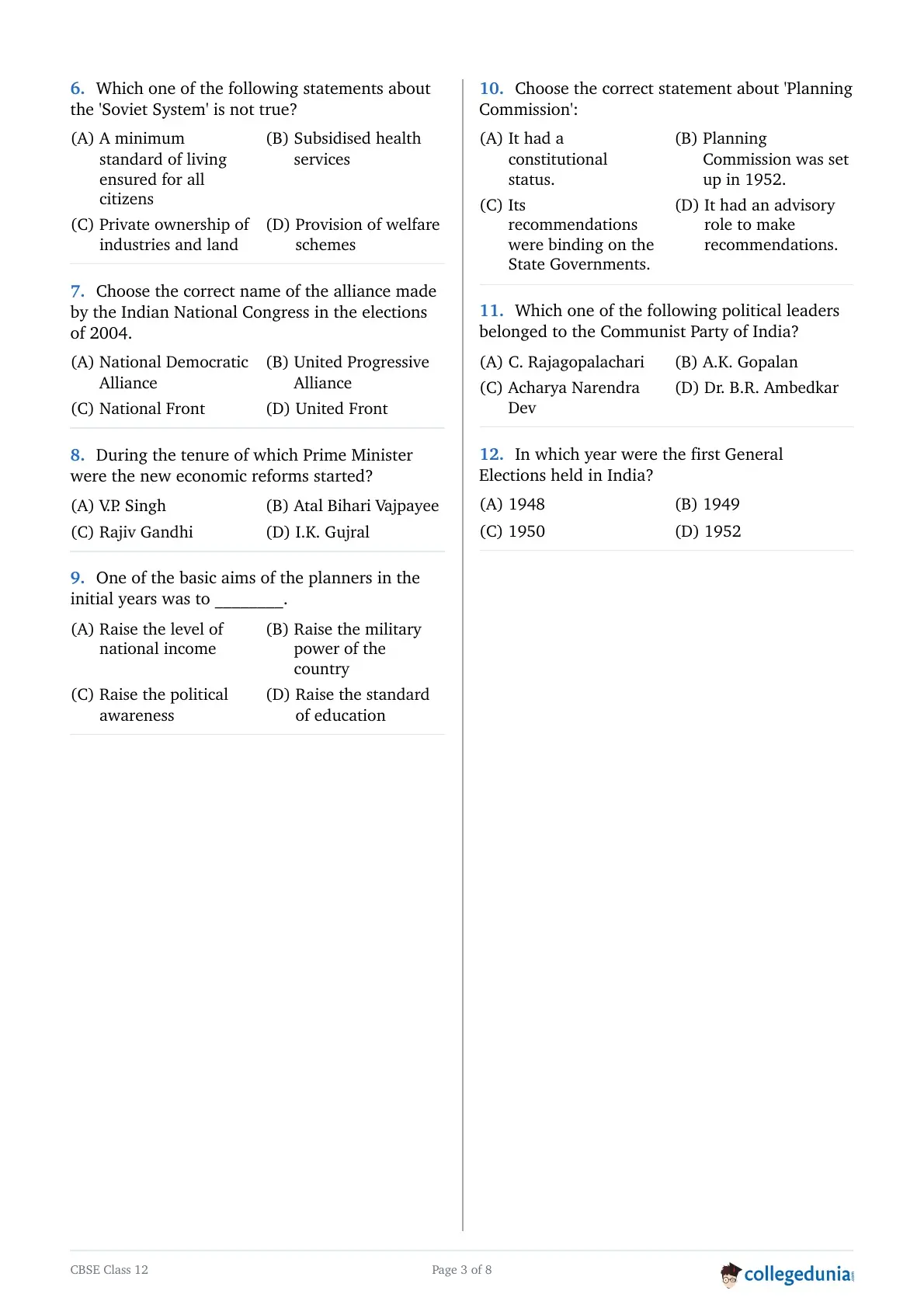
Which one of the following statements about the 'Soviet System' is not true ?
Choose the correct name of the alliance made by the Indian National Congress in the elections of 2004.
One of the basic aims of the planners in the initial years was to _______ .
Choose the correct statement about 'Planning Commission' :
Which one of the following political leaders belonged to the Communist Party of India ?
In which year were the first General Elections held in India ?
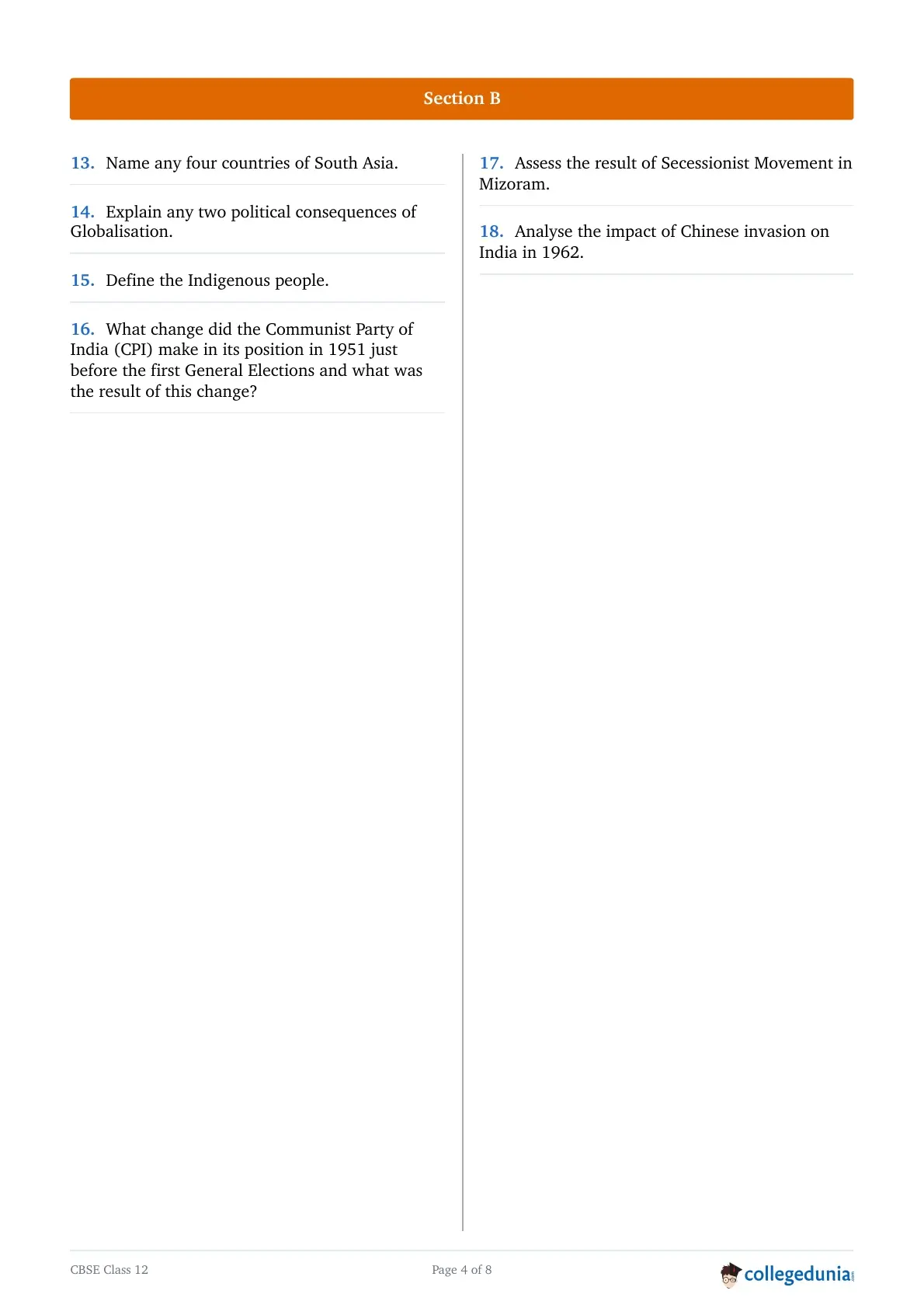
Name any four countries of South Asia.
Explain any two political consequences of Globalisation.
Define the Indigenous people.
What change did the Communist Party of India (CPI) make in its position in 1951 just before the first General Elections and what was the result of this change ?
Assess the result of Secessionist Movement in Mizoram.
Analyse the impact of Chinese invasion on India in 1962.
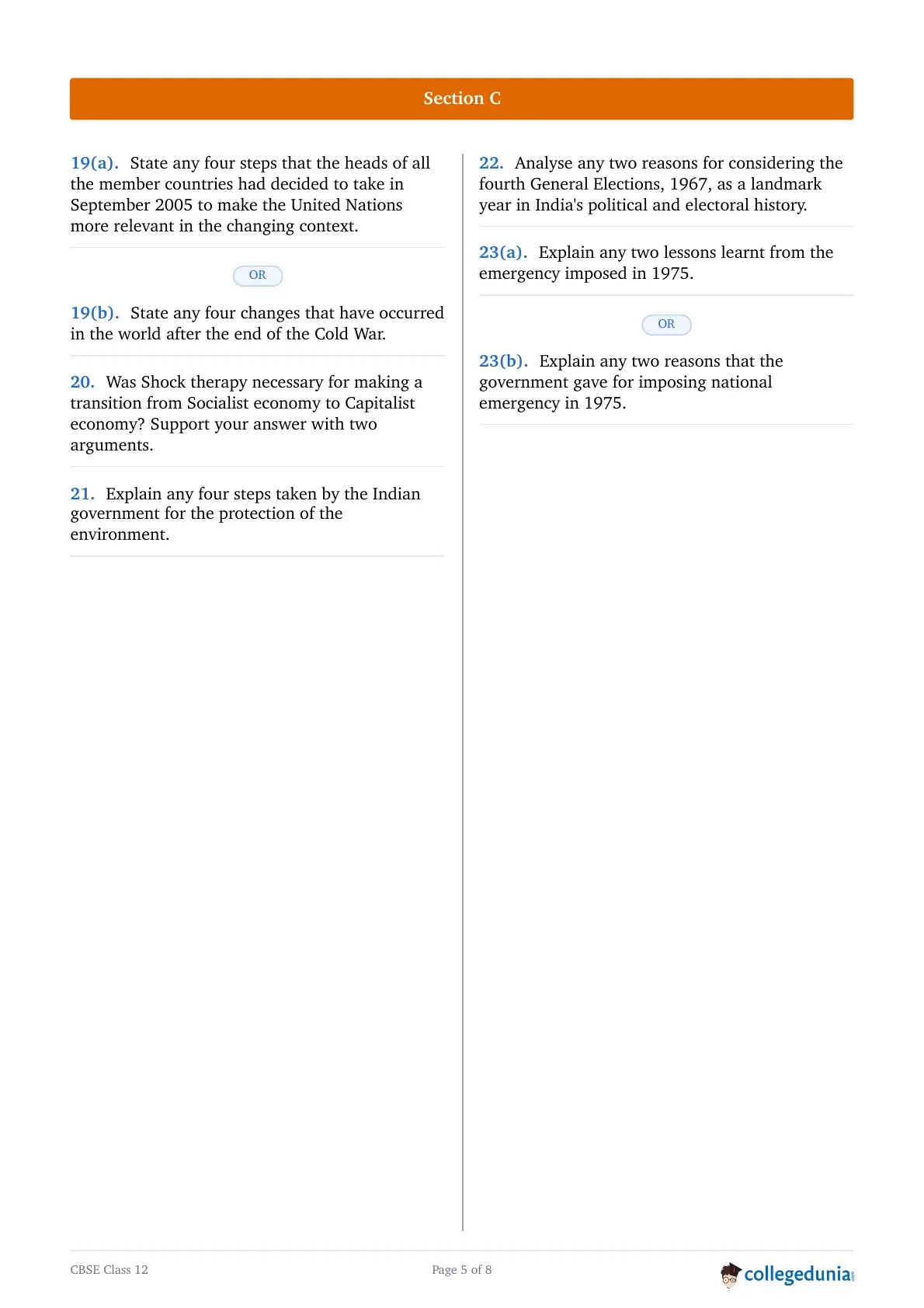
State any four steps that the heads of all the member countries had decided to take in September 2005 to make the United Nations more relevant in the changing context.
State any four changes that have occurred in the world after the end of the Cold War.
Was Shock therapy necessary for making a transition from Socialist economy to Capitalist economy ? Support your answer with two arguments.
Explain any four steps taken by the Indian government for the protection of the environment.
Analyse any two reasons for considering the fourth General Elections, 1967, as a landmark year in India's political and electoral history.
Explain any two lessons learnt from the emergency imposed in 1975.
Explain any two reasons that the government gave for imposing national emergency in 1975.
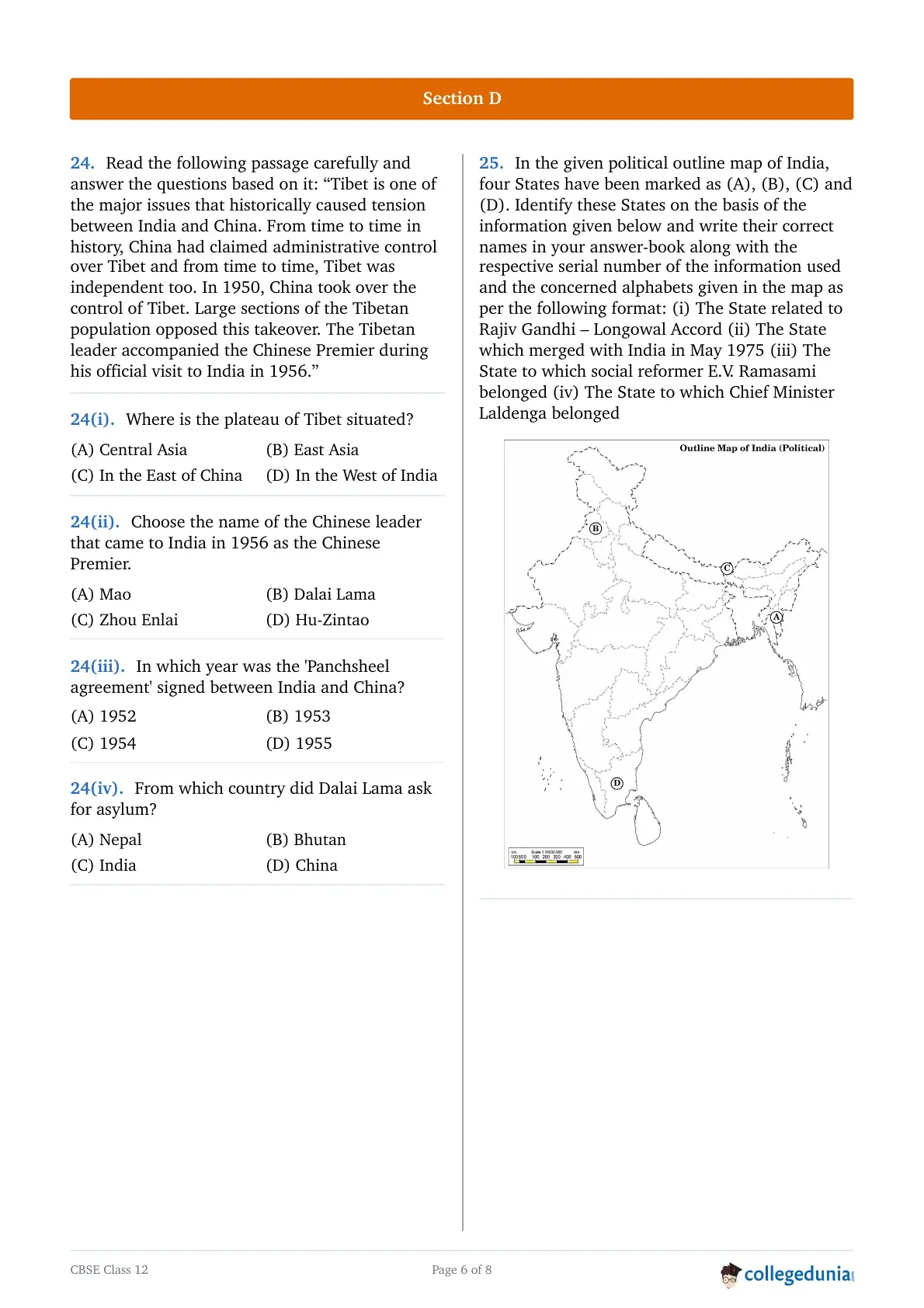
Where is the plateau of Tibet situated ?
Choose the name of the Chinese leader that came to India in 1956 as the Chinese Premier.
In which year was the 'Panchsheel agreement' signed between India and China ?
From which country did Dalai Lama ask for asylum ?
The State related to Rajiv Gandhi - Longowal Accord
The State which merged with India in May 1975
The State to which social reformer E.V. Ramasami belonged
The State to which Chief Minister Laldenga belonged
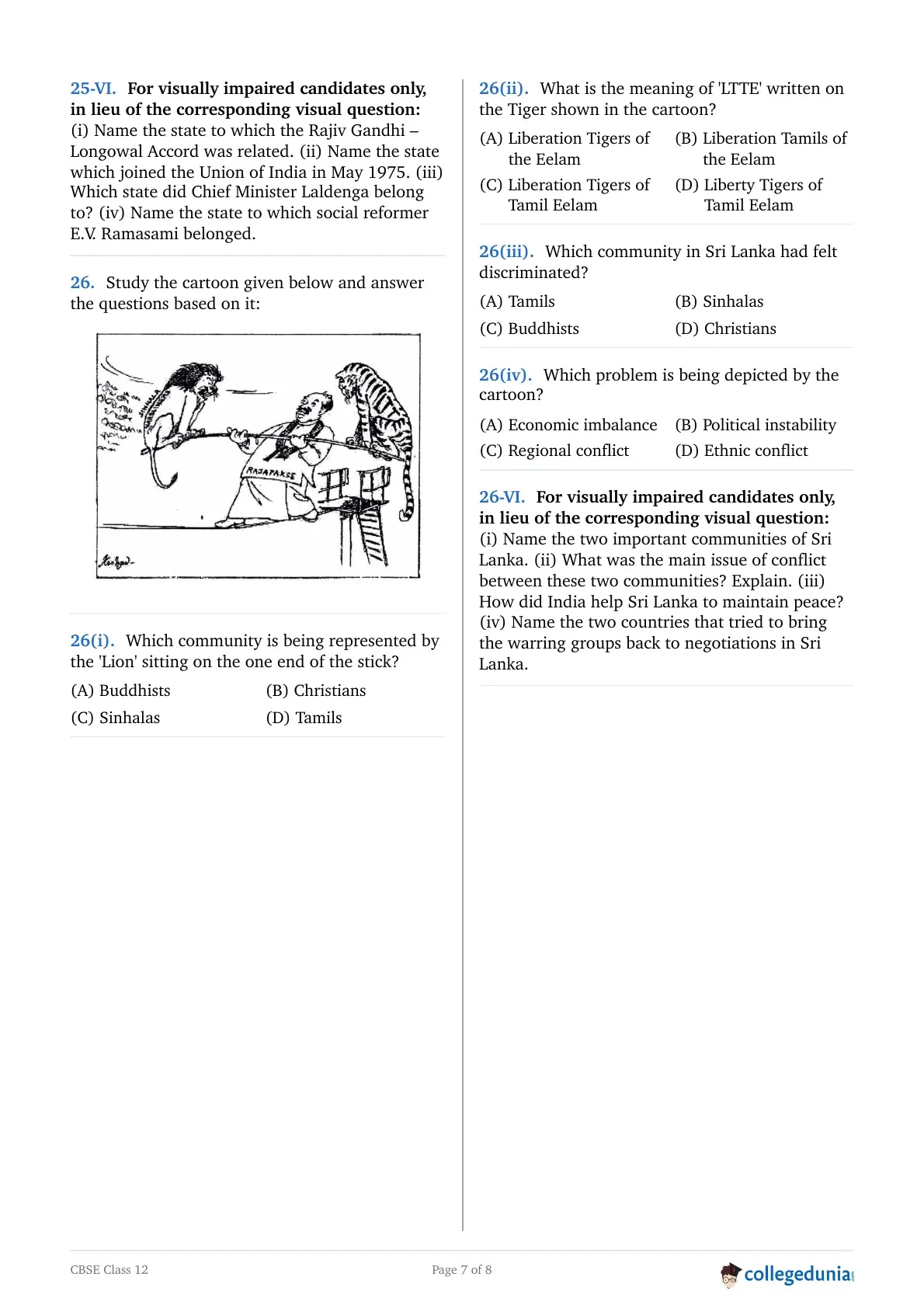
Which community is being represented by the 'Lion' sitting on the one end of the stick ?
What is the meaning of 'LTTE' written on the Tiger shown in the cartoon ?
Which community in Sri Lanka had felt discriminated ?
Which problem is being depicted by the cartoon ?
State any four reasons for considering Japan as an alternate centre of power.
State any four issues of dispute between India and China.
"On many crucial issues, a broad agreement has emerged among most political parties in India." Support the statement with any three examples.
"The decision of the National Front government to implement the recommendations of the Mandal Commission helped in shaping the politics of Other Backward Classes (OBCs)." Support the statement with three examples or arguments.
Describe the process of reorganisation of states in India after 1952.
Describe the process that was adopted to make the partition of British India in 1947 as per the Two-Nation theory.
Explain any three new sources of threats to non-traditional security.
Explain any three components of traditional security policy.
CBSE Class 12 Political Science 2025 Question Paper Details
| Exam | CBSE Class 12 Board Examination 2025 |
| Subject | Political Science |
| Paper code | 59/4/3 |
| Exam date | March 22, 2025 |
| Time allowed | 3 hours (plus 15 minutes of reading time, 10:15 AM to 10:30 AM) |
| Maximum marks | 80 |
| Total questions | 30 (attempt 30) |
CBSE Class 12 Political Science Question Paper Pattern and Marking Scheme
The CBSE Class 12 Political Science 2025 question paper is of 80 marks and has 30 questions, of which 30 are to be attempted. The tables below give the section-wise paper pattern and the split of marks, as printed in the official question paper.
CBSE Class 12 Political Science Question Paper Pattern 2025
| Section | Questions | Question Type | Choice | Marks per Question | Marks |
|---|---|---|---|---|---|
| Section A | Q1-Q12 | Multiple choice questions (MCQs) | All 12 | 1 | 12 |
| Section B | Q13-Q18 | Short answer questions (50 to 60 words) | All 6 | 2 | 12 |
| Section C | Q19-Q23 | Long answer type-I questions (100 to 120 words), with internal choice (OR) in some questions | All 5 | 4 | 20 |
| Section D | Q24-Q26 | Passage, cartoon/picture and map-based questions | All 3 | 4 | 12 |
| Section E | Q27-Q30 | Long answer type-II questions (170 to 180 words), with internal choice (OR) in some questions | All 4 | 6 | 24 |
| Total | 30 questions | Attempt 30 | 80 |
CBSE Class 12 Political Science Marks Distribution 2025
| Question Type | Questions to Attempt | Marks per Question | Total Marks |
|---|---|---|---|
| Multiple choice questions (MCQs) (Section A) | 12 | 1 | 12 |
| Short answer questions (50 to 60 words) (Section B) | 6 | 2 | 12 |
| Long answer type-I questions (100 to 120 words), with internal choice (OR) in some questions (Section C) | 5 | 4 | 20 |
| Passage, cartoon/picture and map-based questions (Section D) | 3 | 4 | 12 |
| Long answer type-II questions (170 to 180 words), with internal choice (OR) in some questions (Section E) | 4 | 6 | 24 |
| Total | 30 | 80 |



Comments