




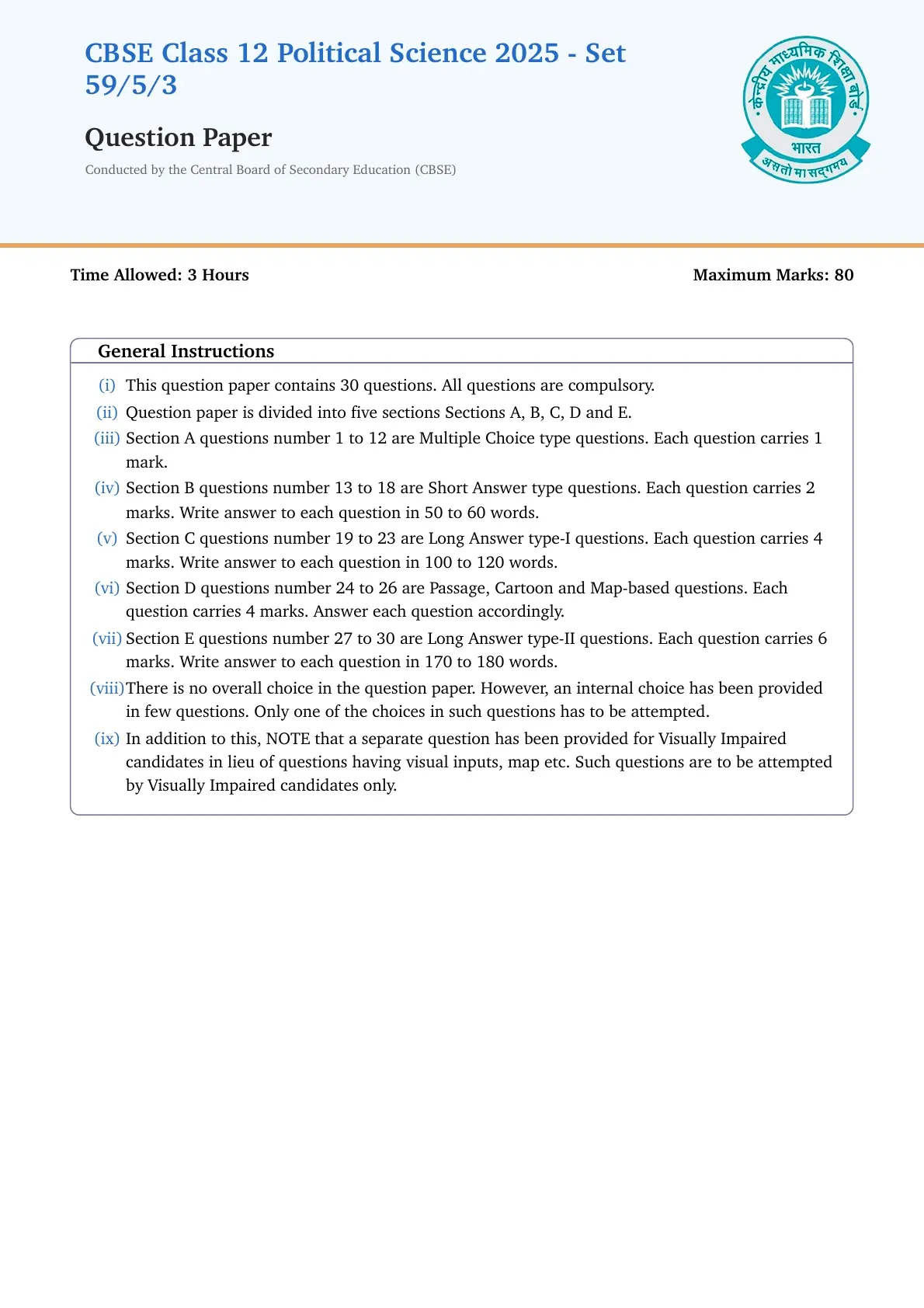
CBSE Class 12 Political Science Question Paper 2025 Code 59/5/3 is available for download here. CBSE conducted the Class 12 Political Science exam on March 22, 2025 from 10:30 AM to 1:30 PM. The Political Science theory paper is of 80 marks.
Also Check: CBSE Class 12 Question Paper 2025 (All Subjects)
The Political Science question paper includes the following types of questions:
- The question paper has 30 questions, all compulsory, for 80 marks in 3 hours, with 15 minutes of extra reading time
- Section A (Q1 to Q12) has 12 multiple choice questions of 1 mark each (12 marks)
- Section B (Q13 to Q18) has 6 short answer questions of 2 marks each, to be answered in 50 to 60 words (12 marks)
- Section C (Q19 to Q23) has 5 long answer type-I questions of 4 marks each, to be answered in 100 to 120 words (20 marks)
- Section D (Q24 to Q26) has 3 passage, cartoon/picture and map-based questions of 4 marks each (12 marks)
- Section E (Q27 to Q30) has 4 long answer type-II questions of 6 marks each, to be answered in 170 to 180 words (24 marks)
- There is no overall choice, but internal choice (OR) is given in some questions of Sections C and E
CBSE Class 12 Political Science Question Paper 2025 Code 59/5/3 PDF
| CBSE Official PDF | CD PDF | CD PDF with Solutions |
|---|---|---|
| Download official PDF 1.60 MB | Download Collegedunia PDF 1.29 MB | – |
CBSE Class 12 Political Science 2025 Set 59/5/3 Questions with Solutions
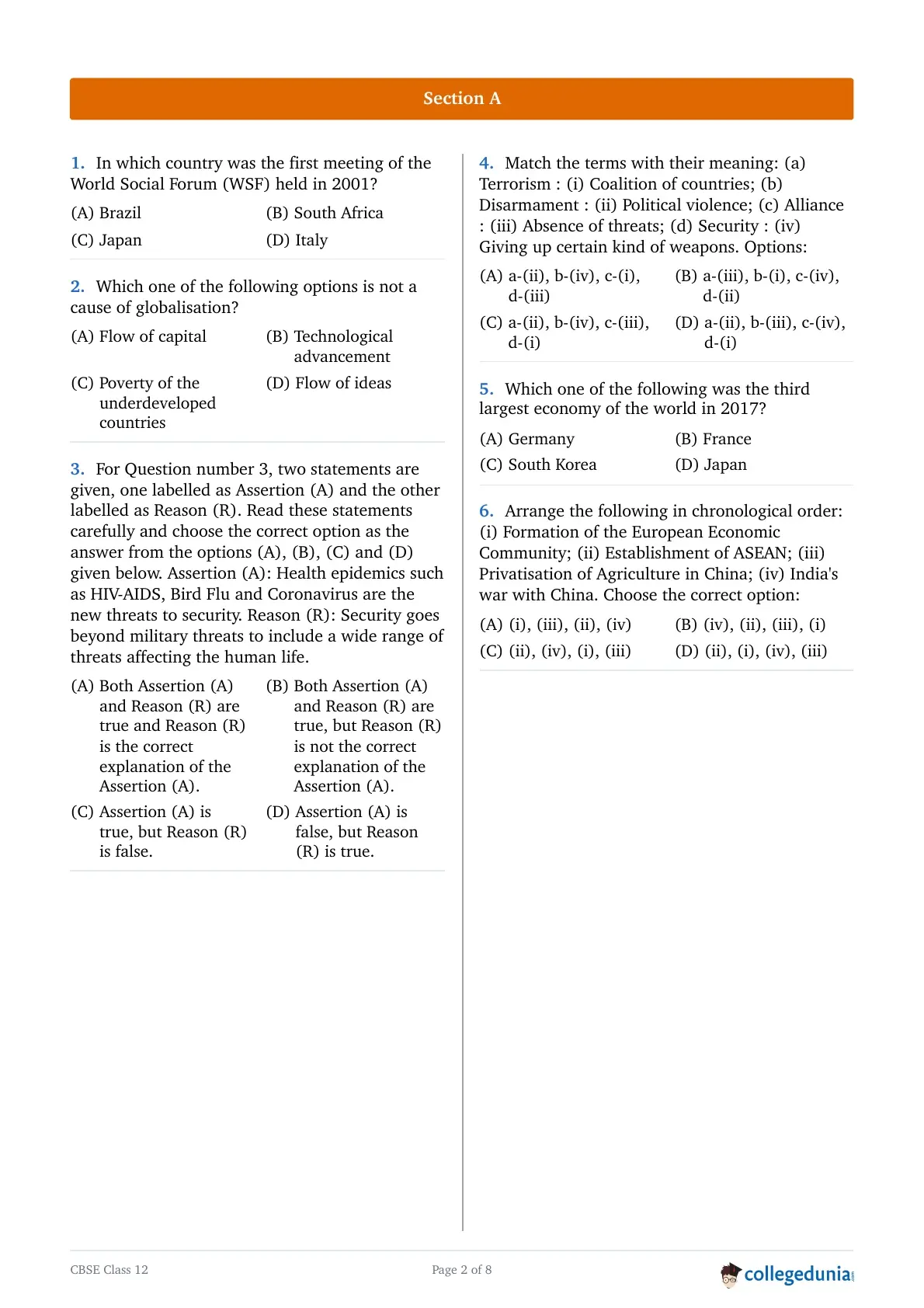
In which country was the first meeting of the World Social Forum (WSF) held in 2001 ?
Which one of the following options is not a cause of globalisation ?
Assertion (A) : Health epidemics such as HIV-AIDS, Bird Flu and Coronavirus are the new threats to security.
Reason (R) : Security goes beyond military threats to include a wide range of threats affecting the human life.
Match the terms with their meaning :
| (a) | Terrorism | : | (i) | Coalition of countries |
| (b) | Disarmament | : | (ii) | Political violence |
| (c) | Alliance | : | (iii) | Absence of threats |
| (d) | Security | : | (iv) | Giving up certain kind of weapons |
Which one of the following was the third largest economy of the world in 2017 ?
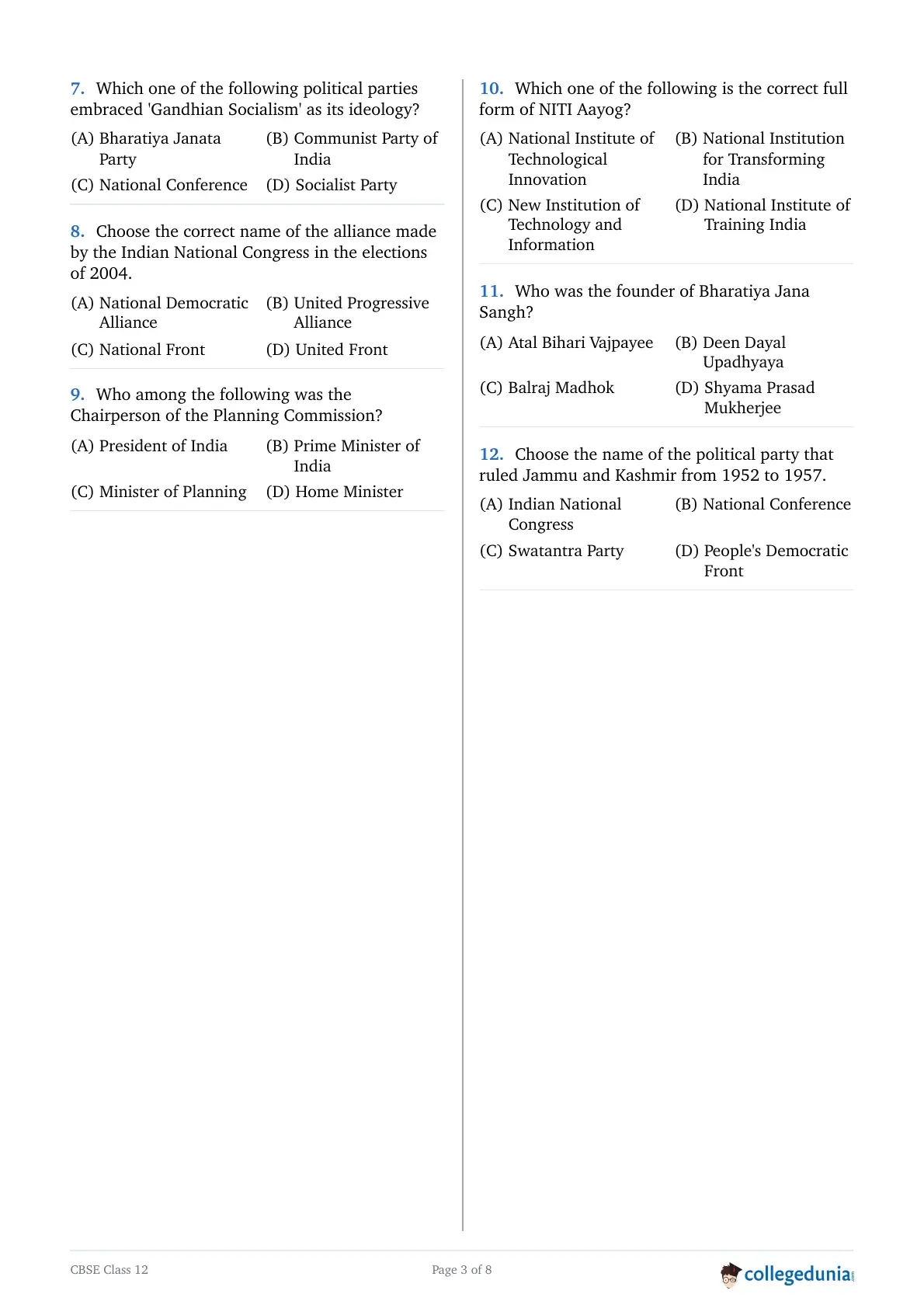
Which one of the following political parties embraced 'Gandhian Socialism' as its ideology ?
Choose the correct name of the alliance made by the Indian National Congress in the elections of 2004.
Who among the following was the Chairperson of the Planning Commission ?
Which one of the following is the correct full form of NITI Aayog ?
Who was the founder of Bharatiya Jana Sangh ?
Choose the name of the political party that ruled Jammu and Kashmir from 1952 to 1957.
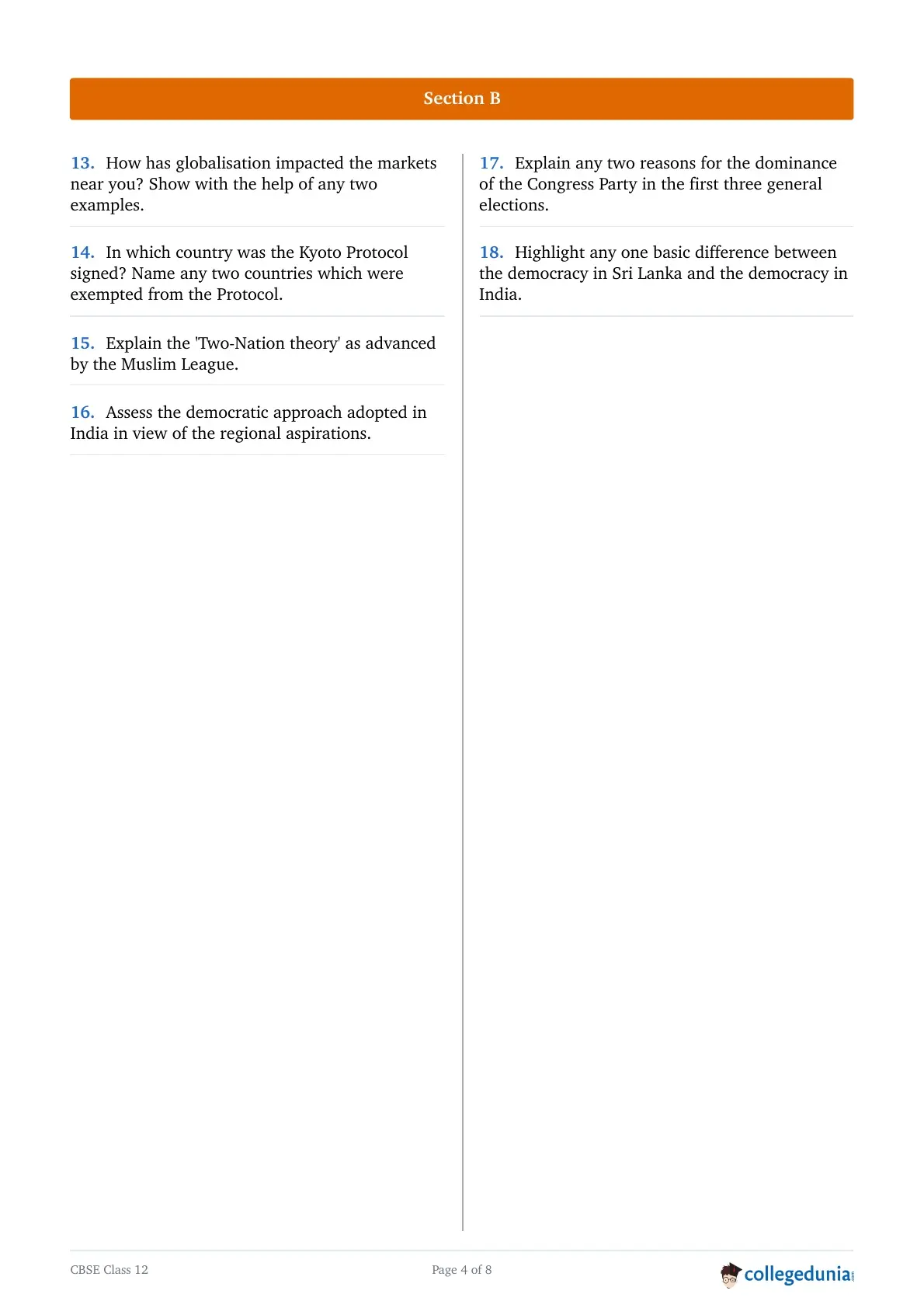
How has globalisation impacted the markets near you ? Show with the help of any two examples.
In which country was the Kyoto Protocol signed ? Name any two countries which were exempted from the Protocol.
Explain the 'Two-Nation theory' as advanced by the Muslim League.
Assess the democratic approach adopted in India in view of the regional aspirations.
Explain any two reasons for the dominance of the Congress Party in the first three general elections.
Highlight any one basic difference between the democracy in Sri Lanka and the democracy in India.
Explain the geo-politics of resources with the help of the example of 'water' as a crucial resource.
Explain any two new sources of threat to Non-traditional Security.
Describe any two events that led to the split in the Congress Party in 1969.
Describe any four steps taken by Indira Gandhi to eradicate poverty (Garibi Hatao) in India.
Analyse the relations between India and Bangladesh.
Analyse the process of transition from monarchy to democracy in Nepal.
Analyse any two reasons for the unrest in Punjab from 1967 to 1980.
The above passage refers to which general elections to the Lok Sabha ?
For how many total seats of the Lok Sabha are the elections held ?
Who among the following was the Deputy Prime Minister of India after the victory of the Janata Party ?
Name the state from where the Congress Party could win only one seat in the above said elections.
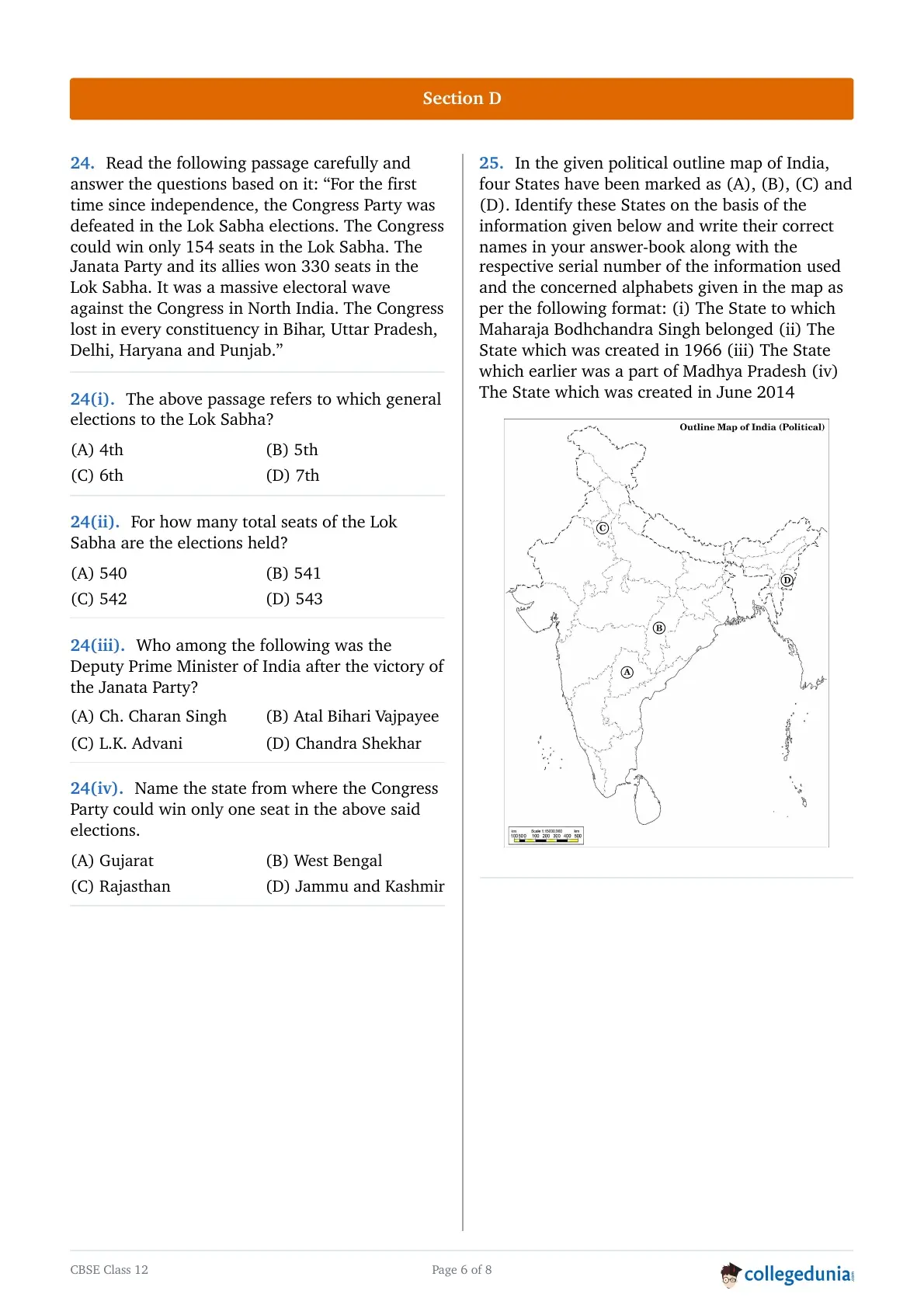
In the given political outline map of India (on page 15), four States have been marked as (A), (B), (C) and (D). Identify these States on the basis of the information given below and write their correct names in your answer-book along with the respective serial number of the information used and the concerned alphabets given in the map as per the following format :
| Serial number of the information used | Concerned alphabet given in the map | Name of the State |
| (i) | ||
| (ii) | ||
| (iii) | ||
| (iv) |
(i) The State to which Maharaja Bodhchandra Singh belonged
(ii) The State which was created in 1966
(iii) The State which earlier was a part of Madhya Pradesh
(iv) The State which was created in June 2014
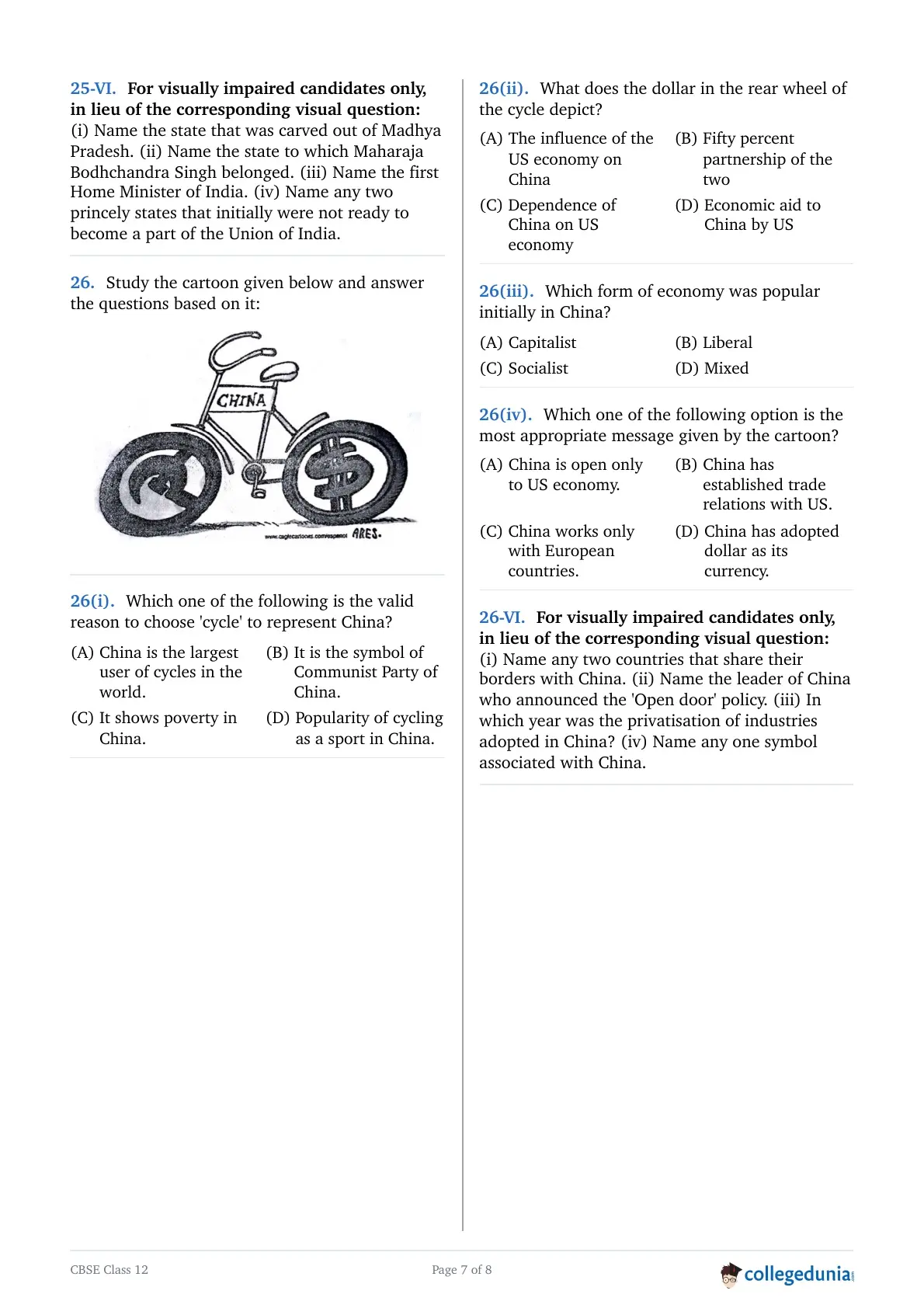
Which one of the following is the valid reason to choose 'cycle' to represent China ?
What does the dollar in the rear wheel of the cycle depict ?
Which form of economy was popular initially in China ?
Which one of the following option is the most appropriate message given by the cartoon ?
Describe any four political developments in India that took place between 1988 to 1993.
Describe any four consequences of the 'Era of Coalition governments' starting from 1989 to 2004.
Explain the three basis on which India justifies its claim to be a permanent member of the Security Council.
Explain the need for an international organisation like the United Nations.
Describe Prime Minister Jawaharlal Nehru's role in formulating and implementing the foreign policy of India.
Describe any three of the Directive Principles of State Policy for the promotion of international peace and security.
Examine any three reasons responsible for the disintegration of the Soviet Union.
Examine any three reasons for the friendly and cooperative relations between India and Russia after the disintegration of the Soviet Union.
CBSE Class 12 Political Science 2025 Question Paper Details
| Exam | CBSE Class 12 Board Examination 2025 |
| Subject | Political Science |
| Paper code | 59/5/3 |
| Exam date | March 22, 2025 |
| Time allowed | 3 hours (plus 15 minutes of reading time, 10:15 AM to 10:30 AM) |
| Maximum marks | 80 |
| Total questions | 30 (attempt 30) |
CBSE Class 12 Political Science Question Paper Pattern and Marking Scheme
The CBSE Class 12 Political Science 2025 question paper is of 80 marks and has 30 questions, of which 30 are to be attempted. The tables below give the section-wise paper pattern and the split of marks, as printed in the official question paper.
CBSE Class 12 Political Science Question Paper Pattern 2025
| Section | Questions | Question Type | Choice | Marks per Question | Marks |
|---|---|---|---|---|---|
| Section A | Q1-Q12 | Multiple choice questions (MCQs) | All 12 | 1 | 12 |
| Section B | Q13-Q18 | Short answer questions (50 to 60 words) | All 6 | 2 | 12 |
| Section C | Q19-Q23 | Long answer type-I questions (100 to 120 words), with internal choice (OR) in some questions | All 5 | 4 | 20 |
| Section D | Q24-Q26 | Passage, cartoon/picture and map-based questions | All 3 | 4 | 12 |
| Section E | Q27-Q30 | Long answer type-II questions (170 to 180 words), with internal choice (OR) in some questions | All 4 | 6 | 24 |
| Total | 30 questions | Attempt 30 | 80 |
CBSE Class 12 Political Science Marks Distribution 2025
| Question Type | Questions to Attempt | Marks per Question | Total Marks |
|---|---|---|---|
| Multiple choice questions (MCQs) (Section A) | 12 | 1 | 12 |
| Short answer questions (50 to 60 words) (Section B) | 6 | 2 | 12 |
| Long answer type-I questions (100 to 120 words), with internal choice (OR) in some questions (Section C) | 5 | 4 | 20 |
| Passage, cartoon/picture and map-based questions (Section D) | 3 | 4 | 12 |
| Long answer type-II questions (170 to 180 words), with internal choice (OR) in some questions (Section E) | 4 | 6 | 24 |
| Total | 30 | 80 |



Comments