




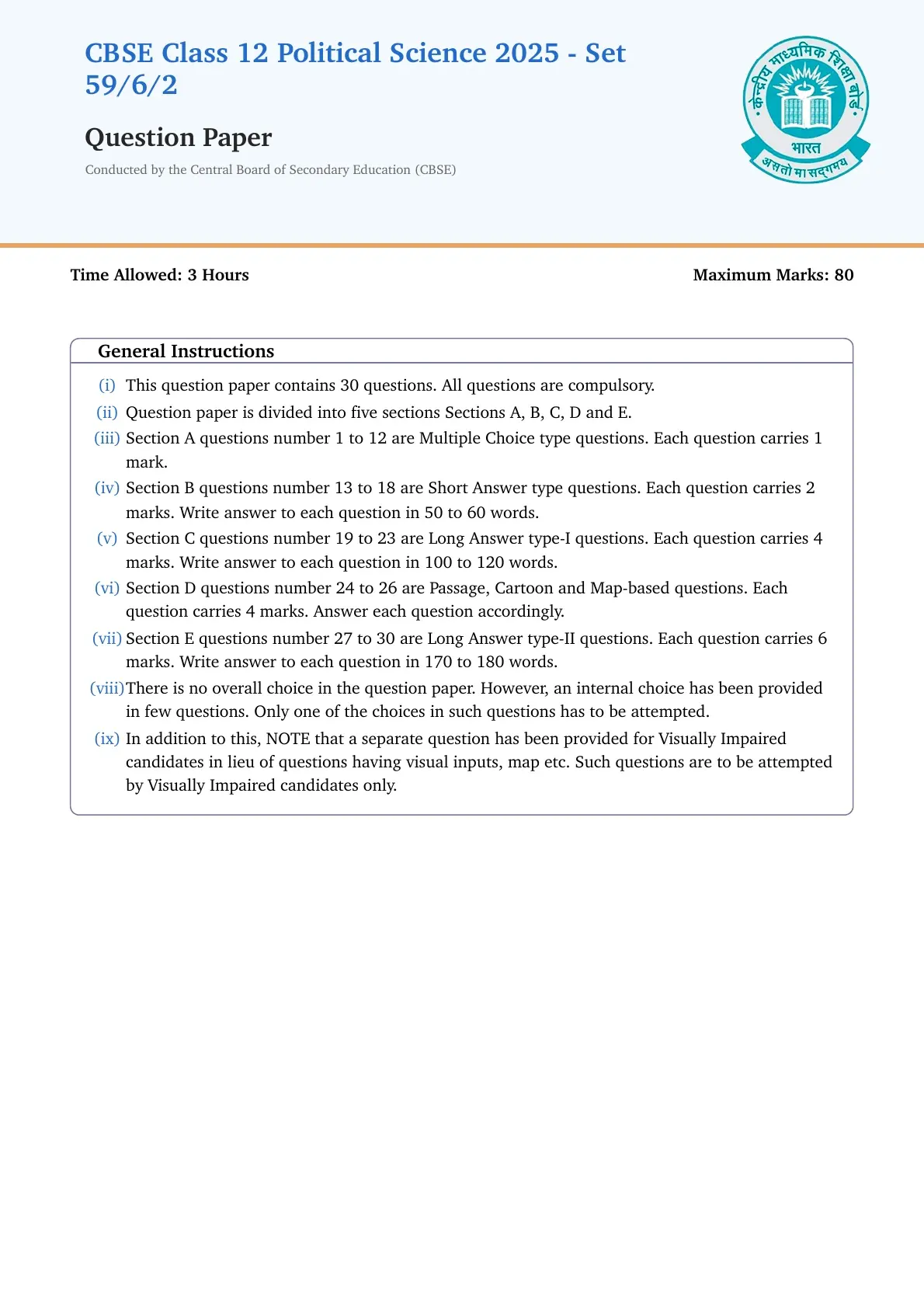
CBSE Class 12 Political Science Question Paper 2025 Code 59/6/2 is available for download here. CBSE conducted the Class 12 Political Science exam on March 22, 2025 from 10:30 AM to 1:30 PM. The Political Science theory paper is of 80 marks.
Also Check: CBSE Class 12 Question Paper 2025 (All Subjects)
The Political Science question paper includes the following types of questions:
- The question paper has 30 questions, all compulsory, for 80 marks in 3 hours, with 15 minutes of extra reading time
- Section A (Q1 to Q12) has 12 multiple choice questions of 1 mark each (12 marks)
- Section B (Q13 to Q18) has 6 short answer questions of 2 marks each, to be answered in 50 to 60 words (12 marks)
- Section C (Q19 to Q23) has 5 long answer type-I questions of 4 marks each, to be answered in 100 to 120 words (20 marks)
- Section D (Q24 to Q26) has 3 passage, cartoon/picture and map-based questions of 4 marks each (12 marks)
- Section E (Q27 to Q30) has 4 long answer type-II questions of 6 marks each, to be answered in 170 to 180 words (24 marks)
- There is no overall choice, but internal choice (OR) is given in some questions of Sections C and E
CBSE Class 12 Political Science Question Paper 2025 Code 59/6/2 PDF
| CBSE Official PDF | CD PDF | CD PDF with Solutions |
|---|---|---|
| Download official PDF 1.67 MB | Download Collegedunia PDF 1.29 MB | – |
CBSE Class 12 Political Science 2025 Set 59/6/2 Questions with Solutions
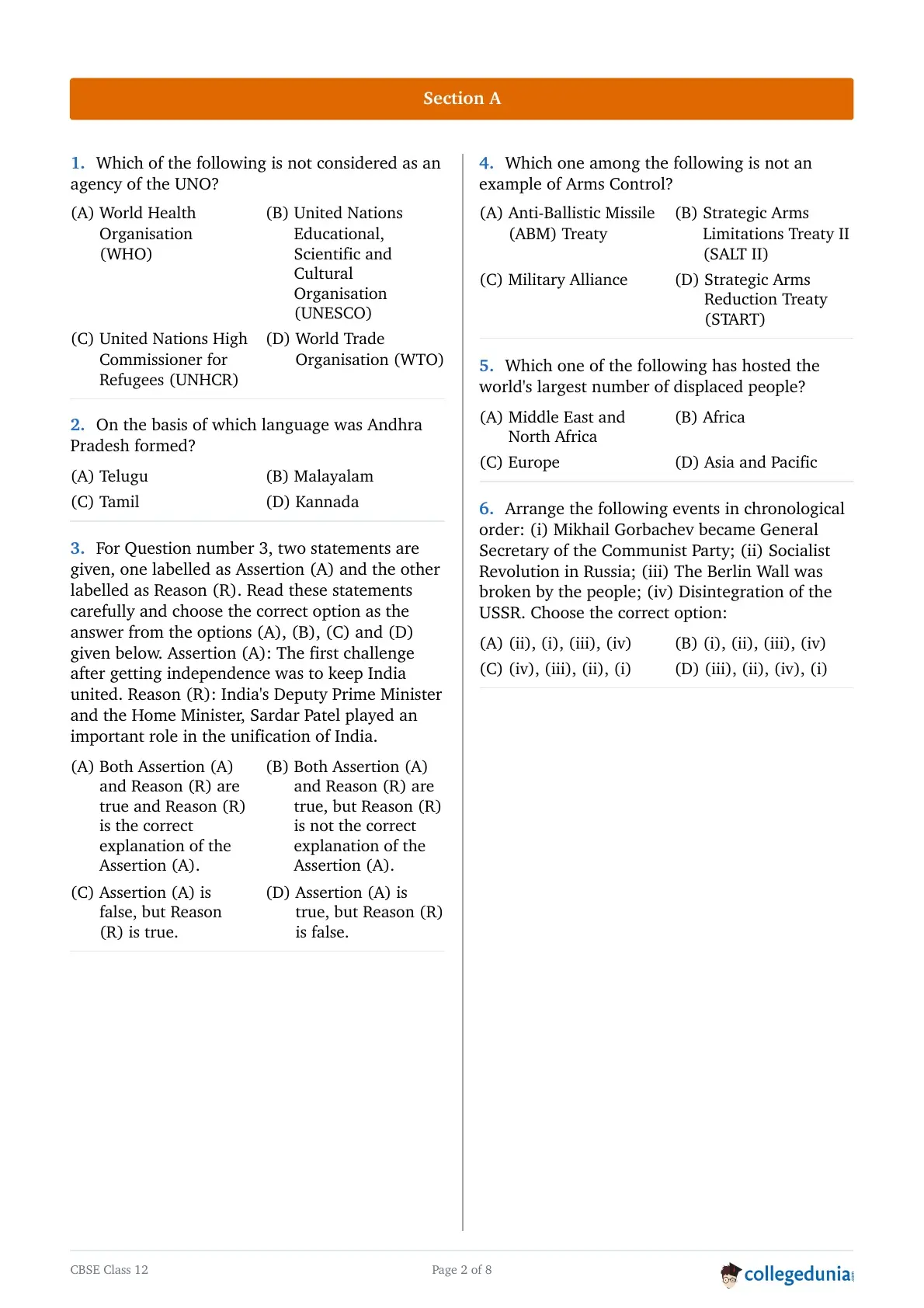
Which of the following is not considered as an agency of the UNO ?
On the basis of which language was Andhra Pradesh formed ?
Which one among the following is not an example of Arms Control ?
Arrange the following events in chronological order :
- (i) Mikhail Gorbachev became General Secretary of the Communist Party
- (ii) Socialist Revolution in Russia
- (iii) The Berlin Wall was broken by the people
- (iv) Disintegration of the USSR
Choose the correct option :
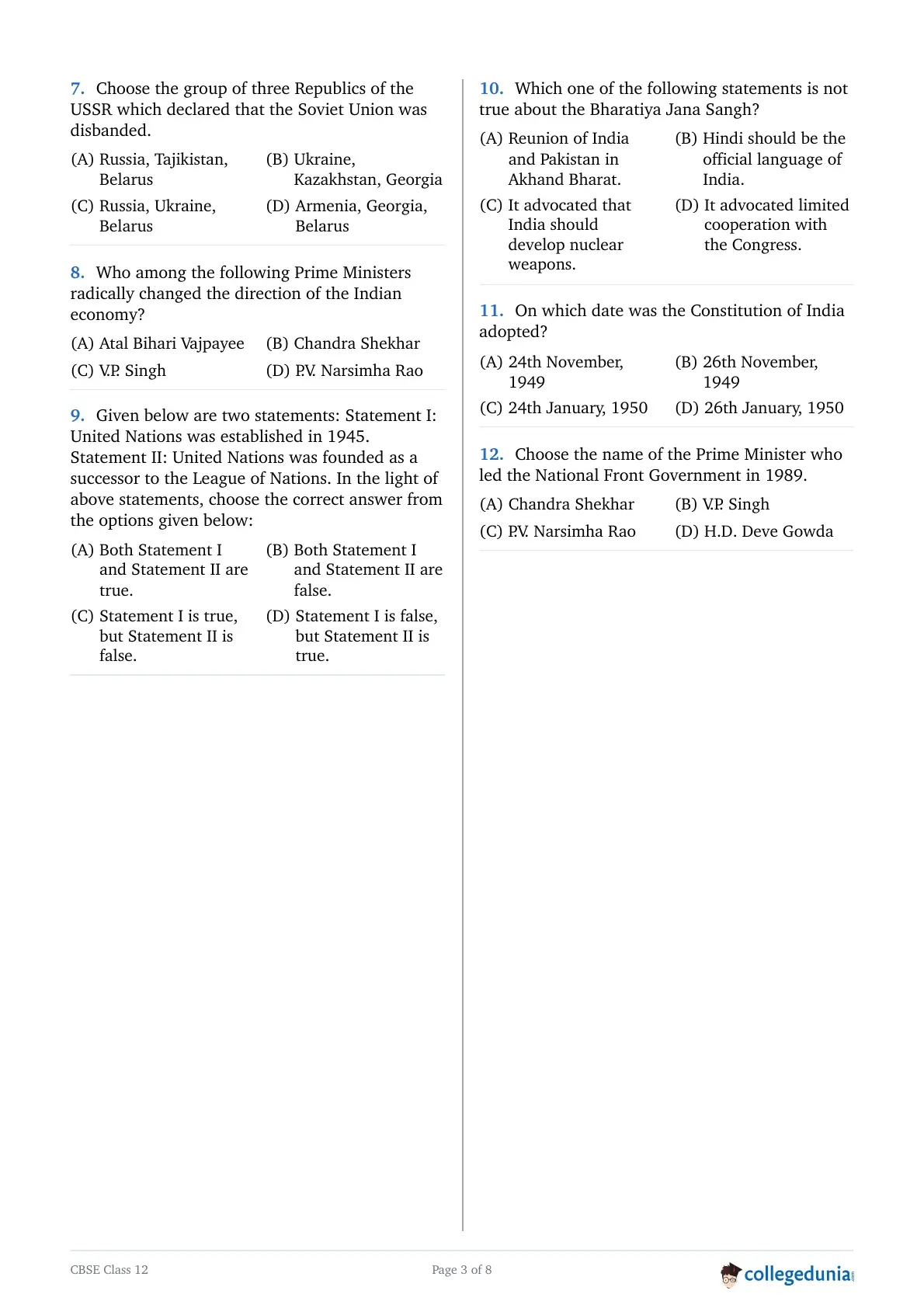
Choose the group of three Republics of the USSR which declared that the Soviet Union was disbanded.
Who among the following Prime Ministers radically changed the direction of the Indian economy ?
Given below are two statements :
Statement I : United Nations was established in 1945.
Statement II : United Nations was founded as a successor to the League of Nations.
In the light of above statements, choose the correct answer from the options given below :
Which one of the following statements is not true about the Bharatiya Jana Sangh ?
On which date was the Constitution of India adopted ?
Choose the name of the Prime Minister who led the National Front Government in 1989.
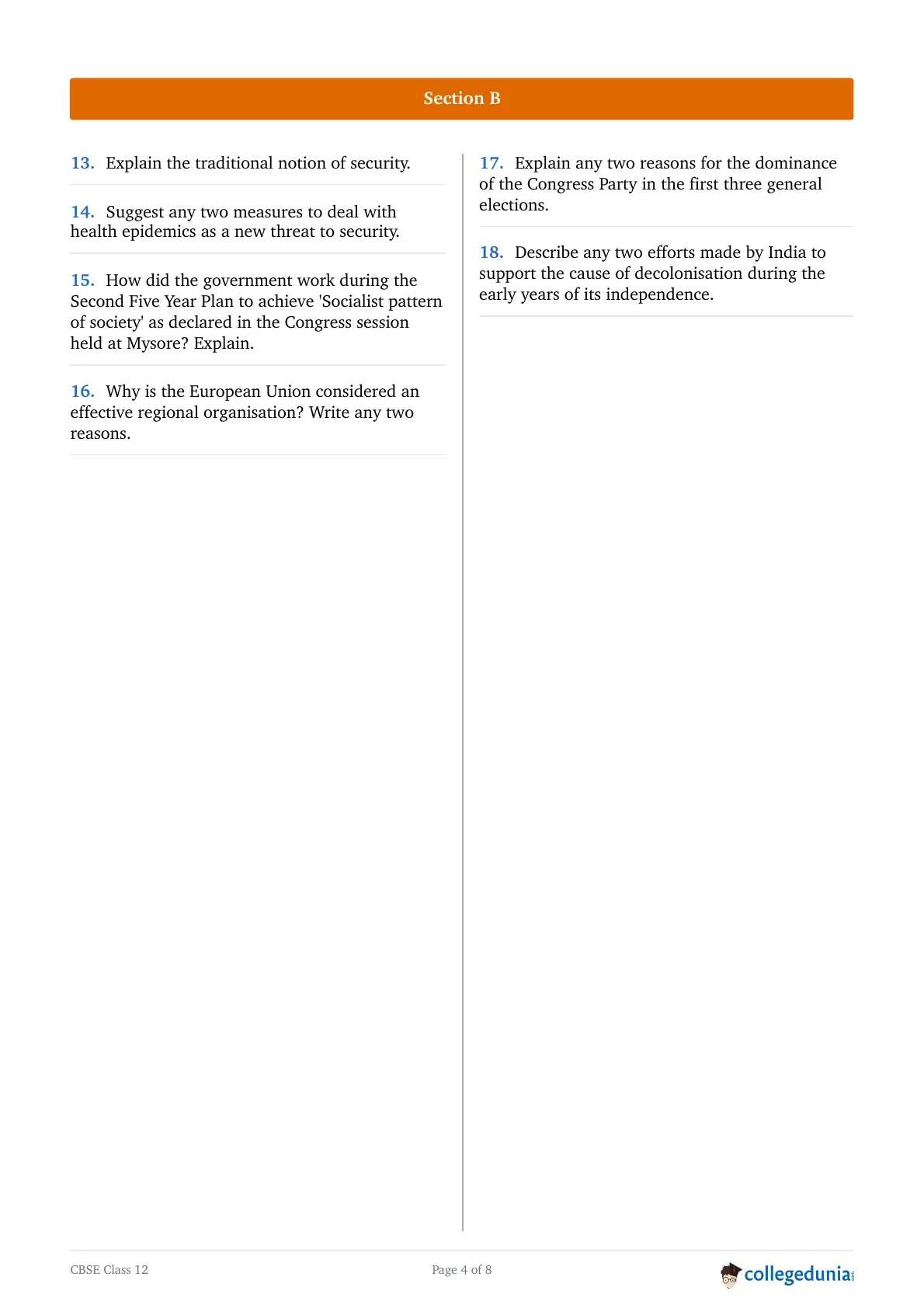
Explain the traditional notion of security.
Suggest any two measures to deal with health epidemics as a new threat to security.
How did the government work during the Second Five Year Plan to achieve 'Socialist pattern of society' as declared in the Congress session held at Mysore ? Explain.
Why is the European Union considered an effective regional organisation ? Write any two reasons.
Explain any two reasons for the dominance of the Congress Party in the first three general elections.
Describe any two efforts made by India to support the cause of decolonisation during the early years of its independence.
Explain the contribution of any two Non-Governmental Organisations working for the protection of human rights in the world.
Explain the contribution of any two international organisations working for human development and international trade.
Explain any two negative consequences of globalisation in India.
"After the disintegration of the Soviet Union, Indo-Russian relations are gaining new heights." Support the statement with any four examples.
"After the Second World War, the Soviet Union was considered a superpower of the world." Support the statement with any four arguments.
Explain any two lessons learnt from the Emergency declared in 1975.
Explain the role of Mahatma Gandhi in reducing communal tension and violence which erupted in some parts of the country at the time of partition.
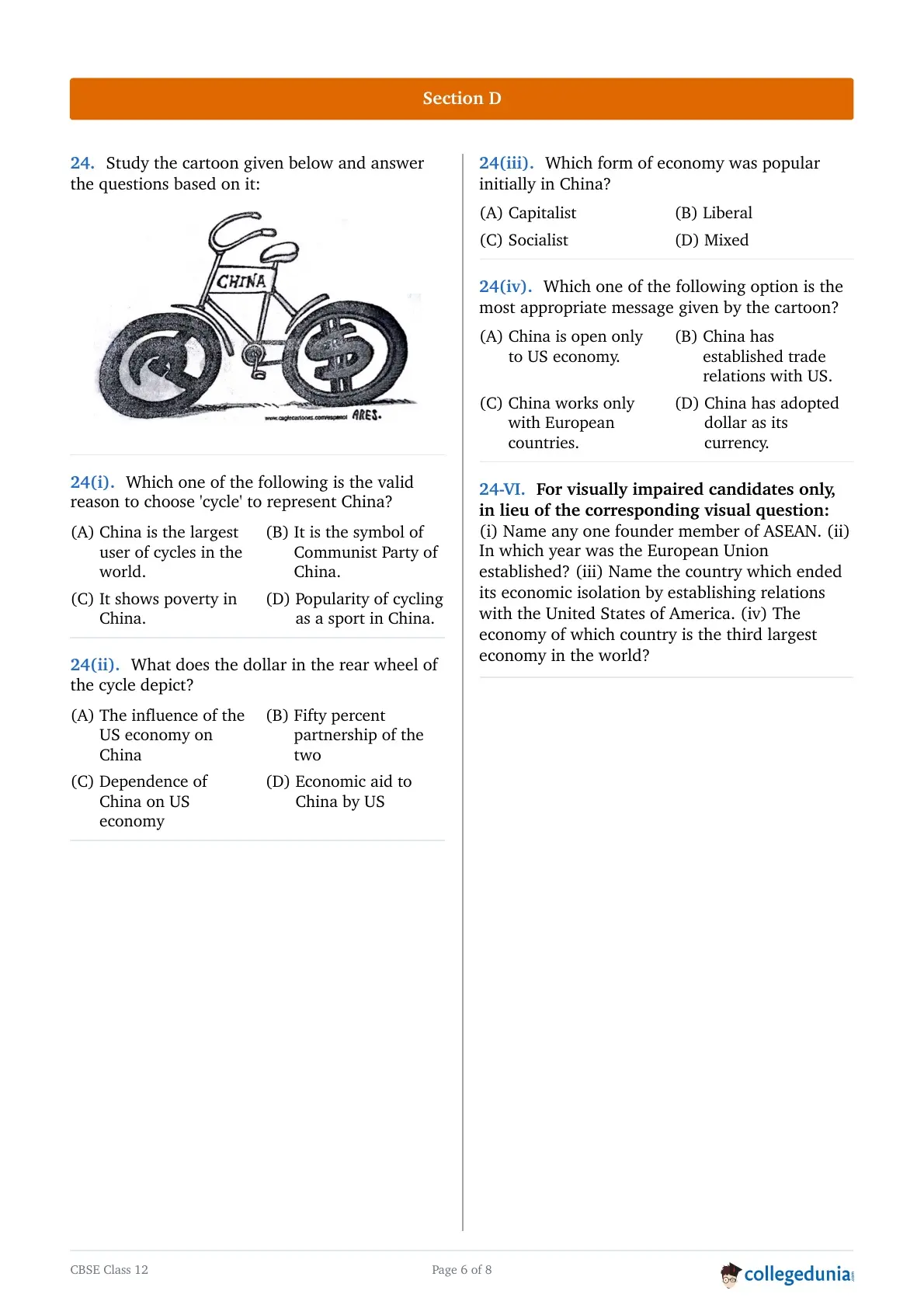
Which one of the following is the valid reason to choose 'cycle' to represent China ?
What does the dollar in the rear wheel of the cycle depict ?
Which form of economy was popular initially in China ?
Which one of the following option is the most appropriate message given by the cartoon ?
Who among the following leaders had played a crucial role in the formulation and implementation of India's foreign policy ?
In which city was the first summit of NAM held in September 1961 ?
Identify the two blocs from whom India wanted to keep a distance.
Which one of the following countries was a supporter of the Non-Aligned Movement ?
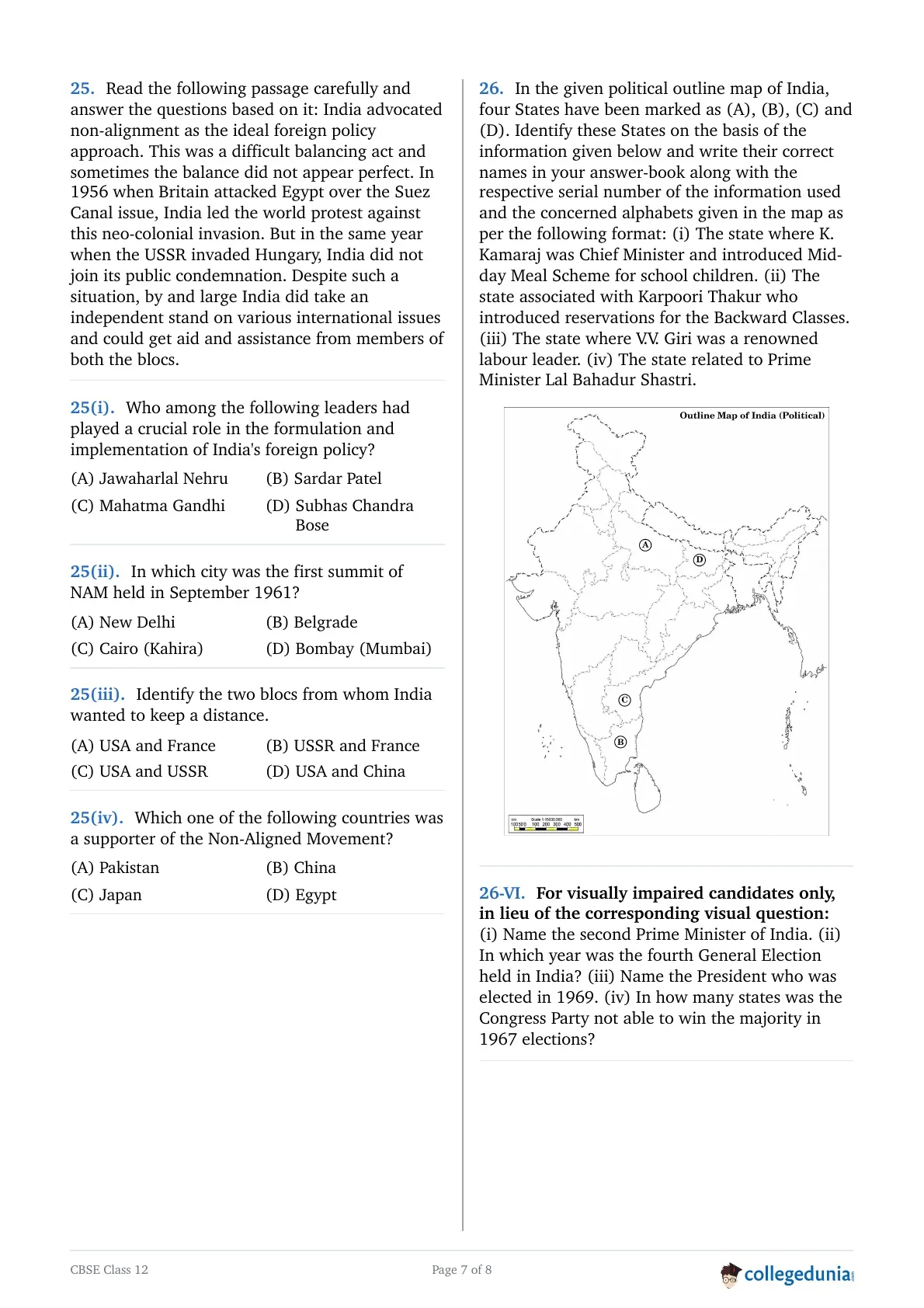
The state where K. Kamaraj was Chief Minister and introduced Mid-day Meal Scheme for school children.
The state associated with Karpoori Thakur who introduced reservations for the Backward Classes.
The state where V.V. Giri was a renowned labour leader.
Analyse the major initiatives taken by the first Earth Summit and the success it achieved in resolving the environmental issues.
Analyse the resource geopolitics and the relevance of water resource to global politics.
Analyse any three reasons for the movement against outsiders in Assam from 1979 to 1985.
Analyse any three reasons for the unrest and violence in Punjab from 1967 to 1985.
Describe any two areas of cooperation and any two areas of conflict among the member countries of the SAARC.
Describe any three events that show that people of all the South Asian countries want to have democracy in their country.
Describe any two positive and any two negative consequences of alliance politics in India.
Trace the political rise of Other Backward Classes in Indian politics since 1990. Also state the role of Mandal Commission in its rise.
CBSE Class 12 Political Science 2025 Question Paper Details
| Exam | CBSE Class 12 Board Examination 2025 |
| Subject | Political Science |
| Paper code | 59/6/2 |
| Exam date | March 22, 2025 |
| Time allowed | 3 hours (plus 15 minutes of reading time, 10:15 AM to 10:30 AM) |
| Maximum marks | 80 |
| Total questions | 30 (attempt 30) |
CBSE Class 12 Political Science Question Paper Pattern and Marking Scheme
The CBSE Class 12 Political Science 2025 question paper is of 80 marks and has 30 questions, of which 30 are to be attempted. The tables below give the section-wise paper pattern and the split of marks, as printed in the official question paper.
CBSE Class 12 Political Science Question Paper Pattern 2025
| Section | Questions | Question Type | Choice | Marks per Question | Marks |
|---|---|---|---|---|---|
| Section A | Q1-Q12 | Multiple choice questions (MCQs) | All 12 | 1 | 12 |
| Section B | Q13-Q18 | Short answer questions (50 to 60 words) | All 6 | 2 | 12 |
| Section C | Q19-Q23 | Long answer type-I questions (100 to 120 words), with internal choice (OR) in some questions | All 5 | 4 | 20 |
| Section D | Q24-Q26 | Passage, cartoon/picture and map-based questions | All 3 | 4 | 12 |
| Section E | Q27-Q30 | Long answer type-II questions (170 to 180 words), with internal choice (OR) in some questions | All 4 | 6 | 24 |
| Total | 30 questions | Attempt 30 | 80 |
CBSE Class 12 Political Science Marks Distribution 2025
| Question Type | Questions to Attempt | Marks per Question | Total Marks |
|---|---|---|---|
| Multiple choice questions (MCQs) (Section A) | 12 | 1 | 12 |
| Short answer questions (50 to 60 words) (Section B) | 6 | 2 | 12 |
| Long answer type-I questions (100 to 120 words), with internal choice (OR) in some questions (Section C) | 5 | 4 | 20 |
| Passage, cartoon/picture and map-based questions (Section D) | 3 | 4 | 12 |
| Long answer type-II questions (170 to 180 words), with internal choice (OR) in some questions (Section E) | 4 | 6 | 24 |
| Total | 30 | 80 |



Comments