




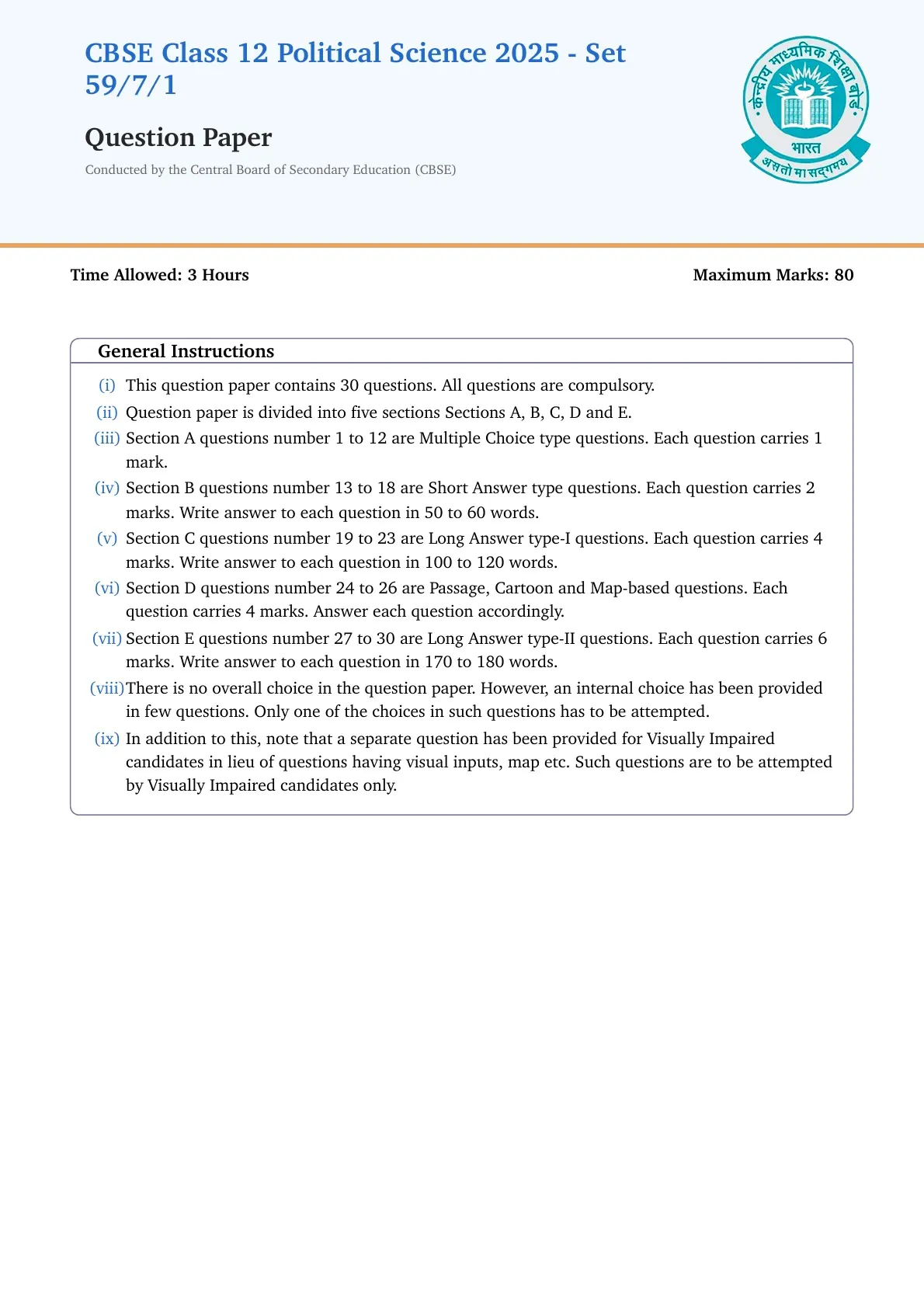
CBSE Class 12 Political Science Question Paper 2025 Code 59/7/1 is available for download here. CBSE conducted the Class 12 Political Science exam on March 22, 2025 from 10:30 AM to 1:30 PM. The Political Science theory paper is of 80 marks.
Also Check: CBSE Class 12 Question Paper 2025 (All Subjects)
The Political Science question paper includes the following types of questions:
- The question paper has 30 questions, all compulsory, for 80 marks in 3 hours, with 15 minutes of extra reading time
- Section A (Q1 to Q12) has 12 multiple choice questions of 1 mark each (12 marks)
- Section B (Q13 to Q18) has 6 short answer questions of 2 marks each, to be answered in 50 to 60 words (12 marks)
- Section C (Q19 to Q23) has 5 long answer type-I questions of 4 marks each, to be answered in 100 to 120 words (20 marks)
- Section D (Q24 to Q26) has 3 passage, cartoon/picture and map-based questions of 4 marks each (12 marks)
- Section E (Q27 to Q30) has 4 long answer type-II questions of 6 marks each, to be answered in 170 to 180 words (24 marks)
- There is no overall choice, but internal choice (OR) is given in some questions of Sections C and E
CBSE Class 12 Political Science Question Paper 2025 Code 59/7/1 PDF
| CBSE Official PDF | CD PDF | CD PDF with Solutions |
|---|---|---|
| Download official PDF 2.07 MB | Download Collegedunia PDF 1.89 MB | – |
CBSE Class 12 Political Science 2025 Set 59/7/1 Questions with Solutions
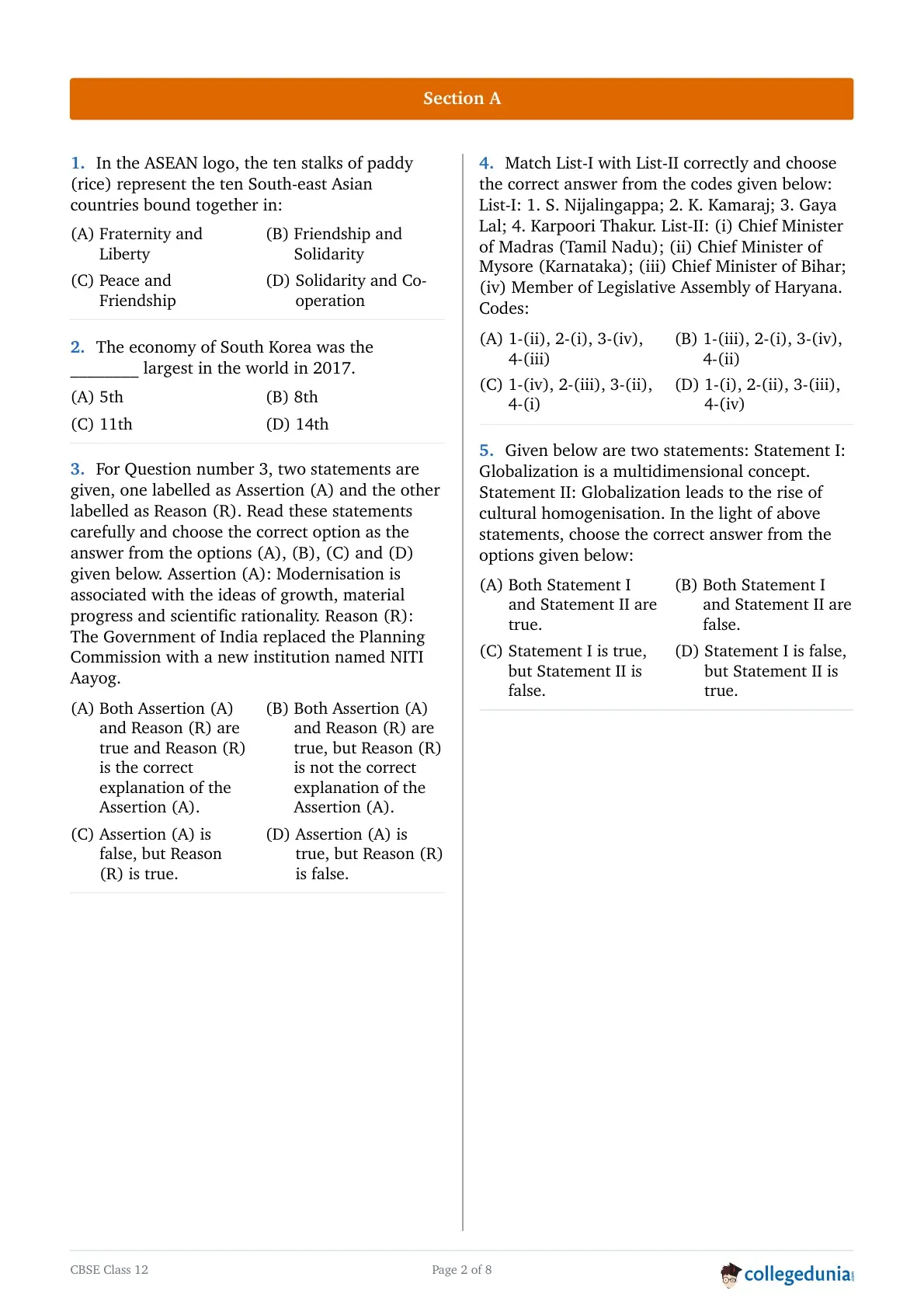
In the ASEAN logo, the ten stalks of paddy (rice) represent the ten South-east Asian countries bound together in :
The economy of South Korea was the _________ largest in the world in 2017.
For Question number 3, two statements are given - one labelled as Assertion (A) and the other labelled as Reason (R). Read these statements carefully and choose the correct option as the answer from the options (A), (B), (C) and (D) given below.
Assertion (A) : Modernisation is associated with the ideas of growth, material progress and scientific rationality.
Reason (R) : The Government of India replaced the Planning Commission with a new institution named NITI Aayog.
Match List-I with List-II correctly and choose the correct answer from the codes given below :
| List-I | List-II |
| 1. S. Nijalingappa | (i) Chief Minister of Madras (Tamil Nadu) |
| 2. K. Kamaraj | (ii) Chief Minister of Mysore (Karnataka) |
| 3. Gaya Lal | (iii) Chief Minister of Bihar |
| 4. Karpoori Thakur | (iv) Member of Legislative Assembly of Haryana |
Codes :
Given below are two statements :
Statement I : Globalization is a multidimensional concept.
Statement II : Globalization leads to the rise of cultural homogenisation.
In the light of above statements, choose the correct answer from the options given below :
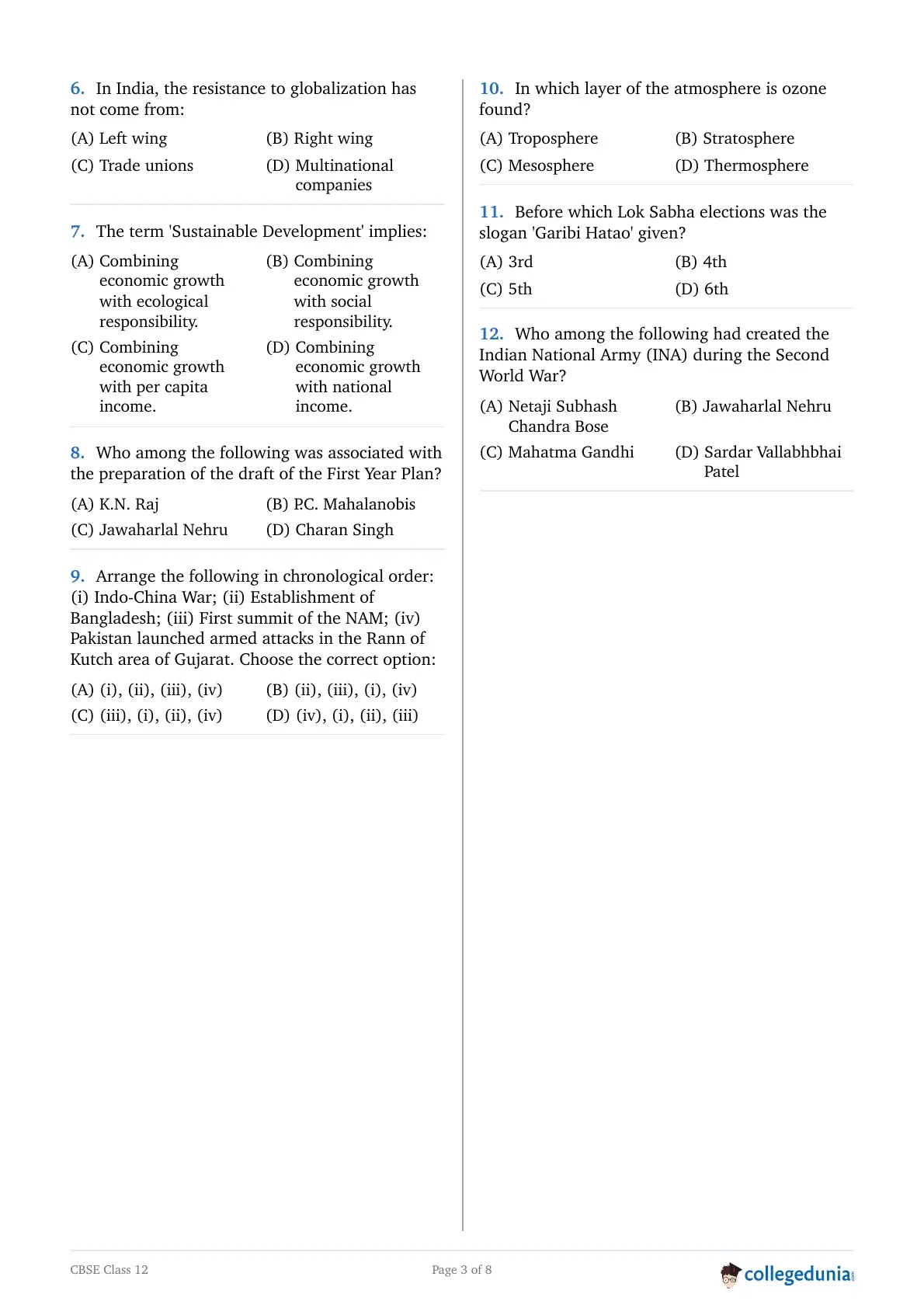
In India, the resistance to globalization has not come from :
The term 'Sustainable Development' implies :
Who among the following was associated with the preparation of the draft of the First Year Plan ?
In which layer of the atmosphere is ozone found ?
Before which Lok Sabha elections was the slogan 'Garibi Hatao' given ?
Who among the following had created the Indian National Army (INA) during the Second World War ?
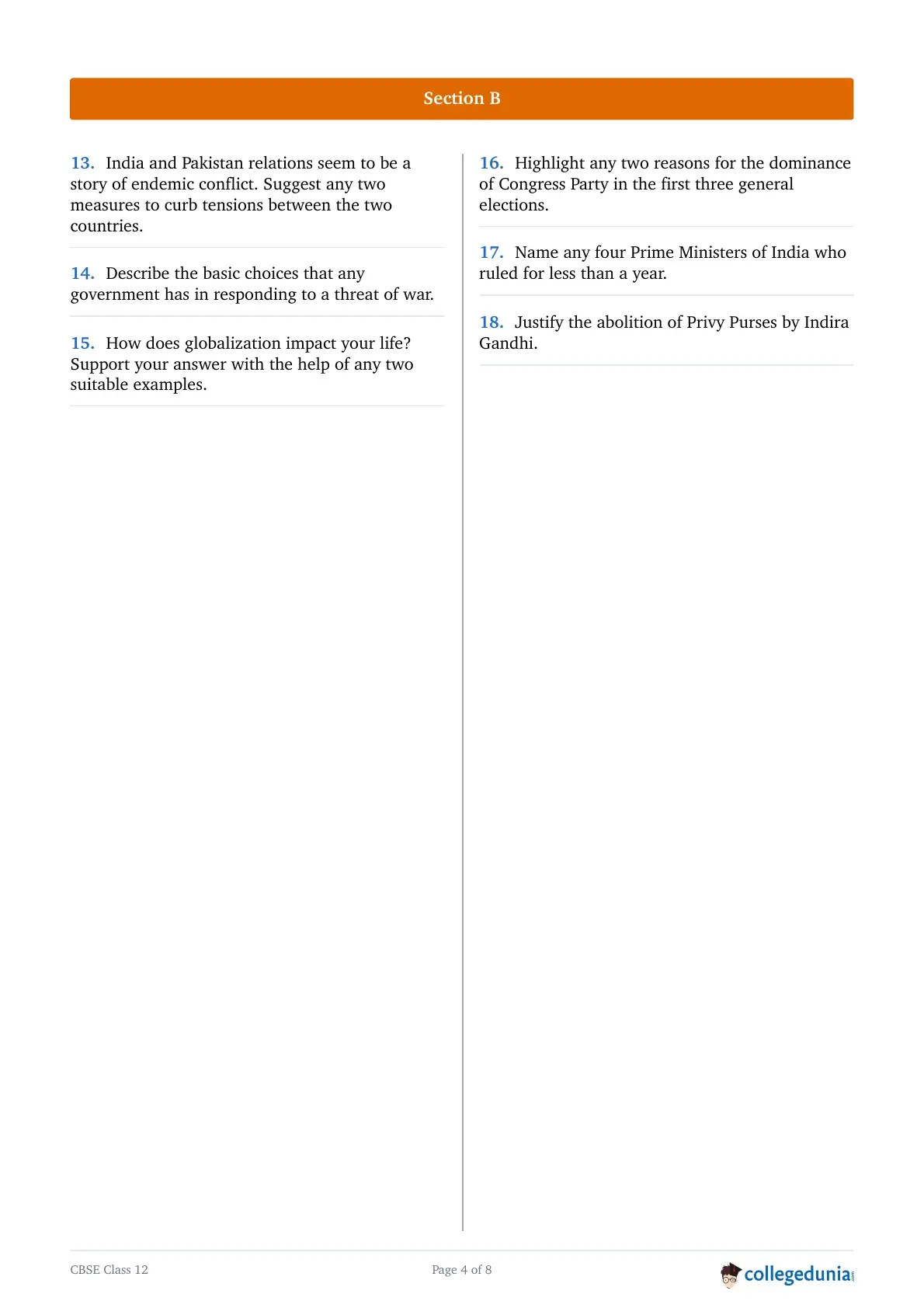
India and Pakistan relations seem to be a story of endemic conflict. Suggest any two measures to curb tensions between the two countries.
Describe the basic choices that any government has in responding to a threat of war.
How does globalization impact your life ? Support your answer with the help of any two suitable examples.
Highlight any two reasons for the dominance of Congress Party in the first three general elections.
Name any four Prime Ministers of India who ruled for less than a year.
Justify the abolition of Privy Purses by Indira Gandhi.
Describe the objectives and means of the student movement in Bihar under the leadership of Jayaprakash Narayan in 1974.
Explain any two differences between the traditional notions of external and internal security.
Explain the various economic policies adopted by China that led to the rise of its economy.
Between the 1960s and the 1980s, South Korea emerged as an economic power in Asia which is termed as "Miracle on the Han River". Explain any two reasons behind it.
Describe any four contributions made by India to promote international peace and security.
Describe any four important principles of India's foreign policy.
Explain any two developments that took place in Indian politics after 1989 which made a long lasting impact on its politics.
SAFTA came into effect from :
SAFTA is related to which one of the following regional organisations ?
Which one of the following objective is true about the spirit behind the idea of SAFTA ?
What among the following was promised by SAFTA ?
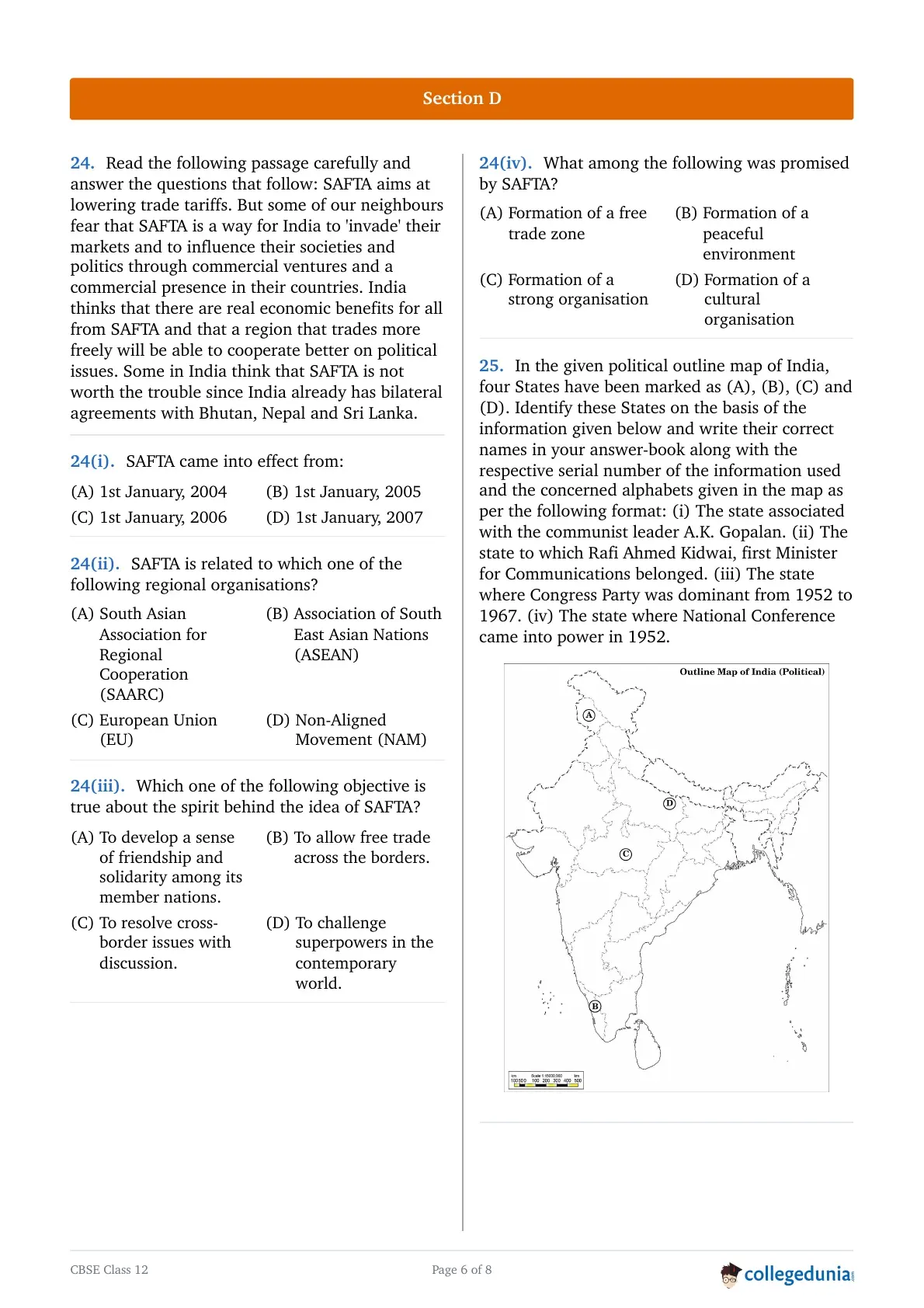
In the given political outline map of India (on page 15), four States have been marked as (A), (B), (C) and (D). Identify these States on the basis of the information given below and write their correct names in your answer-book along with the respective serial number of the information used and the concerned alphabets given in the map as per the following format :
| Serial number of the information used | Concerned alphabet given in the map | Name of the State |
| (i) | ||
| (ii) | ||
| (iii) | ||
| (iv) |
(i) The state associated with the communist leader A.K. Gopalan.
(ii) The state to which Rafi Ahmed Kidwai, first Minister for Communications belonged.
(iii) The state where Congress Party was dominant from 1952 to 1967.
(iv) The state where National Conference came into power in 1952.
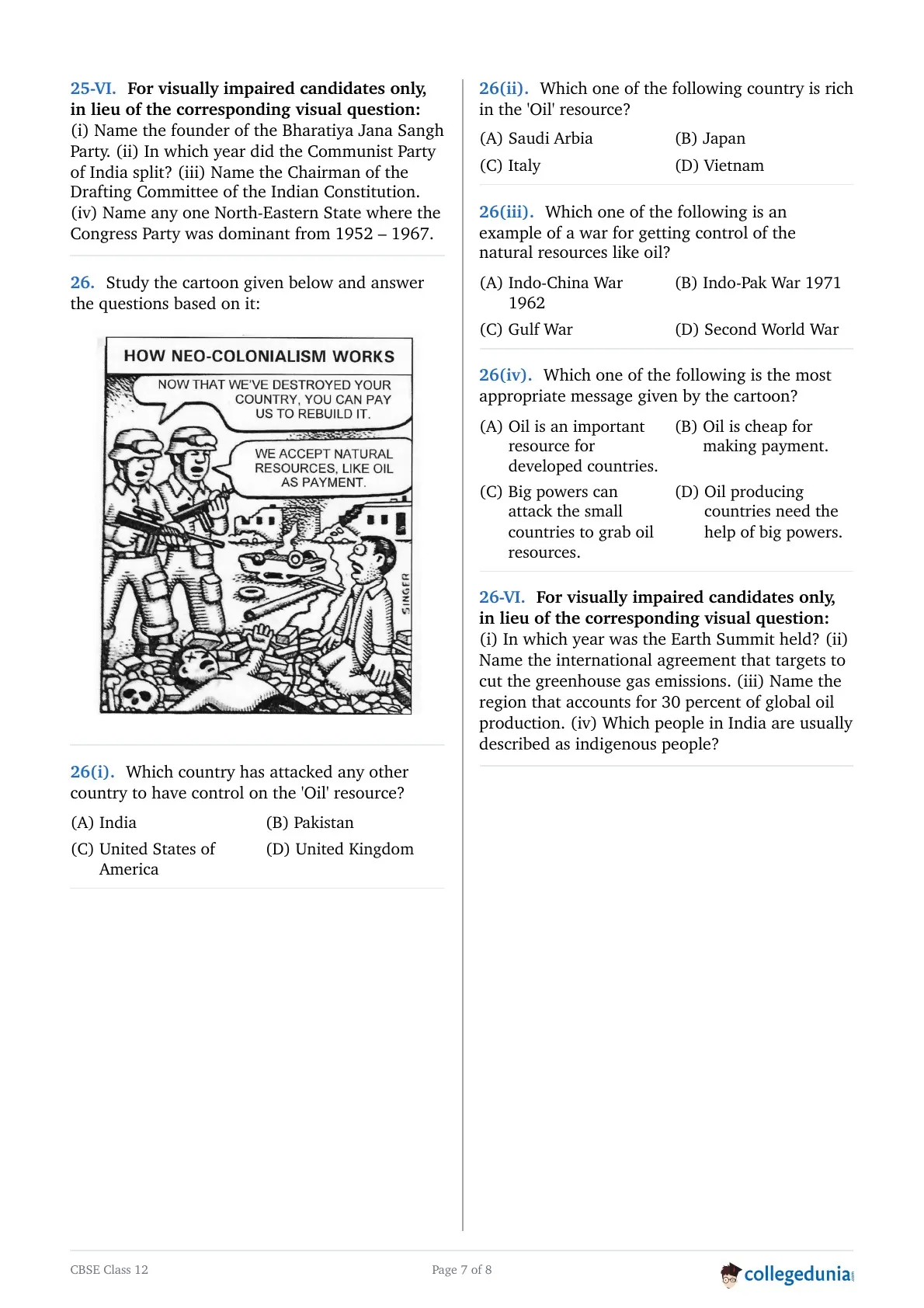
Which country has attacked any other country to have control on the 'Oil' resource ?
Which one of the following country is rich in the 'Oil' resource ?
Which one of the following is an example of a war for getting control of the natural resources like oil ?
Which one of the following is the most appropriate message given by the cartoon ?
Highlight the reasons for the tensions and conflicts faced by any three former Soviet Republics.
Highlight any four reasons for the disintegration of the Soviet Union in 1991.
Justify India's claim for permanent membership of the United Nations Security Council with any four criteria.
Justify the relevance of United Nations Organization in the contemporary world with the help of any four examples.
Explain any two reasons responsible for the establishment of the States Reorganization Commission and highlight the basis on which new states were created.
Explain any three challenges which India faced at the time of independence.
Assess the reasons for the Dravidian Movement and its outcomes.
Why is the period since 1980 known for the rise of regional aspirations ? Assess India's response to these aspirations.
CBSE Class 12 Political Science 2025 Question Paper Details
| Exam | CBSE Class 12 Board Examination 2025 |
| Subject | Political Science |
| Paper code | 59/7/1 |
| Exam date | March 22, 2025 |
| Time allowed | 3 hours (plus 15 minutes of reading time, 10:15 AM to 10:30 AM) |
| Maximum marks | 80 |
| Total questions | 30 (attempt 30) |
CBSE Class 12 Political Science Question Paper Pattern and Marking Scheme
The CBSE Class 12 Political Science 2025 question paper is of 80 marks and has 30 questions, of which 30 are to be attempted. The tables below give the section-wise paper pattern and the split of marks, as printed in the official question paper.
CBSE Class 12 Political Science Question Paper Pattern 2025
| Section | Questions | Question Type | Choice | Marks per Question | Marks |
|---|---|---|---|---|---|
| Section A | Q1-Q12 | Multiple choice questions (MCQs) | All 12 | 1 | 12 |
| Section B | Q13-Q18 | Short answer questions (50 to 60 words) | All 6 | 2 | 12 |
| Section C | Q19-Q23 | Long answer type-I questions (100 to 120 words), with internal choice (OR) in some questions | All 5 | 4 | 20 |
| Section D | Q24-Q26 | Passage, cartoon/picture and map-based questions | All 3 | 4 | 12 |
| Section E | Q27-Q30 | Long answer type-II questions (170 to 180 words), with internal choice (OR) in some questions | All 4 | 6 | 24 |
| Total | 30 questions | Attempt 30 | 80 |
CBSE Class 12 Political Science Marks Distribution 2025
| Question Type | Questions to Attempt | Marks per Question | Total Marks |
|---|---|---|---|
| Multiple choice questions (MCQs) (Section A) | 12 | 1 | 12 |
| Short answer questions (50 to 60 words) (Section B) | 6 | 2 | 12 |
| Long answer type-I questions (100 to 120 words), with internal choice (OR) in some questions (Section C) | 5 | 4 | 20 |
| Passage, cartoon/picture and map-based questions (Section D) | 3 | 4 | 12 |
| Long answer type-II questions (170 to 180 words), with internal choice (OR) in some questions (Section E) | 4 | 6 | 24 |
| Total | 30 | 80 |



Comments