




CBSE Class 12 Political Science Question Paper 2025 Code 59/S/3 (Compartment) is available for download here. CBSE conducted the Class 12 Political Science exam on July 15, 2025 from 10:30 AM to 1:30 PM. The Political Science theory paper is of 80 marks.
Also Check: CBSE Class 12 Question Paper 2025 (All Subjects)
The Political Science question paper includes the following types of questions:
- The question paper has 30 questions, all compulsory, for 80 marks in 3 hours, with 15 minutes of extra reading time
- Section A (Q1 to Q12) has 12 multiple choice questions of 1 mark each (12 marks)
- Section B (Q13 to Q18) has 6 short answer questions of 2 marks each, to be answered in 50 to 60 words (12 marks)
- Section C (Q19 to Q23) has 5 long answer type-I questions of 4 marks each, to be answered in 100 to 120 words (20 marks)
- Section D (Q24 to Q26) has 3 passage, cartoon/picture and map-based questions of 4 marks each (12 marks)
- Section E (Q27 to Q30) has 4 long answer type-II questions of 6 marks each, to be answered in 170 to 180 words (24 marks)
- There is no overall choice, but internal choice (OR) is given in some questions of Sections C and E
CBSE Class 12 Political Science Question Paper 2025 Code 59/S/3 (Compartment) PDF
| CBSE Official PDF | CD PDF | CD PDF with Solutions |
|---|---|---|
| Download official PDF 0.63 MB | Download Collegedunia PDF 0.90 MB | – |
CBSE Class 12 Political Science 2025 Set 59/S/3 (Compartment) Questions with Solutions
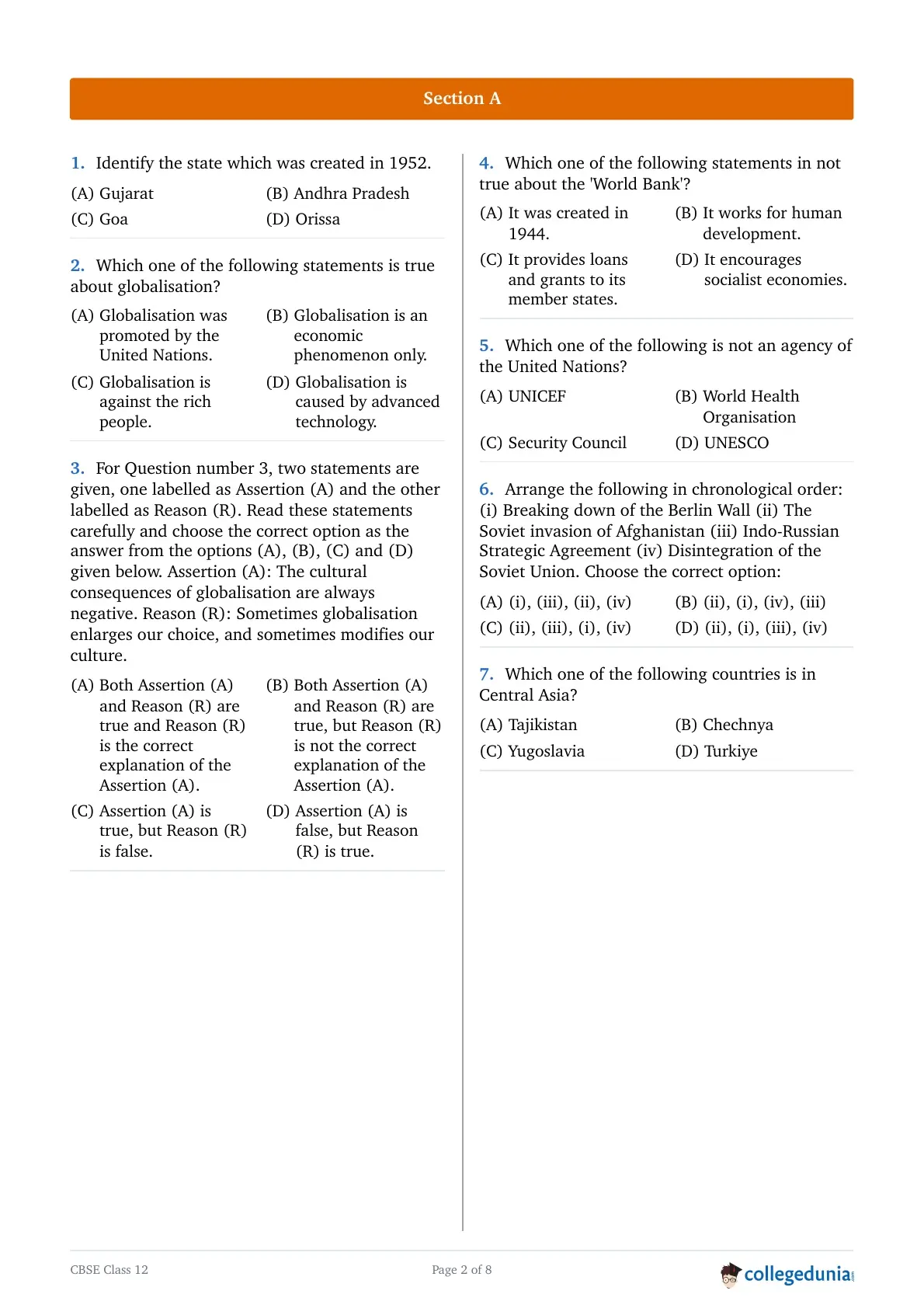
Identify the state which was created in 1952.
Which one of the following statements is true about globalisation ?
For Question number 3, two statements are given - one labelled as Assertion (A) and the other labelled as Reason (R). Read these statements carefully and choose the correct option as the answer from the options (A), (B), (C) and (D) given below.
Assertion (A) : The cultural consequences of globalisation are always negative.
Reason (R) : Sometimes globalisation enlarges our choice, and sometimes modifies our culture.
Which one of the following statements in not true about the 'World Bank' ?
Which one of the following is not an agency of the United Nations ?
Arrange the following in chronological order :
- (i) Breaking down of the Berlin Wall
- (ii) The Soviet invasion of Afghanistan
- (iii) Indo-Russian Strategic Agreement
- (iv) Disintegration of the Soviet Union
Choose the correct option :
Which one of the following countries is in Central Asia ?
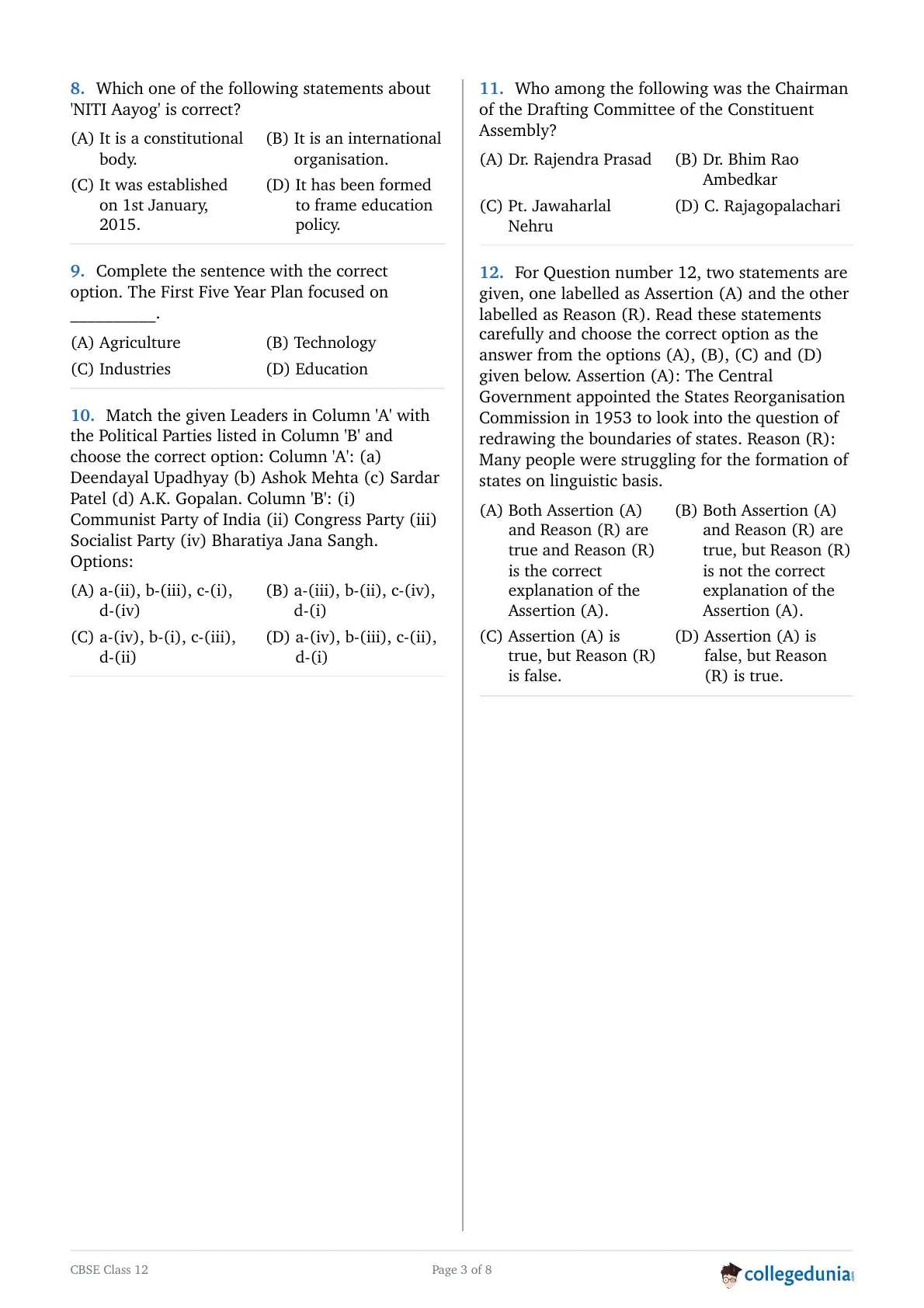
Which one of the following statements about 'NITI Aayog' is correct ?
Complete the sentence with the correct option.
The First Five Year Plan focused on ___________.
Match the given Leaders in Column 'A' with the Political Parties listed in Column 'B' and choose the correct option :
| Column 'A' | Column 'B' |
| (a) Deendayal Upadhyay | (i) Communist Party of India |
| (b) Ashok Mehta | (ii) Congress Party |
| (c) Sardar Patel | (iii) Socialist Party |
| (d) A.K. Gopalan | (iv) Bharatiya Jana Sangh |
Who among the following was the Chairman of the Drafting Committee of the Constituent Assembly ?
For Question number 12, two statements are given - one labelled as Assertion (A) and the other labelled as Reason (R). Read these statements carefully and choose the correct option as the answer from the options (A), (B), (C) and (D) given below.
Assertion (A) : The Central Government appointed the States Reorganisation Commission in 1953 to look into the question of redrawing the boundaries of states.
Reason (R) : Many people were struggling for the formation of states on linguistic basis.
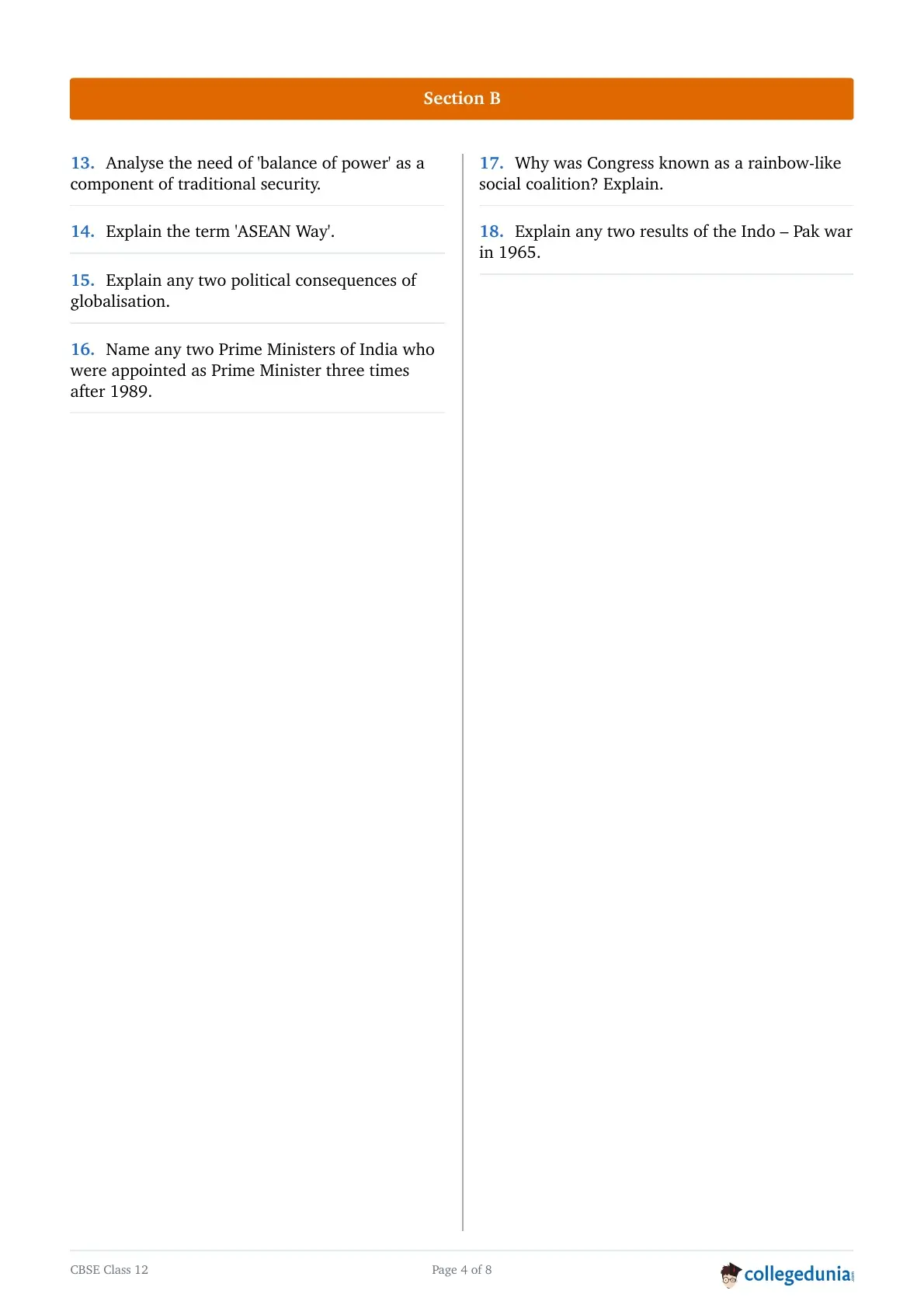
Analyse the need of 'balance of power' as a component of traditional security.
Explain the term 'ASEAN Way'.
Explain any two political consequences of globalisation.
Name any two Prime Ministers of India who were appointed as Prime Minister three times after 1989.
Why was Congress known as a rainbow-like social coalition ? Explain.
Explain any two results of the Indo - Pak war in 1965.
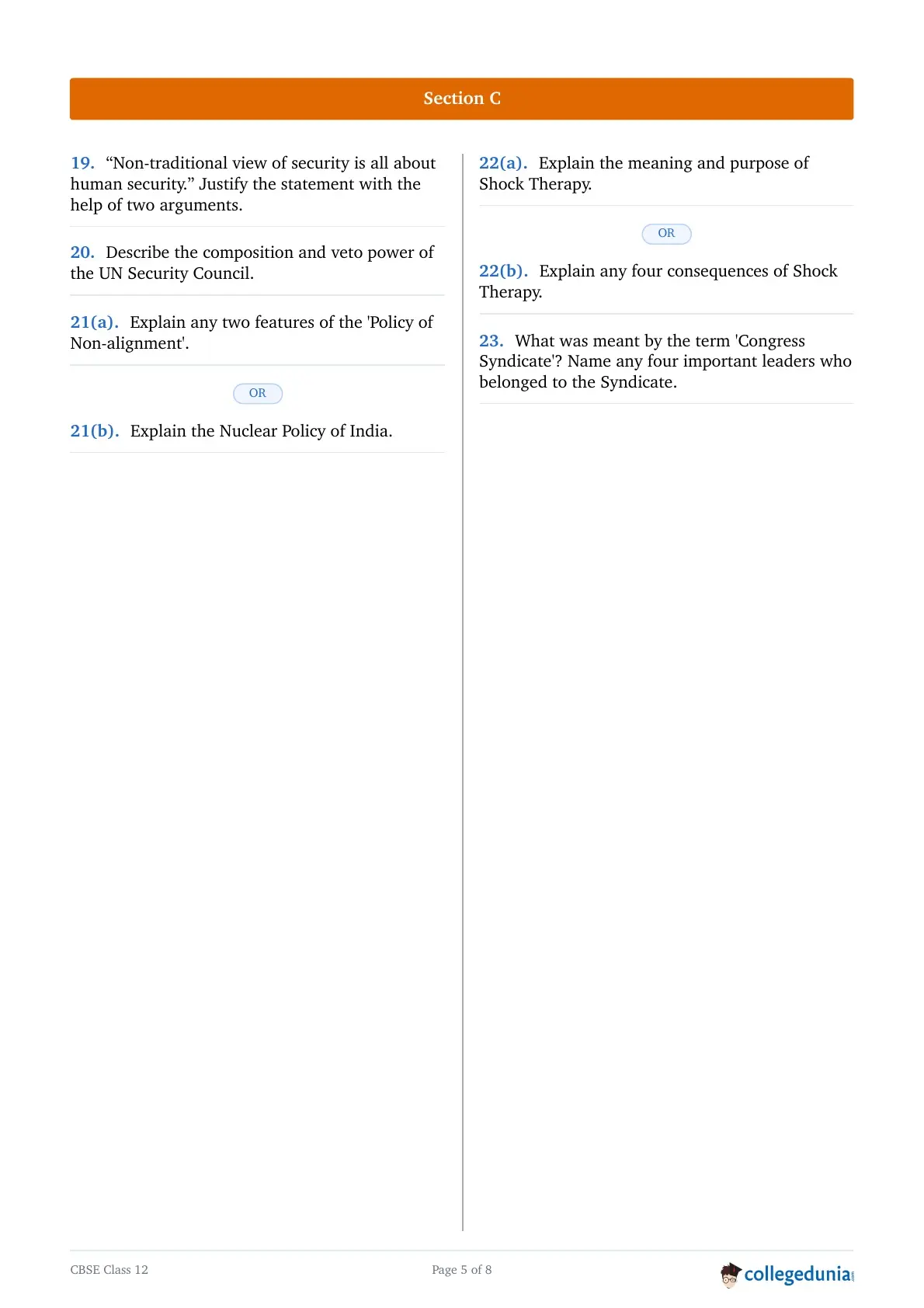
"Non-traditional view of security is all about human security." Justify the statement with the help of two arguments.
Describe the composition and veto power of the UN Security Council.
Explain any two features of the 'Policy of Non-alignment'.
Explain the Nuclear Policy of India.
Explain the meaning and purpose of Shock Therapy.
Explain any four consequences of Shock Therapy.
What was meant by the term 'Congress Syndicate' ? Name any four important leaders who belonged to the Syndicate.
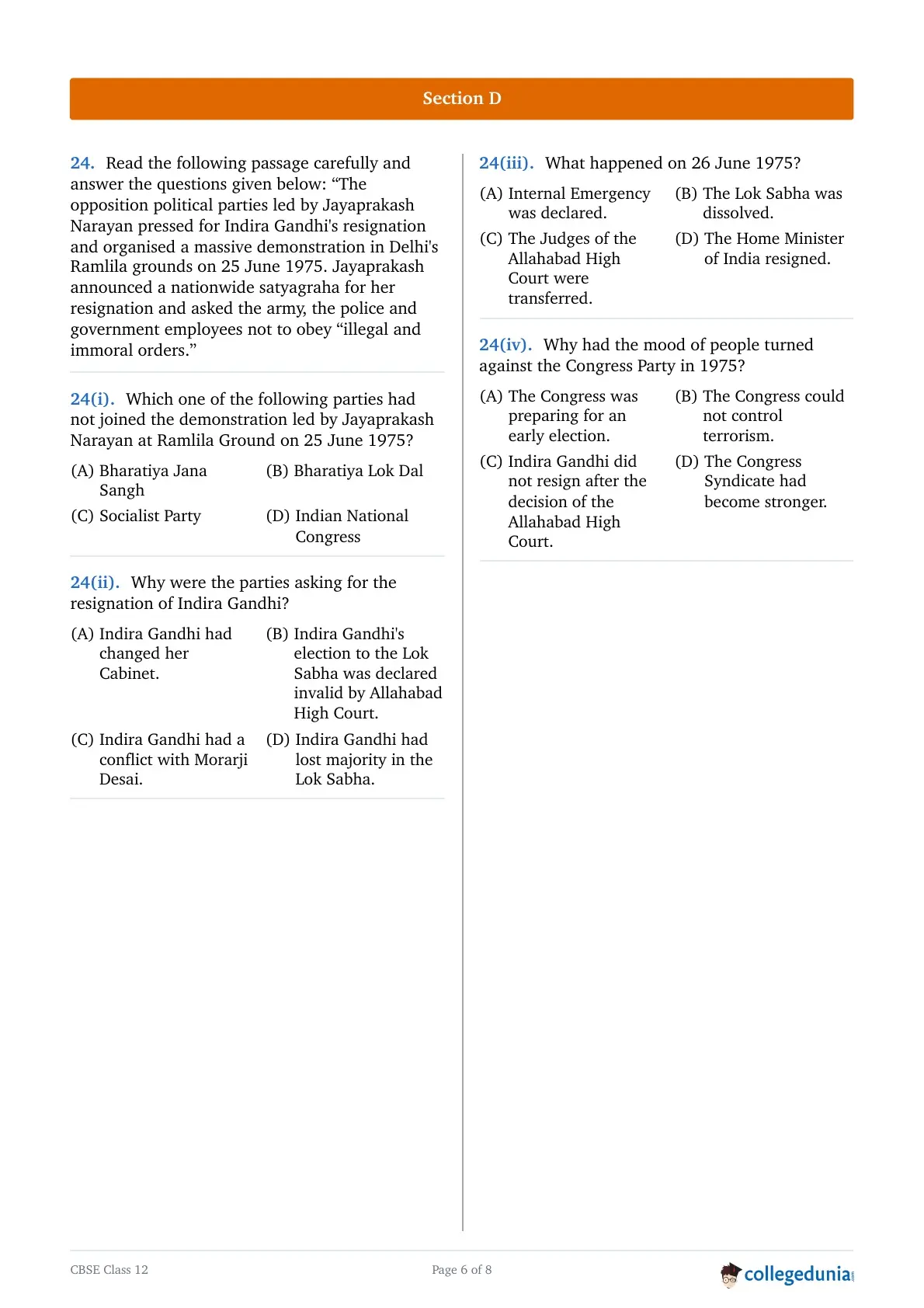
Which one of the following parties had not joined the demonstration led by Jayaprakash Narayan at Ramlila Ground on 25 June 1975 ?
Why were the parties asking for the resignation of Indira Gandhi ?
What happened on 26 June 1975 ?
Why had the mood of people turned against the Congress Party in 1975 ?
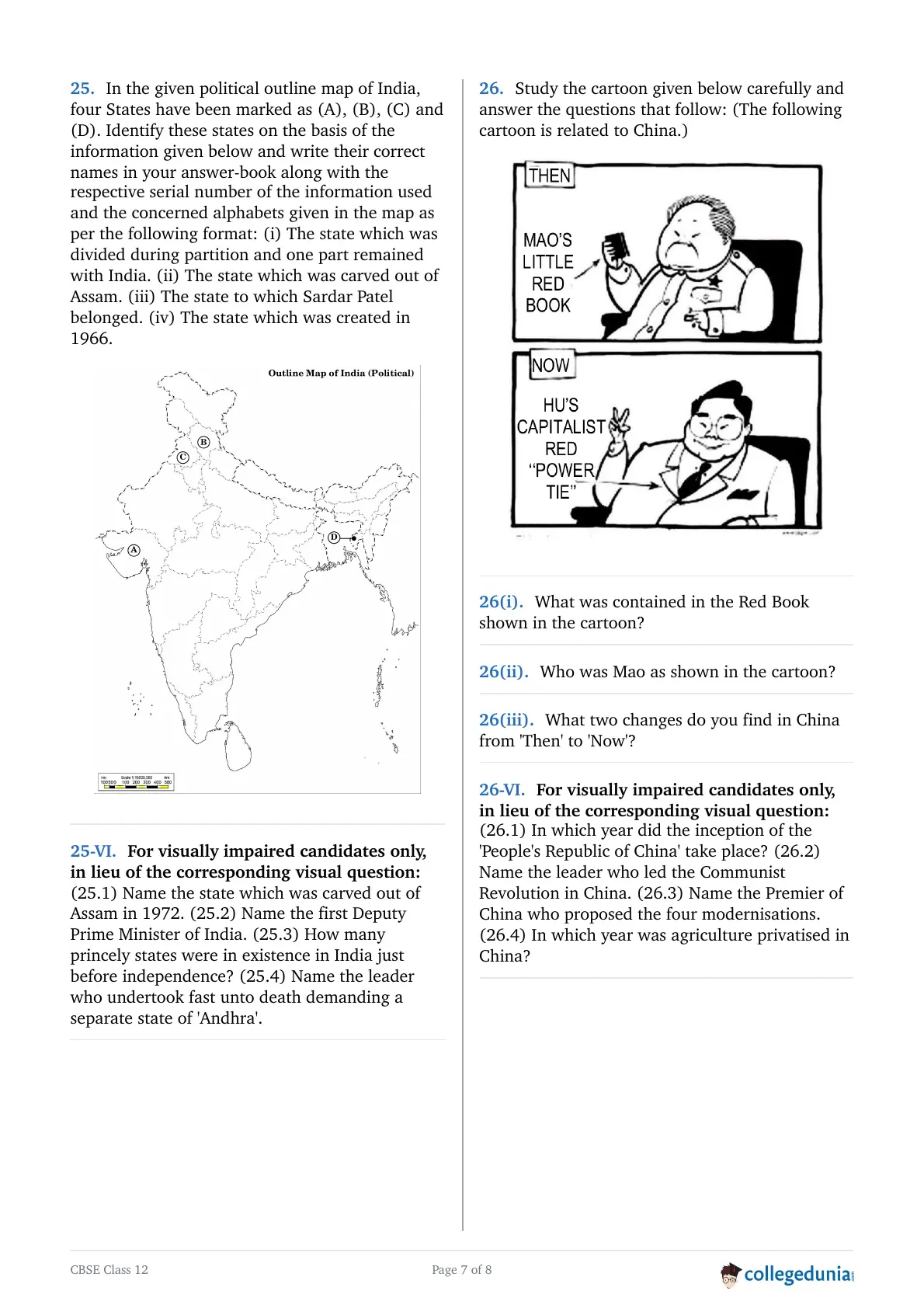
In the given political outline map of India (on page 15), four States have been marked as (A), (B), (C) and (D). Identify these states on the basis of the information given below and write their correct names in your answer-book along with the respective serial number of the information used and the concerned alphabets given in the map as per the following format :
| Serial number of the information used | Concerned alphabet given in the map | Name of the State |
| (i) | ||
| (ii) | ||
| (iii) | ||
| (iv) |
- (i) The state which was divided during partition and one part remained with India.
- (ii) The state which was carved out of Assam.
- (iii) The state to which Sardar Patel belonged.
- (iv) The state which was created in 1966.
What was contained in the Red Book shown in the cartoon ?
Who was Mao as shown in the cartoon ?
What two changes do you find in China from 'Then' to 'Now' ?
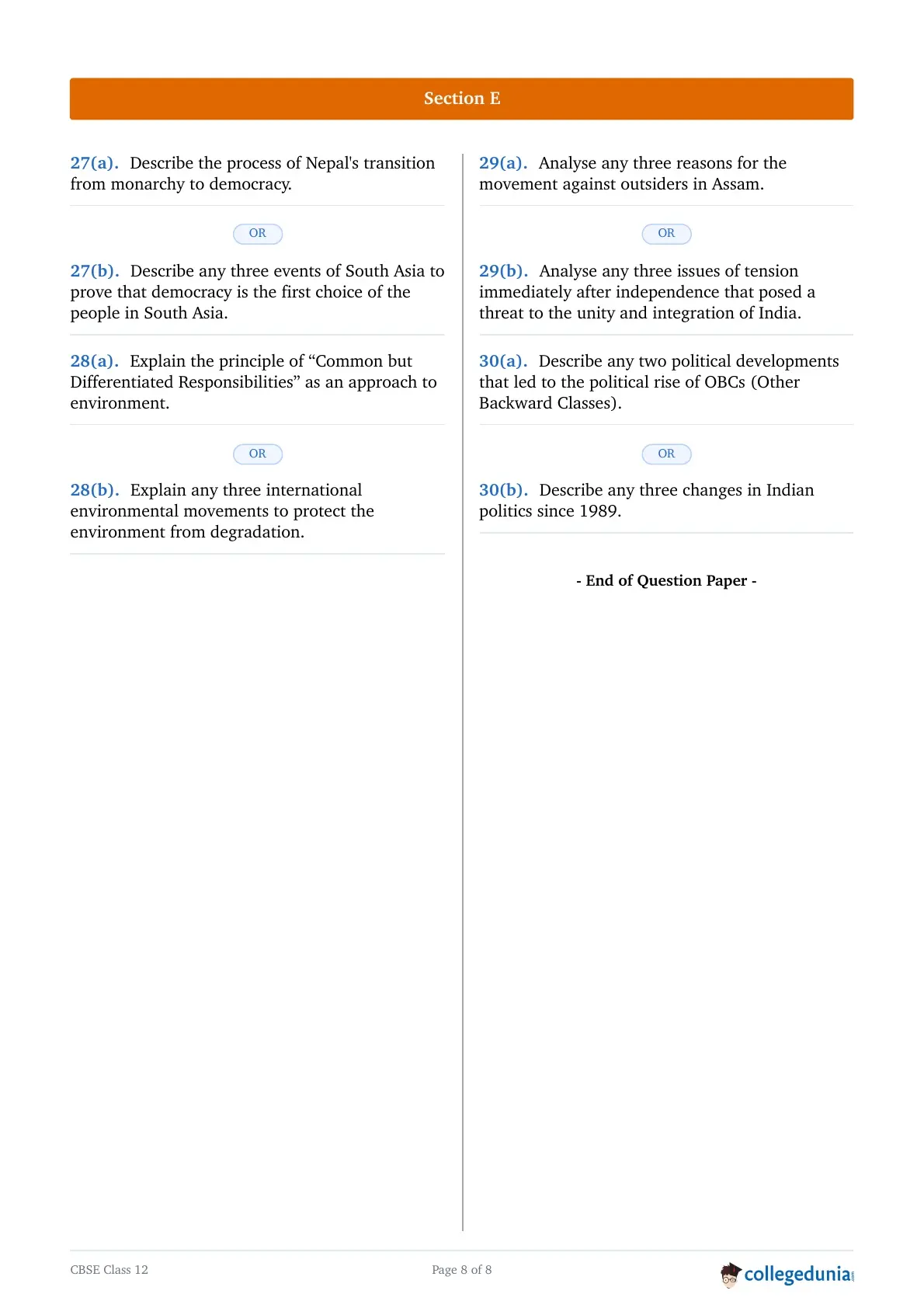
Describe the process of Nepal's transition from monarchy to democracy.
Describe any three events of South Asia to prove that democracy is the first choice of the people in South Asia.
Explain the principle of "Common but Differentiated Responsibilities" as an approach to environment.
Explain any three international environmental movements to protect the environment from degradation.
Analyse any three reasons for the movement against outsiders in Assam.
Analyse any three issues of tension immediately after independence that posed a threat to the unity and integration of India.
Describe any two political developments that led to the political rise of OBCs (Other Backward Classes).
Describe any three changes in Indian politics since 1989.
CBSE Class 12 Political Science 2025 Question Paper Details
| Exam | CBSE Class 12 Board Examination 2025 |
| Subject | Political Science |
| Paper code | 59/S/3 (Compartment) |
| Exam date | July 15, 2025 |
| Time allowed | 3 hours (plus 15 minutes of reading time, 10:15 AM to 10:30 AM) |
| Maximum marks | 80 |
| Total questions | 30 (attempt 30) |
CBSE Class 12 Political Science Question Paper Pattern and Marking Scheme
The CBSE Class 12 Political Science 2025 question paper is of 80 marks and has 30 questions, of which 30 are to be attempted. The tables below give the section-wise paper pattern and the split of marks, as printed in the official question paper.
CBSE Class 12 Political Science Question Paper Pattern 2025
| Section | Questions | Question Type | Choice | Marks per Question | Marks |
|---|---|---|---|---|---|
| Section A | Q1-Q12 | Multiple choice questions (MCQs) | All 12 | 1 | 12 |
| Section B | Q13-Q18 | Short answer questions (50 to 60 words) | All 6 | 2 | 12 |
| Section C | Q19-Q23 | Long answer type-I questions (100 to 120 words), with internal choice (OR) in some questions | All 5 | 4 | 20 |
| Section D | Q24-Q26 | Passage, cartoon/picture and map-based questions | All 3 | 4 | 12 |
| Section E | Q27-Q30 | Long answer type-II questions (170 to 180 words), with internal choice (OR) in some questions | All 4 | 6 | 24 |
| Total | 30 questions | Attempt 30 | 80 |
CBSE Class 12 Political Science Marks Distribution 2025
| Question Type | Questions to Attempt | Marks per Question | Total Marks |
|---|---|---|---|
| Multiple choice questions (MCQs) (Section A) | 12 | 1 | 12 |
| Short answer questions (50 to 60 words) (Section B) | 6 | 2 | 12 |
| Long answer type-I questions (100 to 120 words), with internal choice (OR) in some questions (Section C) | 5 | 4 | 20 |
| Passage, cartoon/picture and map-based questions (Section D) | 3 | 4 | 12 |
| Long answer type-II questions (170 to 180 words), with internal choice (OR) in some questions (Section E) | 4 | 6 | 24 |
| Total | 30 | 80 |



Comments