




The CBSE Board conducted Class 12 Political Science Set 2 - (59/3/2) Exam on March 23, 2026. The CBSE Class 12 Political Science paper covers key topics from Indian Politics, Comparative Politics, and Political Theory and considered moderately difficult. The exam is marked out of 100, with 80 marks for the theory paper and 20 for internal assessment.
Class 12 Political Science Set 2 - (59/3/2) Question Paper 2026 – with Solution PDF is available here for download.
CBSE Class 12 Political Science Set 2 - (59/3/2) Question Paper 2026 with Solution PDF
| CBSE Class 12 Political Science Question Paper 2026 Set 2 - (59/3/2) | Download PDF | Check Solutions |



In which city was the first Summit of the Non-Aligned Movement (NAM) held ?
View Solution
Concept:
The Non-Aligned Movement (NAM) was established during the Cold War era as an international forum of states that chose not to formally align themselves with either of the two major power blocs led by the United States (Capitalist bloc) or the Soviet Union (Socialist bloc).
Key foundational developments of NAM:
Bandung Conference (1955): The Afro-Asian Conference held in Bandung, Indonesia, laid the preliminary groundwork and principles for solidarity among newly independent post-colonial nations.
Founding Leaders: The movement was spearheaded by five key global leaders:
\[ Jawaharlal Nehru (India), \quad Josip Broz Tito (Yugoslavia), \quad Gamal Abdel Nasser (Egypt), \]
\[ Sukarno (Indonesia), \quad and \quad Kwame Nkrumah (Ghana). \]
First Official NAM Summit: The formal establishment and first summit of NAM took place in September 1961.
Step 1: Analyzing the historical background and establishment of NAM.
After World War II, the world was divided into two major military alliances: NATO (led by the USA) and the Warsaw Pact (led by the USSR). Newly independent nations of Asia, Africa, and Latin America sought an independent foreign policy path to preserve their sovereignty, foster national development, and avoid becoming pawns in Cold War proxy conflicts.
Step 2: Evaluating the location of the First Summit.
In September 1961, representatives from 25 neutral countries gathered in Belgrade , the capital of Yugoslavia (hosted by President Josip Broz Tito). This official conference marked the inauguration of the Non-Aligned Movement as an organized international entity.
Step 3: Evaluating the incorrect options.
(B) Bandung: Hosted the landmark Afro-Asian Conference in 1955 which served as a precursor to NAM, but was not the first formal NAM Summit.
(C) Tokyo: Tokyo was never the venue for the founding summit of NAM.
(D) Delhi: Hosted the 7th NAM Summit in 1983, not the first summit.
Hence, the first official NAM Summit was held in Belgrade in September 1961, making Option (A) the correct choice. Quick Tip: Remember the distinction between Bandung and Belgrade: - Bandung Conference (1955): Precursor / foundational conference of Afro-Asian solidarity. - Belgrade Summit (1961): First official Summit of the Non-Aligned Movement (25 participating nations).
Choose the best argument to support India’s claim for permanent membership in the United Nations Security Council :
View Solution
Concept:
The United Nations Security Council (UNSC) consists of 15 members: 5 permanent members (P5—USA, UK, France, Russia, China) with veto power, and 10 non-permanent members elected for two-year terms.
To restructure the UNSC and reflect contemporary geopolitical realities, the UN General Assembly proposed key criteria for new permanent members:
A major economic power
A major military power
A substantial contributor to the UN budget
A large population
A nation that respects democracy and human rights
A country that would make the Council more representative of the world's diversity
Step 1: Analyzing India's fulfillment of UNSC permanent membership criteria.
India is the world's most populous nation and the largest vibrant democracy with an uninterrupted constitutional record and a stable political system. Furthermore, India is one of the world's fastest-growing major economies, elevating its global strategic, political, and financial influence.
Step 2: Comparing the given options based on weight and validity.
(A) India's growing economic power and stable political system: This provides the most comprehensive and concrete structural justification alignment with official UN reform parameters. Economic stature combined with democratic stability ensures that India can bear the strategic and financial responsibilities of a permanent UNSC seat.
(B) India's effective leadership: While true, "effective leadership" is a subjective attribute and not a formal, quantifiable parameter defined by the UN.
(C) India's membership since inception: Being an original signing member in 1945 is a historical fact, but initial membership alone does not automatically entitle a country to UNSC permanent status (over 50 countries were founding members).
(D) Financial contribution to UN budget: India contributes regularly, but its individual share of the regular UN assessed budget is relatively modest compared to top financial contributors like Japan or Germany.
Therefore, India's robust economic growth alongside its stable, functioning democratic framework constitutes the strongest formal argument for permanent UNSC representation. Quick Tip: When evaluating arguments for UNSC expansion, look for arguments combining both objective quantitative power (economic size, population) and political durability (stable democracy, peace contribution).
Which one of the following was the decision of the Supreme Court given on 24 June, 1975 about the Indira Gandhi case ?
View Solution
Concept:
On June 12, 1975, Justice Jagmohan Lal Sinha of the Allahabad High Court passed a landmark verdict in the election petition filed by Raj Narain. The High Court declared Prime Minister Indira Gandhi's election to the Lok Sabha from Rae Bareli invalid on grounds of electoral malpractices (utilizing state machinery and government officials for electioneering).
Indira Gandhi appealed this verdict in the Supreme Court of India.
Step 1: Understanding the Supreme Court's conditional ruling on 24 June, 1975.
On June 24, 1975, Justice V.R. Krishna Iyer, sitting as the vacation judge of the Supreme Court, granted a conditional (partial) stay on the operation of the Allahabad High Court order pending the complete disposal of her appeal.
Step 2: Analyzing the exact terms of the partial stay.
Under the terms of this conditional order:
Indira Gandhi was permitted to continue serving as Prime Minister and remain a Member of Parliament (MP).
However, she was prohibited from attending or taking part in the voting or speaking proceedings of the Lok Sabha.
She was denied drawing salary as an MP during the interim period.
Step 3: Connecting the verdict to political developments.
This partial stay created political instability and prompted intense demands from opposition leaders (led by Jayaprakash Narayan) for her immediate resignation, which directly preceded the declaration of the National Emergency on the night of June 25, 1975. Quick Tip: Timeline of key events in June 1975: - 12 June 1975: Allahabad High Court invalidates Indira Gandhi's election. - 24 June 1975: Supreme Court grants a *partial/conditional stay* (allowing her to stay as MP/PM but restricted from Lok Sabha proceedings). - 25 June 1975: Proclamation of National Emergency under Article 352.
Which one of the following countries was not a founder of ASEAN ?
View Solution
Concept:
The Association of Southeast Asian Nations (ASEAN) was established on August 8, 1967, in Bangkok, Thailand, with the signing of the Bangkok Declaration (ASEAN Declaration).
The primary objectives were to accelerate economic growth, social progress, cultural development, and regional peace and stability in Southeast Asia.
Step 1: Identifying the five founding nations of ASEAN.
The five founding member countries that signed the Bangkok Declaration in 1967 were:
Indonesia
Malaysia
Philippines
Singapore
Thailand
Step 2: Analyzing China's status in ASEAN.
China is geographically located in East Asia (not Southeast Asia) and was not among the founding signatories. China maintains strong bilateral trade relations and acts as a dialogue partner with ASEAN, but it is not a member state of ASEAN.
Step 3: Verifying later expansion of ASEAN.
Over time, five additional Southeast Asian nations joined ASEAN: Brunei (1984), Vietnam (1995), Laos (1997), Myanmar (1997), and Cambodia (1999), expanding total membership to 10 countries.
Hence, China was not a founding member of ASEAN. Quick Tip: To remember the 5 Founding Members of ASEAN (1967), use the mnemonic "TIMPS" : - T hailand - I ndonesia - M alaysia - P hilippines - S ingapore
Given below are two statements :
Statement I : The World Bank was created after the Second World War in the year 1945.
Statement II : The activities of the World Bank are focused on the developing countries.
In the light of above statements, choose the correct answer from the options given below :
View Solution
Concept:
The World Bank is an international financial institution that provides loans, grants, and technical assistance to low- and middle-income nations for development projects.
Step 1: Evaluating Statement I.
Statement I states: *"The World Bank was created after the Second World War in the year 1945."*
According to official historical origin and standard NCERT text, the World Bank (originally established as the International Bank for Reconstruction and Development - IBRD) was created at the United Nations Monetary and Financial Conference held in Bretton Woods, New Hampshire, USA, in July 1944 (before World War II officially ended in 1945). Although its Articles of Agreement formally entered into force in late December 1945, its institutional creation year is recorded as 1944 . Thus, Statement I is technically false.
Step 2: Evaluating Statement II.
Statement II states: *"The activities of the World Bank are focused on the developing countries."*
While its initial focus in the late 1940s was rebuilding war-torn Western European infrastructure, its core operational mandate shifted overwhelmingly toward developing and underdeveloped countries . The World Bank assists developing nations in areas such as human development (education, health), agriculture and rural development, environmental protection, infrastructure building, and governance reform. Thus, Statement II is correct.
Step 3: Conclusion.
Since Statement I is false and Statement II is true, Option (D) is the correct choice. Quick Tip: Key details of Bretton Woods Institutions (1944): - World Bank (IBRD): Created in 1944; focuses on long-term development loans for developing nations. - IMF (International Monetary Fund): Created in 1944; focuses on international financial system stability and short-term balance-of-payments support.
The concept of ‘sustainable development’ emphasises on :
View Solution
Concept:
The term "Sustainable Development" was formally defined in the 1987 Brundtland Report (*Our Common Future*) as: \[ “Development that meets the needs of the present without compromising the ability of future generations to meet their own needs.” \]
Step 1: Analyzing the core pillars of sustainable development.
Sustainable development seeks to harmonize three core dimensions:
Economic growth and industrial progress
Social inclusion and equity
Environmental protection and ecological preservation
Step 2: Evaluating the options.
(A) Utilizing maximum resources: Unchecked resource exploitation causes depletion and environmental degradation, which contradicts sustainability.
(B) Increasing GDP alone: Focusing purely on economic output neglects non-market environmental costs (externalities) and pollution.
(C) Combining economic growth with ecological responsibility: This directly captures the balance required by sustainable development—ensuring economic advancement occurs in harmony with ecological conservation and responsible resource management.
(D) Maximising environmental efforts exclusively: Total environmental preservation without economic development can impede poverty alleviation and social progress in developing regions.
Hence, combining economic prosperity with environmental stewardship forms the core focus of sustainable development. Quick Tip: Sustainable development is an integration concept: Economic Growth + Ecological Balance + Social Equity = Sustainability .
The major objective of ‘Kyoto Protocol’ was :
View Solution
Concept:
The Kyoto Protocol is an international agreement linked to the United Nations Framework Convention on Climate Change (UNFCCC). Adopted in Kyoto, Japan, in December 1997, it entered into force in February 2005.
Step 1: Identifying the core target of the Kyoto Protocol.
The primary objective of the Kyoto Protocol was to establish legally binding commitment targets for industrialized nations to significantly curb and reduce their anthropogenic emissions of principal greenhouse gases (GHGs) , including:
Carbon dioxide (CO\(_2\))
Methane (text{CH\(_4\))
Nitrous oxide (text{N(_2text{O))
Hydrofluorocarbons (HFCs), Perfluorocarbons (PFCs), and Sulfur hexafluoride (text{SF\(_6\))
Step 2: Understanding the principle of CBDR in Kyoto Protocol.
The protocol operated on the principle of "Common But Differentiated Responsibilities" (CBDR) , recognizing that developed industrialized nations were historically responsible for the majority of cumulative atmospheric greenhouse gas emissions. Consequently, binding emission targets were assigned primarily to developed countries (Annex-I nations), while developing countries like India and China were initially exempted from mandatory reduction targets. Quick Tip: Key Environmental Agreements: - Kyoto Protocol (1997): Focuses on limiting Greenhouse Gas Emissions . - Montreal Protocol (1987): Focuses on phasing out Ozone Depleting Substances (CFCs). - Rio Earth Summit (1992): Focuses on Biodiversity and Sustainable Development (Agenda 21) .
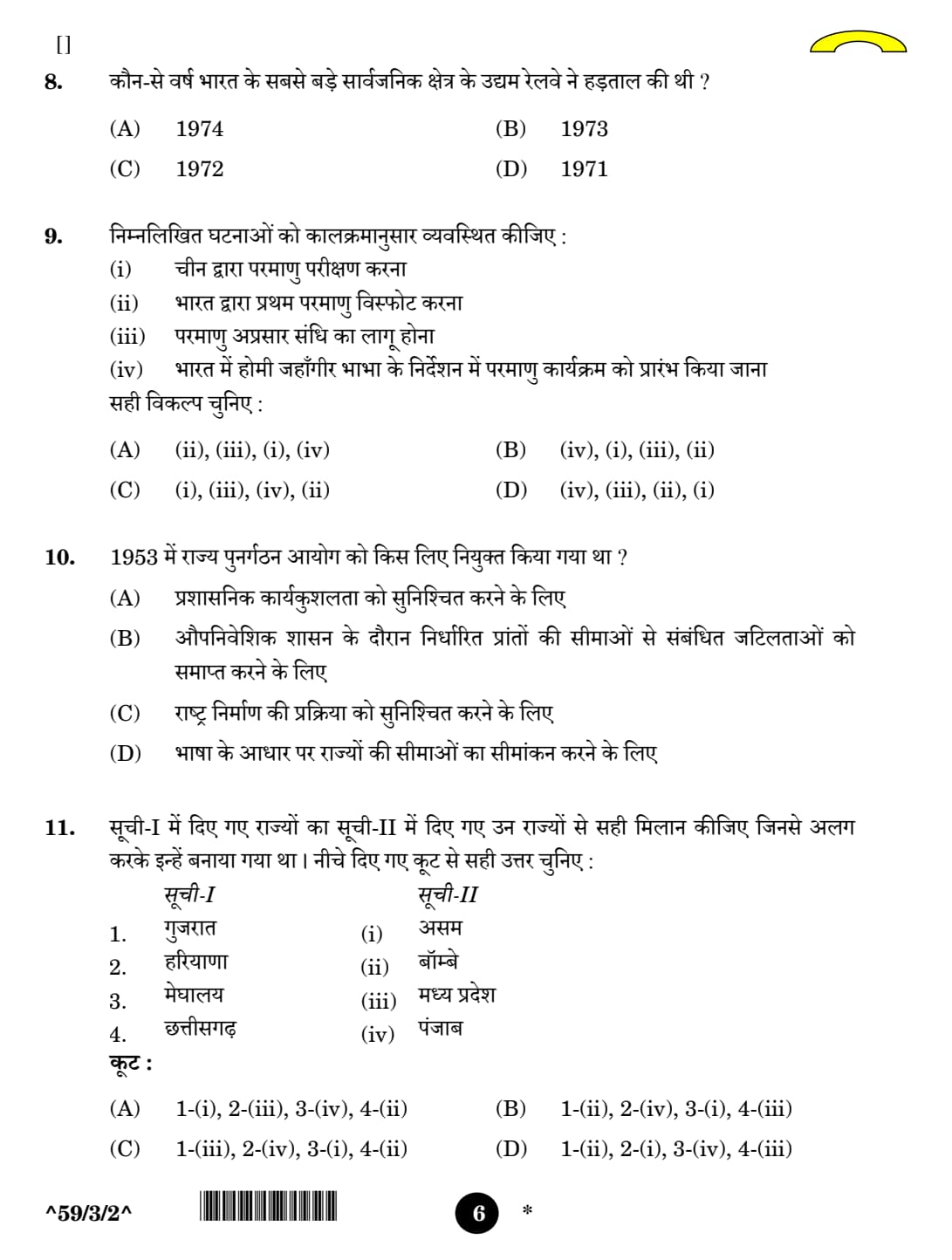
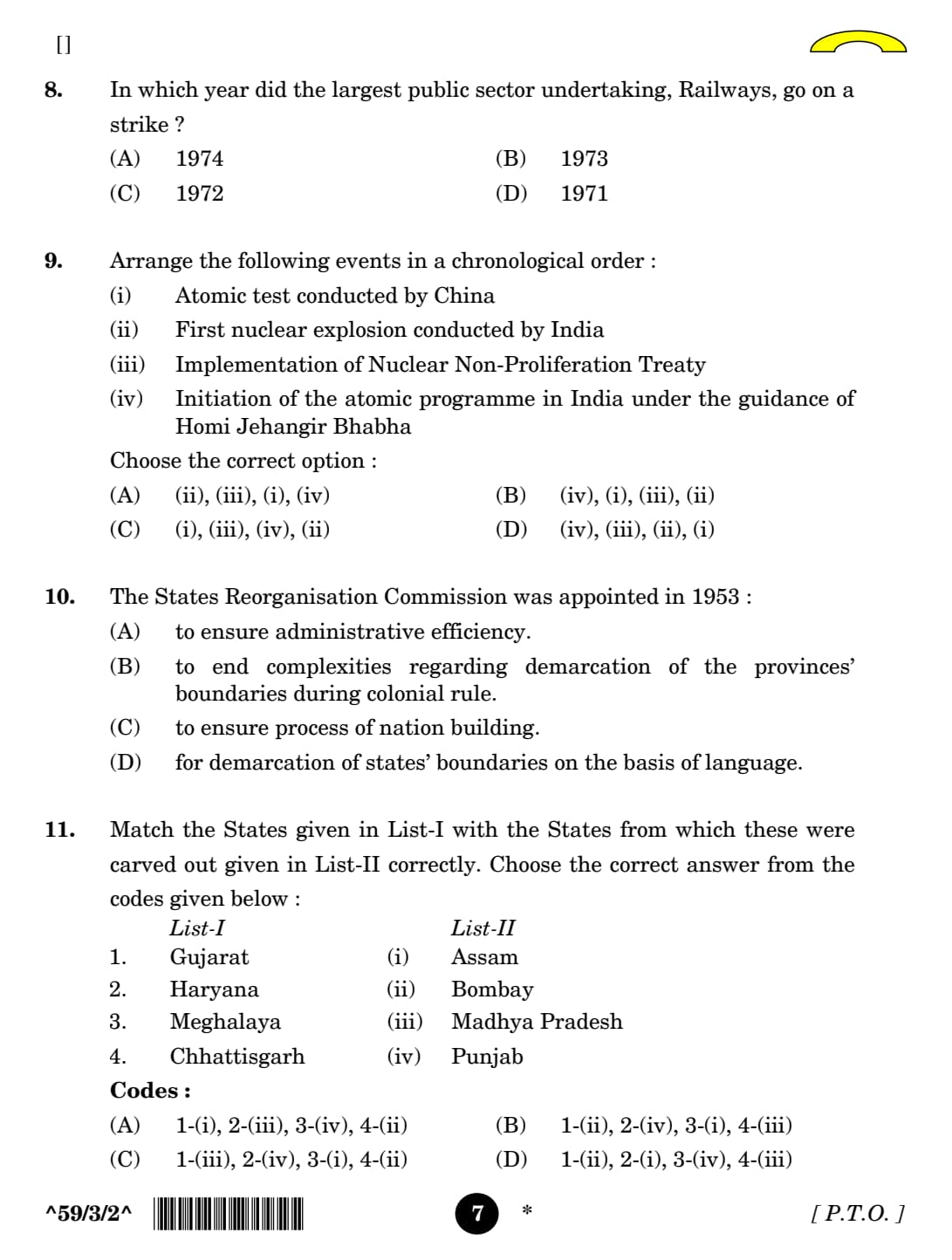
In which year did the largest public sector undertaking, Railways, go on a strike ?
View Solution
Concept:
In May 1974, India witnessed one of its largest industrial labor agitations in history—the All India Railwaymen's Strike .
Step 1: Leadership and context of the strike.
Led by socialist trade union leader George Fernandes under the banner of the *National Coordination Committee for Railwaymen's Struggle (NCCRS)*, over 1.7 million railway workers across India went on an indefinite strike starting on May 8, 1974 .
Step 2: Demands of the railway employees.
The workers demanded:
Bonus payments equivalent to other public sector enterprises
Standardized working hours (8-hour working shifts)
Pay parity and wage revisions to match rising inflation
Step 3: Government response and historical impact.
The Central Government under Prime Minister Indira Gandhi took a firm stance against the strike, declaring it illegal. Thousands of union workers were arrested, leading to widespread national confrontation. The strike lasted for 20 days before being called off unconditionally on May 28, 1974. This event intensified political unrest prior to the 1975 Emergency declaration. Quick Tip: - Historic Railway Strike: Year 1974 - Key Leader: George Fernandes - Primary Reason: Economic distress, high inflation, and bonus demand post-1971 war.
Arrange the following events in a chronological order :
(i) Atomic test conducted by China
(ii) First nuclear explosion conducted by India
(iii) Implementation of Nuclear Non-Proliferation Treaty
(iv) Initiation of the atomic programme in India under the guidance of Homi Jehangir Bhabha
Choose the correct option :
View Solution
Concept:
Understanding the timeline of global and domestic nuclear developments during the 20th century is essential for evaluating international non-proliferation regimes and India's nuclear stance.
Step 1: Determining the exact year for each listed event.
(iv) Initiation of India's atomic programme under Dr. Homi J. Bhabha:
India initiated its peaceful atomic energy research program in 1948 with the establishment of the Atomic Energy Commission of India.
(i) Atomic test conducted by China:
China conducted its first successful nuclear bomb explosion at Lop Nur on October 16, 1964 .
(iii) Implementation of the Nuclear Non-Proliferation Treaty (NPT):
The NPT was opened for signature in 1968 and entered into force/implementation in March 1970 .
(ii) First nuclear explosion conducted by India:
India conducted its first successful peaceful nuclear test (Operation Smiling Buddha) at Pokhran, Rajasthan, on May 18, 1974 .
Step 2: Arranging the events chronologically.
Ordering from earliest to latest: \[ (iv) 1948 \quad \longrightarrow \quad (i) 1964 \quad \longrightarrow \quad (iii) 1970 \quad \longrightarrow \quad (ii) 1974 \]
This sequence corresponds precisely to (iv), (i), (iii), (ii) . Quick Tip: Chronology Timeline: - 1948: India's Atomic Energy Commission setup (Homi Bhabha) - 1964: China's First Nuclear Test - 1970: NPT implementation - 1974: India's First Pokhran Test (Smiling Buddha)
The States Reorganisation Commission was appointed in 1953 :
View Solution
Concept:
Following India's independence in 1947, the internal national map was an administrative legacy of British colonial provincial divisions and princely states. Demands for reorganizing states based on linguistic identity emerged strongly, leading to popular movements across various regions.
Step 1: Background of the creation of the States Reorganisation Commission (SRC).
In 1952, a prolonged agitation led by Potti Sreeramulu (who died after a 56-day hunger strike) resulted in the creation of Andhra State as the first linguistic state for Telugu-speaking populations. To address widespread linguistic statehood demands across the country, the Central Government appointed the States Reorganisation Commission (SRC) in December 1953 .
Step 2: Composition and primary objective of SRC.
The Commission was headed by retired Supreme Court judge Fazal Ali (along with members H.N. Kunzru and K.M. Panikkar). Its central mandate was to study and recommend the redrawing of administrative internal boundaries of Indian states along linguistic lines (language boundaries).
Step 3: Outcome of the Commission.
The Commission submitted its report in 1955, recommending that state boundaries be reorganized to align with continuous linguistic zones. This led to the enactment of the States Reorganisation Act, 1956 , creating 14 states and 6 Union Territories. Quick Tip: - SRC Appointed: December 1953 (Chairman: Fazal Ali) - Primary Basis: Redrawing boundaries according to language spoken . - States Reorganisation Act: Passed in 1956.
Match the States given in List-I with the States from which these were carved out given in List-II correctly. Choose the correct answer from the codes given below :

View Solution
Concept:
Several modern Indian states were created post-1956 by bifurcating existing composite states to fulfill regional socio-linguistic and developmental aspirations.
Step 1: Matching each state with its parent state.
Gujarat (1): Bifurcated from the composite bilingual Bombay State in 1960 into Gujarati-speaking Gujarat and Marathi-speaking Maharashtra. \(\rightarrow\) (ii) Bombay
Haryana (2): Carved out of Punjab in 1966 to separate Hindi-speaking areas from Punjabi-speaking regions. \(\rightarrow\) (iv) Punjab
Meghalaya (3): Initially created as an autonomous state within Assam in 1969 and granted full statehood in 1972 . \(\rightarrow\) (i) Assam
Chhattisgarh (4): Carved out of Madhya Pradesh in November 2000 . \(\rightarrow\) (iii) Madhya Pradesh
Step 2: Formulating the final matched code sequence.
Matching pairs: \[ 1 \rightarrow (ii), \quad 2 \rightarrow (iv), \quad 3 \rightarrow (i), \quad 4 \rightarrow (iii) \]
This corresponds to Option (B). Quick Tip: Key State Reorganisation Years: - 1960: Bombay divided into Gujarat & Maharashtra - 1966: Punjab divided into Punjab & Haryana - 1972: Meghalaya, Manipur, Tripura from Assam/NE region - 2000: Chhattisgarh (from MP), Uttarakhand (from UP), Jharkhand (from Bihar)
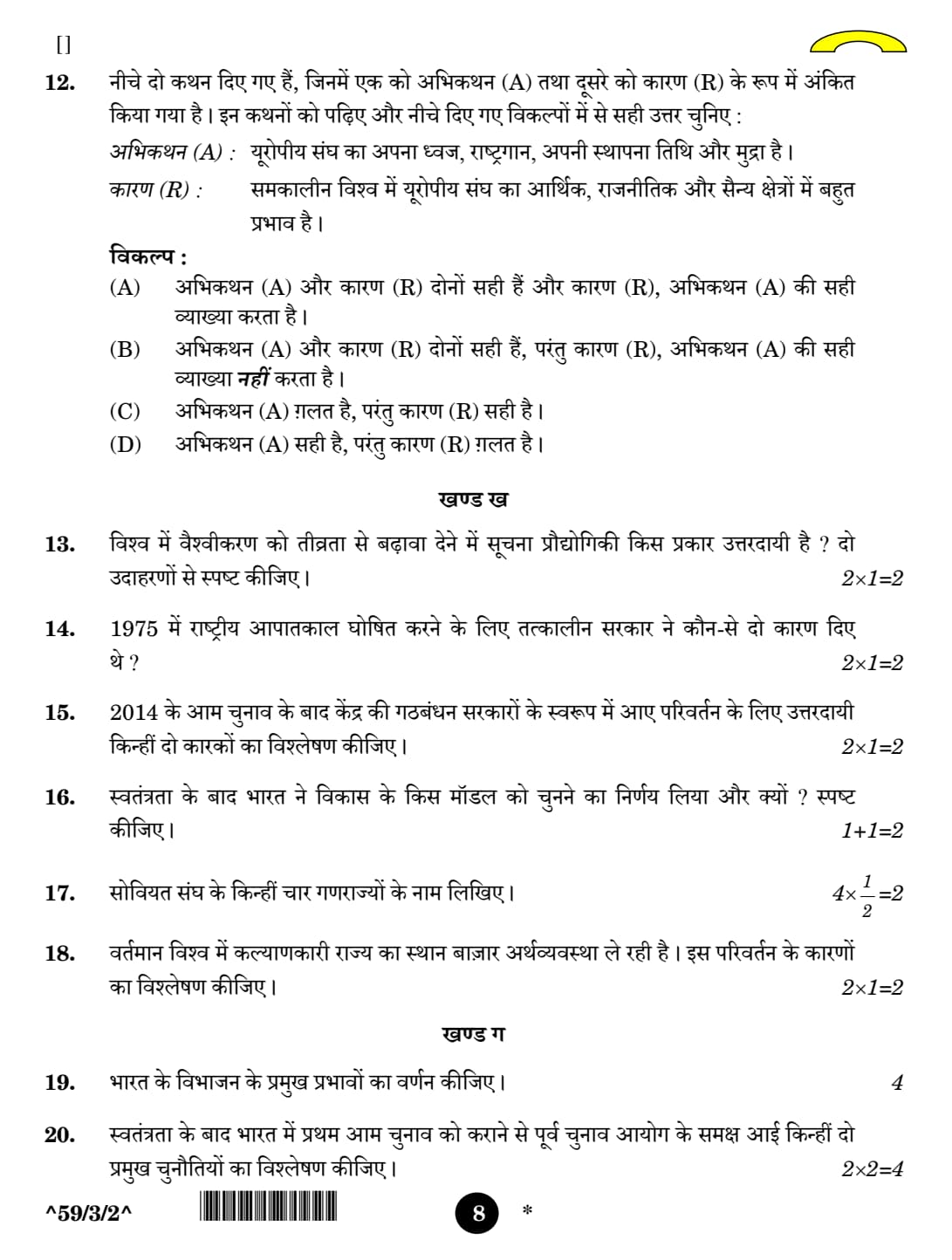
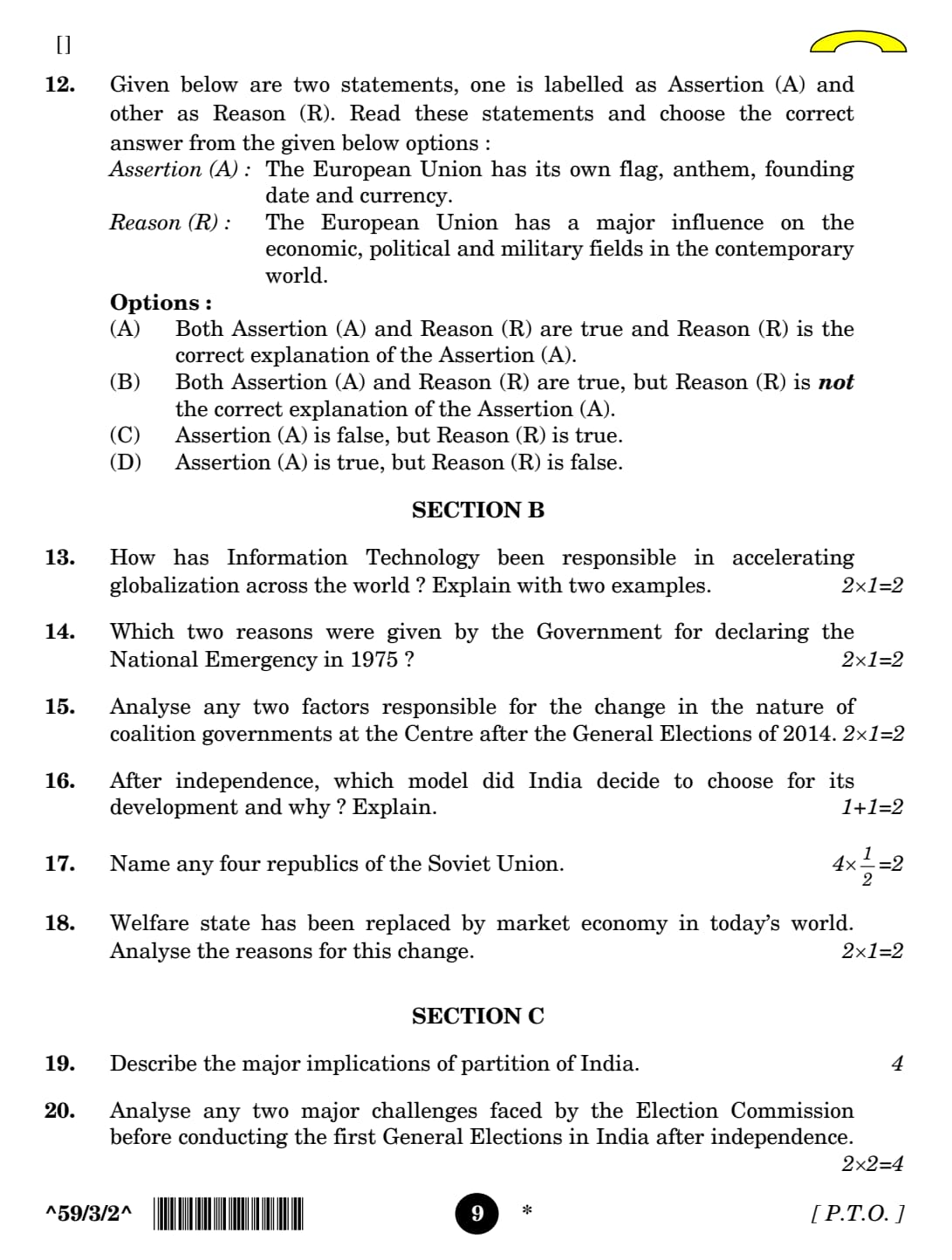
Given below are two statements, one is labelled as Assertion (A) and other as Reason (R). Read these statements and choose the correct answer from the given below options :
Assertion (A) : The European Union has its own flag, anthem, founding date and currency.
Reason (R) : The European Union has a major influence on the economic, political and military fields in the contemporary world.
View Solution
Concept:
The European Union (EU) evolved from an economic partnership (European Economic Community) into an influential supra-national political and economic regional organization.
Step 1: Evaluating Assertion (A).
Assertion (A) states that the European Union possesses institutional symbols similar to a nation-state: its own flag (12 gold stars on a blue background), anthem (Beethoven's 9th Symphony), founding day (Europe Day, 9 May), and a common currency (the Euro). This statement is factually true .
Step 2: Evaluating Reason (R).
Reason (R) states that the EU exerts major economic, political, and military power globally (it is the world's second-largest economy, holds permanent UNSC representation through France, and combined defense expenditure is substantial). This statement is also factually true .
Step 3: Testing the logical connection between (A) and (R).
While both statements are accurate, Reason (R) describes the extent of EU's global influence , whereas Assertion (A) describes its symbols of collective political identity . The possession of a flag, anthem, and currency is an outcome of regional integration initiatives, not the direct cause or explanation of its economic and military influence in world politics. Therefore, R is not the correct explanation of A. Quick Tip: For Assertion-Reason questions: 1. Verify if A is true. 2. Verify if R is true. 3. Insert "because" between A and R to check if R directly explains why A happened.
How has Information Technology been responsible in accelerating globalization across the world ? Explain with two examples.
View Solution
Concept:
Information Technology (IT), encompassing microprocessors, satellite networks, fiber optics, and the internet, serves as the technological backbone of modern globalization. It compresses geographical distances, enables instantaneous cross-border communication, and integrates national economies into a seamless global network.
Step 1: Role of IT in accelerating globalization.
Developments in telecommunications and computer networking have dramatically lowered the cost and time involved in processing and transferring information globally. This technology allows capital, services, data, and cultural content to flow instantly across international boundaries without physical restrictions.
Step 2: Illustrative Example 1: Global Business Process Outsourcing (BPO) and Service Sector.
Advancements in high-speed data connectivity enable companies in developed nations (such as the US or UK) to outsource service-based operations—such as software coding, customer technical support, financial accounting, and medical transcription—to firms in developing countries like India in real-time. For example, a customer calling a bank in London may be seamlessly connected to a call center representative in Bengaluru.
Step 3: Illustrative Example 2: Electronic Financial Transfers and E-Commerce.
IT networks facilitate global financial integration through electronic fund transfers (e.g., SWIFT networks) and international e-commerce platforms. Investors can trade equities, currencies, and bonds across global stock exchanges (New York, London, Tokyo) instantaneously. Similarly, e-commerce platforms allow consumers anywhere in the world to order goods and digital services from global vendors. Quick Tip: When explaining IT's role in globalization, highlight two key domains: 1. Services & Remote Work: Business Process Outsourcing (BPO/ITeS). 2. Financial Interconnection: Real-time cross-border capital flows and E-commerce.
Which two reasons were given by the Government for declaring the National Emergency in 1975 ?
View Solution
Concept:
On June 25, 1975, President Fakhruddin Ali Ahmed declared a nationwide Emergency under Article 352 of the Indian Constitution on the advice of Prime Minister Indira Gandhi. The proclamation cited the existence of a grave threat to national security.
Step 1: Reason 1: Threat of Internal Disturbance and Extra-Constitutional Agitations.
The Central Government argued that the country was facing severe threats of internal disruption caused by opposition-led political agitations. Specifically, the government cited the nation-wide *Bihar Movement* and total revolution (*Sampoorna Kranti*) spearheaded by Jayaprakash Narayan (JP). The opposition had called upon the military, police, and government employees to disobey "illegal and unconstitutional orders" of the government, which the ruling party characterized as an attempt to paralyze the state machinery and subvert democratic stability.
Step 2: Reason 2: Economic Paralysis and Subversive Strikes.
The government asserted that coordinated strikes, protests, and industrial disruptions—such as the massive 1974 All India Railwaymen's Strike—were intentionally orchestrated by opposition parties to destabilize the national economy. The ruling party maintained that extraordinary constitutional measures were necessary to restore law and order, maintain public production, and preserve national integration. Quick Tip: The two official justifications given by the Government for the 1975 Emergency were: 1. Threat of internal disturbance due to political agitations (JP movement). 2. Economic disruption and instability caused by frequent strikes and calls for civil disobedience.
Analyse any two factors responsible for the change in the nature of coalition governments at the Centre after the General Elections of 2014.
View Solution
Concept:
Between 1989 and 2014, Indian politics operated under a multi-party coalition era where no single political party secured an absolute majority in the Lok Sabha. However, the 16th General Elections in May 2014 marked a major structural shift in central coalition dynamics.
Step 1: Factor 1: Emergence of Single-Party Majority within Coalitions (Dominant Party Coalition).
Prior to 2014, central coalitions (such as the NDA under Atal Bihari Vajpayee or the UPA under Manmohan Singh) relied heavily on regional coalition partners for legislative survival. In the 2014 general elections, the Bharatiya Janata Party (BJP) won 282 seats on its own, crossing the single-party majority threshold (272 seats). Although the BJP formed a coalition government under the National Democratic Alliance (NDA), the lead party was no longer vulnerable to political blackmail or policy paralysis from smaller alliance partners. This transformed the arrangement from a "compelled coalition" to a "majority-led surplus coalition."
Step 2: Factor 2: Centralisation of Political Agenda and National Leadership.
Post-2014 coalition politics witnessed a shift toward strong central leadership and a unified national policy agenda. Smaller regional coalition partners experienced diminished bargaining power regarding cabinet allocations and central policy decisions. National issues, welfare delivery schemes, and national security dominated the electoral discourse over localized regional demands, reshaping the power balance between central and state-based parties. Quick Tip: Key structural shifts post-2014: - 1989–2014: Weak coalitions dependent on regional parties. - Post-2014: Dominant single-party majority leading a surplus alliance (NDA), reducing regional leverage.
After independence, which model did India decide to choose for its development and why ? Explain.
View Solution
Concept:
At the time of independence in 1947, India faced deep socioeconomic challenges, including widespread poverty, food insecurity, low industrial capability, and regional disparities. Globally, two major development models existed:
Capitalist Model: Predicated on free-market enterprise, private ownership, and minimal state intervention (followed by the USA and Western allies).
Socialist Model: Predicated on complete state ownership of production factors and centralized state planning (followed by the USSR).
Step 1: Model chosen by India: The Mixed Economy Model.
India decided to adopt a Mixed Economy Model , combining elements from both capitalist and socialist frameworks. Under this model:
The state controlled key heavy industries, infrastructure, and financial institutions (Public Sector).
Private enterprise was allowed to operate, invest, and grow in consumer goods, agriculture, and secondary commerce (Private Sector).
Step 2: Reasons for choosing the Mixed Economy approach.
Poverty Alleviation and Social Welfare: Pure capitalism was rejected because private enterprise alone would not invest in low-return social infrastructure or poverty alleviation projects.
Encouraging Entrepreneurship without Authoritarianism: Complete state socialism (Soviet model) was rejected to preserve individual rights, private initiative, and democratic freedoms.
State-Led Heavy Industrialization: Indian private capitalists lacked sufficient capital to set up huge foundational capital-goods industries (steel, power, transport), necessitating state investment through Five-Year Plans. Quick Tip: - Development Model Chosen: Mixed Economy. - Key Objective: Balance social welfare and state-led planned development with private business initiative under a democratic structure.
Name any four republics of the Soviet Union.
View Solution
Concept:
The Union of Soviet Socialist Republics (USSR) was a federal socialist state created in 1922 following the Russian Revolution. It comprised 15 individual Soviet Socialist Republics (SSRs) , with the Russian Republic as the largest and most dominant component.
Step 1: Listing four prominent Soviet Republics.
Four major republics of the Soviet Union were:
Russian Soviet Federative Socialist Republic (RSFSR) — Capital: Moscow
Ukrainian Soviet Socialist Republic — Capital: Kyiv
Byelorussian Soviet Socialist Republic (now Belarus) — Capital: Minsk
Kazakh Soviet Socialist Republic — Capital: Alma-Ata (now Almaty)
Step 2: Historical context of dissolution (1991).
In December 1991, under the leadership of Russia (Boris Yeltsin), Ukraine, and Belarus, these republics signed the Belavezha Accords, declaring the formal dissolution of the USSR and establishing the Commonwealth of Independent States (CIS). Quick Tip: Other Soviet Republics include: Uzbekistan, Georgia, Armenia, Azerbaijan, Lithuania, Latvia, and Estonia.
Welfare state has been replaced by market economy in today’s world. Analyse the reasons for this change.
View Solution
Concept:
During the mid-20th century, the traditional Welfare State model dominated national governance, where governments took primary responsibility for providing social safety nets, healthcare, education, employment, and controlling public utilities. In recent decades, this approach has transitioned toward market-driven economies characterized by neoliberalism, privatization, and deregulation.
Step 1: Reason 1: Fiscal Crises and Inefficiencies of State-Run Enterprises.
Over time, many welfare states experienced unsustainable public debt, high fiscal deficits, bureaucratic red tape, and operational inefficiencies within state-owned public enterprises. Managing vast public welfare programs required heavy taxation and expenditure, which strained national treasuries and restricted economic dynamism.
Step 2: Reason 2: Impact of Globalization and Neoliberal Economic Policies.
The collapse of the Soviet Union and the end of the Cold War validated market-based capital allocation. International financial bodies like the International Monetary Fund (IMF) and World Bank promoted the Washington Consensus , encouraging structural adjustment programs (SAPs) centered on Liberalisation, Privatisation, and Globalisation (LPG). Nations deregulated industries to attract foreign direct investment (FDI) and boost global competitiveness.
Step 3: Reason 3: Technological Transformation and Consumer Choice.
Rapid advancements in global communications and manufacturing required flexibility, competitive pricing, and rapid innovation—qualities best provided by competitive private markets rather than rigid state monopolies. Market economies offer greater consumer choice and capital efficiency. Quick Tip: Key drivers for shift from Welfare State to Market Economy: 1. High fiscal burdens and public sector inefficiency. 2. Global spread of LPG (Liberalisation, Privatisation, Globalisation) policies. 3. Market competition driving technological innovation and consumer choice.
Describe the major implications of partition of India.
View Solution
Concept:
In August 1947, British India was partitioned into two independent sovereign dominions: India and Pakistan. Based on the principle of religious majorities, partition led to massive political, social, human, and economic consequences.
Step 1: Tragic Communal Violence and Mass Casualties.
Partition triggered unprecedented, terrible communal violence on both sides of the new international borders, particularly in Punjab and Bengal. Entire cities such as Lahore, Amritsar, and Kolkata became divided along religious lines. Between 5 lakh to 10 lakh people lost their lives in severe religious violence.
Step 2: Unprecedented Forced Migration and Refugee Crisis.
Partition resulted in one of the largest and most abrupt forced population transfers in human history. Over 80 lakh (8 million) people migrated across the newly drawn borders. Millions were rendered homeless overnight, forced to abandon their ancestral properties and travel in refugee trains or on foot in long columns called *cafilas*, ending up in makeshift refugee camps.
Step 3: Division of Administrative, Financial, and Physical Assets.
Partition required not only dividing territory but also splitting physical assets, state treasuries, financial liabilities, administrative machinery, military equipment, railway rolling stock, and public utilities. Government liabilities and cash reserves (such as the 55 crore rupees balance owed to Pakistan) had to be divided proportionally.
Step 4: Disruption of Agriculture and Interlinked Industries.
The border divisions disrupted established economic supply chains. For instance, the fertile jute-growing agricultural fields went to East Pakistan, whereas the processing jute mills remained in West Bengal (India). Similarly, vast cotton-producing areas went to Pakistan, while cotton textile mills remained in India, severely disrupting production. Quick Tip: Four major implications of 1947 Partition: 1. Massive communal violence and loss of life (~5-10 lakh deaths). 2. World's largest forced population displacement (~80 lakh refugees). 3. Complex division of state assets, treasury, and military equipment. 4. Economic dislocation (severing raw material sources from processing mills).
Analyse any two major challenges faced by the Election Commission before conducting the first General Elections in India after independence.
View Solution
Concept:
The Election Commission of India was established in January 1950, with Sukumar Sen appointed as the first Chief Election Commissioner. Conducting the first General Elections in 1951–52 on the basis of Universal Adult Franchise across a vast, poor, and newly independent country was an unprecedented democratic exercise.
Step 1: Challenge 1: Preparing Electoral Rolls and Handling Widespread Illiteracy.
Over 85% of the eligible population was illiterate out of approximately 17 crore (170 million) eligible voters. Preparing accurate voter lists was a major operational hurdle. Furthermore, when the draft electoral rolls were compiled, the names of nearly 40 lakh women were omitted or improperly recorded as "wife of..." or "daughter of..." rather than by their actual individual legal names. Sukumar Sen rejected these entries and ordered a complete re-compilation to ensure proper registration of female voters.
Step 2: Challenge 2: Delimitation of Constituencies and Designing Innovative Voting Voting Procedures.
Delimiting legislative boundaries across India's vast and geographically diverse terrain required enormous physical mapping. To enable an illiterate population to vote confidentially, the Election Commission had to innovate a unique ballot system:
Assigning distinct pictorial symbols to each candidate/party.
Placing separate, physically secured ballot boxes for every contesting candidate inside each voting booth, marked with their specific symbol.
Training over 3 lakh polling officers and administrative staff to administer the secret balloting process fairly. Quick Tip: Key challenges of 1st General Election (1951-52): 1. Mass illiteracy (over 85%) requiring voting by ballot symbols. 2. Incomplete voter rolls (omitted women names) and huge logistical delimitation task.
Why have the global efforts to protect the environment not been as successful as desired ? Analyse the reasons.
View Solution
Concept:
Despite multiple international conventions (such as the 1992 Rio Earth Summit, 1997 Kyoto Protocol, and 2015 Paris Agreement), global environmental degradation, climate change, and biodiversity loss continue at an alarming pace.
Step 1: Reason 1: Divergence between Developed and Developing Nations (North-South Divide).
Global negotiations are often stalled by disagreements between the global North (developed nations) and global South (developing nations). Developed countries historically contributed the vast majority of cumulative atmospheric pollution during their industrial growth and push for uniform emission cuts. Developing countries argue that their priority is poverty eradication and economic development, insisting on the principle of "Common But Differentiated Responsibilities" (CBDR) .
Step 2: Reason 2: Prioritisation of Short-Term National Economic Growth.
Nations frequently prioritize short-term economic output, industrial expansion, and energy security over long-term environmental sustainability. Transitioning away from fossil fuels requires high financial investments and structural adjustments, which many governments hesitate to enforce due to fear of losing domestic industrial competitiveness.
Step 3: Reason 3: Lack of Enforceable International Compliance Mechanisms.
Unlike national laws, international environmental agreements rely on voluntary participation and consensus. Most treaties lack legal enforcement mechanisms or penalties for non-compliant states. Major polluters can withdraw from or fail to meet target commitments without facing legally binding sanctions.
Step 4: Reason 4: Inadequate Financial and Technological Transfer.
Developed nations have often failed to fulfill commitments regarding the transfer of green technologies and climate finance (e.g., the promised
(100 billion annual Green Climate Fund) to assist developing nations in transitioning to sustainable energy grids. Quick Tip: Main obstacles in global climate policy: 1. North-South conflict over historical emissions (CBDR principle). 2. Conflict between fast economic expansion and carbon reduction. 3. Lack of binding enforcement penalties in international law.
Evaluate the efforts made to achieve the objectives of the Rio Declaration by the developed and developing countries.
View Solution
Concept:
The United Nations Conference on Environment and Development (UNCED) , held in Rio de Janeiro, Brazil, in June 1992 (popularly known as the Rio Earth Summit ), brought environmental protection to the center of global political discourse. It produced the Rio Declaration , Agenda 21 , and the United Nations Framework Convention on Climate Change (UNFCCC) .
Step 1: Efforts and Perspective of Developed Countries.
Focus on Global Targets: Developed countries emphasized universal obligations to curb carbon emissions, protect biodiversity, and limit deforestation globally.
Technological Innovations: Developed nations invested heavily in renewable energy technology (solar, wind, EV infrastructure) and energy efficiency.
Shortcomings in Commitments: Developed nations have faced criticism for failing to provide adequate financial grants and low-cost technology transfers to the developing world. Furthermore, their per capita resource consumption and carbon footprints remain high.
Step 2: Efforts and Perspective of Developing Countries.
Championing the CBDR Principle: Developing nations (such as India, China, and Brazil) ensured that the Rio Declaration formally incorporated the principle of Common But Differentiated Responsibilities (CBDR) —stating that developed nations bear greater historical responsibility for environmental repair.
Combining Growth with Environment: Developing nations committed to sustainable development goals while prioritizing poverty eradication. India, for example, enacted national climate action plans, expanded solar capacity, and signed the Paris Agreement commitments.
Challenges Faced: Developing nations struggle with resource constraints, industrial reliance on coal, and balancing immediate economic needs with clean energy adaptation. Quick Tip: Key outcome of Rio 1992: - Established Agenda 21 (action plan for sustainable development). - Formally recognized CBDR (Common But Differentiated Responsibilities) balancing global environmental efforts with developmental rights.
Highlight any four features of the Soviet system that made the life of people difficult.
View Solution
Concept:
The Soviet Socialist system created post-1917 was built on an alternative model to Western capitalism. While it guaranteed basic social amenities (employment, education, healthcare) to its citizens, its political and economic structure created severe administrative and social hardships.
Step 1: Feature 1: Authoritarian Control and Absence of Free Speech/Expression.
The Soviet state became highly authoritarian. Citizens lacked political freedom, freedom of speech, and the right to express dissent. Public criticism of party policies, state ideology, or government officials was strictly censored, forcing opposition into underground channels or jokes and satires.
Step 2: Feature 2: One-Party Dominance and Lack of Political Democracy.
The Communist Party of the Soviet Union (CPSU) maintained tight political control over all institutions. No opposition political parties or alternative political choices were permitted. The party was un-accountable to the general public, leading to political apathy among citizens.
Step 3: Feature 3: Bureaucratic Inefficiency, Corruption, and Centralization.
The Soviet system was heavily bureaucratized. State planning authorities in Moscow dictated production quotas for every sector across the entire USSR. This extreme centralization led to administrative inefficiency, corruption, rigid red tape, and an inability to adapt to local regional economic needs.
Step 4: Feature 4: Severe Shortages of Consumer Goods and Poor Quality of Life.
Because state priorities shifted heavily toward military spending, defense hardware, and nuclear armaments (to maintain parity with the US), the consumer goods industry was neglected. Citizens faced continuous shortages of essential consumer items, leading to long queues for basic supplies, low technology quality, and lower living standards compared to the West. Quick Tip: 4 key flaws of Soviet System: 1. Severe restriction on speech, dissent, and political democracy. 2. Total political monopoly of the Communist Party. 3. Rigid, corrupt, centralized state bureaucracy. 4. Shortage of consumer goods due to excessive military spending.
“The United Nations Organisation is generally regarded as the great hope of humanity for peace and progress.” Support the statement with two arguments.
View Solution
Concept:
Established on October 24, 1945, after the devastation of World War II, the United Nations (UN) is the world's premier multilateral international organization, currently comprising 193 member states.
Step 1: Argument 1: Conflict Prevention, Global Security, and Peacekeeping.
The primary mandate of the UN is to save succeeding generations from the scourge of war. Over the past eight decades, the UN has provided an indispensable diplomatic platform for international dialogue, preventing localized conflicts from escalating into a global World War III. Through the UN Security Council and UN Peacekeeping operations worldwide, the organization has successfully mediated ceasefire agreements, supervised disarmaments, and stabilized post-conflict regions (e.g., in Africa, the Middle East, and Asia).
Step 2: Argument 2: Fostering Global Socioeconomic Development and Managing Global Commons.
Beyond security, specialized agencies of the UN drive socio-economic progress, poverty reduction, and public health globally:
WHO (World Health Organization): Coordinates global responses to pandemics and eradicated deadly diseases like smallpox.
UNICEF & UNDP: Work toward child welfare, primary education, and sustainable development goals (SDGs) in developing nations.
UNEP & Climate Frameworks: Lead multilateral efforts to tackle climate change, protect global commons, and assist vulnerable populations during humanitarian disasters. Quick Tip: Key arguments for UN's positive role: 1. Preventing World War III & Peacekeeping: Facilitates global diplomacy and prevents full-scale global military conflicts. 2. Socio-Economic & Humanitarian Leadership: Drives healthcare, development, education, and disaster relief (WHO, UNICEF, UNDP).
Suggest any four measures to make the United Nations Organisation more relevant in the current scenario.
View Solution
Concept:
The geopolitical landscape of the world has changed fundamentally since 1945. To remain effective and legitimate in addressing 21st-century global challenges, the United Nations requires structural and functional reforms.
Step 1: Measure 1: Reform and Expansion of the UN Security Council (UNSC).
The UNSC must be expanded in both permanent and non-permanent categories to reflect contemporary geopolitical realities. Major emerging regional powers and developing countries—such as India, Brazil, Japan, Germany, and representative African nations—must be granted permanent seats to make the body more democratic and representative.
Step 2: Measure 2: Restructuring or Regulating the Veto Power.
The misuse of veto power by the 5 permanent members (P5) often paralyzes the UN during urgent humanitarian crises and armed conflicts. Reforming the veto rule—such as prohibiting its use in cases of genocide, war crimes, and mass atrocities—would enhance the UN's decision-making speed and moral credibility.
Step 3: Measure 3: Strengthening Financial Independence and Regular Funding.
The UN frequently faces financial constraints because several member nations delay their mandatory assessed budget contributions. Implementing stricter financial compliance rules and creating predictable financing mechanisms for UN Peacekeeping and humanitarian operations will ensure operational autonomy.
Step 4: Measure 4: Enhancing Democratic Role of UN General Assembly (UNGA) and Socio-Economic Bodies.
The UN General Assembly, where every member country has one vote, should be given greater legislative and supervisory authority over global security decisions when the Security Council is locked in deadlock. Additionally, boosting funding for the Peacebuilding Commission and Human Rights Council will address root causes of global instability. Quick Tip: Four key UN Reform measures: 1. Expand UNSC permanent seats to include emerging global powers (e.g., India). 2. Restrict/regulate Veto power during humanitarian emergencies. 3. Ensure financial stability through timely mandatory member contributions. 4. Empower the UN General Assembly and peacebuilding agencies.
In the given political outline map of India (on page 13), four States have been marked as and . Identify these States on the basis of the information given below and write their correct names in your answer-book along with their respective serial number of the information used and the concerned alphabet given in the map as per the following format :

24.(i)
The state related to Prime Minister Lal Bahadur Shastri.
View Solution
Concept:
Lal Bahadur Shastri was the second Prime Minister of independent India (1964–1966). Prominent national political figures in post-independence India were associated with specific home states that shaped their political trajectory and electoral representation.
Step 1: Identify the historical connection.
Lal Bahadur Shastri was born in Mughalsarai, Varanasi district, Uttar Pradesh . He held crucial portfolios such as Home Minister and Railway Minister in the Union Cabinet before becoming Prime Minister of India. He represented political constituencies in Uttar Pradesh throughout his Parliamentary career.
Step 2: Map Location Identification.
On the provided political outline map of India, the northern state highlighted with the letter B is Uttar Pradesh .
Step 3: Matching Table Entry.
 Quick Tip: Prime Minister Lal Bahadur Shastri hailed from Uttar Pradesh , represented on the map by the letter B .
The state for which K. Kamaraj initiated Mid-day Meal programme to increase enrolment in education.
View Solution
Concept:
K. Kamaraj served as the Chief Minister of Madras State (now Tamil Nadu) from 1954 to 1963. He introduced groundbreaking educational and social welfare initiatives, notably the Mid-day Meal scheme, which served as a national model to boost primary school enrollment and alleviate child malnutrition.
Step 1: Identify the political leader and reform initiative.
K. Kamaraj introduced the pioneer Mid-day Meal Scheme in primary schools across Tamil Nadu (then Madras State) during his tenure as Chief Minister to ensure that poor children were not deprived of basic education due to poverty or hunger.
Step 2: Map Location Identification.
On the provided political outline map of India, the southern coastal state marked with the letter C is Tamil Nadu .
Step 3: Matching Table Entry.
 Quick Tip: K. Kamaraj introduced the historic Mid-day Meal programme as Chief Minister of Tamil Nadu , represented on the map by the letter C .
The state in which the Congress Party did not get majority in the Assembly Elections of 1967, but formed a government with the support of other parties.
View Solution
Concept:
The Fourth General Elections of 1967 were a major watershed in Indian political history. Congress lost its absolute majority in nine state assembly elections across India, leading to the emergence of multi-party coalition politics and external support arrangements to form state governments.
Step 1: Analyze the political developments of the 1967 elections.
In the 1967 Assembly Elections in Rajasthan , the Congress party fell short of securing an absolute majority on its own. However, through strategic post-poll negotiations, political maneuvering, and outside/coalition support from independent MLAs and smaller parties, the Congress party managed to form the state government under Chief Minister Mohan Lal Sukhadia.
Step 2: Map Location Identification.
On the provided political outline map of India, the western border state marked with the letter D is Rajasthan .
Step 3: Matching Table Entry.
 Quick Tip: In the 1967 elections, Congress failed to get a single-party majority in Rajasthan but managed to form a government with the support of independent MLAs. Rajasthan is represented on the map by the letter D .
The state where Non-Congress coalition government was formed after the Assembly Elections of 1967.
View Solution
Concept:
Following the landmark 1967 general elections, non-Congress parties joined hands to form joint legislative fronts called *Samyukta Vidhayak Dal* (SVD) coalitions in several North Indian states to keep the Congress party out of executive power.
Step 1: Identify the state political coalition.
In Bihar , the Congress party was defeated in the 1967 Assembly Elections. Consequently, a non-Congress coalition government called the *Samyukta Vidhayak Dal* (SVD)—comprising the Socialist Party, Bharatiya Jana Sangh, and other regional groups—was formed, marking a shift toward coalition politics in Northern India.
Step 2: Map Location Identification.
On the provided political outline map of India, the eastern state marked with the letter A is Bihar .
Step 3: Matching Table Entry.
 Quick Tip: A non-Congress Samyukta Vidhayak Dal (SVD) coalition government was formed in Bihar following the 1967 assembly elections, represented on the map by the letter A .
State the famous slogan coined by Lal Bahadur Shastri.
View Solution
Concept:
Lal Bahadur Shastri, the second Prime Minister of India, coined a historic and iconic slogan during a period when India was simultaneously confronting two major crises: a severe food shortage across the nation and the 1965 war with Pakistan. The slogan was intended to boost national morale and emphasize the equal importance of national defence and domestic food self-sufficiency.
Step 1: Identifying the slogan and its contextual significance.
The famous slogan coined by Lal Bahadur Shastri in October 1965 at a public gathering at Ramlila Maidan in Delhi is: \[ \textbf{``Jai Jawan, Jai Kisan''} \quad (Victory to the Soldier, Victory to the Farmer) \]
Detailed Breakdown:
Jai Jawan: Acknowledges and honours the valour, sacrifice, and dedication of the Indian soldiers (Jawans) defending the country's borders against foreign aggression.
Jai Kisan: Recognizes and appreciates the crucial effort of farmers (Kisans) working tirelessly to overcome food grain deficits and ensure food security for the country. Quick Tip: Remember the context of 1965: "Jai Jawan" targeted the 1965 Indo-Pak War, while "Jai Kisan" targeted the severe drought and food crisis in India.
In which year did the Congress Party split?
View Solution
Concept:
The Indian National Congress experienced its first major post-independence internal rift and split due to growing ideological, political, and generational conflicts between the older traditional leadership (known as the 'Syndicate') and the prime minister, Indira Gandhi.
Step 1: Identifying the precise year and background of the split.
The Congress Party officially split in the year 1969.
Step 2: Detailed historical context and outcome of the split.
Trigger Event: The factional conflict reached a peak during the 1969 Presidential elections following the demise of President Zakir Hussain. Indira Gandhi supported Independent candidate V. V. Giri, whereas the official candidate nominated by the Congress Syndicate was Neelam Sanjiva Reddy.
Outcome of the Election: V. V. Giri won the presidential election, marking a victory for Indira Gandhi's faction and a defeat for the Syndicate.
Formal Partition: In November 1969, the Congress Party split into two distinct factions:
Congress (O) - Organisation: Led by the Syndicate (older leaders like K. Kamaraj, Morarji Desai, S. Nijalingappa).
Congress (R) - Requisitionists: Led by Indira Gandhi, which eventually emerged as the dominant Indian National Congress. Quick Tip: Key year to remember for political science exams: 1969 — Congress Split (Congress-O vs. Congress-R).
Who was the second Prime Minister of India after Pt. Jawaharlal Nehru?
View Solution
Concept:
Following the sudden demise of India's first Prime Minister, Pandit Jawaharlal Nehru, in May 1964, the Indian political system faced its first transition of power.
Step 1: Identifying the second Prime Minister of India.
The second Prime Minister of India was Lal Bahadur Shastri.
Step 2: Detailed operational sequence of political succession.
Interim Transition: Immediately following Pandit Jawaharlal Nehru's death on May 27, 1964, Gulzarilal Nanda was appointed as the Acting Prime Minister for a brief period of 13 days.
Unanimous Election: Lal Bahadur Shastri was unanimously elected by the Congress Parliamentary Party as its leader, driven by consensus among Congress President K. Kamaraj and other senior political leaders.
Tenure: Lal Bahadur Shastri formally assumed office as the second Prime Minister of India on June 9, 1964, and served until his unexpected death on January 11, 1966, in Tashkent. Quick Tip: Be careful with terminology: Gulzarilal Nanda was the *Acting* Prime Minister, making Lal Bahadur Shastri the 2nd official Prime Minister of India.
Describe the ‘Kamaraj Plan’ of 1963.
View Solution
Concept:
The 'Kamaraj Plan' was an organizational and political reform strategy proposed in 1963 by K. Kamaraj, the then Chief Minister of Madras (now Tamil Nadu) and a leader in the Indian National Congress.
Step 1: Background and objectives of the Plan.
By 1963, the Congress party was suffering from internal factionalism, loss of public enthusiasm, and declining party organization. To revitalise the party and restore public faith, K. Kamaraj presented a revolutionary proposal to Prime Minister Jawaharlal Nehru.
Step 2: Key features and mechanics of the Kamaraj Plan.
Resignation of Senior Leaders: The plan proposed that senior ministers in the Central Cabinet and Chief Ministers of various states should resign from their governmental ministerial offices.
Return to Grassroots Grass-level Party Work: These experienced leaders were instructed to devote their full energy and time to grassroots organizational work, strengthening the party structure, addressing public grievances, and rebuilding public trust.
Implementation: Prime Minister Jawaharlal Nehru accepted the plan. As a direct result, six Cabinet Ministers (including Morarji Desai, Lal Bahadur Shastri, Jagjivan Ram, and B.U. Patnaik) and six Chief Ministers (including K. Kamaraj himself and C.B. Gupta) resigned from their official government positions to take up party organization assignments.
Step 3: Impact and significance.
The plan demonstrated that power was secondary to party ideology and service.
It successfully elevated K. Kamaraj's stature nationally, leading to his appointment as the President of the Indian National Congress shortly thereafter. Quick Tip: Kamaraj Plan (1963) key takeaway: "Resign from Cabinet/Government posts to work for the Party organization at grassroot level."
Read the passage given below carefully and answer the questions based on it :
India made earnest efforts for the early realisation of freedom of Indonesia from the Dutch colonial regime by convening an international conference in 1949 to support its freedom struggle. India was a staunch supporter of the decolonisation process and firmly opposed racism, especially apartheid in South Africa. The Afro-Asian Conference held in the Indonesian city of Bandung in 1955, commonly known as the Bandung Conference, marked the zenith of India’s engagement with the newly independent Asian and African nations. The Bandung Conference later led to the establishment of the NAM.
Which Indian leader played an important role in manifesting the Afro-Asian unity?
View Solution
Concept:
During the post-World War II decolonisation era, foreign policy initiatives were driven by anti-colonialism, solidarity among newly independent nations, and Asian-African cooperation.
Step 1: Analyzing the options based on the provided passage and historical facts.
From the provided text and historical records of Indian Foreign Policy:
India convened the Asian Relations Conference in March 1947 and an international conference in 1949 to support Indonesian independence from Dutch colonial rule.
Pandit Jawaharlal Nehru, India's first Prime Minister and Foreign Minister, was the primary architect of India's foreign policy and played an instrumental role in bringing together the Asian and African nations.
Nehru co-organized the historic Afro-Asian Conference held in Bandung, Indonesia, in 1955 (the Bandung Conference), which laid the foundation for Afro-Asian unity and the Non-Aligned Movement (NAM).
Therefore, Jawaharlal Nehru is the correct leader. Quick Tip: Pt. Jawaharlal Nehru was both Prime Minister and Foreign Minister of India during this period, making him the central figure of Afro-Asian unity and NAM.
In which year did the Non-Alignment Movement become the symbol of Afro-Asian unity?
View Solution
Concept:
The Asian-African unity established at the Bandung Conference (1955) culminated in a formal, institutionalized global political movement known as the Non-Aligned Movement (NAM).
Step 1: Evaluating the timeline of the Non-Aligned Movement.
The Bandung Conference took place in April 1955 in Indonesia.
The efforts of key founding leaders—Jawaharlal Nehru (India), Josip Broz Tito (Yugoslavia), Gamal Abdel Nasser (Egypt), Sukarno (Indonesia), and Kwame Nkrumah (Ghana)—led to the formal institutionalization of NAM.
The First Summit Conference of Non-Aligned Countries was officially held in Belgrade, Yugoslavia, in September 1961 .
Thus, in 1961, NAM formally materialized and became the supreme international platform symbolizing Afro-Asian unity and solidarity. Quick Tip: Remember the progression: Bandung Conference (1955) \(\rightarrow\) First NAM Summit in Belgrade (1961).
Identify the main intention behind the strengthening Afro-Asian unity.
View Solution
Concept:
During the Cold War era, the world was largely divided into two military power blocs: the US-led Western bloc (capitalist) and the Soviet-led Eastern bloc (communist). Newly decolonized countries needed a strategy to preserve their newly won sovereignty.
Step 1: Analyzing the core motivation of Afro-Asian unity and Non-Alignment.
Newly independent nations of Asia and Africa had suffered centuries of imperial exploitation and colonial domination.
Joining military alliances like NATO, SEATO, or the Warsaw Pact would mean subordinating their sovereign foreign policies to superpower interests (USA or USSR).
The foundational objective behind strengthening Afro-Asian unity was to maintain foreign policy autonomy, prevent neo-colonialism, avoid being drawn into Cold War proxy rivalries, and preserve independence by keeping an equal distance from both superpowers.
Therefore, option (D) accurately reflects the main intention behind Afro-Asian unity. Quick Tip: Non-alignment did not mean neutrality or isolationism; it meant independence of foreign policy decision-making without joining military alliances.
The first summit of the Non-Aligned Movement (NAM) was held in which year?
View Solution
Concept:
The Non-Aligned Movement formally established its summit framework through international conferences of heads of state or government.
Step 1: Identifying the year and venue of the first NAM Summit.
The First Summit of the Non-Aligned Movement (NAM) was held in September 1961.
Venue: Belgrade, Yugoslavia.
Participants: Attended by 25 member states from Asia, Africa, Europe, and Latin America.
Key Founders Present: Jawaharlal Nehru (India), Josip Broz Tito (Yugoslavia), Gamal Abdel Nasser (Egypt), Sukarno (Indonesia), and Kwame Nkrumah (Ghana).
Hence, option (A) is the correct answer. Quick Tip: First NAM Summit: Belgrade, 1961 (25 attending states).
Study the cartoon given below carefully and answer the questions based on it :

Name any two countries of East Asia.
View Solution
Concept:
East Asia is a subregion of Asia defined by both geographical location and cultural-economic ties. It encompasses nations located in the eastern portion of the Asian continent.
Step 1: Identifying East Asian nations.
Prominent countries in the East Asian subregion include:
Japan
South Korea (Republic of Korea)
China (People's Republic of China)
North Korea (Democratic People's Republic of Korea)
Taiwan
Step 2: Selecting two valid countries for the answer.
Any two valid East Asian countries can be listed, for example: \[ 1. Japan \quad and \quad 2. South Korea \] Quick Tip: Commonly cited East Asian countries: Japan, South Korea, China, North Korea.
Identify and name the leader shown in the cartoon.
View Solution
Concept:
Political cartoons in international relations often depict heads of government to symbolize national economic policies and foreign relations.
Step 1: Analyzing the cartoon features.
The cartoon shows a leader wearing traditional martial arts attire (a judo/karate gi) looking at a heated stack labeled "Competition" next to a sign pointing towards "EAST ASIAN NATIONS".
The speech bubble states: ``WE'LL HAVE TO GET USED TO IT...''.
This visual depicts India's Prime Minister who pursued economic reforms, international trade integration, and the proactive implementation/expansion of the 'Look East' Policy (and engagement with ASEAN and East Asian economies).
Step 2: Identifying the leader.
The leader depicted in the cartoon is Dr. Manmohan Singh (former Prime Minister of India). Quick Tip: Dr. Manmohan Singh played a central role as Finance Minister (1991) and later Prime Minister in integrating India with East Asian economies under the Look East policy.
Explain the meaning of the sentence given in the cartoon ‘WE’LL HAVE TO GET USED TO IT’.
View Solution
Concept:
The cartoon illustrates the economic challenges, rapid industrial growth of East Asian nations, and India's strategic foreign policy adaptation known as the 'Look East' Policy (initiated in 1991).
Step 1: Deconstructing the elements in the cartoon.
Hot Stack Labeled 'Competition': Symbolizes the intense, high-pressure global trade and industrial market competition posed by rapidly growing East Asian economies (such as China, Japan, South Korea, and ASEAN members).
Barefoot Leader on Hot Plates: Symbolizes the heat and pressure Indian industry and economic policy face as they open up markets and reduce trade barriers.
Step 2: Detailed explanation of the sentence.
The phrase "WE'LL HAVE TO GET USED TO IT" carries the following meanings:
Acceptance of Global Economic Competition: India cannot remain isolated behind protectionist walls. It must adapt to, accept, and endure the fierce economic competition from East Asian markets.
Commitment to Economic Integration: It reflects India's policy decision to deepen economic ties, sign trade agreements, and engage with East Asian nations despite the domestic market pressures.
Enhancing Domestic Efficiency: It underscores the necessity for Indian industries and policy-makers to improve productivity, technology, and competitiveness to match global standards. Quick Tip: The phrase highlights India's necessity to face intense market competition as part of globalization and its 'Look East' policy initiative.
Name any one country which resisted the adoption of the ‘Euro’.
View Solution
Concept:
When the European Union introduced the Euro (€) as its single shared currency through the Maastricht Treaty, member states were expected to integrate their monetary policies. However, certain member nations actively resisted adopting the Euro to protect their national monetary sovereignty, retain control over interest rates, and preserve national identity tied to their national currency.
Step 1: Identify the country and economic resistance.
Denmark (and formerly the United Kingdom ) actively resisted the adoption of the single European currency, the Euro.
Step 2: Historical and political context.
During the negotiations of the Maastricht Treaty (1992), Denmark negotiated an official "opt-out" clause regarding the Economic and Monetary Union (EMU), allowing it to retain its native currency, the Danish Krone (DKK). Danish citizens officially rejected the adoption of the Euro in a national referendum held in September 2000.
Similarly, the United Kingdom refused to join the Eurozone, maintaining the British Pound Sterling (£) until its eventual departure from the EU (Brexit). Sweden also chose not to adopt the Euro following a public referendum in 2003.
Name any two new member countries of European Union.
View Solution
Concept:
Following the dissolution of the Soviet Union and the collapse of eastern communist regimes in 1989–1991, the European Union expanded significantly eastward. The process of integrating Central and Eastern European post-communist states into the EU framework is known as EU Eastern Enlargement.
Step 1: Identify two notable new member states.
Two notable post-2000 member nations that joined the European Union are Croatia and Poland .
Step 2: Context of eastern enlargement waves.
Poland: Joined the European Union during the historic "Big Bang" enlargement wave on May 1, 2004 , alongside nine other nations (Estonia, Latvia, Lithuania, Czech Republic, Slovakia, Hungary, Slovenia, Cyprus, and Malta).
Croatia: Joined the European Union on July 1, 2013 , becoming the 28th member nation of the bloc after completing extensive political, judicial, and economic governance reforms following the breakup of Yugoslavia. Quick Tip: Prominent newer member nations of the European Union include Poland (joined in 2004) and Croatia (joined in 2013).
Explain any two main objectives of establishing the ASEAN Regional Forum (ARF).
View Solution
Concept:
The Association of Southeast Asian Nations (ASEAN) established the ASEAN Regional Forum (ARF) in 1994 as a multilateral regional security dialogue platform to coordinate regional peace, military transparency, and multilateral security cooperation across the wider Asia-Pacific region.
Two Main Objectives of Establishing the ASEAN Regional Forum (ARF):
Fostering Multilateral Political and Security Dialogue:
The ARF was established to provide an open, inclusive regional platform where ASEAN member states alongside major world powers (including India, the United States, China, Russia, Japan, and the European Union) can deliberate on multilateral security, defense policies, counter-terrorism, and regional stability.
It aims to manage emerging security challenges and territorial disputes (such as the South China Sea maritime claims) through peaceful diplomatic dialogue rather than military escalation.
Promoting Confidence-Building Measures and Preventive Diplomacy:
The ARF seeks to develop institutional trust among Asia-Pacific nations through concrete Confidence-Building Measures (CBMs) , such as sharing defense white papers, increasing transparency in military exercises, and facilitating military-to-military exchanges.
It actively promotes Preventive Diplomacy to identify potential bilateral or regional conflicts early, prevent armed hostilities, and support peacekeeping, disaster relief coordination, and maritime safety across member borders. Quick Tip: Established in 1994 , the ASEAN Regional Forum (ARF) primarily aims to: 1. Promote political and security dialogue across the Asia-Pacific. 2. Advance Confidence-Building Measures (CBMs) and preventive diplomacy.
Describe the sequence of events responsible for the establishment of democracy in Nepal.
View Solution
Concept:
Nepal transitioned from an absolute hereditary monarchy to a constitutional monarchy, and eventually to a democratic, secular federal republic through popular democratic movements and civil unrest over several decades.
Step 1: The Absolute Monarchy Period and First Pro-Democracy Movement (1990).
Traditionally, Nepal was a Hindu kingdom with absolute executive authority concentrated in the hands of the King.
In 1990 , facing intense pro-democracy protests organized by political parties, King Birendra accepted constitutional reforms.
A new constitution was introduced that established a Constitutional Monarchy with a multi-party parliamentary system. However, the King retained substantial powers, and political instability persisted.
Step 2: Rise of the Maoist Insurgency (1990s).
During the 1990s, the Maoists (Communist Party of Nepal - Maoist) gained strong influence across rural parts of Nepal.
They advocated an armed revolution against the monarchy and the existing socio-economic elites, leading to a decade-long violent triangular civil conflict between the Royal Nepalese Army, the Maoists, and parliamentary political parties.
Step 3: Royal Takeover by King Gyanendra (2002–2005).
Following the tragic royal massacre in 2001, King Gyanendra ascended the throne.
In February 2005 , King Gyanendra dismissed the elected Prime Minister, dissolved the parliament, imposed a state of emergency, and seized full executive powers, completely ending constitutional democracy.
Step 4: The Historic April 2006 Popular Uprising (Jan Andolan II).
Seven Party Alliance (SPA): Major mainstream political parties formed a Seven Party Alliance (SPA) to restore democracy.
Alliance with Maoists: The SPA reached a historic 12-point understanding with the Maoist rebels to unite against the absolute monarchy.
In April 2006 , massive nationwide pro-democracy demonstrations, strikes, and street protests ({Jan Andolan II) paralyzed the country.
Overwhelmed by public pressure, King Gyanendra surrendered power on April 24, 2006, restored the dissolved parliament, and appointed a democratic government.
Step 5: Abolition of Monarchy and Adoption of Democratic Constitution (2006–2015).
In 2007 , the restored parliament stripped the King of his powers, and Nepal was declared an interim federal republic.
In 2008 , elections were held for the Constituent Assembly, which formally abolished the 240-year-old monarchy and declared Nepal a Federal Democratic Republic.
Finally, in September 2015 , Nepal promulgated its comprehensive, democratic, secular constitution, establishing full democratic governance. Quick Tip: Key Timeline for Nepal Democracy: 1990 (Constitutional Monarchy) \(\rightarrow\) 2002-05 (King Gyanendra's Absolute Coup) \(\rightarrow\) April 2006 (Jan Andolan II / SPA-Maoist Uprising) \(\rightarrow\) 2008 (Monarchy Abolished) \(\rightarrow\) 2015 (New Constitution).
Describe the sequence of events responsible for the end of the military government and establishment of democracy in Bangladesh.
View Solution
Concept:
After winning independence from Pakistan in 1971, Bangladesh experienced political turmoil, political assassinations, and long periods of military dictatorship before restoring multi-party parliamentary democracy in 1990.
Step 1: Post-Independence Crisis and Initial Authoritarianism (1971–1975).
Bangladesh gained independence in December 1971 under the leadership of Sheikh Mujibur Rahman (Awami League) and adopted a democratic constitution based on secularism, nationalism, and socialism.
In early 1975, Sheikh Mujib amended the constitution, instituted a presidential system, and banned all opposition political parties (BAKSAL rule).
In August 1975 , Sheikh Mujibur Rahman was assassinated in a military coup, ushering in a long era of military influence and dictatorship.
Step 2: Military Rule under Ziaur Rahman (1975–1981).
General Ziaur Rahman assumed power, formed the Bangladesh Nationalist Party (BNP), and won elections in 1978.
Although he restored multi-party politics to some extent, executive power remained under military dominance.
General Ziaur Rahman was assassinated in another military coup attempt in May 1981.
Step 3: Dictatorship under General H.M. Ershad (1982–1990).
In March 1982 , General Hussain Muhammad Ershad staged a bloodless military coup, suspended the constitution, and established full military rule.
Ershad later formed the Jatiya Party to legitimise his rule and won disputed elections in 1986.
Step 4: Mass Popular Uprising for Democracy (1987–1990).
Students, civil society, trade unions, and major opposition political parties rallied together against Ershad's regime.
The movement was led by two main political party leaders:
Sheikh Hasina (Awami League)
Begum Khaleda Zia (Bangladesh Nationalist Party - BNP)
Continuous pro-democracy strikes (hartals), student protests, and civil disobedience immobilized the administration and economy.
Step 5: Resignation of Ershad and Restoration of Democracy (1990–1991).
Facing overwhelming public outrage and losing the support of the army top brass, General Ershad was forced to resign on December 6, 1990 .
An interim caretaker government was established under Chief Justice Shahabuddin Ahmed to conduct free and fair elections.
In 1991 , multi-party parliamentary elections were successfully held, marking the re-establishment of constitutional democracy in Bangladesh. Quick Tip: Key Leaders & Events in Bangladesh Democracy: 1975 (Assassination of Sheikh Mujib) \(\rightarrow\) 1982 (Gen. Ershad's Coup) \(\rightarrow\) 1990 (Mass movement led by Sheikh Hasina & Khaleda Zia forces Ershad's resignation) \(\rightarrow\) 1991 (Democratic Elections).
Explain the role of traditional notion of security in the contemporary world.
View Solution
Concept:
The traditional notion of security focuses primarily on state-centric, national military security and protection of territorial integrity, national sovereignty, and physical independence from external military threats.
Step 1: Defining the core concerns of Traditional Security.
Traditional security is grounded in political realism and addresses external military threats posed by other sovereign states. The key components and roles of traditional security in the contemporary world include:
Step 2: Key functions and mechanisms of Traditional Security.
Deterrence and Defense:
Deterrence: Preventing a potential adversary from initiating a war by maintaining sufficient military strength so that the costs of attacking outweigh any perceived benefits.
Defense: Responding effectively during an actual outbreak of war to repel the enemy, minimize damage, and defeat the aggressor state.
Balance of Power:
States constantly monitor the military capabilities of neighboring and rival nations.
When a country grows significantly powerful, neighboring states build up their own military capacity or enter strategic alliances to maintain a military equilibrium (balance of power) to prevent hegemony.
Alliance Building:
Forming formal coalitions or formal military alliances (e.g., NATO) with other states to pool military power and collectively deter or respond to external aggression.
Internal Military Security:
Traditional security also encompasses maintaining internal law, order, and territorial integrity against armed separatism, insurgencies, or violent civil conflicts within state borders.
Arms Control and Disarmament:
Regulating the acquisition, development, and deployment of weapons (e.g., NPT, SALT, START treaties) to prevent catastrophic wars and manage military rivalries responsibly.
Step 3: Role in the Contemporary World.
Despite the emergence of non-traditional threats (like terrorism, climate change, and pandemics), traditional security remains crucial today due to ongoing border disputes, nuclear proliferation, territorial invasions, and geopolitical conflicts among major global powers. Quick Tip: Traditional Security = State-centric + Military threats + Sovereignty/Territorial integrity + Deterrence, Defense, & Balance of Power.
How can the various contemporary threats to security be dealt with? Explain any three methods.
View Solution
Concept:
Contemporary security includes non-traditional threats such as international terrorism, climate change, global health pandemics, poverty, forced migration, and cyber threats. These threats are global in scope, cross international borders, and cannot be solved by any single nation using traditional military force alone.
Step 1: Identifying global methods to deal with non-traditional security threats.
Addressing these non-traditional threats requires multilateralism, soft power, global cooperation, and structural socioeconomic reforms. Three central methods include:
Step 2: Detailed explanation of the three methods.
Cooperative Security and Global Governance:
Non-traditional threats (such as climate change, transnational epidemics like COVID-19, and international cybercrime) do not respect national boundaries.
Therefore, states must engage in bilateral, regional, and international cooperation through global bodies such as the United Nations (UN), World Health Organization (WHO), and Interpol.
Cooperative security involves shared intelligence gathering, joint military/police operations against terror networks, collaborative medical research, and binding global treaties (e.g., Paris Climate Agreement).
Sustainable Development and Poverty Alleviation:
Economic inequality, extreme poverty, food insecurity, and environmental degradation are major root causes of conflict, violent extremism, mass illegal migration, and internal instability.
Method: States and international institutions (like the World Bank and UNDP) must focus on achieving Sustainable Development Goals (SDGs), providing equitable access to resources, expanding global trade concessions for developing nations, and building economic resilience.
Use of International Law, Diplomacy, and Disarmament Treaties:
Resolving conflicts and containing threats peacefully requires strengthening international norms and diplomatic channels.
Implementing arms control treaties (such as the Chemical Weapons Convention, Biological Weapons Convention, and Nuclear Non-Proliferation agreements) prevents dangerous weapons from falling into the hands of non-state actors or rogue regimes.
Diplomacy and peaceful mediation through third-party actors prevent local conflicts from escalating into full-scale regional wars. Quick Tip: For Non-Traditional Security Threats: Military force is insufficient \(\rightarrow\) Use Cooperative Security, Global Institutions, Diplomacy, and Sustainable Development.
How did the Mandal Commission recommendations prove to be an effort to solve the problems of Other Backward Classes (OBCs)? Analyse.
View Solution
Concept:
The Second Backward Classes Commission, popularly known as the Mandal Commission , was appointed by the Janata Party government in 1979 under the chairmanship of B.P. Mandal to identify the socially and educationally backward classes in India and recommend steps for their advancement.
Step 1: Background and Context of the Commission.
Article 340 of the Indian Constitution provides for the appointment of a commission to investigate the conditions of socially and educationally backward classes.
The Mandal Commission submitted its landmark report in 1980 . It identified that Other Backward Classes (OBCs) constituted approximately 52% of the total population of India, but were severely underrepresented in public employment, higher education, and political power structures.
Step 2: Key Recommendations of the Commission.
To solve the problems of social inequality, educational backwardness, and lack of representation, the Commission made the following major recommendations:
27% Reservation in Government Jobs: Reserving 27% of all posts and seats in public sector undertakings and central government jobs for candidate belonging to OBCs.
Reservation in Educational Institutions: Extending 27% seats in higher educational institutions, including universities, technical institutes, and medical colleges, to OBC students.
Land Reforms and Socio-Economic Upliftment: Recommending comprehensive land distribution and agrarian reforms to improve the material, financial, and structural position of backward rural communities.
Step 3: Implementation and Long-term Structural Impact.
In 1990 , the Union Government led by Prime Minister V.P. Singh (National Front Government) officially decided to implement the 27% job reservation recommendation.
Supreme Court Validation (Indra Sawhney Case, 1992): The Supreme Court upheld the constitutional validity of the 27% reservation for OBCs while introducing the 'creamy layer' exclusion principle.
Political and Social Empowerment: The implementation provided unprecedented opportunities for social mobility, higher education access, and administrative participation for OBC communities. It transformed Indian democracy by giving rise to OBC political leadership and making Indian politics more representative and inclusive. Quick Tip: Mandal Commission Highlights: Head: B.P. Mandal (1979) \(\rightarrow\) Estimated OBC Population: 52% \(\rightarrow\) Key Recommendation: 27% Reservation in jobs/education \(\rightarrow\) Implemented in 1990 by V.P. Singh.
Examine any three grounds on which the regional parties support the various coalition governments formed at the Centre in India.
View Solution
Concept:
The era of coalition politics in India (1989–2014) saw a shift from single-party dominance to multi-party alliances. Regional political parties became crucial "kingmakers" in forming and sustaining government coalitions at the national level.
Step 1: Identifying the role of regional parties in coalition governments.
Regional parties support national coalitions at the Centre based on strategic, political, financial, and ideological considerations.
Step 2: Detailed examination of three key grounds for support.
Securing Regional Development, Financial Grants, and Autonomy:
Regional parties leverage their parliamentary leverage to demand larger financial packages, central developmental grants, infrastructure projects, and special status for their respective states.
Supporting central coalitions allows them to ensure greater state autonomy and influence federal decision-making processes in favor of their state's interest (e.g., river water sharing, disaster relief funds).
Participation in National Governance and Power-Sharing:
Being part of a governing central coalition grants regional parties key Cabinet Ministries (e.g., Railways, Agriculture, IT, Infrastructure).
This direct inclusion in central executive authority elevates regional leaders to national stature, giving them a direct voice in framing national policies and cabinet choices.
Keeping Political Adversaries/Rivals Out of Power:
Regional parties often extend support to central coalitions driven by local political rivalries in their home states.
For example, a regional party in a state may support a national alliance at the Centre primarily to prevent its main state-level political opponent from gaining central patronages or federal leverage. Quick Tip: 3 Grounds for Regional Parties Supporting Central Coalitions: 1. Economic Grants & Federal Autonomy for the State. 2. Ministerial Power-Sharing at the Centre. 3. Keeping State Level Political Opponents out of Power.
Explain the advantages of democratic approach towards national integration amidst the diversity of India.
View Solution
Concept:
Unlike many post-colonial nation-states that attempted to enforce cultural uniformity, assimilation, or suppression of regional identities, India chose a democratic approach to national integration—a framework that accommodates cultural, linguistic, regional, and religious diversity within a democratic constitutional setup.
Step 1: Defining the Democratic Approach to Integration.
The democratic approach views regional aspirations and cultural diversity not as anti-national threats, but as integral components of democratic expression. It aims for unity through accommodation rather than forced assimilation.
Step 2: Detailed advantages of the democratic approach.
Peaceful Conflict Resolution and Accommodation of Regional Aspirations:
Democratic institutions (e.g., elections, parliamentary debate, dialogue) provide a legitimate peaceful channel for regional grievances to be expressed and resolved.
Examples like the Assam Accord or Mizoram Accord demonstrated how democratic negotiation converted armed insurgencies into peaceful political participation.
Preservation of Linguistic and Cultural Identity:
Through the linguistic reorganization of states (1956) and constitutional guarantees (Articles 29 and 30), India protected regional languages and minority cultures.
Citizens feel secure that their distinct regional identities are respected, which strengthens their loyalty to the larger Indian state.
Strengthening Federalism and Power Sharing:
A democratic federal structure distributes power between the Union and the States (Union List, State List, Concurrent List).
Power-sharing allows regional groups to govern themselves at the state level while participating in national governance, reducing feelings of alienation and central domination.
Enhancing Legitimacy and Emotional Unity:
Forced unity leads to resentment and eventual secessionist movements (as seen in Soviet Union or Pakistan in 1971).
Democratic accommodation fosters genuine national unity ("Unity in Diversity"), where citizens voluntarily align with national identity alongside their regional identities. Quick Tip: Core Democratic Principle: "Unity in Diversity" through dialogue, federal power-sharing, and linguistic recognition—not forced assimilation.
Why was the state of Jammu and Kashmir constituted into two Union Territories? Explain the reasons.
View Solution
Concept:
In August 2019, the Parliament of India passed the Jammu and Kashmir Reorganisation Act, 2019 , which abrogate the special status granted under Article 370 and reorganized the state into two separate Union Territories:
1. Jammu and Kashmir (with a Legislative Assembly)
2. Ladakh (without a Legislative Assembly)
Step 1: Analyzing the key reasons behind the reorganization.
The decision to reorganize Jammu and Kashmir into two Union Territories was driven by several administrative, political, security, and socio-economic objectives:
Step 2: Detailed explanation of the key reasons.
Fulfilling the Long-Standing Aspirations of the People of Ladakh:
The region of Ladakh had geographically, culturally, and linguistically distinct characteristics compared to the Kashmir Valley and Jammu.
For decades, the people of Ladakh (both in Leh and Kargil) felt neglected by the state leadership in Srinagar and repeatedly demanded direct governance from the Centre as a Union Territory to ensure balanced regional growth.
Enhancing National Security and Combating Cross-Border Terrorism:
Jammu and Kashmir had faced decades of cross-border state-sponsored terrorism, militancy, and radicalization.
Bringing the territory under direct Central administration (as a Union Territory) provided the Union Government and security agencies direct administrative oversight to maintain law and order, curb terror financing, and streamline security operations.
Promoting Economic Development and Investment:
Article 370 created legal barriers for outside private investment, industrial growth, and infrastructure projects.
Restructuring the region into Union Territories brought national economic laws into effect, facilitating private investments, tourism development, job creation, and economic integration with the rest of India.
Extending Full Constitutional Rights and Progressive Central Laws:
Prior to 2019, many progressive central laws—such as the Right to Education (RTE), Prevention of Atrocities Act (for SC/STs), Panchayati Raj amendments, and reservations for marginalized groups—were not automatically applicable to J&K.
Converting the state into Union Territories ensured equal application of the Constitution of India and all federal welfare schemes to all residents. Quick Tip: J&K Reorganisation (2019) Reasons: 1. Long-standing demand of Ladakh for UT status. 2. Direct central administration for better security against cross-border terrorism. 3. Boosting investment and economic development. 4. Extension of all progressive Indian constitutional rights and central laws.
CBSE Class 12 Political Science Exam Pattern 2026
| Section | Question No. | Type | Marks Each | Total Marks |
|---|---|---|---|---|
| A | 1–12 | Multiple Choice Questions (MCQs) | 1 | 12 |
| B | 13–18 | Short Answer Questions | 2 | 12 |
| C | 19–23 | Long Answer Type I | 4 | 20 |
| D | 24–26 | Passage/Cartoon/Map-based Questions | 4 | 12 |
| E | 27–30 | Long Answer Type II | 6 | 24 |
| Total Theory Marks | 80 |



Comments