




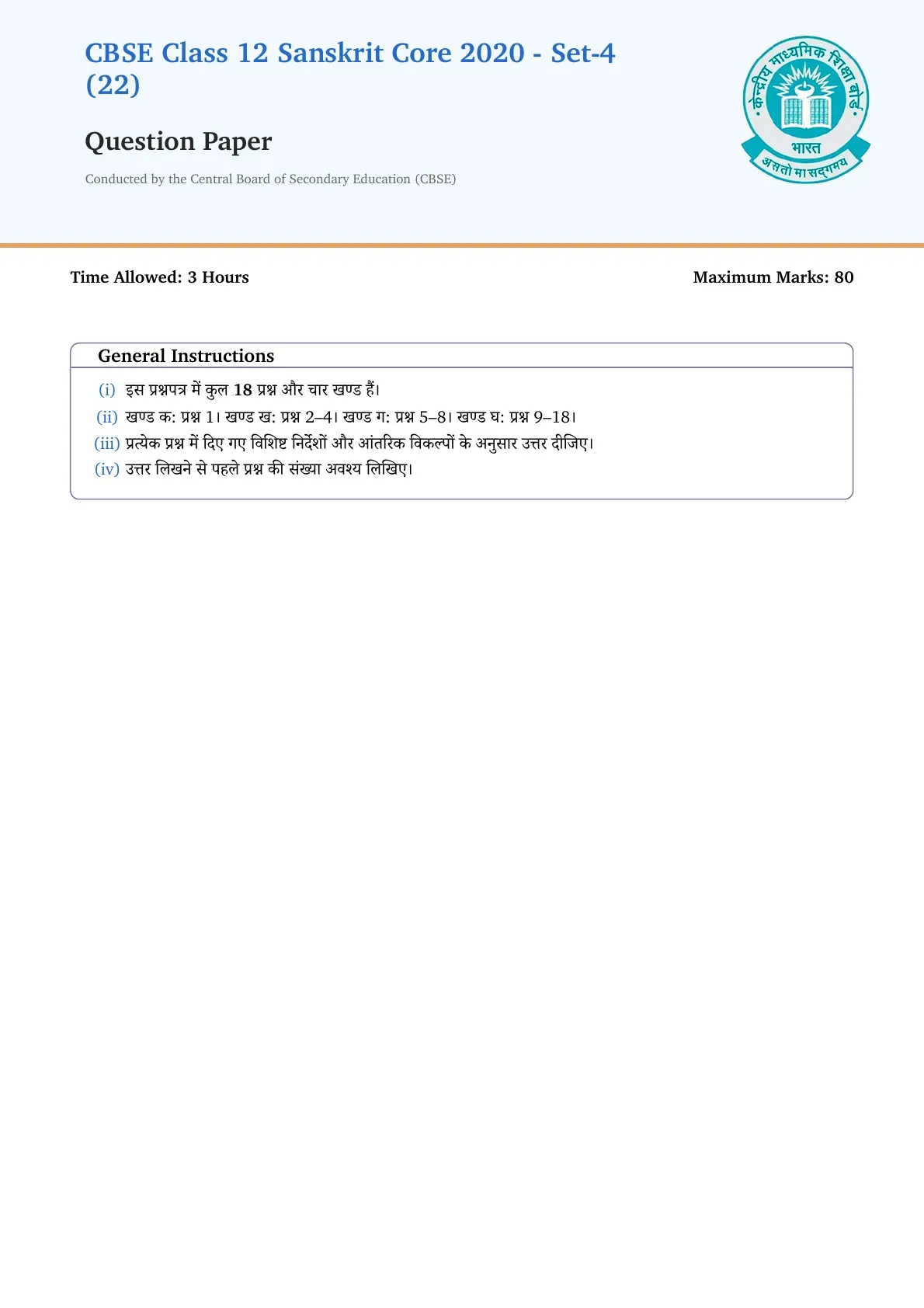
CBSE Class 12 Sanskrit Core Question Paper 2020 Code Set-4 (22) is available for download here. CBSE conducted the Class 12 Sanskrit Core exam on February 28, 2020 from 10:30 AM to 1:30 PM. The Sanskrit Core theory paper is of 80 marks.
Also Check: CBSE Class 12 Question Paper 2020 (All Subjects)
The Sanskrit Core question paper includes the following types of questions:
- The question paper has 18 questions for 80 marks in 3 hours, with 15 minutes of reading time (paper distributed at 10.15 a.m., no writing before 10.30 a.m.)
- It has four sections: A Unseen Reading Comprehension (10 marks), B Sanskrit Writing Skills (15), C Applied Grammar (20) and D (Part I Reading Comprehension 25, Part II General Introduction to Sanskrit Literature 10)
- Questions are to be answered in Sanskrit only unless stated otherwise
- Many questions print how many items to attempt, for example 'only six questions' in Q5 and Q7 and 'only five questions' in Q6, and some carry an internal OR choice (Q4, Q12, Q13 and Q16)
- Section C has four grammar questions worth 6, 5, 6 and 3 marks (sandhi, compounds, suffixes and case-endings)
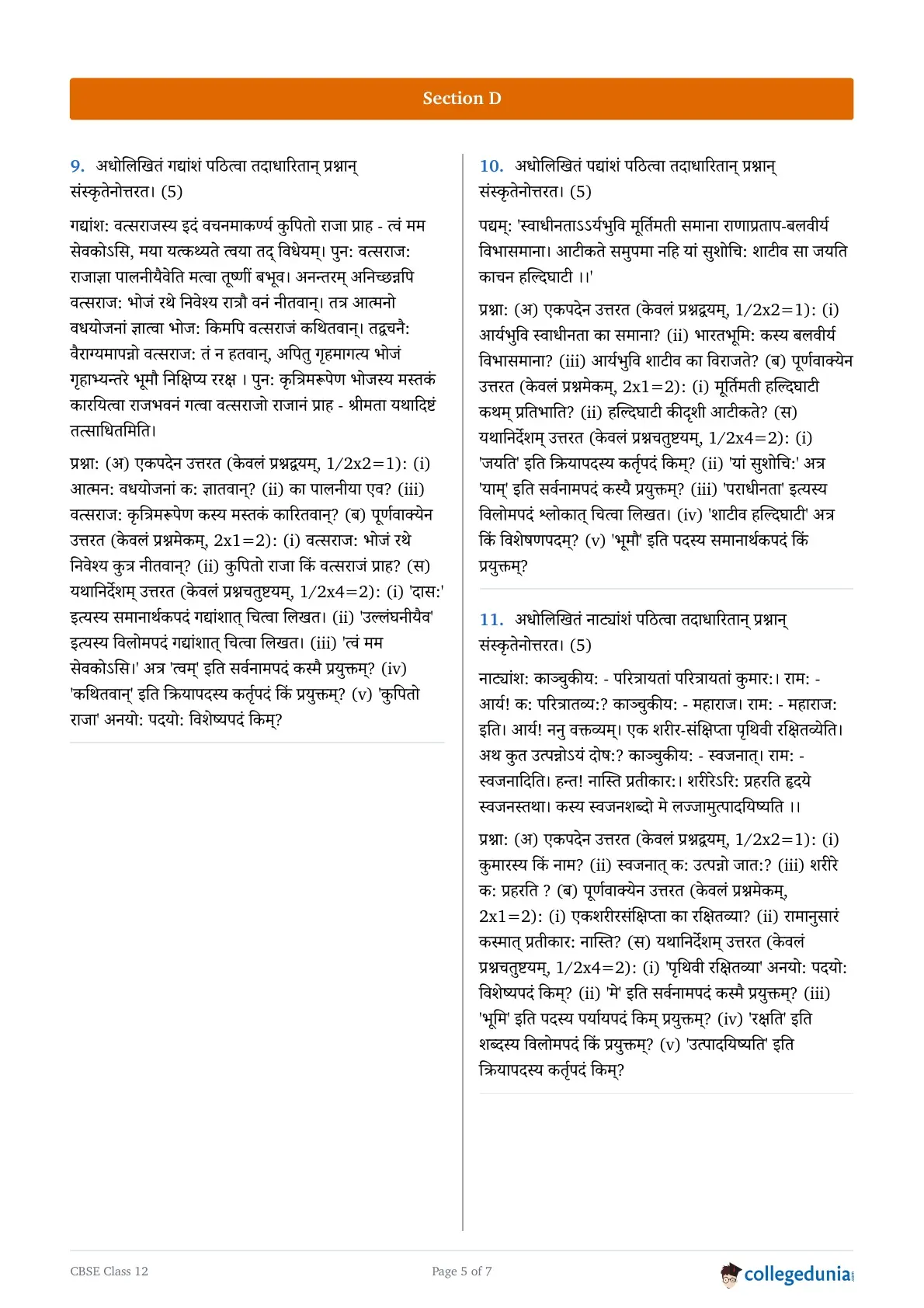
- Section D Part I has three 5-mark comprehension passages (prose, verse, drama) followed by four questions of 2 to 3 marks, and Part II has three questions of 3, 3 and 4 marks
CBSE Class 12 Sanskrit Core Question Paper 2020 Code Set-4 (22) PDF
| CBSE Official PDF | CD PDF | CD PDF with Solutions |
|---|---|---|
| Download official PDF 0.41 MB | Download Collegedunia PDF 0.24 MB | – |
CBSE Class 12 Sanskrit Core 2020 Question Paper Details
| Exam | CBSE Class 12 Board Examination 2020 |
| Subject | Sanskrit Core |
| Paper code | Set-4 (22) |
| Exam date | February 28, 2020 |
| Time allowed | 3 hours (plus 15 minutes of reading time, 10:15 AM to 10:30 AM) |
| Maximum marks | 80 |
| Total questions | 18 (attempt 18) |
CBSE Class 12 Sanskrit Core Question Paper Pattern and Marking Scheme
The CBSE Class 12 Sanskrit Core 2020 question paper is of 80 marks and has 18 questions, of which 18 are to be attempted. The tables below give the section-wise paper pattern and the split of marks, as printed in the official question paper.
CBSE Class 12 Sanskrit Core Question Paper Pattern 2020
| Section | Questions | Question Type | Choice | Marks per Question | Marks |
|---|---|---|---|---|---|
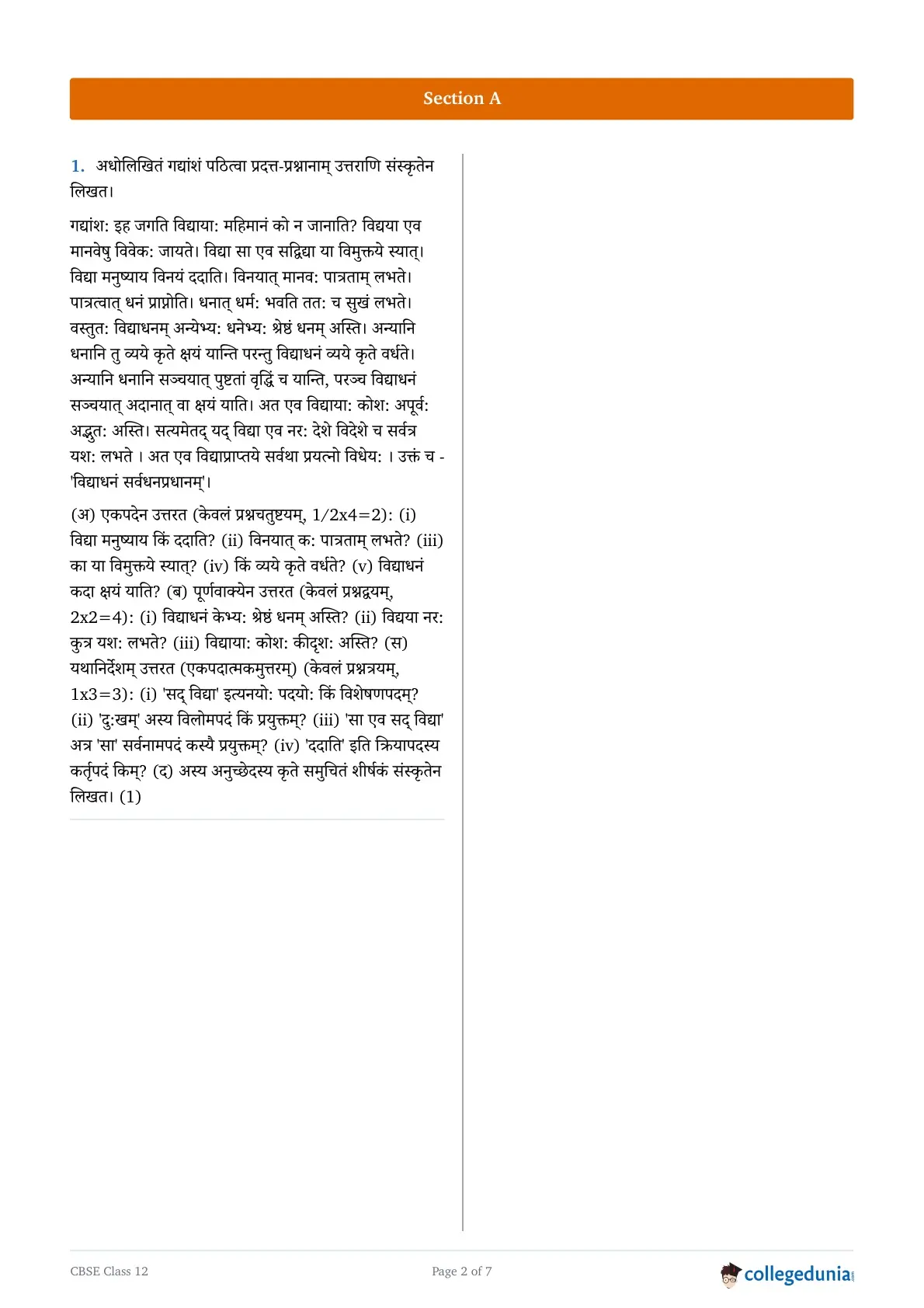
| Section A: Unseen Reading Comprehension | Q1 | Unseen prose passage in Sanskrit: one-word answers (4 of 5 questions, 1/2 each), full-sentence answers (2 of 3, 2 each), answers as directed (3 of 4, 1 each) and a suitable title (1) | All 1 | 10 | 10 |
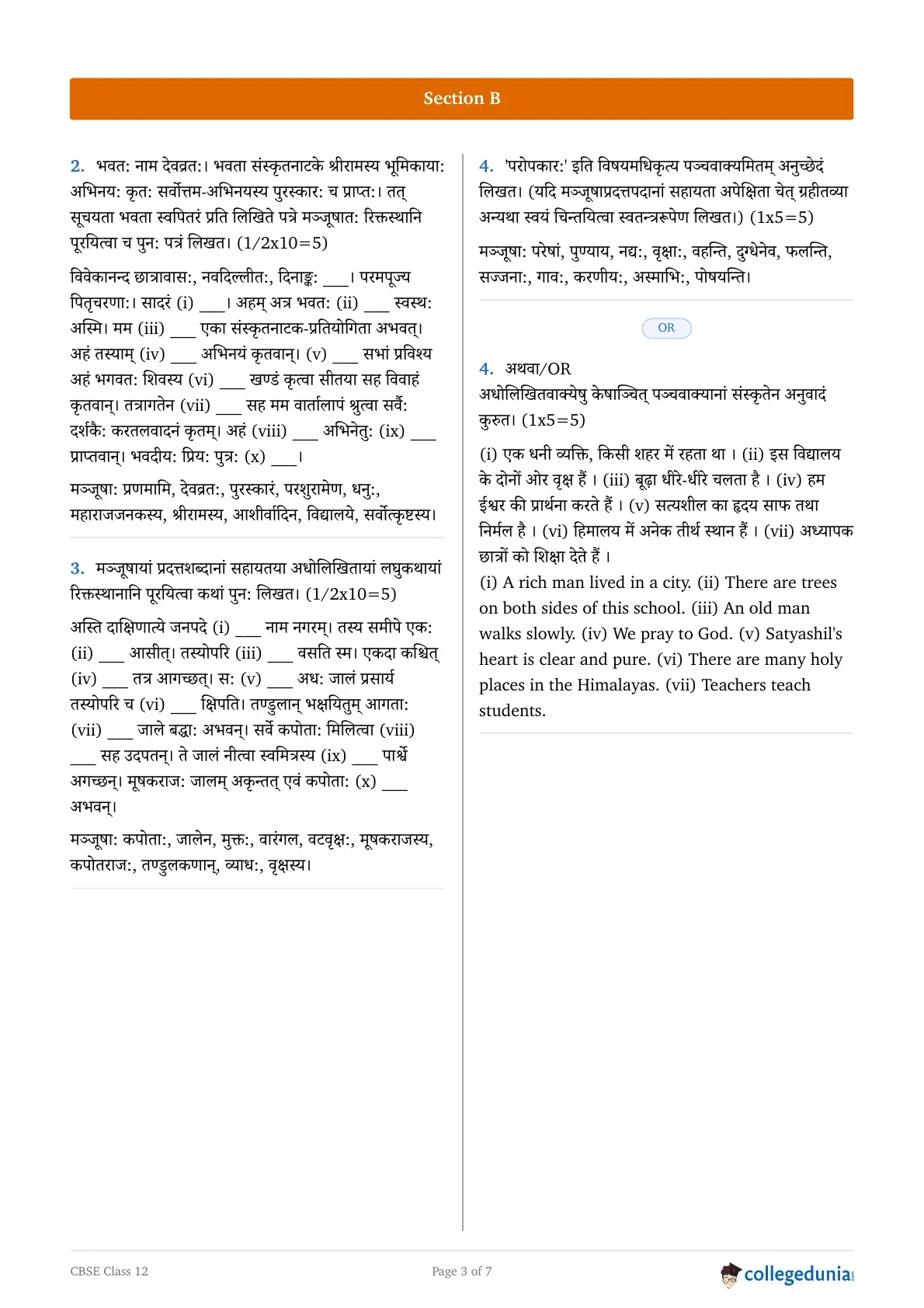
| Section B: Sanskrit Writing Skills | Q2 | Letter: fill the 10 blanks with words from the box (1/2 mark each) | All 1 | 5 | 5 |
| Q3 | Short story: fill the 10 blanks with words from the box (1/2 mark each) | All 1 | 5 | 5 | |
| Q4 | Paragraph of five Sanskrit sentences on a given topic (1 mark each), or translate any five of seven sentences into Sanskrit (1 mark each) | All 1 | 5 | 5 | |
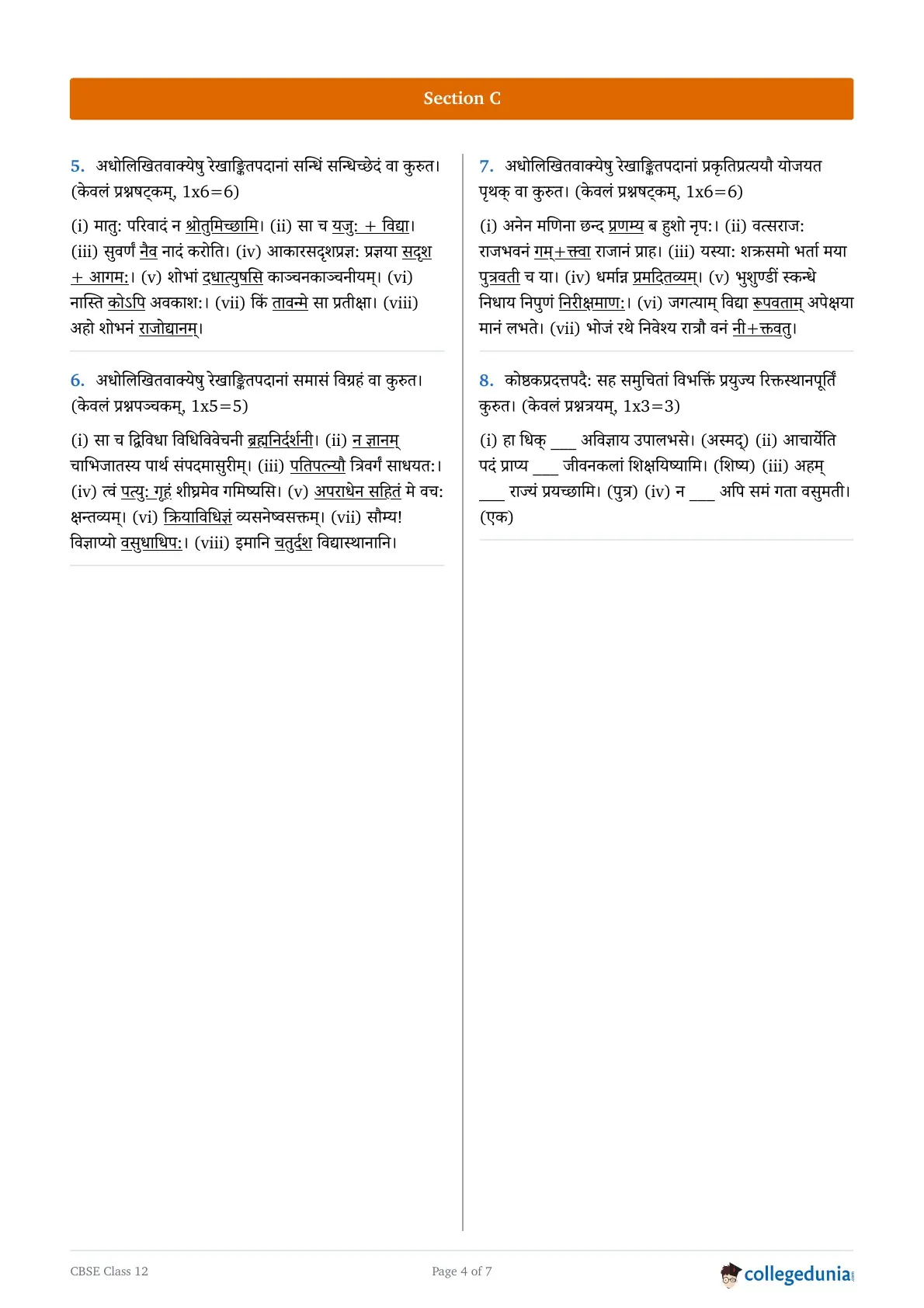
| Section C: Applied Grammar | Q5 | Sandhi: join or disjoin sandhi in six of eight underlined words (1 mark each) | All 1 | 6 | 6 |
| Q6 | Compounds: compound or expound five of eight underlined words (1 mark each) | All 1 | 5 | 5 | |
| Q7 | Suffixes: add or separate suffixes in six of seven underlined words (1 mark each) | All 1 | 6 | 6 | |
| Q8 | Case-endings: fill three of four blanks with the correct case-ending (1 mark each) | All 1 | 3 | 3 | |
| Section D: Part I Reading Comprehension (25 marks) and Part II General Introduction to Sanskrit Literature (10 marks) | Q9 | Part I: prose passage with questions in Sanskrit (one-word 2 of 3, full-sentence 1 of 2, as directed 4 of 5) | All 1 | 5 | 5 |
| Q10 | Part I: verse with questions in Sanskrit (one-word 2 of 3, full-sentence 1 of 2, as directed 4 of 5) | All 1 | 5 | 5 | |
| Q11 | Part I: drama passage with questions in Sanskrit (one-word 2 of 3, full-sentence 1 of 2, as directed 4 of 5) | All 1 | 5 | 5 | |
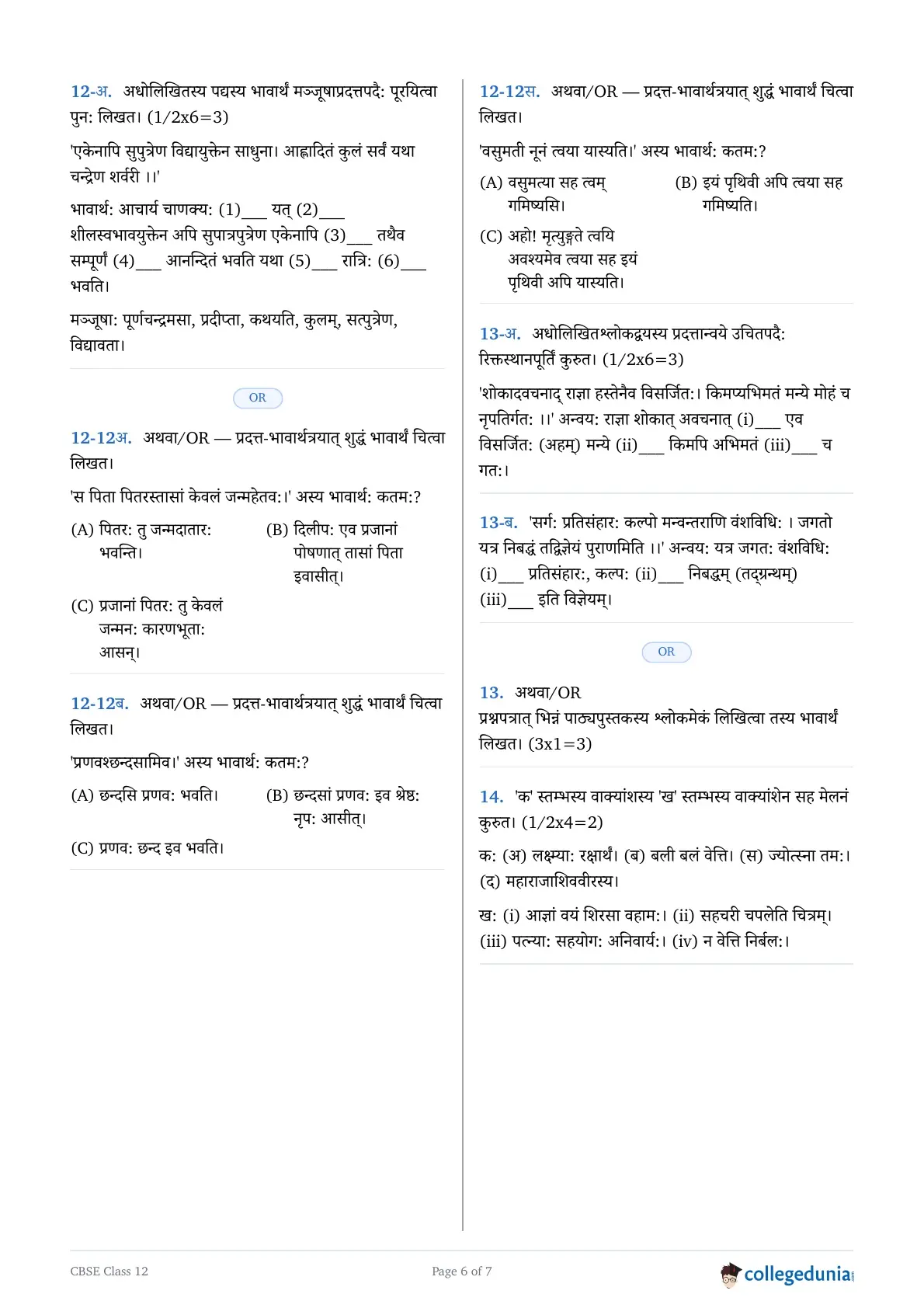
| Q12 | Part I: complete the central idea of a verse from the box (1/2 x 6), or pick the correct explanation out of three for three lines (1 x 3) | All 1 | 3 | 3 | |
| Q13 | Part I: fill the blanks in the prose order of two verses (1/2 x 6), or write one textbook verse with its meaning (3) | All 1 | 3 | 3 | |
| Q14 | Part I: match the sentence parts of Column 'ka' with Column 'kha' (1/2 x 4) | All 1 | 2 | 2 | |
| Q15 | Part I: select the correct meaning of underlined words as per context (4 of 5 questions, 1/2 each) | All 1 | 2 | 2 | |
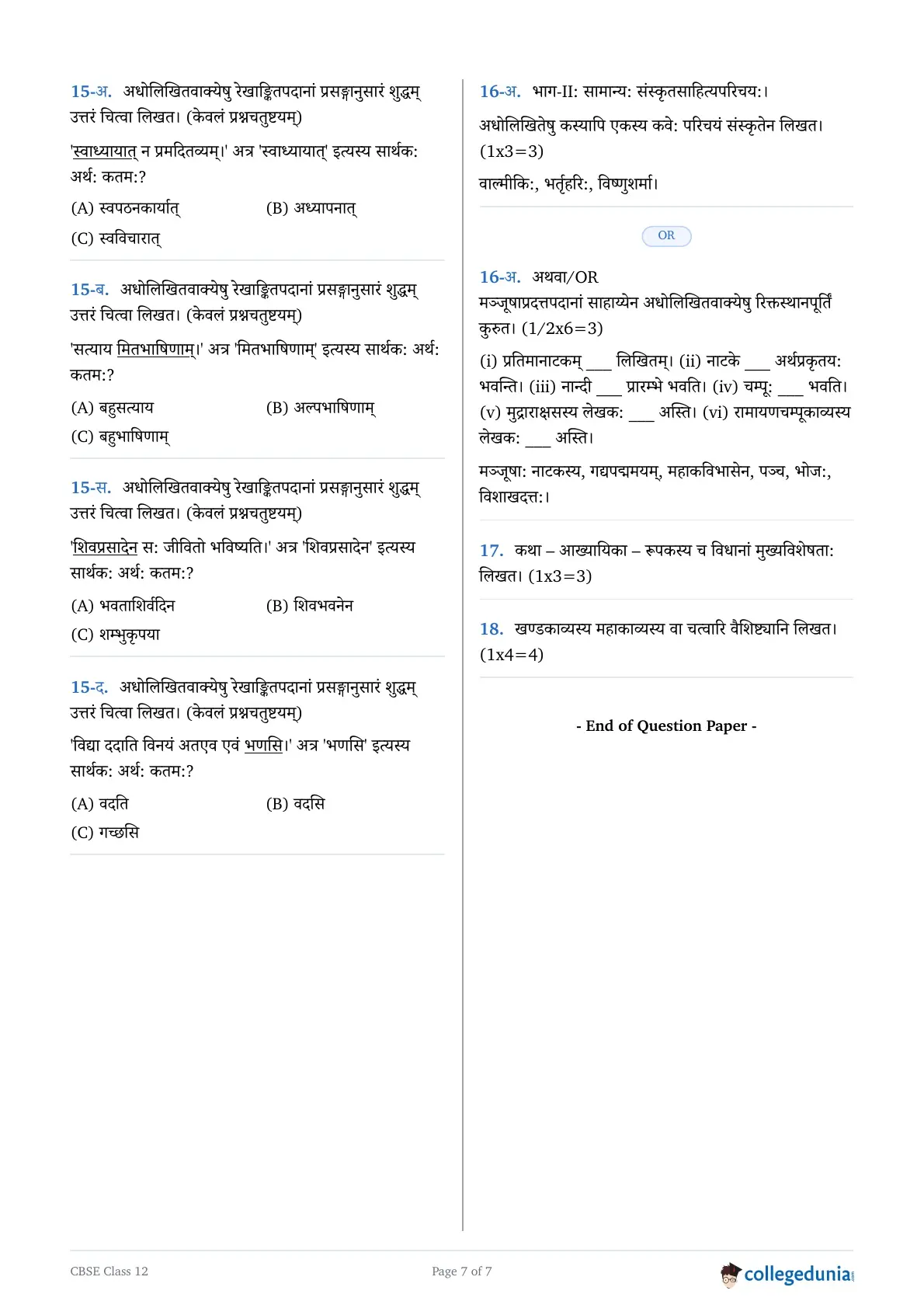
| Q16 | Part II: short note on any one of three poets (3), or fill six blanks from the box (1/2 x 6) | All 1 | 3 | 3 | |
| Q17 | Part II: main characteristics of katha, akhyayika and rupaka (3) | All 1 | 3 | 3 | |
| Q18 | Part II: any four characteristics of khandakavya or mahakavya (4) | All 1 | 4 | 4 | |
| Total | 18 questions | Attempt 18 | 80 |
CBSE Class 12 Sanskrit Core Marks Distribution 2020
| Question Type | Questions to Attempt | Marks per Question | Total Marks |
|---|---|---|---|
| Unseen prose passage in Sanskrit: one-word answers (4 of 5 questions, 1/2 each), full-sentence answers (2 of 3, 2 each), answers as directed (3 of 4, 1 each) and a suitable title (1) (Unseen passage) | 1 | 10 | 10 |
| Letter: fill the 10 blanks with words from the box (1/2 mark each) (Writing skills) | 1 | 5 | 5 |
| Short story: fill the 10 blanks with words from the box (1/2 mark each) (Writing skills) | 1 | 5 | 5 |
| Paragraph of five Sanskrit sentences on a given topic (1 mark each), or translate any five of seven sentences into Sanskrit (1 mark each) (Writing skills) | 1 | 5 | 5 |
| Sandhi: join or disjoin sandhi in six of eight underlined words (1 mark each) (Applied grammar) | 1 | 6 | 6 |
| Compounds: compound or expound five of eight underlined words (1 mark each) (Applied grammar) | 1 | 5 | 5 |
| Suffixes: add or separate suffixes in six of seven underlined words (1 mark each) (Applied grammar) | 1 | 6 | 6 |
| Case-endings: fill three of four blanks with the correct case-ending (1 mark each) (Applied grammar) | 1 | 3 | 3 |
| Part I: prose passage with questions in Sanskrit (one-word 2 of 3, full-sentence 1 of 2, as directed 4 of 5) (Textbook comprehension and literature) | 1 | 5 | 5 |
| Part I: verse with questions in Sanskrit (one-word 2 of 3, full-sentence 1 of 2, as directed 4 of 5) (Textbook comprehension and literature) | 1 | 5 | 5 |
| Part I: drama passage with questions in Sanskrit (one-word 2 of 3, full-sentence 1 of 2, as directed 4 of 5) (Textbook comprehension and literature) | 1 | 5 | 5 |
| Part I: complete the central idea of a verse from the box (1/2 x 6), or pick the correct explanation out of three for three lines (1 x 3) (Textbook comprehension and literature) | 1 | 3 | 3 |
| Part I: fill the blanks in the prose order of two verses (1/2 x 6), or write one textbook verse with its meaning (3) (Textbook comprehension and literature) | 1 | 3 | 3 |
| Part I: match the sentence parts of Column 'ka' with Column 'kha' (1/2 x 4) (Textbook comprehension and literature) | 1 | 2 | 2 |
| Part I: select the correct meaning of underlined words as per context (4 of 5 questions, 1/2 each) (Textbook comprehension and literature) | 1 | 2 | 2 |
| Part II: short note on any one of three poets (3), or fill six blanks from the box (1/2 x 6) (Textbook comprehension and literature) | 1 | 3 | 3 |
| Part II: main characteristics of katha, akhyayika and rupaka (3) (Textbook comprehension and literature) | 1 | 3 | 3 |
| Part II: any four characteristics of khandakavya or mahakavya (4) (Textbook comprehension and literature) | 1 | 4 | 4 |
| Total | 18 | 80 |



Comments