



Education Content Expert
Angle of Elevation is a widely used concept in trigonometry related to heights and distances. Line of Sight, Angle of Elevation, and Angle of Depression are the three basic and important terms while dealing with heights and distances using Trigonometry.
- Angle of Elevation is referred to as the angle formed between the horizontal line and the line of sight.
- It is formed when the line of sight is upward from the horizontal line.
- As its name defines itself, the angle of elevation means it is formed above the observer’s eye.
Read More: NCERT Solutions for Class 10 Maths Some Applications of Trigonometry
| Table of Content |
Key Terms: Angle of Elevation, Angle of Depression, Triangle, Adjacent Side, Line of Sight, Trigonometry, Angle of Elevation Formula
What is Angle of Elevation?
[Click Here for Sample Questions]
Angle of Elevation is defined as the angle which is formed between the horizontal line and the line of sight. If the line of sight is upward from the horizontal line, then the angle formed is the Angle of Elevation.
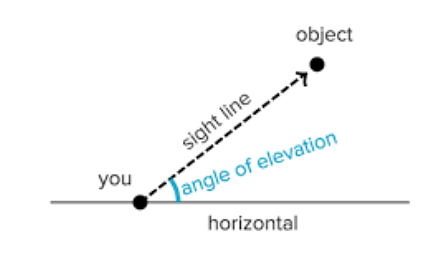
Angle of Elevation
In the above figure, the observer is looking at the object at a height, standing on the ground, forming an angle with the line of sight and the horizontal line. Now, joining the line of sight and the horizontal line with an imaginary line, a right-angled triangle will be formed.
- Trigonometry is used to find the distance of the observer from the object (tower or building).
- The height of the tower or the given height at which the object is kept is taken as perpendicular.
- The horizontal line is taken as the base of the triangle that will be formed by all these intersections.
Read More:
| Relevant Concepts | ||
|---|---|---|
| Some Applications of Trigonometry | Right Angle | Sine Function |
| Trigonometry Values | Inverse Trigonometric Functions | Introduction to Trigonometry Formula |
Important Terms in Angle of Elevation
[Click Here for Sample Questions]
The terms related to the Angle of Elevation are as follows:
- Angle
- Horizontal Line
- Line of Sight
Angle
An angle is a figure formed by two rays or two line segments sharing a common endpoint, known as the vertex of the angle. Angles can also be formed by the intersection of two or more planes.
- An angle is the gap in between two lines that connect on one vertex.
- Angles are measured in degrees.
Horizontal Line
A horizontal line is defined as a straight line that is drawn from left to right or right to left and it is parallel to the x-axis in the coordinate plane.
- A straight or horizontal line is on the coordinate surface where all the points on that line have the same y-coordinate.
- The angle of the object from the observer’s eye and horizontal line combine to form the angle of elevation.
Line of Sight
The line which is drawn from the eyes of the observer to the point being viewed on the object is called the line of sight.
- Here, the object is always kept above the sight of the observer.
- If the angle of elevation is known then distance or the altitude can be easily determined.
The reason for using the trigonometric functions over here is that the angle formed with the observer’s eye to the top of a building or tower gives rise to an imaginary right-angled triangle, where the height of the building or tower is considered as the perpendicular of the triangle, and hence, it becomes very easy to apply the trigonometric functions on it.
Read More: Some Applications of Trigonometry Important Questions
Angle of Elevation Formula
[Click Here for Sample Questions]
Angle of Elevation Formula is used when the opposite side, hypotenuse, and adjacent side to the right angle are given. If the distance of the object and its height is given, Angle of Elevation Formula is given as
Tangent of Angle of Elevation = Height of Given Object/ Distance of Observer from Object
OR
Tan θ = Opposite Side/Adjacent Side
Solved ExampleExample: Find the height of a building if a girl stands at point P, which is 8 units away from a building and forms a 45° angle of elevation with point Q. Solution: Given that
Using the Angle of Elevation Formula, we can find the height of the QR, tan θ = QR/PR. tan 45° = QR/8 We know that tan 45° is 1, so, 1 = QR/8 QR = 8 units |
Read More: Some Applications of Trigonometry Revision Notes
Angle of Depression
[Click Here for Sample Questions]
Angle of Depression is the angle formed between the observer’s line of sight and the horizontal line when the object is placed below the level of eye of the observer.
- It is the opposite of the angle of elevation when it comes to the positioning of the observer and the object.
- The line of sight of the observer would be below the horizon.
- Therefore, the angle of elevation and the angle of depression are congruent to each other.
Check More:
| Related Topics | ||
|---|---|---|
| Trigonometry Table | Trigonometric Ratios | Sin Cos Formulas |
| Trigonometric Identities | Difference Between Trigonometry and Geometry | Cot Tan Formula |
Difference between Angle of Elevation and Angle of Depression
[Click Here for Sample Questions]
Angle of Elevation and Angle of Depression are the two important concepts in Trigonometry and its applications. Angle of Depression is just the opposite of the angle of elevation.
The difference between Angle of Elevation and Angle of Depression is as follows:
| Angle of Elevation | Angle of Depression |
|---|---|
| When an object is positioned above the observer, Angle of Depression is created. | Angle of Depression develops when an object is positioned below the observer's line of sight. |
| It is also called as an upward angle. | It is also referred to as a downward angle. |
| The object lies below the horizontal line. | The object is above the horizontal line. |
Read More: Some Applications of Trigonometry MCQs
Things to Remember
- Angle of Elevation is the angle produced between the horizontal line and the line of sight.
- It is an angle formed above the eye of the observer.
- Line of Sight is the path that an observer draws from their eyes to the place they are viewing on an item.
- Angle of Elevation Formula is Tan θ = Opposite Side/Adjacent Side.
- It is used to find distances, heights of buildings or towers with the help of trigonometric ratios, such as sine, cosine and tangent.
- Angle of depression refers to the angle from the horizontal downward to an object.
Sample Questions
Ques. Give an example of the angle of elevation. (2 Marks)
Ans. Consider a person is standing on the earth’s surface and looking at the top of a tower, then the angle formed between the horizontal surface and the distance from the eye of the person to the top of the tower is known as the angle of elevation.
Ques. If a building is situated above an object with a 45 degree angle of inclination from the observer. Determine the horizontal distance between the viewer and the building if it is 90 feet tall. (3 Marks)
Ans. Given,
- θ = 45 degrees
- Height of the building = 90 ft.
We need to find the distance between the observer and the base of the building.
By the formula, we know that,
tan θ = Height of the building/ Distance between the observer and the building
tan 45 = 90/ D
Since, by the use of trigonometric tables, tan 45 =1
D = 90 ft.
Hence, the distance between the observer and the base of the building is equal to the given height of the building.
Ques. An artificial earth satellite's angles of elevation are measured from two earth stations that are located on the same side of the satellite, and they are discovered to be 30° and 60°. In the same vertical plane as the satellite are the two ground stations. Find the distance between the satellite and Earth if the distance between the earth stations is 4000 km. (√3 = 1.732) (3 Marks)
Ans. Let BC be x m.

In triangle ABC :
∠ACB = 60°
tan θ = opposite side/Adjacent side
tan 60° = AB/BC
√3 = AB/BC
AB = √3BC
AB = x√3 ----(1)
In triangle ABD :
∠ADB = 30°
tan θ = opposite side/Adjacent side
tan 30° = AB/BD
1/√3 = AB/(BC + CD)
1/√3 = AB/(x + 4000)
AB = (x + 4000)/√3 ---->(2)
(1) = (2)
x√3 = (x + 4000)/√3
3 x = x + 4000
3x - x = 4000
x = 2000
Distance between the satellite and earth(AB) = x√3
= 2000 (1.732) = 3464 km
Ques. The angles of depression of a building's top and bottom are observed to be 30° and 60°, respectively, from the top of a 60 m-tall skyscraper. Identify the building's height. (3 Marks)
Ans. From the given information, we can draw a rough diagram

In triangle ABC :
Let AB = x and BD = 60 - x
∠ACB = 30°
tan θ = opposite side/Adjacent side
tan 30° = AB/BC
1/√3 = x/BC
BC = x √3 ----(1)
In triangle ADE :
∠AED = 60°
tan θ = opposite side/Adjacent side
tan 60° = AD/DE
√3 = 60/DE
DE = 60/√3 ----(2)
(1) = (2)
x √3 = 60/√3
3x = 60
x = 20 m
CE = 60 - 20 = 40 m
Height of the building = 40 m.
Ques. Calculate the size of ∠BAC in the given triangles. (3 Marks)

Ans. In right triangle ABC [see Fig.6.12(a)]
tan θ = opposite side / adjacent side = ⅘
(i) Tan θ = opposite side/adjacent side = ⅘
θ = tan-1(⅘) = tan-1(0.8)
θ = 38.7° (since tan 38.7° = 0.8011)
∠BAC = 38.7°
(ii) In right triangle ABC [see Fig.6.12(b)]
tan θ = 8/3
θ = tan-1(8/3) = tan-1(2.66)
θ = 69.4° (since tan 69.4° = 2.6604)
∠BAC = 69.4°
Ques. A tower is a vertically positioned on the ground. The top of the tower rises at an angle of 30° from a location on the ground that is 48 metres from its base. Find the tower's height. (2 Marks)

Ans. Let PQ be the height of the tower.
Take PQ as height and QR is the distance between the tower and the point R. In right triangle PQR, ∠PRQ = 30°
Tan θ = PQ/QR
Tan 30 = h/48 gives, √3 = h/48 so, h = 16√3.
Therefore the height of the tower is 16√3 m.
Ques. A kite is in the air 75 metres above the earth. The kite's string is temporarily tied to a location on the ground. The string is 60 degrees inclination from the horizontal. Determine the length of the string assuming there is no slack in it. (2 Marks)

Ans. Let AB be the height of the kite above the ground. Then, AB = 75.
Let AC be the length of the string.
In right triangle ABC, ∠ACB = 60°
sin θ = AB/AC
sin 60° = 75/AC
gives √3/2 = 75/AC so AC = 150/√3 = 50√3 m
Hence, the length of the string is 50√3 m.
Ques. Two ships are sailing in the sea on either sides of a lighthouse. The angle of elevation of the top of the lighthouse as observed from the ships are 30° and 45° respectively. If the lighthouse is 200 m high, find the distance between the two ships. (√3=1.732) (3 Marks)
Ans. Let AB be the lighthouse. Let C and D be the positions of the two ships.
Then, AB = 200 m.
∠ACB = 30° , ∠ADB = 45°
In right triangle BAC, tan 30° = AB/AC
1/√3 = 200/AC gives AC = 200√3 ...(1)
In right triangle BAD, tan 45° = AB/AD
1 = 200/AD gives AD = 200 ...(2)
Now, CD = AC + AD = 200√3 + 200 [by (1) and (2)]
CD = 200(√3 + 1) = 200 × 2. 732 = 546.4
Distance between the two ships is 546.4 m.
Ques. Find the value of x in the given figure. (3 Marks)

Ans. In this figure, there are two angles of elevation given, one is 30° and the other one is 45°. In △POQ, ∠PQO = 30 degrees and OQ=27 feet. Applying the angle of elevation formula tan θ = PO/OQ, we get tan 30 = h/27. The value of tan 30 is 1/√3.
1/√3 = h/27
h = 27/√3
h = 3 √3/√3
h = 3 ft.
Now, apply the same formula in △POR, we get tan θ = PO/OR.
tan 45 = 3/x
The value of tan 45 is 1, and PO = 3 ft.
⇒ 1 = 3/x
x = 3 ft
Ques. What is Line of Sight? (1 Mark)
Ans. Line of Sight is defined as the line which is drawn from the eyes of the observer to the point being viewed on the object.
Check-Out:



Comments