



Education Journalist | Study Abroad Lead
In trigonometry, every function has an inverse function and the arccot function is the inverse of the cot function. Arccot is represented as cot-1. Cot, which is inverse of tangent, is expressed as the ratio of the adjacent side to the opposite side of a particular angle of a right-angled triangle. Arccot formula like other inverse formulas is used to identify an angle. There are six trigonometric functions and each with an inverse function; arccot is one of the inverse functions.
| Table of Content |
Key Takeaways: Arccot formula, Trigonometry, Inverse trigonometry, Right-angle triangle, Trigonometric functions
Arccot Formula
[Click Here for Sample Questions]
Arccot formula finds it’s use in trigonometry mathematics, where the cotangent is defined as the ratio of the adjacent side to the opposite side of a specific angle of a right-angled triangle whereas the arccot function is the inverse of the cotangent function. Arccot is also referred to as cot-1.
The basic arccot formula can be represented as:
θ = arccot(adjacent/opposite)
Example:
In a given triangle, the base of the angle C is 1 and the perpendicular side is √3.
So, cot-1 (1/√3) = C
cot C = 1/√3
cot C = cot 60°
C = 60°
Values of arccot
| x | arccot(x) | arccot(x) |
|---|---|---|
| -√3 | 5π/6 | 150° |
| -1 | 3π/4 | 135° |
| -√3/3 | 2π/3 | 120° |
| 0 | π/2 | 90° |
| √3/3 | π/3 | 60° |
| 1 | π/4 | 45° |
| √3 | π/6 | 30° |
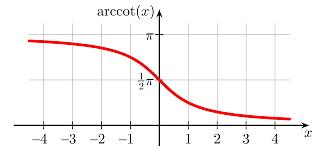
Arccot Graph
[Click Here for Sample Questions]
Graph of any inverse trigonometric function can be made from the graph of the trigonometric function by switching the x-axis and y-axis. For example, if (a, b) is a point on the graph of a trigonometric function, then (b, a) becomes the corresponding point on the graph of its inverse trigonometric function.
Graph for Arrcot Function
Domain & Range of Arccot
| Domain | -∞ < x < ∞ |
| Range | 0 < y < π |
Arccot Trigonometric Function Formula
| Arccot Formula | cot-1(-x) = π – cot-1(x), x ∈ R |
Inverse trigonometric function
[Click Here for Sample Questions]
Inverse trigonometric functions are known as ‘Arc Functions’. For a given value of trigonometric functions, there is an inverse trigonometric function. The inverse trigonometric functions and the trigonometric functions perform opposite operations. It is well understood that trigonometric functions are especially applicable to the right-angle triangle. The six important functions are used to find the angle in the right triangle when two sides of the triangle measure are known.
Each trigonometric function has an inverse. Below are the six trigonometric functions and their inverse:
| Trigonometric functions | Inverse |
|---|---|
| Sine | arcsine |
| Cosine | arccos |
| Tangent | arctan |
| Secant | arcsec |
| Cosecant | arccsc |
| Cotangent | arccot |
Things to Remember
- Trigonometric and inverse trigonometric functions have practical applications in many areas like physics, landscaping, building, architecture, etc.
- The representation sin–1 x must not be confused with (sin x) –1. Because sin–1 x represents an angle, the value of whose sine is x, similarly for other trigonometric functions.
- The smallest numerical value of θ, either +ve or -ve, is known as the principal value of the function.
- The study of trigonometry first started in ancient India. The ancient Indian Mathematicians like Aryabhatta (476A.D.), Brahmagupta (598 A.D.), Bhaskara I (600 A.D.) and Bhaskara II (1114 A.D.) found important results of trigonometry. All this knowledge of trigonometry went to Arabia and then to Europe from India.
Also Read:
Sample Questions
Ques: Calculate the value of A if A = cot-1(-1). (2 marks)
Ans: Given,
A = cot–1(-1)
We know that cot 3π/4 = -1
A = cot–1(cot 3π/4)
Therefore, A = 3π/4 = 135°
Ques: Find the value: Arc cot [tan (−37o)] (2 marks)
Ans: Arc cot [tan (37o)]
=cot−1[tan (−37o)]
=cot−1(−tan37o)
=π−cot−1(tan37o)
=π−cot−1(cot53o)
=π−53o
Ques: Find the value: arccos (cos (− \(\frac{\sqrt{3}}{2}\))) (2 marks)
Ans: arccos (cos (- \(\frac{\sqrt{3}}{2}\)))
=cos−1[cos (−\(\frac{\sqrt{3}}{2}\))]
=cos−1cos (\(\frac{\sqrt{3}}{2}\)) as cos (− π) = cosπ
=\(\frac{\sqrt{3}}{2}\)
Ques: If x = cot-1(-\(\frac{\sqrt{3}}{3}\)), then calculate the value of x?(2 marks)
Ans:
Given,
x = cot-1(-\(\frac{\sqrt{3}}{3}\))
We know that cot 2π/3 = -\(\frac{\sqrt{3}}{3}\)
x = cot-1(cot 2π/3)
Thus, x = 2π/3 or x = 120°
Ques: Find arctan √2 + arctan\(\frac{1}{\sqrt{2}}\)(2 marks)
Ans: Arctan √2 +arctan\(\frac{1}{\sqrt{2}}\)
=tan−1 √2 +tan−1 \(\frac{1}{\sqrt{2}}\)
=tan−1√2 +cot√2 (as tan−11/x= cot−1 x)
=π/2 (as tan−1 x + cot−1 x= π/2)
Ques: In the right-angled triangle ABC, if the base of the triangle is 4 and the height is 3. Find the base angle.(2 marks)
Ans: To find: θ
Using the arccot formula,
θ=arccot(adjacent/opposite)
θ=arccot (4/3) = 36.8770
Thus, the base angle is 36.8770
Ques: Find the principal values of the inverse circular function cot−1(- 1) (2 marks)
Ans: If the principal value of cot−1 x is α then we know, - π/2≤ θ ≤ π/2 and θ ≠ 0.
Therefore, If the principal value of cot−1 (- 1) be α then cot−1 (- 1) = θ
⇒ cot θ = (- 1) = cot (-π/4) [Since, - π/2 ≤ θ ≤ π/2]
Therefore, the principal value of cot−1 (- 1) is (-π/4).
Ques: Find the General and Principal Values of cot−1√3 (2 marks)
Ans: Let x = cot−1 √3
⇒ cot x = √3
⇒ cot x = tan (π/6)
⇒ x = π/6
⇒ cot−1 √3 = π/6
Thus, the principal value of cot−1 √3 is π/6 and its general value = nπ + π/6.
Ques: Find the General and Principal Values of cot−1 (- √3) (2 marks)
Ans: Let x = cot−1(-√3)
⇒ cot x = -√3
⇒ cot x = cot (-π/6)
⇒ x = -π/6
⇒ cot−1 (-√3) = -π/6
Thus, the principal value of cot−1 (-√3) is -π/6 and its general value = nπ - π/6.
Ques: Solve cos (tan-1 x) = sin (cot -1 3/4) (2 marks)
Ans: We have: cos (tan-1 x) = sin (cot -1 3/4)
cos (tan-1 x) = sin (sin -1 4/5)
cos (tan-1 x) = 4/5
tan-1 x = cos-14/5
⇒ tan-1 x = tan -13/4
Hence x = ¾
Ques: Find the values of cos (tan−1 ¾) (3 marks)
Ans: Let, tan−1 ¾ = θ
Thus, tan θ = ¾
Since it’s known that sec2 θ - tan2 θ = 1
⇒ sec θ = √(1 + tan2 θ)
⇒ sec θ = √(1 + (3/4)2)
⇒ sec θ = √(1 + 9/16)
⇒ sec θ = √(25/16)
⇒ sec θ = 5/4
Therefore, cos θ = 4/5
⇒ θ = cos−1 4/5
Putting the value of θ:
We get, cos (tan−1 ¾) = cos (cos−1 4/5) = 4/5
Therefore, cos (tan−1 ¾) = 4/5
For Latest Updates on Upcoming Board Exams, Click Here: https://t.me/class_10_12_board_updates
Check-Out:



Comments