



Content Curator
Biomagnification is the accumulation of toxic chemical substances in living organisms to a concentration higher than those found in the inorganic, non-living environment or in the food they eat. This is also known as Biological magnification or bio-amplification. In this article, we will discuss more about Biomagnification, its causes, effects, examples and some important questions.
| Table of Content |
Key Terms: Biomagnification, food chain, pesticides, insecticides, fungisides, toxins
Biomagnification
[Click Here for Sample Questions]
The term “Biomagnification” refers to the increase in polluted substances due to the intoxicating environment. The contaminants can be heavy metals such as arsenic, mercury and pesticides such as DDT.
The organisms take up these substances through the food they consume. When the higher food chain organisms feed on the lower food chain organisms that contain these toxins, the toxins get accumulated in the higher organisms.
The increase in the concentration of mercury in the food chain is explained in the image below.
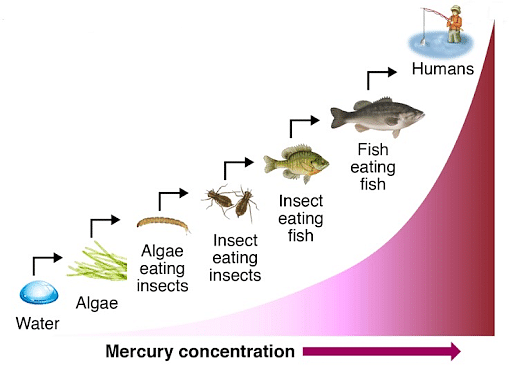
Biomagnification
Also Read: Biomagnification or Biological Magnification
Causes of Biomagnification
[Click Here for Previous Year Questions]
Given below are the major causes of Biomagnification:
1. Agricultural Products
The chemicals used in the agricultural sector such as insecticides, pesticides and fungicides are highly toxic and are released into the rivers, soil and lakes. Heavy metals such as mercury, arsenic, lead are present in trace amounts in these substances. These have a negative impact on the health of aquatic organisms and humans.

2. Organic Contaminants
Manures and biosolids are industrially processed and contain contaminants. These substances are harmful to humans and plants as well as their industrial use can cause Biomagnification.

Organic Contaminants
3. Industrial Activities
The toxic substances are released into the lakes, soil, oceans and rivers by industries and factories. Additionally, the gas released pollutes the environment and enters the food chain which causes Biomagnification.

4. Mining Activities in the Ocean
Deep-sea mining is done to extract metals such as cobalt, aluminium, zinc, gold and silver. During this process a huge amount of sulphide and selenium is generated which further gets deposited in soil and water resources, destroying the oceans and coastal regions.

Also read: Air pollution control
Effects of Biomagnification
[Click Here for Sample Questions]
Given below are some of the major effects of Biomagnification on the environment and living organisms.
1. Impact on Human Health
Biomagnification makes humans more prone to kidney problems, cancer, birth defects, liver failure, heart diseases and respiratory problems.
2. Impact on Reproduction & Development of Marine Creatures
The vital organs of aquatic organisms get accumulated with toxic chemicals, interfering with their process of development and reproduction. For example, the sea birds' eggshells are so thin that they may be crushed by the birds at the time of incubation. Toxic chemicals such as selenium and mercury harm aquatic creatures’ reproductive organs.
3. Coral Reefs Destruction
The main cause of coral reef destruction is cyanide. Cyanide is used in fishing and gold leaching. Many marine creatures use coral reefs for food as well as for living. So, the destruction of coral reefs harms the lives of many aquatic animals.
4. Disturbance in Food Chain
The food chain gets disturbed due to the toxins and chemicals released into the water bodies. The small organisms absorb the toxins and are eaten up by larger organisms. As a result, the toxins are collected in the higher level of organisms.
| Related Topics | ||
|---|---|---|
| Waste Disposal | Types of Waste | Pollution |
| Environment (Protection) Act, 1986 | Municipal Solid Waste | Air (Prevention and Control of Pollution) Act |
Real-Life Examples of Biomagnification
[Click Here for Sample Questions]
Here are a few real-life examples of Biomagnification –
Example 1:
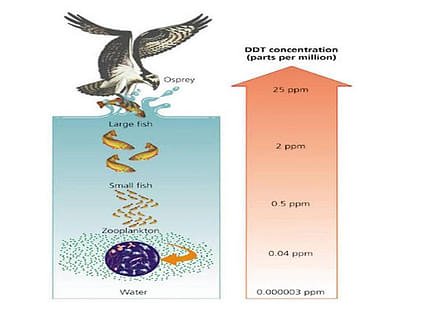
- When pesticide are sprayed to control mosquitoes, a trace amount of DDT is released which gets accumulated in the cells of various aquatic organisms when mixed with water.
- When the feeders in the food chain such as fishes and clams consume these organisms, they also consume DDT. Furthermore, the DDT concentration becomes ten times higher than in the previous stage.
- The concentration of DDT rises through the food chain, from one trophic to the next. For example, if a seagull eats one of these fish, it will consume more DDT. When compared to that fish, it can go up to 40 times or more. As a result, there is a 400-fold increase throughout this relatively short food chain.
Example 2:
- The presence of mercury in several predatory fishes is another important example of Biomagnification. Shark, tuna, king mackerel and other large fishes contain more toxic mercury than smaller fishes.
- The toxic level is so high that medical experts suggest pregnant women avoid eating these fish as it can damage the baby’s nervous system.
Also read: Montreal Protocol
Things to Remember
[Click Here for Previous Year Questions]
- Biomagnification is the accumulation of toxic substances in the organs of an organism at different trophic levels of a food chain.
- The chemicals used in the agricultural sector such as insecticides, pesticides and fungicides have a negative impact on the health of aquatic organisms and humans.
- The industrial use of manures and biosolids can cause Biomagnification.
- Biomagnification disturbs the process of development and reproduction in aquatic organisms.
Also Read:
Previous Years Questions
- Which is wrong with respect to our responsibility as a human being to protect our environment? [JEE Mains 2019]
- BOD stands for? [JEE Mains 2016]
- Biochemical Oxygen Demand (BOD) value can be a measure of water pollution caused by the…? [JEE Mains 2016]
- Ozone is destroyed by CFCs in the upper stratosphere Ozone holes increase the amount of UV…? [JEE Mains 2019]
- Addition of phosphate fertilisers to water bodies causes? [JEE Mains 2015]
- A water sample has ppm level concentration of the following metals…? [JEE Mains 2019]
Sample Questions
Ans: (i) Continuous increase in DDT concentration is due to the following reasons:
- DDT cannot be metabolised.
- DDT cannot be excreted and it is passed on to the next higher trophic level.
(ii) Biomagnification is responsible for increase in DDT content in the food chain.
Ques.2: DDT content in the water of a lake that supplies drinking water to the nearby villages, is found to be 0.003 ppm. The kingfishers of that area are reported to have 2 ppm of DDT. Why has the concentration increased in these birds? What harm will this cause to the bird population? Name the phenomenon. (All India 2008, 3 Marks)
Ans: DDT cannot be metabolised or excreted by the organism and gets accumulated in the organisms which further passes to the next higher trophic level through the food chain. Hence, concentration of DDT gets increased in birds. This will disturb the calcium metabolism and make eggshells thin which will further cause their premature breaking.
This eventually causes a decline in the bird population. The phenomenon responsible for this is biomagnification.
Ques.3: Explain biomagnification. How does the biomagnification of DDT affect the population of fish-eating birds? (All India 2010, 3 Marks)
Ans: Biomagnification can be defined as the increase in the concentration of contaminants in the successive trophic levels.
The toxic substances accumulated by the organisms cannot be metabolised or excreted. They get accumulated in an organism and passes on to higher trophic levels.
The population of fish-eating birds gets adversely affected by DDT. DDT is very poisonous and disturbs the calcium metabolism in birds which causes thinning of their eggshells and premature breaking of such eggs.
It leads to a decline in the bird population.
Ques.4: A crane had a DDT level of 5 ppm in its body. What would happen to the population of such birds? Explain giving reasons. (All India 2009, 3 Marks)
Ans: Fish-eating bird crane has a DDT level of 5 ppm due to biomagnification.
- The high concentration of DDT disturbs calcium metabolism in birds.
- It will result in thinning of eggshells and premature breaking of the egg.
- The bird population will decline.
Ques. DDT Biomagnification causes a decrease in bird population by (1 Mark)
(a)Disturbing calcium metabolism
(b)Thinning of eggshells
(c)Premature breaking of eggs
(d)All of the above
Ans: D. All of the above
Explanation: DDT is a colourless and odourless crystalline compound that is used as an insecticide. DDT is deposited on the fish bodies and when birds consume them, it accumulates on the birds’ bodies thereby entering the food chain. With each trophic level, the concentration of DDT rises, which is referred to as Biomagnification. The high concentration of DDT disrupts the bird’s calcium metabolism and causes thinning of eggshells and premature breaking of eggs. As a result, the population decreases.
Ques. What is Biomagnification? (2 Marks)
Ans: Biomagnification or Biological Magnification refers to the process by which harmful and toxic substances enter the food chain and become concentrated in the living organisms’ bodies at each successive level of the food chain.
Ques. Describe Biomagnification with the help of DDT in water i.e. in the food chain phytoplankton→zooplankton→small fish→large fish→humans. (4 marks)
Ans: Biological Magnification is the gradual increase in the concentration of a prolonged substance in the food chain’s higher trophic levels. For instance, if one organism consumes another, these substances go ahead in the food chain, becoming more intense at each step.
Biomagnification of a toxic substance has the capability to harm organisms and especially those organisms that are at the top of the food chain. When DDT is consumed by phytoplankton and then by humans, the concentration increases as the food chain progresses.
- When toxic chemicals and pollutants are released in different environments, their concentration appears to be very low.
- Phytoplankton are the small floating plants in the seas and are normally responsible for the absorption of these toxins.
- Zooplankton eat phytoplankton and thus absorb the toxins, which remain trapped within them.
- Toxins are taken up by the small fish when they feed on zooplanktons, and they are absorbed in their fatty tissues. Accumulation occurs and the concentrations reach around 20 parts per billion.
- When the large fishes eat small fishes for food they also consume the toxins accumulated in the fatty tissues of small fishes. Due to this, the concentrations increase 80-100 parts per billion.
- Concentration levels in top-level organisms such as large fish or humans reach the highest ranges of 10,000 to 15,000 parts per billion. As a result, cancer, kidney and liver failure, respiratory disorders and other diseases become more common in humans.
Ques. Explain how the phenomenon of Biological magnification affects organisms belonging to different trophic levels, particularly the tertiary consumers. (4 Marks)
Ans: To explain the effect of Biological magnification on the tertiary consumers let’s take the example of DDT which is used in farmlands to get rid of pests.
- DDT is washed out from the farmland and reaches water bodies. When DDT reaches water bodies the small phytoplankton collects some amount of DDT which further passes on to the zooplankton which is the next trophic level and then to the fish which consume this zooplankton and at the end to the tertiary consumers.
- DDT concentration would increase with each trophic level with producers having the lowest concentration and tertiary consumers having the highest concentration of DDT accumulation.
- This is due to the fact that tertiary consumers eat many secondary consumers who in turn consume many primary consumers. Tertiary consumers thus accumulate the highest concentration of toxic chemicals.
For Latest Updates on Upcoming Board Exams, Click Here: https://t.me/class_10_12_board_updates
Check-Out:



Comments