



Education Journalist | Study Abroad Lead
An ecosystem is a community of varied organisms in their physical environment in which both matter and energy are conserved. In an Ecosystem, the rate at which Biomass is produced is called productivity. Productivity is a link to keep the ecosystem in stable condition. The total productivity of an ecosystem depends on two aspects: its primary and secondary productivity. In this article, we will understand what productivity is, energy flow, and related sample questions.
Read More: What is Biomass?
| Table of Content |
Key Terms:- Bio-mass, fuel, ecosystem, Primary productivity, Autotrophs, Trophic level, Heterotrophs, Biomass energy, Energy Flow, Productivity
What is Productivity?
[Click Here for Previous Year Questions]
Productivity is defined as the amount of biomass energy that enters the ecosystem from one trophic level to another trophic level. Now, you might be wondering what biomass is? So, biomass is the usage of animal or plant material for the generation of fuel in order to produce heat and electricity. Biomass is also referred to as the unit mass of organic material and living matter distributed per unit area. This rate of generation of biomass in an ecosystem is measured in mass per volume per unit time. Productivity in the ecosystem is divided into two categories-
- Primary Productivity
- Secondary Productivity
The autotrophs’ (plants) productivity is referred to as Primary productivity whereas the productivity of heterotrophs (animals) is known as secondary productivity.
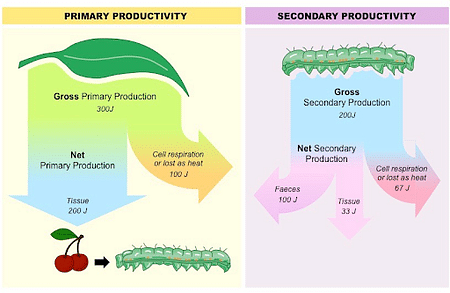
Types of Productivity
- Unit of Productivity
Productivity is expressed in units of mass per volume per unit of time, such as grams per square meter per day (gm−2d−1). The unit of mass can be the amount of mass of generation of carbon or can relate to dry matter.
Read More:
Primary Productivity
[Click Here for Sample Questions]
The amount of radiant energy produced per unit area by autotrophs over a given period of time is called Primary Productivity. Sunlight is the major source of energy. Photosynthesis is the primary tool for the production of organic materials from inorganic compounds. These autotrophs could be chemoautotrophs and photoautotrophs. In Chemoautotrophs the energy is derived with a chemical process other than photosynthesis whereas in Photoautotrophs the main source of energy is Sunlight. Primary productivity is further categorized into two categories: Gross Primary Productivity (GPP) and Net Primary Productivity (NPP).
- Gross Primary Productivity (GPP)
The amount of solar energy stored by organisms having their main source as photosynthesis is called Gross Primary Productivity. Environmental and Photosynthetic elements are the prominent factors for Gross Primary Productivity. It is measured by the content of Chlorophyll present per unit area, or the Photosynthetic number i.e., amount of CO2 fixed/g CHL/hour.
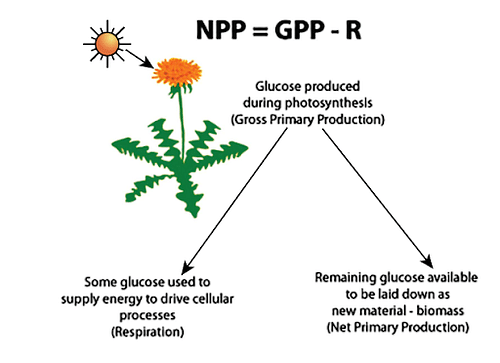
NPP = GPP
- Net Primary Productivity (NPP)
During the process of gross productivity, some of the energy is lost performing activities like respiration and heat loss due to metabolism. The amount of energy that is left after the energy loss is Net Primary Productivity. In simpler terms, it is the difference between the Gross Primary productivity and loss of Energy.
Net Primary Productivity = GPP – Energy lost
Read More: Parasitism
Secondary Productivity
[Click Here for Previous Year Questions]
Heterotrophs are the source of Secondary Productivity. Consumers utilize the produced food materials in their respiration and also convert the food matter to different tissues hence this type of productivity keeps moving from one organism to another i.e., generation of biomass in secondary productivity is influenced by the transfer of organic compounds from one trophic level to another via feeding. It can also be stated as the increase in biomass in heterotrophs. Animals, protists, bacteria, and fungi influence secondary production.

Secondary Productivity
Energy Flow and Trophic Levels
[Click Here for Sample Questions]
The amount of energy goes on to decrease whenever energy is transferred from one trophic level to another. Only 10% of the energy is transferred to the next level, the rest 90% of the energy is lost as heat.
For example, the primary producers (Green Vegetation) produce 10,000 kcal of energy with the help of sunlight. Primary consumers will only be able to consume 1000 kcal as 9,000 kcal will be lost as heat while transferring the energy. The secondary consumers will only be able to consume 100kcal while the tertiary consumers will be consuming only 10kcal. The size and energy richness of the producer level decides the consumer trophic levels.
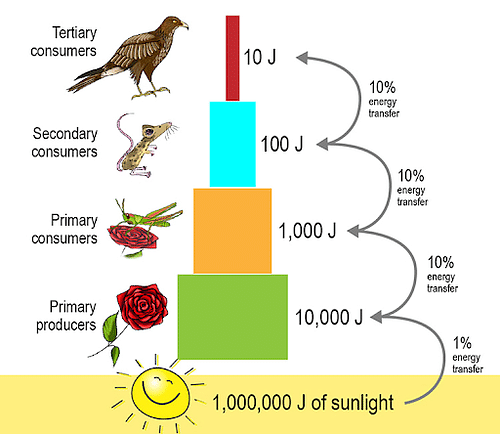
Transfer of energy between various trophic levels
Biomass Productivity of various Ecosystems
[Click Here for Previous Year Questions]
The below table lists the ecosystems in decreasing order of their productivity.
| Producer | Biomass productivity (gC/m2/yr) |
|---|---|
| Swamps and Marshes | 2,500 |
| Coral reefs | 2,000 |
| Algal beds | 2,000 |
| River estuaries | 1,800 |
| Temperate forests | 1,250 |
| Cultivated lands | 650 |
| Tundras | 140 |
| Open ocean | 125 |
Things to Remember
- The rate at which Biomass is produced in the ecosystem is called productivity.
- Productivity in an ecosystem is classified as Primary Productivity and Secondary Productivity.
- For Primary Productivity Sunlight is the main source of energy.
- In Secondary productivity, Animals are the prime source of energy.
- The productivity of the ocean is estimated to be approximately 50 × 1015 grams (50 × 109 metric tons) of carbon per year which is half of the global total.
- Only 10% of the energy stored as biomass in one trophic level gets stored in the next trophic level.
Read More:
| Important Chapter Topics | ||
|---|---|---|
| Pelagic Zone | Benthic Zone | Productivity in Ecosystem |
| Biome Vs Ecosystem | Food Chains and Webs | Decomposers |
| Microbes in Human Welfare | Diversity in Living Organisms | Biomes |
Previous Year Questions
- Energy transfer from one trophic level to other, in a food chain, is...[Neet 1999]
- _____ is the rate of production of organic matter by consumers….[Neet 2012]
- About 70% of total global carbon is found in...[Neet 2008]
- The biomass available for consumption by the herbivores and the decomposers is called...[Neet 2010]
- Both hydrarch and xerarch successions lead to….[Neet 2011]
- During ecological succession….[Neet 2015]
- In a biotic community, the primary consumers are...[Neet 1995]
- In an ecosystem, which one shows one-way passage...[Neet 1998]
- Which ecosystem has the maximum biomass?…[Neet 2017]
- Vertical distribution of different species occupying different levels in a biotic community is known as...[Neet 2015]
- What is true of ecosystem?...[Neet 1998]
- Which is not a functional unit of an ecosystem...[Neet 2012]
- Which of the following acts as 'nature's scavengers'...[Neet 1997]
- Which of the following ecological pyramids is generally inverted?...[Neet 2019]
- Which of the following ecosystem has the highest gross primary productivity?...[Neet 1997]
- Which one of the following types of organisms occupy more than one trophic level in a pond ecosystem?….[Neet 2009]
- Which one of the following is not a gaseous biogeochemical cycle in ecosystem?...[Neet 2012]
- Which one of the following is a characteristic feature of cropland ecosystem?...[Neet 2016]
- Which one of the following animals may occupy more than one trophic levels in the same ecosystem at the same time?...[Neet 2011]
- Which of the following pairs is a sedimentary type of biogeochemical cycle?….[Neet 1995]
Sample Questions
Ques. What is Productivity in an ecosystem? What are its types? (3 marks)
Ans. Productivity is the amount of biomass generated in an ecosystem when one moves from one trophic level to another. The rate of generation of biomass in an ecosystem is measured in mass per volume per unit time. Productivity in the ecosystem is divided into two categories- Primary Productivity and Secondary Productivity. The autotrophs’ (plants) productivity is referred to as Primary productivity whereas the productivity of heterotrophs (animals) is known as secondary productivity.
Ques. Explain Primary Productivity? (5 marks)
Ans. The amount of energy produced by autotrophs per unit area in a given time is known as primary productivity. Autotrophs use sunlight as the major source of energy generation and the process of generating this energy is enabled via Photosynthesis. The autotrophs are again classified as chemoautotrophs and photoautotrophs. In Chemoautotrophs the energy is derived with a chemical process other than photosynthesis whereas in Photoautotrophs the main source of energy is Sunlight along with photosynthesis. Primary productivity is further categorized into two categories- Gross Primary Productivity (GPP) and Net Primary Productivity (NPP).
- Gross Primary Productivity (GPP)
The amount of solar energy stored by organisms having the main source as photosynthesis is called Gross Primary Productivity. Environmental factors and Photosynthetic elements are the prominent factors for Gross Primary Productivity.
- Net Primary Productivity (NPP)
During the process of gross productivity, some of the energy is lost performing activities like respiration and heat loss due to metabolism. The amount of energy that is left after the energy loss is Net Primary Productivity.
Net Primary Productivity = GPP – Energy lost
Ques. Explain the process of Energy flow in different trophic levels. (3 marks)
Ans. The amount of energy goes on to decrease whenever energy is transferred from one trophic level to another. Only 10% of the energy is transferred to the next level, the rest 90% of the energy is lost as heat.
For example, the primary producers (Green Vegetation) produce 10,000 kcal of energy with the help of sunlight. Primary consumers will only be able to consume 1000 kcal as 9,000 kcal will be lost as heat while transferring the energy. The secondary consumers will only be able to consume 100kcal while the tertiary consumers will be consuming only 10kcal. The size and energy richness of the producer level decides the consumer trophic levels.
Ques. Why are there a limited number of trophic levels in an ecosystem? (2 marks)
Ans. The amount of energy goes on decreasing when moving from one trophic level to another higher trophic level. The net energy transferred is only 10% of the energy present in the previous trophic level as the rest is lost in respiration. This energy loss restricts the number of trophic levels as the energy will come to negligible at one point.
Ques. How can poaching of tigers affect the ecosystem? (2 marks)
Ans. Tigers make up an important part of the tertiary trophic level and help in maintaining ecological balance. They regulate the growth of herbivores and help in eliminating old and sick animals from the animal kingdom, maintaining the health of the forest as well as the ecosystem.
Ques. What factors influence the productivity of an ecosystem? (2 marks)
Ans. Sunlight, Water, Carbon dioxide, and Nutrients are some of the factors that affect the productivity of an ecosystem.
Ques. What are the most productive Ecosystems? (1 mark)
Ans. Estuaries, Swamps, Marshes, Tropical rainforests, Temperate rainforests are the most productive ecosystems.
Ques. What are the terrestrial and Aquatic Ecosystems? (3 Marks)
Ans. A terrestrial Ecosystem refers to a land-based ecosystem. Terrestrial Ecosystems are distributed around various geographical zones and are divided into four types that includes
- Desert Ecosystems.
- Forest Ecosystems.
- Tundra Ecosystems.
- Grassland Ecosystems.
Aquatic Ecosystem – The ecosystem present inside a water body is referred to as an Aquatic ecosystem. There are mainly two types of aquatic ecosystems.
- Marine Ecosystem
- Freshwater Ecosystem
Ques. What are the limitations of the ecological pyramid in the ecosystem? (3 Marks)
Ans. Following are the limitations of the ecological pyramid in the ecosystem
- species can function at more than one trophic level.
- Ecology follows a complex food chain but the pyramid represents only simple food chains.
- These pyramids do not undertake Decomposers and these decomposers play a crucial role in maintaining stability in an ecosystem.
For Latest Updates on Upcoming Board Exams, Click Here:https://t.me/class_10_12_board_updates
Do Check Out:



Comments