



Education Journalist | Study Abroad Lead
Grazing Food Chain is a food chain in which the lowest trophic energy level is acquired from organisms that are involved in photosynthesis (plants, grass etc). These green plants are the primary producers in this food chain who prepare their own food with energy from the sun via photosynthesis. The food chain later moves from herbivores to carnivores This grazing food chain is the primary source of energy flow in the ecosystem.
| Table of Content |
Key Terms: Grazing Food Chain, Energy Flow, Trophic Level, ecosystem, Predator Chain, Parasitic Chain, Food chain, Detritus food chain, terrestrial food chain
What is a Food Chain?
[Click Here for Sample Questions]
It is the order of energy flow in the environment between organisms in the form of food. This food chain starts from a lower trophic level organism and ends at a higher trophic level organism. A food chain is of two types they are Grazing Food Chain and the detritus food chain, where the grazing food chain is the primary source of energy flow in the aquatic food chain and the detrital food chain is the primary source of energy flow in the terrestrial food chain.

Grazing Food Chain
[Click Here for Sample Questions]
Grazing Food Chain is a food chain in which the primary level of energy is derived via photosynthesis by organisms that are the primary producers of this food chain. Then, the energy is transferred from primary producers to herbivores and carnivores in the form of food.
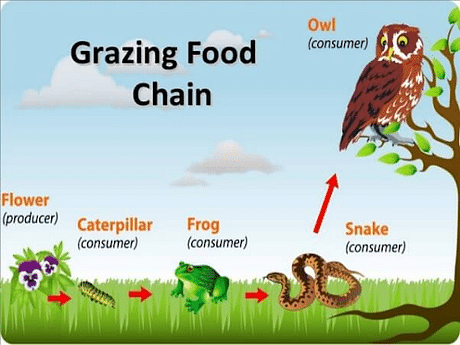
Features of Grazing Food Chain
[Click Here for Sample Questions]
The features of the grazing food chain are as follows:
- The grazing food chain closely depends on the sun which is a primary source of energy in this food chain.
- There are various factors that affect this food chain which include oxidation of plants, virus attack and plant decay due to increased water flow.
- This food chain always helps in adding energy to the environment and it is highly helpful in fixing inorganic nitrogen in the soil.
- It involves every macroscopic organism which means all the organisms which are visible in the naked eye are involved in this food chain.
Also Read:
Types of Grazing Food Chain
[Click Here for Sample Questions]
There are two main types of grazing food chain, they are as follows:
- Predator Chain
- Parasitic Chain
Predator Chain
Predator Chain is a type of food chain in which the photosynthetic organisms are eaten by primary consumers (fish, insects) and the primary consumers are eaten by secondary consumers (Birds).
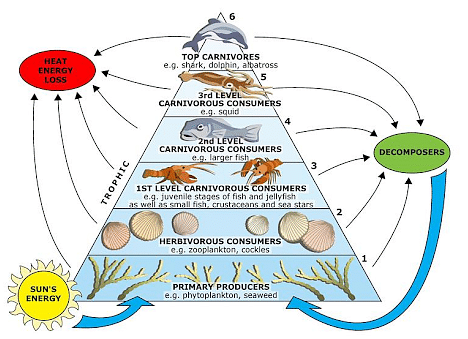
Parasitic Chain
Parasitic Chain is a type of grazing food chain in which the photosynthetic organisms and consumers are affected by parasites like fungus.
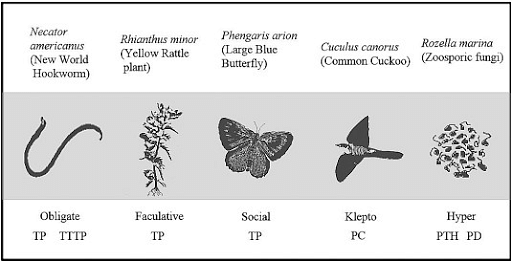
Parasitic Chain
How is the Grazing Food Chain Different from Detritus?
[Click Here for Sample Questions]
The grazing food chain is different from the detritus food chain in the following way:
- The photosynthetic organisms are the primary source of food in the Grazing Food Chain whereas the decomposers that feed on decaying matters are the starting trophic level.
- The sun is the primary source of energy in the grazing food chain whereas energy from the dead remains of organisms is a primary energy source in the detritus food chain.
- The grazing food chain helps in adding energy to the environment whereas the detritus food chain takes up energy from the detritus.
- The grazing food chain fixes inorganic nitrogen whereas the detritus food chain help in fixing inorganic nutrients.
- All macroscopic organisms or involved in Grazing Food Chain whereas both macro and microscopic are involved in the detritus food chain.
Also Read: Difference Between Sperm and Ovum
Flow of Energy in the Grazing Food Chain
[Click Here for Sample Questions]
The flow of energy in the grazing food chain occurs in the following way:
- A representation of energy flow in an ecosystem is known as trophic levels which denote the position of an organism in the food chain.
- The energy flow in the food chain is unidirectional.
- Energy will decrease at each trophic level because of heat formation at each level.
- Thus, energy loss is quite common in the food chain this results in only a few trophic levels in a food chain (beyond that levels no organism will get an adequate amount of energy to survive).
Examples of Grazing Food Chain
[Click Here for Sample Questions]
In an aquatic ecosystem: The phytoplanktons are the primary producer of food and it is eaten by zooplankton. Then the zooplankton is eaten by fishes and finally, the fishes are eaten by humans. Here phytoplanktons are at lower trophic levels and humans are at higher trophic levels.
In a terrestrial ecosystem: The plants or grass are the primary producers known as autotrophs which synthesize their own food via photosynthesis. Then the grass is eaten by rabbits which are herbivores also known as primary consumers. Then the rabbits are eaten by a fox which is a carnivore and also known as secondary consumers. In every food chain, there are only four or five trophic levels because of energy insufficiency.
Also Read: Difference Between Gene and DNA
Things to Remember
[Click Here for Sample Questions]
- The food chain is a representation of the transfer of energy from one organism to another organism in the form of food.
- They are two types of food chains they are Grazing food chains and Detritus Food Chain.
- In the grazing food chain, autotrophs are the primary producer of food whereas in the detritus food chain dead animals are consumed by subsoil organisms.
- The food web is the interconnection of various food chains of an ecosystem with different energy flow levels.
Also Read:
Sample Questions
Ques: Explain in detail the Detritus food chain with examples. (4 marks)
Ans: Detritus food chain is a type of food chain that begins with dead organisms (detritus). Here the detritus (decay or dead organism and plants) is utilized to its maximum level. All subsoil organisms which are both macroscopic and microscopic are involved in this kind of food chain
Example: A dead organic matter is consumed by microscopic organisms like bacterias and fungi. Then the microscopic organism is eaten by microscopic organisms like earthworms. Then the earthworms are consumed by birds and so on
Ques: Explain the trophic level of Grazing food chains. (4 marks)
Ans: The trophic level is a representation of energy flow between organisms in the food chain
The lowest trophic level in the grazing food chain is autotrophs, organisms that produce their own food via photosynthesis. Then the second trophic level is primary consumers, herbivore organisms like fish, rabbit, and deer. The third tropic level is secondary consumers, a carnivore that eats herbivores. The highest trophic level is tertiary consumers, a high-level carnivore that eats both primary consumers and secondary consumers like lions, tigers, etc.
Ques: What is a food web? (2 marks)
Ans: A food web is a natural interconnection of various food chains in an ecosystem which is also known as a consumer-resource system.
Ques: What is a food pyramid? (2 marks)
Ans: A food pyramid is a graphical representation that shows the level of energy flow from one trophic level to another trophic level in an ecosystem and it is similar to a food chain
Ques: What is the end of the food chain? (2 marks)
Ans: All type of food chains ends with the topmost consumer which eats both primary consumers and secondary consumers and it is known as predator
Ques: Difference between prey and predator. (3 marks)
Ans: The difference between prey and a predatory are as follows:
| Predator | Prey |
|---|---|
| An organism that hunts other living organisms for food | An organism that is killed by other organisms for food |
| Eg. Lion, Snakes, Eagle, Tiger | Eg. Deer, Rat, Fish, Rabbits |
Ques: What is the role of humans in food chains? (3 marks)
Ans: Humans play different roles in food chains based on their food habits. If a human eats only plants (primary producers), they are known as primary consumers or if human eats animals that eat autotrophs then they are known as secondary consumers. So humans are both primary consumers(herbivores) and secondary consumers(Carnivores) then they are known as omnivores.
Ques: What is a habitat? (2 marks)
Ans: A habitat is a place that consists of resources, biotic components which is suitable for an organism to make its home.
Ques: What is meant by ecosystem? (2 marks)
Ans: An ecosystem is a combination of living organisms and the environment in which the organisms interact and live their life. These biotic and abiotic components are interlinked with the energy flows and nutrient cycles.
Ques: What are the factors that affect food chains? (3 marks)
Ans: Some abiotic factors like temperature, latitude, rainfall have some effects on biotic components like the structure of habitat, food habits of organisms, presence of top-level organisms. So the changes in abiotic components cause some changes in the food chain
For Latest Updates on Upcoming Board Exams, Click Here: https://t.me/class_10_12_board_updates
Check-Out:



Comments