



Content Curator
Biomass is the form in which a flow of energy takes place from the sun to plants, plants to animals, plants to humans, animals to humans, etc, in the ecosystem. A small amount of biomass is utilized by the consumers or secondary consumers as we move to different trophic levels. Whereas, it is just the opposite in the case of the aquatic ecosystem. In this article, we will look into the detailed explanation of biomass, its types and ecological pyramids.
| Table of Content |
Keyterms: Energy, Flow of energy, Biomass, Trophic levels, Ecosystem, Ecological pyramids, Organic materials, Biogenic materials, Food, Wood wastes, Agricultural wastes
Also Read: Hypogeal Germination
What is Biomass?
[Click Here for Sample Questions]
Biomass is an important renewable source of energy composed of organic materials like plants and animals. Organic materials which can be included in biomass are animal manure, biogenic materials, food, wood wastes, agricultural wastes, etc.
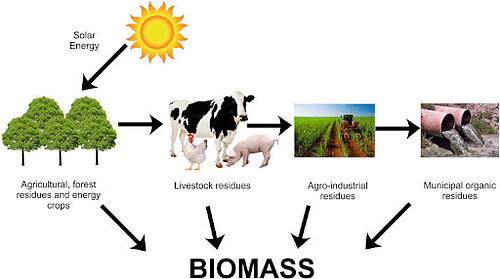
Biomass
Also Read:
Types of Biomass
[Click Here for Previous Year Questions]
The different types of Biomass are as follows.
Terrestrial Biomass: Terrestrial biomass is the biomass present in the terrestrial ecosystem. It generally decreases at subsequent trophic levels. Examples of terrestrial biomass are grasses, trees, shrubs, etc., which are classified as terrestrial producers and grasshoppers, deer, hawks, etc. are terrestrial consumers.
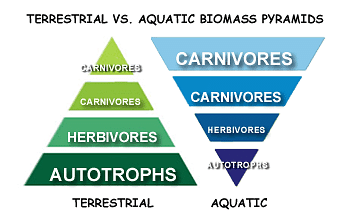
Terrestrial and Aquatic Biomass
Ocean Biomass: Ocean biomass is the biomass present in the oceanic ecosystem. There is an opposite process of energy flow in the oceanic ecosystem as compared to the terrestrial ecosystem. Ocean biomass increases at subsequent trophic levels. Examples of ocean biomass are phytoplankton, zooplankton, filter feeders, predatory fish, etc.
Productivity
[Click Here for Sample Questions]
In the process of primary production, biomass is produced by plants during photosynthesis. And the rate of biomass production in this process is called productivity. It is expressed as gm-2yr-1 or kcal m-2yr-1.

Primary and Secondary Productivity
When organic matter (biomass) is produced by the plants during photosynthesis per unit area over some time, it is termed as primary productivity and when organic matter (biomass) is produced by consumers per unit area over a period of time it is termed as secondary productivity.
Gross Primary Productivity (GPP)
Organic matter is produced during the process of photosynthesis and the rate of this production is called the gross primary productivity.

Difference Between Gross and Net Primary Production
Net Primary Production (NPP)
A part of the GPP gets utilized by the plants in respiration (R) and the leftover biomass (organic matter) which becomes available for consumption to heterotrophs is called net primary production.
Net Primary Production = Gross Primary Production - R
Also Read: Biogeochemical Cycles
Flow of Energy between Trophic Levels
[Click Here for Previous Year Questions]
Energy flow in an ecosystem is an important process as it is responsible for all metabolic activities. The flow of energy between trophic levels in an ecosystem is unidirectional, i.e. it flows from producers to top consumers.
| Trophic Level | Trophic Level Interaction | |
|---|---|---|
| I | Autotrophs | Green Plants (producer) |
| II | Heterotrophs | Herbivore (primary consumer) |
| III | Heterotrophs | Carnivore (secondary consumer) |
| IV | Heterotrophs | Carnivore (tertiary consumers) |
| V | Heterotrophs | Top carnivores (quaternary consumers) |

Flow of Energy
The energy always flows from producers to subsequent trophic levels (producer to herbivore, carnivore, etc.). There is some loss of energy at each trophic level which results in decreased energy levels in the upper trophic levels. The numbering of trophic levels is done from producers to top consumers and there are usually 4 or 5 trophic levels; loss of energy in higher trophic levels makes it practically impossible to reach beyond the 5th trophic level.
Also Read: Invertebrates
Ecological Pyramids
[Click Here for Sample Questions]
The ecological pyramid is an important concept of energy flow. When different trophic levels are expressed in diagrammatic form, we refer to them as ecological pyramids. In an ecological pyramid, the producer forms the base of the pyramid, while the top carnivore from its tip and the other trophic level is in between them. Since there is a gradual decrease in the number biomass and energy of organisms the diagrammatic form assumes the shape of a pyramid.
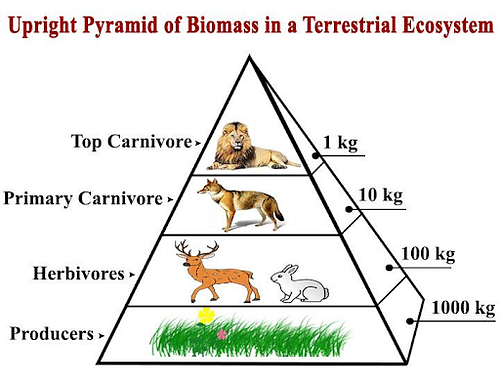
Ecological Pyramid
There are three categories of ecological pyramids:
- Pyramid of Numbers
- Biomass Pyramid
- Pyramid of Energy
Pyramid of Numbers
Pyramid of Numbers depicts the relationship between the number of primary producers and consumers of subsequent levels. Pyramids of numbers are usually seen in grasslands, where grasses form the base of the pyramid due to their large number. The number of individuals decreases in each trophic level.
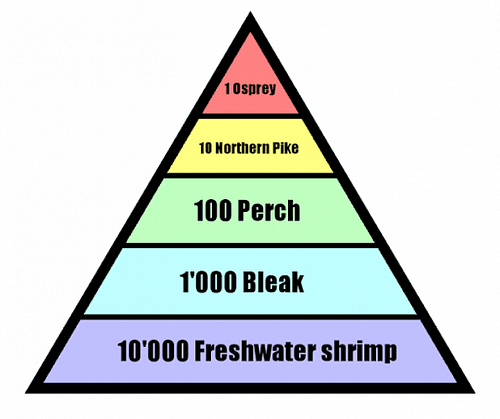
Pyramid of Numbers
But the pyramid of numbers is not a good medium to study the trophic structure because it is difficult to count all the organisms.
Biomass Pyramid
There is a loss of biomass at each trophic level, where each trophic level has a certain mass of living material called the standing crop. Since there is a loss in biomass the representation of biomass utilization in subsequent stages of trophic level in an ecosystem is termed as biomass pyramid. It represents the relationship between producers and consumers in terms of biomass.

Biomass Pyramid
In the aquatic ecosystem, the biomass pyramid is inverted because there is an increase in standing crops at each trophic level.
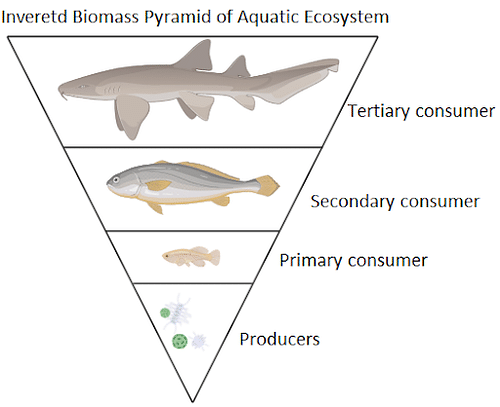
Inverted Aquatic Pyramid
Also Read:
Pyramid of Energy
[Click Here for Previous Year Questions]
The pyramid of energy helps in the comparison of the functional roles of trophic levels. This pyramid is always upright because there is a loss of energy in the form of heat and chemical energy. The energy which can be utilized decreases from sunlight to the producer, then to the consumer. The pyramid of energy also explains the concept of biomagnifications.
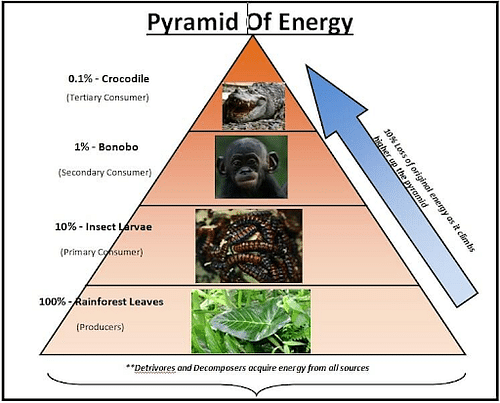
Pyramid of Energy
Also Read: Reverse Osmosis
Things to Remember
- Biomass refers to the amount of organic matter produced by plants or primary producers during the process of photosynthesis.
- The rate of biomass production is called productivity.
- Net primary production is the amount of GPP left after being utilized by plants in the process of respiration.
- The pyramid of biomass represents the relationship between producers and consumers in the ecosystem at different trophic levels.
- The pyramid of biomass is upright in the case of the terrestrial ecosystem, while it is inverted in the aquatic ecosystem.
Previous Year Questions
- The biomass available for consumption by the herbivores...[NEET 2010]
- Both hydrarch and xerarch successions lead to...[NEET 2011]
- During ecological succession...[NEET 2015]
- In a biotic community, the primary consumers are...[NEET 1995]
- In an ecosystem, which one shows one-way passage...[NEET 1988]
- Upper part of sea/aquatic ecosystem contains...[NEET 1988]
- Vertical distribution of different species occupying different...[NEET 2015]
- What is true of ecosystem?...[NEET 1988]
- Which ecosystem has the maximum biomass ?...[NEET 2017]
- Which of the following aquatic plant does not show pollination by water? … (KCET 2021)
- Aquatic reptiles are … (NEET 1999)
- Upper part of sea/aquatic ecosystem contains … (NEET 1988)
- An ecosystem which can be easily damaged but can recover … (NEET 2004)
- Energy transfer from one trophic level to other...[NEET 1999]
- the rate of production of organic matter by consumers….[NEET 2012]
- About 70% of total global carbon is found in...[NEET 2008]
- An ecosystem which can be easily damaged but can….[NEET 2004]
Sample Questions
Ques. What is the difference between terrestrial and aquatic biomass pyramids? (3 marks)
Ans. The biomass pyramid represents the relationship between producers and consumers in an ecosystem at different trophic levels in the terms of biomass. The biomass pyramid is upright in the case of a terrestrial ecosystem because a small amount of standing crop gets utilized in the next trophic level. While in the case of the aquatic ecosystem the biomass pyramid is inverted because the number of producers is less and consumers increase and hence, the amount of standing crop increases at subsequent trophic levels, for example, a small standing crop of phytoplankton is utilized by zooplankton and so on.
Ques. What is biomass in an ecosystem? (2 marks)
Ans. In an ecosystem, biomass is the mass of organic matter or living tissue which is further divided into different trophic levels- producers, herbivores, predators, top predators and decomposers.
Ques. Construct a pyramid of biomass starting with phytoplankton. Label three trophic levels. Is the pyramid upright or inverted? Justify your answer. (3 marks)
Ans. In the pyramid of biomass starting with phytoplankton, phytoplankton is the primary producer, zooplankton is the primary consumer and fishes are secondary consumers.

The pyramid of biomass, in this case, is inverted because there is an increase in the consumers as well as biomass in the subsequent trophic levels.
Ques. What is an ecological pyramid? Give its types. (3 marks)
Ans. The diagrammatic representation of the relationship of different trophic levels in an ecosystem is termed an ecological pyramid. There are three types of ecological pyramids-
- Pyramid of Numbers
- Pyramid of Biomass
- Pyramid of Energy
Generally, there is some loss of number, biomass and energy of organisms in an ecosystem as we move upwards in the trophic levels, that’s why this representation takes the form of a pyramid. The ecological pyramids can be upright or inverted.
Ques. Distinguish between (5 marks)
(a) Grazing food chain and detritus food chain
(b) Production and decomposition
(c) ‘Upright and inverted pyramid
Ans. (a) Grazing Food Chain (GFC) begins with primary producers or plants and ends in carnivores (tertiary or top carnivores) whereas Detritus Food Chain (DFC) begins with detritus or dead organic matter and it ends in carnivores. In GFC, energy for the food chain comes from the sun whereas, in DFC, energy for the food chain comes from organic remains or detritus.
(b) Production is the phenomenon in which the energy is produced by the process of synthesis of an organic compound from inorganic substances (such as CO2, H2O & minerals) utilizing the sunlight. It traps energy.
Decomposition refers to the breakdown of complex organic matter into simpler ones. It releases energy.
(c) In an upright pyramid (e.g., grassland & cropland ecosystem), biomass or number of organisms or amount of energy decreases
on moving to upper trophic levels while in an inverted pyramid (eg. tree ecosystem) these quantities tend to increase ongoing to successive trophic levels.
Ques. Distinguish between (5 marks)
(a)Food chain and food web
(b) Litter and detritus
(c) Primary and secondary productivity
Ans. (a) A food chain is a sequence of different types of organisms by which the flow of energy occurs from one trophic level to another whereas the food web is the network of various food chains interconnected to each other. Food webs increase the adaptability and competitiveness of organisms.
(b) Litter is the dead organic material fallen on the surface of the soil like leaves, remains of animals and excreta. Detritus is the dead organic matter found below the soil surface that is eaten up by the detritivores or broken down by decomposers.
(c) Primary productivity is the rate of synthesis of biomass or energy fixation by the plants. It is comparatively quite high.
Secondary productivity is the rate of synthesis of biomass by consumers (herbivores and carnivores). It is small and decreases with the rising trophic level.
Ques. Define ecological pyramids and describe with examples, pyramids of number and biomass. (3 marks)
Ans. An ecological pyramid is a graphical method to show the number of organisms or biomass or amount of energy present at different trophic levels. Pyramid of number: The number of individuals at each trophic level is shown in the pyramid. The pyramid of numbers (for example of a grassland) is upright. In this, there is a decrease in the number of organisms starting from primary producers (plants) to top consumers (carnivores). Pyramid of biomass: The pyramid of biomass is a graphic representation of the amount of biomass per unit area sequence wise in rising trophic levels with producers at the base and top carnivores at the apex. Pyramids of biomass of a tree or grassland ecosystem are upright and the pyramid of a pond ecosystem is inverted.

Ques. What is primary productivity? Give a brief description of factors that affect primary productivity. (3 marks)
Ans. The primary productivity of an ecosystem is the amount of energy fixed or biomass synthesized by primary producers or green plants per unit area per unit time during photosynthesis. Factors affecting primary productivity are –
-Plant species inhabiting a particular area
-Sunlight
-Temperature
-Soil water
-Nutrients
lit deserts, sunlight is abundant but water is scarce or nutrients are lacking. Therefore, in such areas, water & nutrients supply become the limiting factors.
Ques. Give an account of energy flow in an ecosystem. (2 marks)
Ans. The flow of energy in an ecosystem is unidirectional. The ultimate source of energy is the sun. The solar energy is captured by the green plants which utilize it in synthesizing their own food. The energy fixed by the green plants is transferred to herbivores which feed on them. The energy is then transferred to higher trophic levels (carnivores). At every step, a considerable amount of energy is lost. According to the 10% law, only 10% of the total energy stored in a trophic level is transferred to the next trophic level of a food chain.
Ques. Write important features of a sedimentary cycle in an ecosystem. (2 marks)
Ans. The movement of nutrient elements through various components of an ecosystem takes place by a biogeochemical cycle. It is of 2 types – gaseous and sedimentary. A nutrient that does not enter the atmosphere easily is said to have a sedimentary cycle. The sedimentary cycle involves the cycling of sulphur, phosphorus etc. which are located in the earth’s crust.
Phosphorus is a very important element as it is present in various substances found in living beings. The cycling of phosphorus in an ecosystem occurs in such a way that plants obtain it from soil or rocks. The animals or primary consumers obtain it from plants. Secondary consumers or carnivores take it from herbivores while omnivores (like a man) receive it both from plants and animals. Phosphorus present in organisms is also released during decomposition.
For Latest Updates on Upcoming Board Exams, Click Here:https://t.me/class_10_12_board_updates
Check Out:



Comments