



Education Journalist | Study Abroad Lead
Fleming’s Left-Hand Rule and Fleming’s Right-Hand Rule are important rules for magnetism and electromagnetism. Developed by John Ambrose Fleming in the late 19th century, Fleming’s rules are also used to find the direction of motion in an electric motor. A current-carrying conductor experiences force perpendicular to the field and the current direction, when found in an external magnetic field.
- Fleming’s left-hand rule states that if we arrange our thumb, index finger (or forefinger), and middle finger perpendicular to each other, then they denote the directions of Motion, Current, and Magnetic Field respectively.
- Fleming’s right-hand rule is used to determine the direction of induced current. This rule is used to understand the functioning of electric motors by determining the direction of the force.
Fleming’s Left Hand and Right-Hand rules do not determine the magnitude; instead, they only show the direction of – magnetic field, current, and force – when the direction of the other two parameters is already known
Also Check: Magnetic Force
Key Terms: Fleming’s Left Hand Rule, Electromagnetic Induction, Current, Magnetic Field, Magnetic Force, Electric Motors, Conductors
What is Fleming's Left Hand Rule?
[Click Here for Sample Questions]
Fleming’s left-hand rule states that when we stretch the thumb, middle finger, and index finger of the left hand so they are perpendicular to each other, the conductor placed in the magnetic field experiences Magnetic force.
- Thumb represents the direction of Force (F)
- Middle Finger represents the direction of current (I)
- Index Finger represents the direction of magnetic field (B)
| “Fleming’s left-hand rule states that when a conductor carrying current is exposed to an external magnetic field, it experiences a force.” |
When electric current flows via a conductor, a cylindrical magnetic field is produced around it.
- In case an external magnetic field has been brought near the current-carrying conductor, both the magnetic field and the electromagnetic field interact with one another.
- The interaction between current and magnetic fields generates a physical force.
- As seen in fleming’s left-hand rule diagram, a left hand can be used to indicate three perpendicular axes on the thumb, index finger, and middle finger.
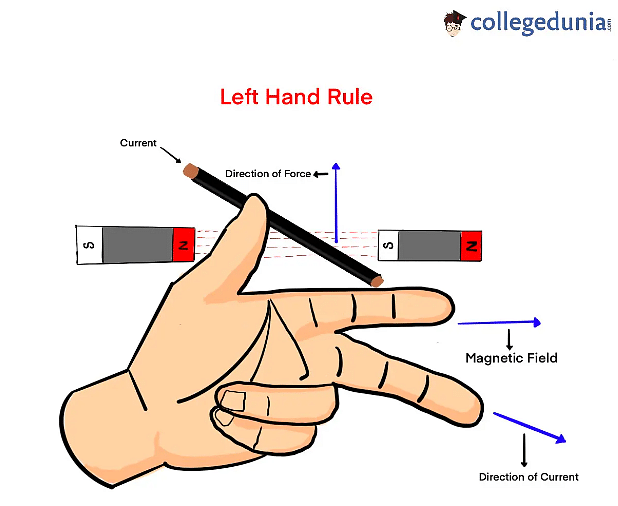
When the direction of the magnetic field and current are known, Fleming's Left-Hand Rule can be used to find the direction of force or motion of the conductor in an electric motor.
Read More: EMF Formula
Characteristics of Fleming’s Left Hand Rule
[Click Here for Sample Questions]
According to Faraday’s law of electromagnetic induction, when we place a moving conductor inside a magnetic field, a current will be induced in the same.
- The rule was postulated by John Ambrose Fleming.
- If the conductor is moved forcefully inside the magnetic field, a relationship will exist between the direction of the magnetic field, applied force, and the current.
Solved ExampleExample: As per the figure given below, determine the direction in which the coil will begin to rotate when the current will be passed via it in direction ABCD by connecting a battery at the ends A and D of the coil.
Coil Diagram Solution: The coil will begin to rotate in an anti-clockwise direction. |

Applications of Fleming’s Left-Hand Rule
[Click Here for Sample Questions]
There are several applications of Fleming’s Left-Hand Rule. Some of them include:
- Fleming’s Left-hand Rule is broadly used to determine the direction of an electron or proton when the magnetic field is applied.
- Fleming’s Left-hand Rule is also used in the working principle of electrical motors.
- It is also used in Moving coil galvanometers.
Fleming’s Left-Hand Rule for Electric Motors
[Click Here for Sample Questions]
When electrical current flows through a conductor (represented as the middle finger in Fleming’s Left Hand Rule), a cylindrical magnetic field forms around it. The magnetic field and the electromagnetic field interact when an external magnetic field (represented as the index finger) is brought close to the energized conductor. This interaction produces a perpendicularly opposed physical force (represented by the thumb).

There are two parts to a standard DC electric motor: a Rotor and a Stator.
- The rotor is free to rotate within the stator because it nests into it. The rotor is the only component that receives power from a separate source.
- The stator of a basic motor is a ring of permanent magnets, while the rotor is neatly wrapped with conductive copper wire multiple times.
Fleming's Left-Hand RuleElectrical current is transmitted through copper wire coils on the rotor from an external power source.
|
Fleming's left-hand rule can be used to describe motion in any type of electric motor. Commercial motors have:
- An electromagnet instead of a permanent magnet
- A large number of turns in the current-carrying coil
- A soft iron core around which the coil is coiled
An armature is the soft iron core on which the coil is coiled. The motor's power is increased as a result of this.
Fleming’s Left-Hand Rule ExamplesQues. Determine the direction of the magnetic field when an electron moves vertically upwards and is deflected towards the south as a result of a uniform magnetic field. Ans. Using Fleming’s left-hand rule, we can determine the direction of the magnetic field. When the electron (negative charge) moves upward, the direction of the current is downwards. The force acting on the electron is in the south direction. Hence, the magnetic field is towards the east. Ques. Determine the direction of the force that acts on a proton if the proton moves towards the east by entering a uniform magnetic field in a downward direction. Ans. Using Fleming’s left-hand rule, the direction of the force that acts on the proton is – As the proton is moving towards the east, the motion of the current is also towards the east. The direction of force is towards the north as the magnetic field acts downwards. Hence, the direction of the force acting is north. |
What is Fleming’s Right-Hand Rule?
[Click Here for Sample Questions]
As per Faraday’s law of electromagnetic induction, an electric current is induced when a conductor is seen to move through a magnetic field. Fleming’s right-hand rule can be used in order to determine the direction of this induced current.
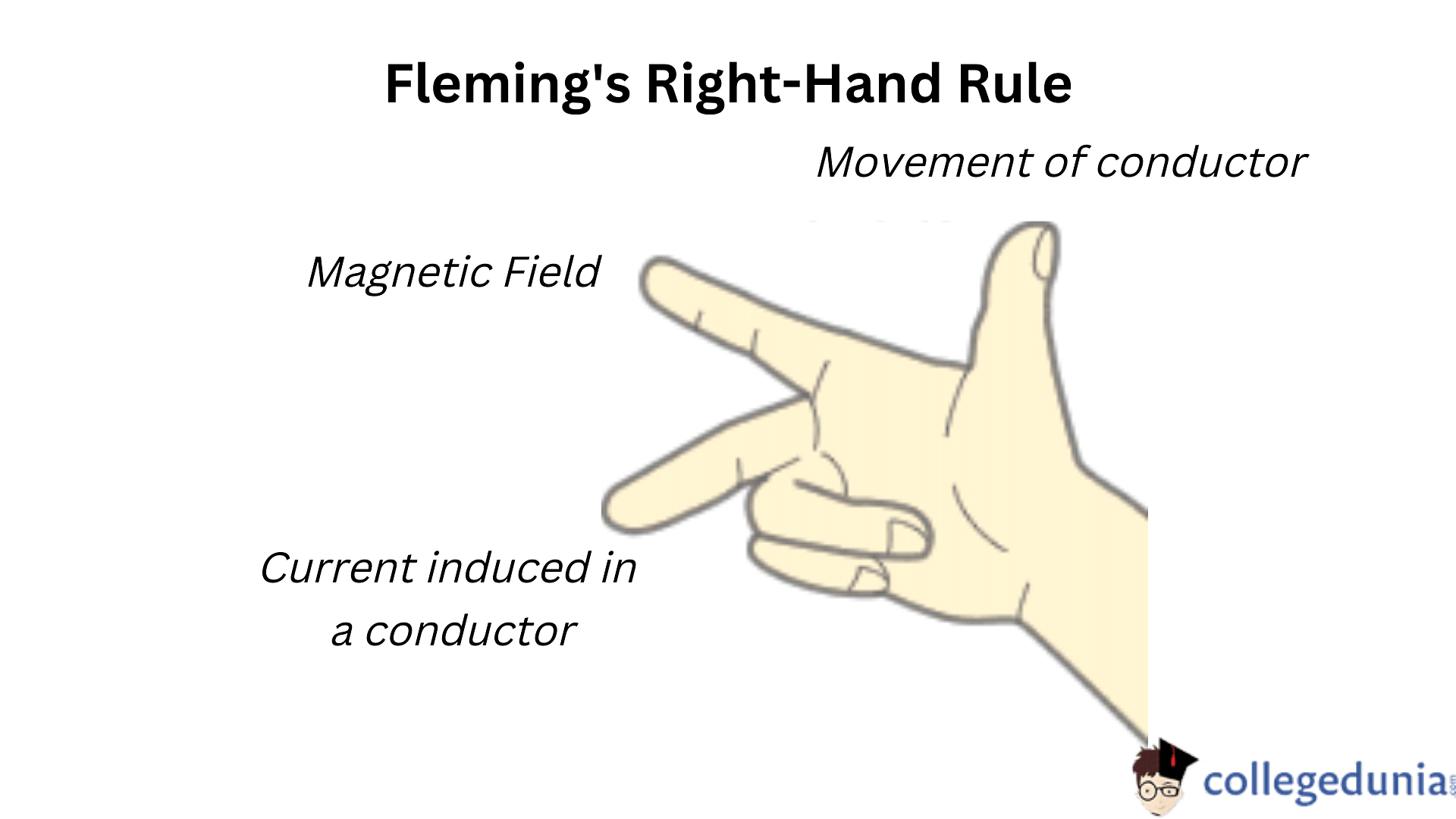
Fleming's Right-hand Rule
Fleming’s Right-Hand Rule states that –
If we put our thumb, forefinger, and middle finger of our right-hand perpendicular to one another, then the thumb will point toward the direction of motion of the conductor, the forefinger will point toward the direction of the magnetic field and the middle finger will point toward the direction of the induced current.
Flemings Right-hand Rule Experiment
Aim: Fleming's right rule helps give the direction of induced current present in a conductor in case it is moved in a magnetic field. This experiment is to understand the direction of induced current.
Apparatus: A stationary magnet and a coil linked to a galvanometer are moved through the magnetic field.
Experiment: When the coil is moved via the magnetic field, the galvanometer is going to exhibit deflection mainly due to the induction of current.
- When the coil is moved via the magnetic field in only one direction, the galvanometer is going to show deflection.
- Similarly, when the coil is moved via the magnetic field, the galvanometer is again going to show deflection, now in the opposite direction.
- Thus, the direction of the current changes.
- This direction of induced current can be found using Fleming's right-hand rule.
Difference between Fleming’s Left-hand Rule and Right-hand Rule
[Click Here for Sample Questions]
The difference between Fleming’s left-hand rule and right-hand rule is explained below:
| Fleming’s Left-Hand Rule | Fleming’s Right-Hand Rule |
|---|---|
| Fleming’s left-hand rule is used for the working of electric motors | Fleming’s right-hand rule is used in the working of electric generators. |
| It is used to find the direction of motion in an electric motor. | It is used to find the direction of induced current when a conductor is moving in a magnetic field. |
| The thumb denotes the direction of the thrust on the conductor. | The thumb denotes the direction of motion of the conductor. |
| The index finger denotes the direction of the Magnetic Field. | The index finger denotes the direction of the Magnetic Field. |
| The middle finger denotes the direction of the current. | The middle finger denotes the direction of the induced current. |
Fleming’s left-hand rule is applicable to Electric Motors while Fleming’s right-hand rule is applicable to Generators. Fleming’s left-hand and right-hand rules are a pair of visual mnemonics (learning techniques). These rules are used to determine the direction of the resultant – either current or thrust.
Things to Remember
- Fleming’s left-hand rule states that when a current-carrying conductor is exposed to an external magnetic field, it experiences a force perpendicular to both the magnetic field as well as to the flow of current.
- It is used to determine the magnetic field direction acting on the electron.
- Fleming’s left-hand rule is used in the working of electric motors.
- If we arrange our thumb, middle finger, and forefinger of the left-hand perpendicular to each other, then the direction of the parameters denoted by is:
- Thumb – Magnetic Force
- Forefinger – Magnetic Field
- Mid finger – Current
Sample Questions
Ques. What is the difference between Fleming's left-hand rule and right-hand rule? [5 marks]
Ans. The differences between Flemming's left-hand rule and right-hand rule are as shown below:
| Fleming’s Left-Hand Rule | Fleming’s Right-Hand Rule |
|---|---|
| The rule is used for the working of electric motors | The rule is used in the working of electric generators |
| It is used to find the direction of motion in an electric motor | It is used to find the direction of induced current when a conductor is moving in a magnetic field. |
| The thumb denotes the direction of the thrust on the conductor. | The thumb denotes the direction of motion of the conductor. |
| The index finger denotes the direction of the Magnetic Field. | The index finger denotes the direction of the Magnetic Field. |
| The middle finger denotes the direction of the current | The middle finger denotes the direction of the induced current |
Ques. How to remember Fleming’s left-hand rule? [3 marks]
Ans. Fleming's left-hand rule can be remembered by the word left. The word “left” contains the letter “f” which can denote force. The force is delivered by a motor. By that, you can remember the Fleming left-hand rule.
- First finger: B
- Second finger: I
- Thumb: F
Ques. Can we calculate the direction of force acting on a proton, going towards the east, with a downward magnetic field using Fleming's left-hand rule? [3 marks]
Ans. As the proton is going towards the east, the current is also traveling toward the east.
As the magnetic field is acting downwards, the force is directed towards the north.
As a result, we can say that the force is acting in a northerly direction.
Ques. Is a magnetic field source analogous to an electric current source? [1 mark]
Ans. No, because the magnetic field's source is not a magnetic charge, whereas the electric field's source is an electric charge.
Ques. State the principle of working electric motors. [2 marks]
Ans. The magnetic effect of electricity is the basis of an electric motor's operation. When put in a magnetic field, a current-carrying conductor experiences force and rotates. Fleming's left-hand rule can be used to calculate the direction of rotation of the conductor.
Ques. In an electric motor, what is the function of the split ring? [1 mark]
Ans. In an electric motor, the split ring serves as the commutator. After each half rotation of the coil, the commutator reverses the direction of the current flowing through it. The coil continues to rotate in the same direction due to the reversal of the current.
Ques. Can we figure out the direction of the magnetic field acting on the electron moving upwards by using Fleming's left-hand rule? [2 marks]
Ans. We know that an electron has a negative charge. When an electron moves upward, the current flows in the opposite direction, down. The force acting on the electron is assumed to be in the south direction. As a result, the magnetic field is oriented towards the east.
Ques. Determine the angle between a given magnetic field and the force that acts on a current-carrying conductor. [1 mark]
Ans. As per the question, the angle between a given magnetic field and the force that acts on a current-carrying conductor is 90°.
Ques. Where is Fleming’s Right-hand Rule used? [1 mark]
Ans. Fleming’s Right-hand rule is used to determine the direction of induced current when a conductor is moving in a magnetic field.
Ques. Determine the direction of the magnetic field assuming that an electron moves vertically upwards and further gets deflected toward the direction south due to a uniform magnetic field. [3 marks]
Ans. After implementing Fleming’s left-hand rule, we can find the direction of the magnetic field that acts on the electron. Therefore,

We are aware that the charge on an electron is always negative. When the electron moves in an upward direction, the direction of current faces the opposite direction; which simply means that the direction of current becomes downwards. It is mentioned that the force which acts on the electron is towards the south. Thus, the magnetic field’s direction is towards the east.
Ques. Name the rule used for electric generators. [1 mark]
Ans. Fleming’s right-hand rule has been used for electric generators.



Comments