



Education Content Expert
Cervix is a muscular, tunnel-like organ. It is the lower region of the uterus that connects the uterus and vagina. It is also referred to as the “neck of the uterus”. The average size of the cervix is around 4 centimeters. Cervix plays an important role in allowing fluids to pass between the uterus and vagina. It enables a baby to leave the uterus so that it can travel through the vagina during birth. It is also a common site for cellular changes that may indicate the presence of cancer. Cervix is composed of two regions known as the ectocervix and the endocervical canal.
Read More: NCERT Solutions For Class 12 Biology Human Reproduction
| Table of Content |
Key Terms: Cervix, Vagina, Uterus, Childbirth, Mucus, Endocervical Canal, Ectocervix Canal, Menstruation, Endometriosis, Inflammation
What is Cervix?
[Click Here for Sample Questions]
Cervix is an organ of the female reproductive system. It is the lower portion of the uterus connecting the vagina with the main body of the uterus. Thus, it acts as a gateway between them.
- Cervix plays an integral role in menstruation, fertility, pregnancy, and childbirth.
- It is typically 3-4 cm in size, however, the size may differ according to age, genetics, and childbirth.
- Half of the cervix sits inside the vaginal canal.
- It is distinct from the uterus and is thus considered a separate anatomical structure.
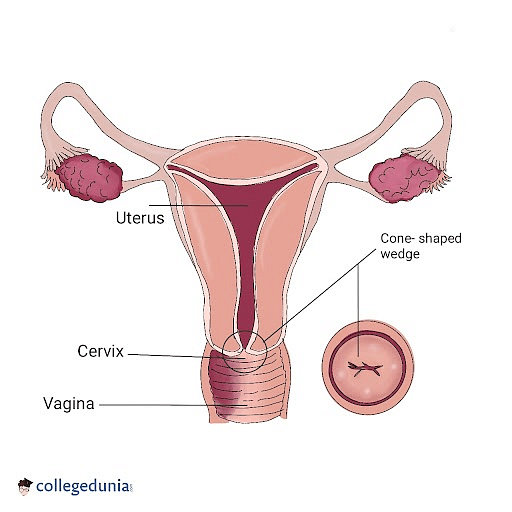
Cervix
Read More:
| Relevant Concepts | ||
|---|---|---|
| Ovum | Parturition | Pelvic Bones |
| Sexual Reproduction | Male and Female Reproductive Organs | Contraception |
Anatomy of Cervix
[Click Here for Previous Year Questions]
Cervix is the lowest region of the uterus that attaches the uterus to the vagina. It provides a passage between the uterine cavity and the vaginal cavity.
- Cervix is about 4 centimeters long and it projects about 2 centimeters to the upper layer of the vaginal cavity.
- It consists typically of two regions namely the ectocervix and the endocervical canal.
- The ectocervix region is lined with stratified squamous epithelium.
- The other region endocervical canal is in the inner part of the uterine cervix.
- This region is lined with simple columnar epithelium which secretes mucus.
- The uterine cavity begins at the part in which endocervical canals end.
- This part is a narrow region which is known as the internal os.
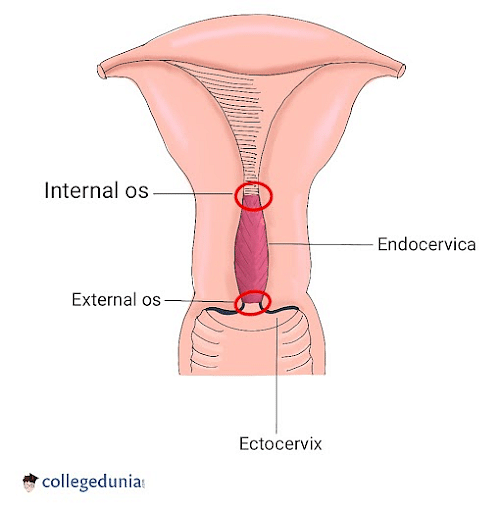
Anatomy of Cervix
Read More: Human Reproduction MCQs
Functions of Cervix
[Click Here for Sample Questions]
Cervix is responsible to perform various important functions of a female body which are as follows:
Production of Mucus
- Cervix is the part of the female body that produces mucus.
- Mucus is produced in a greater amount in the cervix at the time of greater chance of pregnancy.
- Mucus produced in the cervix changes its consistency during the period of the menstrual cycle.
Helps in Blood Flow during Menstruation
- During the time of menstruation, the cervix helps in the passage of smooth blood flow by opening it a little bit.
- It is known as an open cervix in an open position.
Produce Mucus during Pregnancy
- Mucus is produced by the cervix at the time of pregnancy as well.
- The mucus produced in that time period is comparatively thick.
- It creates a cervical plug which is responsible for protecting the embryo during its growth stage from all kinds of infections.
Keep Fetus in Uterus until Birth
- The cervix which opens during the time of menstruation closes down completely at the stage of pregnancy.
- It thereby helps the fetus in the uterus properly until the time of birth.
- During pregnancy, it becomes firmer and stronger, thus protecting the fetus until birth.
Opens during Childbirth
- During childbirth, the cervix dilates, thus allowing the delivery of the baby.
- It widens during the time of labor so that the child can come out of the uterus very easily.
- It can dilate up to 10 cm, which is considered fully dilated by doctors.
Read More: Human Reproduction Important Questions
Problems Affecting Cervix
[Click Here for Previous Year Questions]
Cervix can be affected by different kinds of problems of which some can prove to be fatal or serious. It can be caused due to various causes with different symptoms ranging from minor inflammation to cervical cancer. Even though the problem is minor, immediate medical assistance is required in all cases.
Sexually Transmitted Infection
- Most sexually transmitted infections will affect the healthy functioning of the cervix.
- The infection is caused due to the transmission of germs through sexual partners.
- Some of the sexually transmitted infections that affect the cervix are genital herpes, gonorrhea, chlamydia human papillomavirus, trichomonas, etc.
Inflammation of Cervix
- Infections can be caused in the cervix due to the presence of bacteria and viruses in the body.
- This may cause some kind of inflammation of the cervix which is known as cervicitis.
- The most common symptoms of cervicitis are pain during urination, pain in the lower abdomen, vaginal discharge, and bleeding even after menstruation.
- Cervicitis can be caused due to allergies or irritation of condoms, tampons, and spermicides.
- It can also occur in the body as a side effect of radiation therapy, which is a common treatment for cancer.

Cervical Cancer
Endometriosis
- Cervical endometriosis is a condition seen in most women with no particular symptoms.
- It is a condition in which lesions can occur outside the cervix.
- It can only be discovered through pelvic examination.
- However, some may experience several symptoms such as pelvic pain, bleeding after intercourse, abdominal abnormalities or heavy periods, and so on.
Cervical Ectropion
- This condition can occur in women whose cells have to be lined in the cervix, and grown outside.
- Particularly, these cells can be redder and more sensitive than normal and cause bleeding and discharge.
Also Check:
| Related Topics | ||
|---|---|---|
| Female Hormones | Birth Control | Human Reproductive System |
| Sex Hormones and Reproductive Functions | Reproductive Health | Internal Fertilization |
Things to Remember
- Cervix is the lowest region of the uterus which attaches it to the vagina.
- Cervix acts as a narrow passage between the vaginal cavity and uterine cavity.
- It has two parts namely the ectocervix and endocervical canal.
- The ectocervix region is made up of stratified squamous epithelium whereas the endocervical canal of simple columnar epithelium.
- Cervix has different functions such as producing mucus in the cervix, helping blood flow during menstruation, childbirth, etc.
- It can be affected by sexually transmitted infections, inflammation, cervicitis, endometriosis, and cervical ectropion.
Previous Years’ Questions
- Lower narrow end of the uterus is called…
- The number of cervical vertebrae in mammals including humans… (Himachal Pradesh PMT 2011)
- Diaphragms, cervical caps, and vaults are barriers made…
- The shape of the uterus is like an inverted pear…
- Which of the following is correct for the pairs of cervical nerves… (GUJCET 2009)
- The non-keratinized stratified squamous epithelium…
- The accompanying diagram shows the changes that take place…
- Metadiscoidal placenta is found in…
- Given below is an incomplete flow chart showing influence…
- The phase of the menstrual cycle in humans that… (AIIMS 2003)
Sample Questions
Ques. What is Cervix? (3 Marks)
Ans. Cervix is a part of the female reproductive tract that connects the vagina to the uterus. It is a fibromuscular organ that forms a canal between the lower end of the uterus and the vagina. It is a passage between the vaginal cavity and the uterine cavity in which sperm enters during intercourse and blood goes out during menstruation. It plays a major role in the menstrual cycle, fertility, pregnancy, and childbirth.
Ques. What are the major functions of the cervix? (3 Marks)
Ans. Cervix has different functions in the reproductive system of females. The major functions of the cervix are
- Producing mucus in the cervix.
- Help in the passage of blood flow during menstruation.
- Producing mucus during pregnancy.
- Keep the fetus in the uterus until birth span.
- Open during the time of birth of the baby.
Ques. What are the three main parts of the cervix? (3 Marks)
Ans. The three main parts of the cervix are
- Endocervical Canal
- Ectocervix
- Internal os
Internal os is the opening leading to the uterus, while the endocervical canal acts as a tunnel in between the internal os and ectocervix. The ectocervix is the part of the cervix which it bulges into the vagina.
Ques. What is a Low Cervix? (3 Marks)
Ans. The cervix which is firm and closed is known as the low cervix. It is not fertile. Low cervix normally occurs in women due to childbirth and pregnancy. Cervix can become low because of its weakening of it and also due to the aging process in women. The low production of estrogen is the reason behind that. The low cervix is not dangerous and is a completely natural phenomenon.
Ques. What is known to be a short cervix? (3 Marks)
Ans. Short cervix is one whose size is less than normal. Some women are born with a short cervix although it is quite rare. A woman with such a cervix may experience pregnancy loss, preterm labor, and early delivery because their cervix will not be able to provide proper protection to the fetus during pregnancy. The condition can be diagnosed by undergoing an ultrasound test.
Ques. Name some sexually transmitted infections that can affect the cervix. (3 Marks)
Ans. Here are some sexually transmitted infections which can affect or create a problem for the cervix:
- Gonorrhoea
- Chlamydia
- Genital Herpes
- Trichomonas
- Human Papillomavirus (HPV)
Ques. What is the size of the cervix? (1 Mark)
Ans. Cervix is about 4 centimeters long and it projects about 2 centimeters. It is seen as the upper layer of the vaginal cavity.
Ques. What are the problems that can affect the cervix? (3 Marks)
Ans. Cervix can be affected by many kinds of problems if it is not taken care of properly. It can be affected by conditions such as
- Sexually Transmitted Infections
- Inflammation
- Cervicitis
- Endometriosis
- Cervical Ectropion
Ques. What are the causes of Cervicitis? (2 Marks)
Ans. Cervicitis is the infection of the cervix that can be caused due to the presence of some bacteria or viruses or due to the allergies or inflammation of condoms, tampons, spermicide, and other related items.
Ques. Where is the cervix situated? (1 Mark)
Ans. Cervix is situated between the vagina and the uterus.
Ques. Does cervix play any role in the process of reproduction? (3 Marks)
Ans. Cervix helps in the process of reproduction because it performs many important functions related to reproduction. It acts as a passage of sperm to the vagina to fertilize eggs. It also secretes certain mucus which helps in the smooth transport of sperm. Moreover, it becomes dilated during childbirth which makes the process of child delivery easier.
Check-Out:



Comments