



Education Journalist | Study Abroad Lead
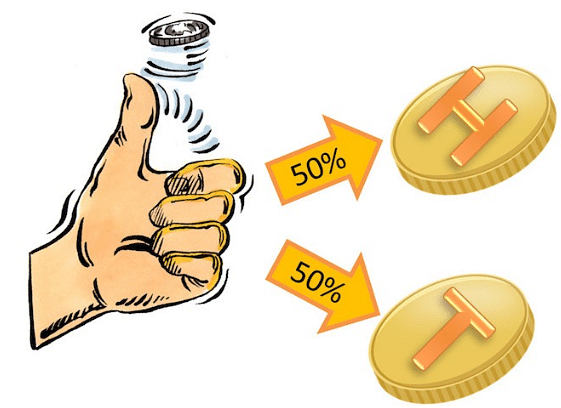
Coin Toss Probability is the probability for the outcome of heads or tails, especially when two or more coins are considered. This conventional method of tossing a coin to determine chances in sports is used because the probability of getting a head in a coin toss is as likely as getting a tail, i.e. 50% chances of getting heads or tails. So, in a one coin toss, there are only two possibilities, either getting a head (H) or a tail (T). But what if we toss 2 coins together? or say 3, 4 or 5 coins? In this case, the following formula is used.
Probability of an event = Number of favourable outcomes / total number of outcomes.
Read Also: Theoretical Probability
| Table of Content |
Key Takeaways: Probability, Coin Toss Probability, Favourable Outcomes, Total Outcomes, Event
Coin Toss Probability
[Click Here for Sample Questions]
Probability is defined as the measurement of chances i.e. the possibility of an event to occur. If the probability of an event is high, it is likely that the event will take place. Probability is measured between 0 and 1, inclusive. Hence, if an event is unlikely to take place, its probability will be 0 whereas 1 tells about the certainty for the occurrence of the event.
Coin Toss Probability
Now what is the probability of getting a tail when a coin is tossed? Given the situation that the coin is fair, without thinking the answer would be 50% or ½. This is because of the fact that the outcome of tossing a coin will either be a head or a tail and both are equally likely. So we can say that:
Number of total possible outcomes = 2
Favourable outcome of getting a tail = 1
Probability of getting a tail = Favourable Outcome / Total Outcomes = ½
Similarly,
Probability of getting a head = Favourable Outcome / Total Outcomes = ½
Hence,
Probability of an event = Number of favourable outcomes / total number of outcomes.

Possible Outcomes of a Toss
Also Read:
Example of Coin Toss Probability
[Click Here for Sample Questions]
The best way to understand coin toss probability is by examples. One such example is given below:
Example - Two fair coins are tossed simultaneously. What is the probability of getting only one tail?
Now suppose, when 2 coins are tossed, the possible outcomes can be either {HH, TT, HT, TH} i.e. there will be four possible outcomes.
Thus, we can say that the total number of possible outcomes = 4
Getting only one tail includes {HT, TH} outcomes.
So number of favourable outcomes = 2
Therefore, probability of getting only one tail is;
Probability of an event = no. of favourable outcomes / total number of outcomes
Probability of an event = 2/4
Probability of an event = 1/2
or, Probability of an event = 0.5
Things to Remember
- Probability is defined as the measurement of the possibility of an event to occur.
- The value of probability lies between 0 and 1.
- A probability of one ensures the certainty for the occurrence of the event.
- If an event is unlikely to take place, its probability will be 0.
- Probability of an event is given by; Probability = Number of favourable outcomes / Total number of outcomes.
Also Read:
Sample Questions
Ques. Define Probability. What is the formula for finding probability? (2 marks)
Ans. Probability is defined as the measurement of chances of an event to occur. If the probability is high, it is likely that the event will take place. If an event is unlikely to take place, its probability will be low. Probability is measured between 0 and 1. The probability of an event is given by'
Probability of an event = Number of favourable outcomes / total number of outcomes.
Ques. Two fair coins are tossed simultaneously. What is the probability of getting two heads? (3 marks)
Ans. Now suppose, when 2 coins are tossed, the possible outcomes can be either {HH, TT, HT, TH} i.e. there will be four possible outcomes.
Thus, we can say that the total number of possible outcomes = 4
Getting two heads includes {HH} outcomes.
So, number of favourable outcomes = 1
Therefore, probability of getting two heads is;
Probability of an event = no. of favourable outcomes / total number of outcomes
Probability of an event = 1/4
or, Probability of an event = 0.25
Ques. Three fair coins are tossed simultaneously. What is the probability of getting at least 2 heads? (3 marks)
Ans. Now suppose, when 3 coins are tossed, the possible outcomes can be either {HHH, HHT, HTH, HTT, THH, THT, TTH, TTT}.
Thus, we can say that the total number of possible outcomes = 8
Possible outcomes of getting at least 2 heads = 4 = {HHT, HTH, HTT, HHH}
So, number of favourable outcomes = 4
Therefore, probability of getting at least two heads is;
Probability of an event = no. of favourable outcomes / total number of outcomes
Probability of an event = 4/8
Probability of an event = 1/2
or, Probability of an event = 0.5
Ques. Three fair coins are tossed simultaneously. What is the probability of getting at least 2 tails? (3 marks)
Ans. Now suppose, when 3 coins are tossed, the possible outcomes can be either {HHH, HHT, HTH, HTT, THH, THT, TTH, TTT}.
Thus, we can say that the total number of possible outcomes = 8
Possible outcomes of getting at least 2 tails = 4 = {HTT, THT, TTH, TTT}
So, number of favourable outcomes = 4
Therefore, probability of getting at least two tails;
Probability of an event = no. of favourable outcomes / total number of outcomes
Probability of an event = 4/8
Probability of an event = 1/2
or, Probability of an event = 0.5
Ques. A coin is tossed three times randomly. What is the probability of getting the same face? (3 marks)
Ans. Now suppose, when 3 coins are tossed, the possible outcomes can be either {HHH, HHT, HTH, HTT, THH, THT, TTH, TTT}.
Thus, we can say that the total number of possible outcomes = 8
Possible outcomes of getting the same face = 2 = {HHH, TTT}
So, number of favourable outcomes = 2
Therefore, probability of getting the same face is;
Probability of an event = no. of favourable outcomes / total number of outcomes
Probability of an event = 2/8
Probability of an event = 1/4
or, Probability of an event = 0.25
Ques. What is the probability of getting a head when a coin is tossed? (3 marks)
Ans. When a coin is tossed, the possible outcomes can be either {H,T}
Thus, we can say that the total number of possible outcomes = 2
Possible outcomes of getting a head = 1 = {H}
So, number of favourable outcomes = 1
Therefore, probability of getting a head is;
Probability of an event = no. of favourable outcomes / total number of outcomes
Probability of an event = 1/2
or, Probability of an event = 0.5
Ques. Two coins are tossed 100 times randomly and it is found that two heads appeared 60 times, one head appeared 72 times, and no head appeared 14 times. What is the probability of: (5 marks)
(a) getting two heads
(b) getting one head
(c) getting no head
Ans. Total number of possible outcomes = 100
Number of times two heads appeared = 60
Number of times one head appeared = 72
Number of times no head appeared = 14
- Probability of getting two heads = no. of favourable outcomes / total number of outcomes
probability of getting two heads = 60/100
probability of getting two heads = 0.6
- Probability of getting one head = no. of favourable outcomes / total number of outcomes
probability of getting two heads = 72/100
probability of getting two heads = 0.72
- Probability of getting no head = no. of favourable outcomes / total number of outcomes
probability of getting two heads = 14/100
probability of getting two heads = 0.14
For Latest Updates on Upcoming Board Exams, Click Here: https://t.me/class_10_12_board_updates
Check-Out:



Comments