



Education Journalist | Study Abroad Lead
Column Matrix (or column vector) is the kind of matrix that only consists of a single column. A Column Matrix’s order is shown by m × 1, so that the rows will only consist of a single element that is arranged in a way for them to show a column of elements. The elements in a matrix are held by the row and column. The column elements are arranged vertically while the row elements are arranged horizontally. A row matrix will tend to have just one row only, which is opposite of the column matrix. Operations like addition or subtraction on a column matrix can only be done with another column matrix that has the same order.
| Table of Contents |
Key Terms: Matrix, Column Matrix, Elements, Rows, Horizontal, Rectangle, Algebraic Operations, Matrix Order, Square Matrix, Infinite Matrix, Addition, Multiplication
What is a Matrix?
[Click Here for Sample Questions]
A matrix is an array of numbers that is in the shape of a rectangle. These numbers are known as the entries of the matrix. Matrices can have operations like addition and multiplication done on them. The vertical and horizontal lines of entries in a matrix are known as columns and rows, respectively.
A matrix’s size is determined by the number of columns and rows it boasts. So, in that sense, a matrix doesn't have a limit on the numbers of columns and rows in it, but as long as these elements are positive integers. A matrix that has n columns and m rows is known as an m × n matrix, or also as an m-by-n matrix, while n and m are known as its dimensions.
The video below explains this:
Matrices Detailed Video Explanation:
Read More: Determinant of a Matrix
Types of Matrices
[Click Here for Sample Questions]
A matrix can be of various kinds, depending on the number of elements, rows, columns, etc. in it. The Matrices that have a single row are known as a row matrix, while the ones with a single column are known as a column matrix. A Square matrix is the one where the number of rows and columns are the same. A matrix containing an infinite number of columns or rows, or both, is known as an infinite matrix. In some cases, a matrix known as an empty matrix can also be found as it has no rows or no columns. The different types of matrices are as follows:
- Row Matrix
- Column Matrix
- Square Matrix
- Scalar Matrix
- Zero Matrix
- Identity Matrix
- Diagonal Matrix
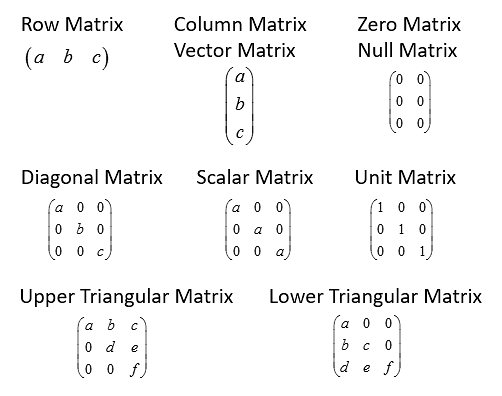
Types of Matrices
What is A Column Matrix?
[Click Here for Sample Questions]
A column matrix is the kind of matrix where the elements are arranged in various numbers of rows but only have a single column. They are therefore known as the column vector or the Column Matrix as we all know it.
For example, we could have some elements in a matrix but all the elements will be arranged in just a single column. Let’s take the assumption that the elements are arranged in m rows in this particular case. So, the elements will be arranged in m row and a single column.
A matrix of the order m × 1 is formed and is named M. The mathematical form of this will be
\(M=\left[\begin{array}{c} e_{11} \\ e_{21} \\ e_{31} \\ \vdots \\ e_{m 1} \end{array}\right]_{m \times 1}\)
This matrix shows a rectangle shape. So, a column matrix can be identified as a rectangular matrix and is expressed as M = [eij]m x n.
In a particular case of a column matrix, the number of columns j=1, so, n will be equal to 1 too, and since i = m, the matrix can be written in a simple form as M = [ei1] m × 1.

Column Matrix
Read More: Orthogonal Matrix
Examples of Column Matrix
[Click Here for Sample Questions]
Here are a few examples of Colum Matrix:
Example 1: This is an example of a column matrix of the order 2x1
\(A=\left[\begin{array}{l} 1 \\ 7 \end{array}\right]_{2 \times 1}\)
Here, there are two elements that have been arranged in two rows and one column.
Example 2: Given below is an example of a column matrix of the order
\(A=\left[\begin{array}{l} 3 \\ 2 \\ 8 \\ 5 \end{array}\right]_{4 \times 1}\)
Here, there are four elements arranged in four rows and one column.
Properties of a Column Matrix
[Click Here for Sample Questions]
There are various properties of the column matrix. These are as follows.
- A column matrix consists of just a single column.
- A column matrix consists of several rows.
- The number of elements and the number of rows in a column matrix are equal.
- A column matrix can also be known as a rectangular matrix.
- When a column matrix is transposed, it is known as a row matrix.
- Operations like addition or subtraction on a column matrix can only be done with another column matrix that has the same order.
- Multiplication on a column matrix can only be done with a row matrix
- A singleton matrix is born when a column matrix is multiplied with a row matrix.
Read More: Transpose of a Matrix
Operations on a Column Matrix
[Click Here for Sample Questions]
Column Matrices can have algebraic operations like subtraction, addition, division and multiplication be performed. Addition or Subtraction on a column matrix can only be done with another column matrix. Here, both the matrices must have the same order.
\(A = \begin{bmatrix} 7 \\ -3 \\ 4 \\ 5 \\ \end{bmatrix}\), \(B = \begin{bmatrix} 3 \\ 8 \\ 2 \\ -7 \\ \end{bmatrix}\)
\(A + B = \begin{bmatrix} 7+3 \\ (-3)+8 \\ 4+2 \\ 5+(-7) \\ \end{bmatrix} = \begin{bmatrix} 10 \\ 5 \\ 6 \\ -2 \\ \end{bmatrix}\)
The multiplication of a column matrix can only be done by a row matrix, and the number of columns in the first matrix and the number of rows in the second matrix must be equal so that it holds the condition of matrix multiplication.
\(A = \begin{bmatrix} 4 \\ 2 \\ 3 \\ 1 \\ \end{bmatrix}\), \(B = \begin{bmatrix} 7 & 4 & 6 & 5 \end{bmatrix}\)
\(\begin{align*} A \times B &= \begin{bmatrix} 4 \\ 2 \\ 3 \\ 1 \\ \end{bmatrix} \times \begin{bmatrix} 7 & 4 & 6 & 5 \end{bmatrix} \\ &= \begin{bmatrix} 4 \times 7 & 4 \times 4 & 4 \times 6 & 4 \times 5 \\ 2 \times 7 & 2 \times 4 & 2 \times 6 & 2 \times 5 \\ 3 \times 7 & 3 \times 4 & 3 \times 6 & 3 \times 5 \\ 1 \times 7 & 1 \times 4 & 1 \times 6 & 1 \times 5 \\ \end{bmatrix} \\ &= \begin{bmatrix} 28 & 16 & 24 & 20 \\ 14 & 8 & 12 & 10 \\ 21 & 12 & 18 & 15 \\ 7 & 4 & 6 & 5 \\ \end{bmatrix} \end{align*}\)
When a column matrix is multiplied by a row matrix, a square matrix is created. The column matrix, however, has no inverse of itself, so it cannot be used for division.
Read More: Elementary Matrix Operations
Things to Remember
- A matrix is an array of numbers that is in the shape of a rectangle.
- These numbers are known as the entries of the matrix.
- Matrices can have operations like addition and multiplication done on them.
- The vertical and horizontal lines of entries in a matrix are known as columns and rows, respectively.
- A column matrix is the kind of matrix where the elements are arranged in various numbers of rows but only have a single column.
- A column matrix can be identified as a rectangular matrix and is expressed as M = [eij]m × n
- Addition or Subtraction on a column matrix can only be done with another column matrix.
- The multiplication of a column matrix can only be done by a row matrix, and the number of columns in the first matrix and the number of rows in the second matrix must be equal.
Also Read:
Sample Questions
Ques. Find the transpose of a column matrix as given below. (3 Marks)
\(\begin{bmatrix} 5 \\ 11 \\ 4 \\ 3 \end{bmatrix}\)
Ans. The given matrix is shown as
A = \(\begin{bmatrix} 5 \\ 11 \\ 4 \\ 3 \end{bmatrix}\)
The columns of this matrix must be written as row elements, so that we could find the transpose of this column matrix.
AT = \(\begin{bmatrix} 5 & 11 & 4 & 3 \end{bmatrix}\)
Hence found that the column matrix’s transpose is a row matrix.
Ques. Find the product of the given column matrix and the row matrix. (3 Marks)
\(\begin{bmatrix} 4 \\ 5 \\ 3 \end{bmatrix}\) and \(\begin{bmatrix} 2 & 6 & 9 \end{bmatrix}\)
Ans. The given matrices are shown as
A = \(\begin{bmatrix} 4 \\ 5 \\ 3 \end{bmatrix}\) and B = \(\begin{bmatrix} 2 & 6 & 9 \end{bmatrix}\)
\(\begin{align*} A \times B &= \begin{bmatrix} 4 \\ 5 \\ 3 \end{bmatrix} \times \begin{bmatrix} 2 & 6 & 9 \end{bmatrix} \\ &= \begin{bmatrix} 4 \times 2 & 4 \times 6 & 4 \times 9 \\ 5 \times 2 & 5 \times 6 & 5 \times 9 \\ 3 \times 2 & 3 \times 6 & 3 \times 9 \end{bmatrix} \\ &= \begin{bmatrix} 8 & 24 & 36 \\ 10 & 30 & 45 \\ 6 & 18 & 27 \end{bmatrix} \end{align*}\)
Therefore when a column matrix and a row matrix is multiplied, it is known as a singleton matrix.
Ques. What Is The Transpose of A Column Matrix? (2 Marks)
Ans. When a column matrix is transposed it gives a row matrix. A column matrix of the order n × 1, will have a transpose matrix, which will become a row matrix of order 1 × n upon transposing. The column matrix’ elements are arranged in a vertical manner and the elements in a row matrix a vertical format.
Ques. What Are The Operations Of A Column Matrix? (3 Marks)
Ans. Operations like that of subtraction, multiplication and addition can be done using a column matrix. However, an inverse of a column matrix is impossible as it is not a square matrix. The subtraction or addition of two matrices is only possible when the two-column matrices have the same order. A column matrix can be multiplied by a row matrix, Only if it Satisfies the matrix multiplication condition that is the number of rows of a row matrix must be equal to the number of columns in the column matrix.
Ques. What Is the Difference Between Column Matrix And Row Matrix? (3 Marks)
Ans. The column matrix’s elements are arranged in a vertical way, while the row matrix’s elements are distributed in a horizontal way. The order of a column matrix is shown as n × 1, whereas the order of a row matrix is shown as 1 × n. The number of elements in the column matrix or a row matrix is equal. A column matrix and a row matrix will produce a singleton matrix upon multiplication.
Ques. What do you understand by the Order of Column Matrix? (3 Marks)
Ans. The order of a column matrix has been given as n × 1, so, the column matrix has only one column and n number of rows. In a column matrix, the number of rows is equal to the number of elements.
For Example,
\(C = \begin{bmatrix} 6 \\ 0 \\ 9 \end{bmatrix}\)
Here, C is a column matrix of the order 3 × 1. Here the three elements are arranged in the matrix in three rows and one column.
Ques. Give any two examples of a column matrix. (2 Marks)
Ans. Given below are the two examples of a column matrix:
Example 1:
\(D = \begin{bmatrix} -5 \\ 8 \\ 2 \\ 3 \end{bmatrix}\)
Here, D is the column matrix of order 4 × 1. Here there are four elements arranged in four rows and one column.
Example 2:
\(A = \begin{bmatrix} 1 \\ 2 \\ 3 \\ 4 \\ 6 \end{bmatrix}\)
Here, A is a column matrix of order 5 × 1. Here there are five elements arranged in five rows and one column.
For Latest Updates on Upcoming Board Exams, Click Here: https://t.me/class_10_12_board_updates
Check-Out:



Comments