



Education Journalist | Study Abroad Lead
Elementary Matrix Operations play a vital role in applications of algebra in mathematics. It helps in solving linear equations and also in finding the inverse of a matrix. Matrix is one of the most powerful tools in mathematics. It's a rectangular array of integers structured in rows and columns, in simple terms. The order or dimension of a matrix is determined by the number of rows and columns. The order of a matrix or array is represented by the formula m x n, where n denotes the number of columns and m is the number of rows. In this article, we will have a closer look at the Let's take a closer look at the definition of Matrix, Elementary operations of Matrix, elementary row operations, elementary column operations etc.
| Table of Content |
What is a Matrix?
[Click Here for Sample Questions]
A matrix is a rectangular array of integers with rows and columns organised in a grid. A matrix is represented by the array of integers below. An example of a matrix or array is as shown below.
The dimension or order of a matrix refers to the number of rows and columns it contains. By convention, rows are listed first, followed by columns. As a result, we may state that the above matrix's dimension (or order) is m x n, implying that it has m rows and n columns. A matrix has some important elementary matrix operations which comprises of elementary row operations and elementary column operations.
Also Read: Identity Matrix
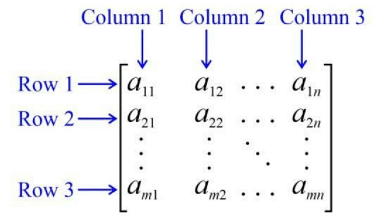
Matrix
The numbers that appear in the rows and columns of a matrix are referred to as matrix elements. The first column of the first row in the given matrix has the value 21; the second column of the first row has the value 62; and so on.

A matrix
Discover about the Chapter video:
Determinants Detailed Video Explanation:
Types of Matrix
[Click Here for Sample Questions]
- Transpose Matrix

Transpose Matrix
The transpose of one matrix is another matrix in which the original matrix's rows are used as columns in the second matrix.
The transpose of matrix A, for example, is easily seen to be A'. The first row of matrix A becomes the first column of A', the second row of A becomes the second column of A', and the third row of A becomes the third column of A'.
- Square Matrix
An n x n matrix, or a matrix with the same number of rows as columns, is known as a square matrix. The different types of square matrices are:
- Symmetric Matrix- A matrix is said to be symmetric if its transpose is the same as its own.
Also Read: Symmetric Matrix

Symmetric Matrices
- Diagonal Matrix-. A diagonal matrix is a type of symmetric matrix that is unique. It's a symmetric matrix containing off-diagonal components that have zeros.

Diagonal Matrices
- Scalar Matrix- A scalar matrix is a type of diagonal matrix that is unique. It's a diagonal matrix with components of equal value running diagonally.
Also Read: Scalar Matrix

Scalar Matrices
Elementary Operations of Matrix
[Click Here for Sample Questions]
The inverse of a matrix is usually found using Elementary Matrix Operation techniques. The following are the two types of elementary matrix operations:
- Primary or Elementary Row Operations: Primary or elementary row operations are operations done on the rows of an array or matrix.
- Primary or Elementary Column Operations: Primary or elementary column operations are the elementary matrix operations performed on its columns.
The three basic elementary matrix operations or elementary operations of a matrix are as follows:
- The interchange of any two rows or columns.
- Multiplication of a row or a column by a non-zero number.
- Multiplication of a row or a column by a non-zero number and adding the result to some other row or column.
Also Read: Singular Matrix
Elementary Row Operations
[Click Here for Sample Questions]
In the case of elementary row operations, the elementary matrix operations are performed only on the rows of a matrix:
Case 1: The Interchange of any Two Rows
In a matrix or array, any two rows can be swapped or switched. When the ith row and the jth row are swapped, the result is Ri ↔ Rj which is an elementary row operation. The matrix A, for example, is shown below.
\(A = \begin{bmatrix} 2&4\\ 1&3 \end{bmatrix}\)
We may achieve the following result by using the elementary row matrix operations R1 ↔ R2
\(A = \begin{bmatrix} 1&3\\ 2&4 \end{bmatrix}\)
Case 2: Multiplication of Row by a Non-zero Number
Any non-zero integer can be used to multiply the elements of any row. Ri ↔ k Ri is the multiplication of the ith row with k (any non-zero value).
We've presented a matrix A as an example.
A= [2 5 6 3]
So, if we perform the Elementary row operation R1↔3R1,we obtain:
A= [6 15 18 9]
Case 3: Multiplication of Row by a Non-zero Number and Add the Result to the Other Row
After multiplying the matrix with any non-zero value, we may add the elements of any row with the corresponding elements of another row. The sum of the elements of an ith row and the elements of the jth row, multiplied by k (any non-zero number), is symbolically expressed as Ri ↔ Ri + k Rj.
We've presented a matrix A as an example.
\(A = \begin{bmatrix} 2&4\\ 1&3 \end{bmatrix}\)
We acquire by using the elementary rpw operation R2↔R2+2R1
\(A = \begin{bmatrix} 2&4\\ 7&15 \end{bmatrix}\)
Elementary Column Operations
[Click Here for Sample Questions]
In the case of elementary column operations, the elementary matrix operations are performed only on the columns of a matrix:
Case 1: The Interchange of any Two Columns
In a matrix or array, any two columns can be swapped or switched. When the ith column and the jth column are swapped, Ci ↔ Cj denotes the substitution. Suppose we have:
\(A = \begin{bmatrix} 2&4\\ 1&3 \end{bmatrix}\)
We may achieve the following result by using the elementary column matrix operations C1 ↔ C2
\(A = \begin{bmatrix} 4&2\\ 3&1 \end{bmatrix}\)
Case 2: Multiplication of a Column by a Non-zero Number
Any non-zero integer can be used to multiply the elements of any column. Ci ↔ k Ci is the multiplication of the ith column with k (any non-zero value).
We've presented a matrix A as an example.
\(A = \begin{bmatrix} 2&4\\ 1&3 \end{bmatrix}\)
So, if we perform the Elementary column operation C1↔ 3C1,we obtain:
\(A = \begin{bmatrix} 6&4\\ 3&3 \end{bmatrix}\)
Case 3: Multiplication of a Column by a Non-zero Number and Add the Result to the Other Column
After multiplying the matrix with any non-zero value, we may add the elements of any column with the corresponding elements of another column. The sum of the elements of an ith column and the elements of the jth column, multiplied by k (any non-zero number), is symbolically expressed as Ci ↔ Ci + k Cj.
We've presented a matrix A as an example.
\(A = \begin{bmatrix} 2&4\\ 1&3 \end{bmatrix}\)
We acquire by using the elementary column operation C2↔C2+2C1
\(A = \begin{bmatrix} 2&8\\ 7&5 \end{bmatrix}\)
Also Read:
| Related Articles | ||
|---|---|---|
| Complex Numbers and Quadratic Equations | Geometric Mean (G.M.) | Bayes Theorem Formula |
| Sequence and Series | Arithmetic Progressions Revision Notes | Real Numbers Formula |
Things to Remember
- A matrix is a collection of integers organised into rows and columns.
- The dimensions of a matrix are the number of rows and columns, which are denoted as m x n, where m and n are the number of rows and columns, respectively.
- There are certain fundamental operations that can be done on a matrix known as the elementary matrix operations which are elementary row operations and elementary column operations.
- A matrix's three fundamental elementary operations or transformations are as follows:
- Any two rows or columns can be swapped.
- Multiplication of a non-zero value by a row or column.
- Add the result to the other row or column after multiplying the row or column by a non-zero value.
Also Read: Adjacency Matrix
Sample Questions
Ques. What is the definition of an elementary matrix operation? (2 marks)
Ans. The operations in elementary arithmetic: addition, subtraction, multiplication, and division are examples of elementary operations. Row operations and column operations are both examples of elementary operations.
The operations done on rows and columns of a matrix to change the provided matrix into a new form in order to make the computation simpler are known as elementary operations of a matrix.
Ques. What is the purpose of using basic row operations? (1 mark)
Ans. In Gaussian elimination, elementary row operations are employed to turn the supplied matrix into the reduced row Echelon form.
Ques. What are the Practical Applications of Matrices? (5 marks)
Ans. Matrices are an important component of mathematics.
- They let us store a large amount of data in a single rectangular array. As a result, it has a wide range of applications in physics and engineering.
- You don't have to write major equations that depend on multi-dimensional values separately when you use a matrix.
- Many GPS businesses, in fact, employ the matrix technique to give consumers with complete accuracy.
- Matrixes are also used by several IT organisations to store their user databases.
- Arrays may also be used to produce graphs and conduct many forms of scientific study.
- Many economists believe it is the most effective technique for solving a variety of issues.
Ques. What is the meaning of the Elementary 3rd matrix? (2 marks)
Ans. A matrix produced from the identity matrix is a n x n elementary matrix of type I, type II, or type III. by conducting a single type I, II, or III elementary row operation (or a single type I, II, or III elementary column action).
Ques. Mention the three basic operations of matrices. (3 marks)
Ans. The three elementary operation of matrices are:
- Any two rows or columns can be swapped.
- Multiplication of a non-zero value by a row or column.
- Add the result to the other row or column after multiplying the row or column by a non-zero value.
Ques. Is it Possible to Deduce the Matrix's Rank Using Simple Matrix Operations? (3 marks)
Ans. The rank of a matrix is defined as the number of linearly independent column vectors or row vectors contained in it. By using column or row elementary operations, we may easily change the array into its echelon form. We must count the number of non-zero columns or rows after transforming the matrix to its echelon form. In basic terms, the rank of the matrix is the number of non-zero rows or columns after executing the elementary matrix operations. The echelon form of the matrix can be obtained using either the elementary row operations or the column operations.
Ques. Is it possible to swap rows in a matrix? (3 marks)
Ans. Yes, we can swap the rows of a matrix to create a new one. For instance, R1↔R2 or R1↔R3 and so on. It is an elementary row operation of a matrix.
When the ith row and the jth row are swapped, the result is Ri ↔ Rj. The matrix A, for example, is shown below.
\(A = \begin{bmatrix} 9&4\\ 1&8 \end{bmatrix}\)
We may achieve the following result by using the elementary matrix operations R1 ↔ R2
\(A = \begin{bmatrix} 1&8\\ 9&4 \end{bmatrix}\)
Ques. On a 2x3 matrix A, use the basic operator C2↔C1. (3 marks)
Ans. Given that,
\(A = \begin{bmatrix} 9&4&2 \\ 1&9&5 \end{bmatrix}\)
Now we must use the C2↔C1 elementary matrix operation. This indicates that column 2 must be swapped out for column 1. We obtain C2↔C1 when we do this column operator on A.
\(A = \begin{bmatrix} 4&9&2 \\ 9&1&5 \end{bmatrix}\)
Ques. Are all elementary matrices square? (1 mark)
Ans. A square matrix is always an elementary matrix. Applying one row operation on the identity matrix of the same size yields any elementary matrix, which we typically refer to as E.
Ques. Do simple row operations affect a matrix's determinant? (2 marks)
Ans. Row operations do not modify whether or not a determinant is 0; at most, they change the determinant's sign or change it by a non-zero factor. Reduce the matrix to a reduced row-echelon form using row operations.
Ques. What is the determinant of a K on the diagonal elementary scaling matrix? (2 marks)
Ans. An n x n identity matrix with k on the diagonal is the same as a n x n scaling matrix with k on the diagonal. This indicates it's a triangular matrix, and the product of its diagonal entries is its determinant.
For Latest Updates on Upcoming Board Exams, Click Here: https://t.me/class_10_12_board_updates
Check-Out:



Comments