



Education Journalist | Study Abroad Lead
Comparative anatomy refers to the study of the similarities and differences in the structures of different species. Homologies or analogies are body parts that are similar. Both show evidence that evolution is true. Homologous structures are structures found in related organisms that were passed down from a common ancestor. The study of vertebrate animals is the main focus of this area. Comparative anatomy was extensively used by British naturalist Charles Darwin to advance his theory of evolution by natural selection, which revolutionized the field by explaining structural differences between species as arising from their evolutionary descent by natural selection from a common ancestor.
| Table of Content |
Keyterms: Comparative anatomy, Species, Homologies, Analogies, Evolution, Homologous structures, Natural selection, Vertebrate animals, Trait
Read More: Open Type Circulatory System
What is Comparative Anatomy?
[Click Here for Sample Questions]
Comparative anatomy can be defined as the study of the anatomy of different animal species in order to understand the history of evolution from their common ancestors by studying the adaptive changes that have occurred. It's like phylogeny and evolutionary biology together.
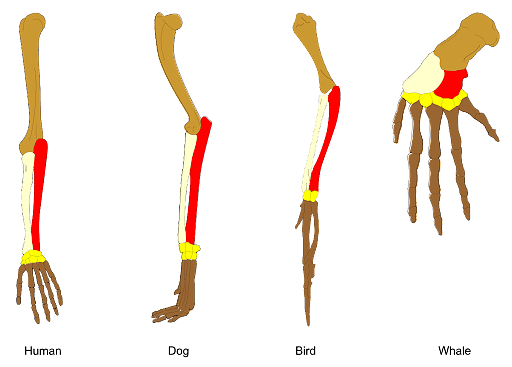
Comparative anatomy
The study of comparative anatomy in biology is necessary in order to comprehend the areas of variation that led to evolution. Biologists and scientists use the fossil evidence left behind to compare modern creatures to prehistoric organisms in order to see the evolution that has occurred. Evolution is a long-term genetic change that occurs in a species in a specific location. Organisms evolve in order to help them survive in their environment. This gene shuffle leads to the formation of a new trait, which aids the animal's survival in the environment.
Also Read:
History of Comparative Anatomy
[Click Here for Sample Questions]
The work of French naturalist Pierre Belon, who demonstrated in 1555, that the bones of humans and birds are made up of comparable materials arranged in the same way, is the foundation of modern comparative anatomy. Comparative anatomy advanced substantially in the 18th century thanks to the work of two French naturalists, Georges-Louis Leclerc, Comte de Buffon, and Louis-Jean-Marie Daubenton.
Georges Cuvier, a French Biologist, in the 19th century established a stronger scientific foundation of the topic by claiming that the functional and structural traits of an animal are the result of their interaction with their environment. Cuvier also disproved the 18th-century idea that the animal kingdom is organized in a single linear succession from the simplest to the most complex. Instead, Cuvier classified all animals into four broad classes based on their body plans (vertebrates, mollusks, articulates, and radiates).
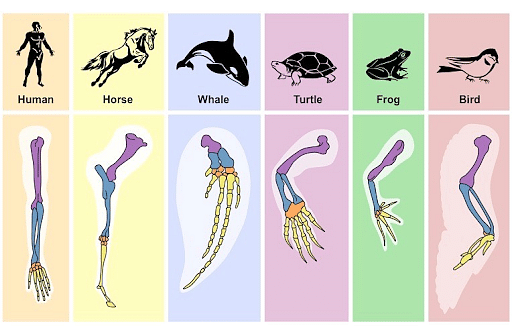
Comparative anatomy
Another notable person in the discipline was British anatomist Sir Richard Owen, mid-nineteenth-century, whose enormous understanding of vertebrate structure did not prevent him from criticizing British biologist Charles Darwin's idea of evolution by natural selection.
In establishing his theory, Darwin made considerable use of comparative anatomy, which revolutionized science by explaining anatomical variations between species as coming from their evolutionary descent by natural selection from a common ancestor.
Read More: Difference between adolescence and puberty
Analogous Structures
[Click Here for Sample Questions]
Analogous structures are structures that are similar in different animals. Although the equivalent organs perform similar duties, their origins and arrangement are vastly different. The wings of birds and insects, for example, perform the same function, i.e., both creatures use their wings to fly, yet their origins are different. The anatomy of a bird's wing is quite similar to that of a human's forelimbs or hands, but it is extremely different from that of an insect's wing. Bird wings and insect wings are similar structures that have evolved as a result of convergent evolution.
Read More: Types of Receptors
Homologous Structures
[Click Here for Sample Questions]
Homologous structures are organs or structures seen in vertebrates that have a similar structural arrangement but differing functionalities. The forelimbs of bats, horses, birds, and whales, for example, have similar anatomy and origin, but they serve diverse purposes. Bats use their forelimbs to glide through the air, whereas birds use theirs to fly. Horses' forelimbs are used for running on the ground, while whales' forelimbs, known as flippers, are used for swimming. All of the vertebrates' homologous structures have diverse functions but have a similar structural architecture.

Analogous and Homologous Structures
Forelimb structure, which is comparable to that of whales and cats, is another example of homologous structure. People and whales may not appear to be closely connected at first appearance, yet millions of years ago, there was an ancestor that was similar to both humans and whales. A new species was created as a result of evolution. Furthermore, from those species, even newer species have emerged.
Read More: Test for Fats
Comparative Anatomy Representative Samples
[Click Here for Sample Questions]
- The anatomy of the brain in different vertebrates has undergone evolutionary alterations. The Olfactory lobes, Optic lobes, Cerebral lobes, Cerebellum, and Medulla oblongata are the five lobes of the brain found in almost all vertebrates.
- The cerebral hemisphere of mammals is substantially larger than that of fishes, owing to structural variations in the brain of different vertebrates. Fishes, on the other hand, have a significantly larger olfactory lobe than mammals.
- The heart of all vertebrates has chambers called ventricle, auricle, conus arteriosus, sinus venous, and so on. The configuration of chambers in the hearts of vertebrates is critical for partitioning. The chambers serve as a barrier to keep oxygenated and deoxygenated blood from mingling.
- There is an evolutionary change in the heart anatomy of vertebrates, such as the single-chambered heart of fishes progressively evolving into the hearts of other organisms adapted to their habitat and necessity. Amphibians and reptiles have three-chambered hearts, but mammals and birds have four-chambered hearts.
- The vertebral column is formed by four mesodermal masses in each somite in all vertebrate species. The vertebral column is made up of vertebrae with a centrum, neural canal, neural arch, neural spine, articular processes, and transverse processes in each.

Comparative anatomy of mammals
Things to Remember
- Comparative anatomy is the study of the body architecture of distinct species of animals in order to comprehend the adaptive changes that over time have occurred as the species evolved from common ancestors.
- The goal of comparative anatomy is to examine the functioning structure of animals and to determine the phylogenetic links between different groups of animals.
- There are three types of structures found in comparative anatomy- homologous, analogous and vestigial.
- Organs or skeletal elements of animals and organisms that are homologous show that they share a common ancestry due to their similarities. Homologous structures don’t have to resemble each other in function or appearance.
- The analogous structures are not inherited from the same ancestor and are not identical. However, they have a similar appearance and serve a comparable purpose.
- Comparative anatomy aids scientists in identifying species based on comparable anatomical structure characteristics.
- Darwin made extensive use of comparative anatomy, which transformed science by explaining anatomical differences between species as a result of natural selection from a common ancestor.
Also Read:
Sample Questions
Ques. Explain why comparative anatomy is important. (3 marks)
Ans: Comparative anatomy elucidates the evolutionary links between certain anatomical structures, allowing biologists and scientists to classify those structures and animals. There are two sorts of relationships between structures in comparative anatomy: homologous structures and similar structures. Comparative anatomy is an important tool for identifying whether or not two species share a common ancestry. Furthermore, the emergence of diversity in anatomical features suggests that creatures have evolved to survive and respond to their surroundings.
Ques. Describe briefly the concept behind comparative anatomy? (2 marks)
Ans: Comparative anatomy is the study of the body architecture of many animal species in order to understand the adaptive changes that have occurred over time as they evolved from common ancestors.
Ques. What is the significance of comparative anatomy as proof of evolution? (2 marks)
Ans: Comparative anatomy has traditionally been used to support evolution, and comparative genomes are now following suit, demonstrating that creatures have a common ancestor. It also helps scientists distinguish between species based on anatomical structure similarities.
Ques. What role do comparative anatomy and embryology play in evolutionary theory? (2 marks)
Ans: If distantly related species developed separately in comparable conditions, structural similarities between them are equivalent. Natural selection is supported by these findings. All early vertebrate embryos have tail and gill slits, which are examples of embryological evidence that supports common ancestry.
Ques. What causes analogous structures to change? (2 marks)
Ans: When species experience difficulties surviving in a given habitat, they may acquire specialized features to help them overcome those obstacles. And, in the same environment, multiple species of organisms may encounter similar survival obstacles, thus genetic mutation may shape the species' structures or organs in the same way, leading to the production of equivalent structures.
Ques. Who was the first to discover comparative anatomy? (1 mark)
Ans: Because his general approach is comparative and encompasses a plethora of anatomical and morphological descriptions, his scope is vast, and his techniques are rigorous and systematic, many credit Aristotle as the father of comparative anatomy.
Ques. Give an example of comparative anatomy. (2 marks)
Ans: The similar bone structure in the forelimbs of cats, whales, bats, and humans is a common example of comparative anatomy. All of these appendages are made up of the same basic components, but they perform very different purposes.
For Latest Updates on Upcoming Board Exams, Click Here: https://t.me/class_10_12_board_updates
Check-Out:



Comments