



Content Curator
Condensation Polymerization is a process in which polymers are formed by removing water or alcohol during polymerization. The final molecular weight of the polymer is controlled by the equilibrium concentration of water or alcohol in the molten polymer at the end polymerization. In this article, we will discuss Polymerization, Condensation Polymerization, its characteristics and Important Questions.
| Table of Content |
Keyterms: Condensation, Polymerization, Polymers, water, alcohol, Condensation Polymerization, Addition Polymerization, methanol
Polymerization
[Click Here for Sample Questions]
Polymerization is defined as a process in which monomers engage in a chemical reaction and form long polymer chains or three-dimensional networks. Polymerization typically happens via different reaction mechanisms which are full of factors just like the functional groups of the reacting compounds and their nonbonding interactions. There are mainly two types of polymerization- Condensation Polymerization and Addition Polymerization.
Also Read: Molecular Orbital Theory Postulates
Condensation Polymerization
[Click Here for Sample Questions]
Condensation polymerization is a step-growth polymerization where tiny molecules react with each other to make larger structural units while releasing the by-products like water or methanol molecule. The by-products are usually known as condensate.
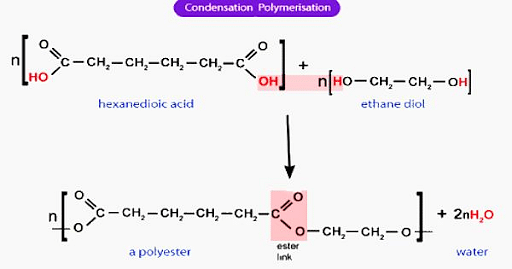
Polymerization is also generally mentioned as step-growth polymerization. There are few exceptions that require to be considered. There are instances where molecules of some substances react as condensation polymerization, however, they follow the chain growth pattern as seen in additional polymerization. The esterification of carboxylic acids with alcohols is a good example of a condensation reaction.

Characteristics of Condensation Polymerization
[Click Here for Sample Questions]
The main characteristics of Condensation Polymerization are:
- The molecules should have one or two functional groups (like alcohol, amine, or carboxylic acid groups).
- The reaction takes place between two similar or different functional groups or monomers. It will occur between a dimer and oligomer, one monomer and one compound or between a series and another chain of polymers.
- Smaller molecules sometimes mix to form larger molecules.
- Mixed properties of both the molecules or functional groups are taken into consideration.
- A linear polymer is obtained because of the condensation product when both functional groups are difunctional.
- When one of the functional groups is tri-functional or tetra-functional, the polymer formed is a cross-linked polymer having a three-dimensional network.
- The average molecular weight decreases once monomers are added with one reactive cluster. Therefore, the functionality of every monomer determines the average relative molecular mass and cross-link density.
Also Read:
| Related Articles | ||
|---|---|---|
| Synthetic Rubber | Copolymer | Polythene |
| Column chromatography | Polarity | Shapes of Atomic Orbital |
Examples of Condensation Polymerization
[Click Here for Sample Questions]
The most common example of products of polymerization is Nylon and Polyester.
When adipic acid monomer and hexamethylene diamine monomer reacts, then the final products obtained are polyamide and water.

The reaction between a dibasic acid and a glycol to form polyester is another form of condensation polymerization. The by-product here is again water which is keenly avoided.

Addition Polymerization and Condensation Polymerization
[Click Here for Sample Questions]
In addition polymerization, polymers are formed by adding monomers without by-products. In condensation polymerization, polymers are formed due to the condensation of many different monomers, which leads to the formation of small molecules. Few key differences between both are given below:
- In Addition Polymerization monomers solely join at the active site of the chain. However, in condensation polymerization, any molecule can react with the other.
- In Addition Polymerization, there are three distinct steps. Initiation, propagation and finally termination. In condensation polymerization, there is no termination step. The end groups stay reactive through the complete method.
- Addition polymerization leads to homo-chain polymers whereas condensation polymerization leads to hetero-chain polymers.
- The most important distinction is that in addition to polymers there is no loss of atom. However, in a condensation reaction, there is a loss of a molecule of water, ammonia, etc. as a by-product.
- In addition polymerization, lewis acids and radical initiators are catalysts and in condensation polymerization, acid monomers catalyze the reactions.
Read more: Concentration of Ore
Things to Remember
[Click Here for Sample Questions]
- The process in which monomers engage in a chemical reaction and form long polymer chains is called Polymerization.
- Condensation polymerization is a step-growth polymerization process.
- In condensation polymerization, tiny molecules react with each other to form larger structural units and release by-products like water or methanol molecules.
- The condensation polymerization reaction takes place between two similar or different functional groups or monomers.
Also Read: Hybridization
Sample Questions
Ques.1: What does the part ‘6, 6’ mean in the name nylon-6, 6? (Delhi, All India 2015, 1 Mark)
Ans: In Nylon ‘6,6’, the part ‘6,6’ implies that it is a condensation polymer of two types of monomer molecules. Each molecule is containing six carbon atoms i.e. adipic acid (HOOC (CH2)4 COOH) and hexamethylenediamine (H2N CH2 CH2 CH2 CH2 CH2 CH2 NH2).
Ques.2: What is the primary structural feature necessary for a molecule to make it useful in a condensation polymerization reaction? (All India 2014, 1 Mark)
Ans: the primary structural feature necessary for a molecule to make it useful in a condensation polymerization reaction is the presence of two bifunctional monomer molecules undergo condensation with the loss of simple molecules of water, alcohol to form a dimer.
Ques.3: Give one example of a condensation polymer. (All India 2013, 1 Mark)
Ans: One very common example of condensation polymer is Nylon 6,6.
Ques.4: Differentiate between chain growth and step-growth polymerization. (All India 2013, 2 Marks)
Ans: Chain growth polymerization: Chain Growth polymerization is a process that involves successive addition of monomer units to the growing chain which carries a reactive intermediate such as a free radical, a carbocation or a carbanion.
Example: Polyethene, Teflon, PAN etc.
Step-growth polymerization: In step-growth or condensation polymerization, the polymer is formed in a stepwise manner with the loss of simple molecules like H2O, alcohol etc.
Example: Polyamides like Nylon 6,6, Polyesters etc.
Ques.5: What is the repeating unit in the condensation polymer obtained by combining HO2CCH2CH2CO2H (succinic acid) and H2NCH2CH2NH2 (ethylene diamine)? (Delhi 2016, 2 Marks)
Ans: The repeating unit in the condensation polymer which is obtained by combining HO2CCH2CH2CO2H (succinic acid) and H2NCH2CH2NH2 (ethylene diamine) is Polyvinyl Chloride (PVC).

Ques.6: Differentiate between condensation and addition polymerizations. Give one example of each of the resulting polymers. (All India 2014, 2 Marks)
Ans: Condensation polymerization: In condensation polymerization, two or more bifunctional molecules undergo a series of independent condensation reactions and small molecules like H2O, alcohol, NH3, CO2, HCl, etc. are eliminated to form a macromolecule.
Example: Formation of nylon 6, 6

Addition polymerization: In addition polymerization, the molecules of the same or different monomers are combined to form a macromolecule. These molecules are formed among molecules containing double and triple bonds.
Example: Formation of polyethene.

Ques.7: Draw the structures of the monomers of the following polymers : (All India 2010, 2 Marks)
(i) Bakelite
(ii) Nylon-6
Ans: (i) Bakelite: Phenol and formaldehyde ? Condensation polymer (Bakelite).

(ii) Nylon-6: The monomeric repeating unit of Nylon-6 is Caprolactam.

Ques.8: Give one example of each of the following
(i) addition polymers
(ii) condensation polymers
(iii) copolymers. (Delhi 2015, 3 Marks)
Ans:

Ques.9: Explain the following terms giving a suitable example for each : (All India 2012, 3 Marks)
(i) Elastomers
(ii) Condensation polymers
(iii) Addition polymers
Ans: (i) Elastomers: Elastomers are rubber-like solids with elastic properties. The polymer chains are combined together by the weakest intermolecular forces so that they can be stretched. For example- Buna-S, Buna-N etc.
(ii) Condensation polymers: Formulation of Nylon-6,6.

(ii) Addition polymers: Formation of Polyethene from Ethene.

For Latest Updates on Upcoming Board Exams, Click Here: https://t.me/class_10_12_board_updates
Check-Out:



Comments