



Education Content Expert
Copper Hydroxide is a hydroxide of Copper with the chemical formula of Cu(OH)2. It is a pale greenish-blue or bluish-green crystalline solid precipitate produced when sodium or potassium hydroxide is added in excess to a solution of copper salt.
- It is also referred to as Cupric Hydroxide.
- Copper Hydroxide is an inorganic compound used in the preparation of various salts.
- It is strongly basic in nature, but it’s hard to observe it directly due to its low solubility in water.
- It is a crystalline but inert compound used in the preparation of a wide variety of salts.
- Copper Hydroxide is insoluble in ethanol and has negligible solubility in water.
Key Terms: Copper Hydroxide, Copper, Hydroxide, Sodium Hydroxide, Copper Sulfate, Potassium Hydroxide, Ions
What is Copper Hydroxide?
[Click Here for Sample Questions]
Copper Hydroxide is a chemical compound with the chemical formula Cu(OH)2. It is the hydroxide of the metal copper.
- It is a highly water-insoluble crystalline source of Copper for uses compatible with higher (basic) pH environments.
- Copper Hydroxide is typically blue in color.
- Some forms of Copper Hydroxide are sold as "stabilized" copper hydroxide, which is likely to be a mixture of copper (II) carbonate and hydroxide.
- These types of Calcium Hydroxide are often greener in color.
- It is rarely found as an uncombined mineral because it reacts with carbon dioxide present in the atmosphere to form a basic copper(II) carbonate.
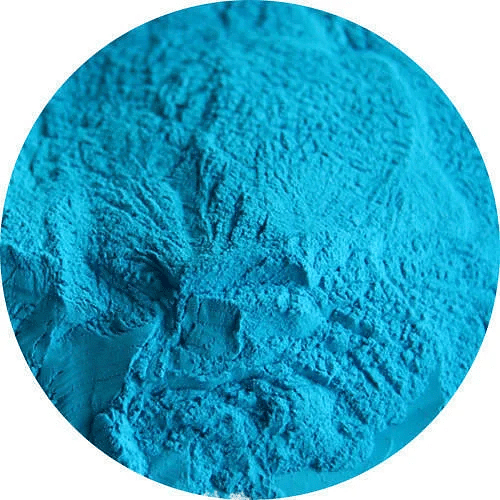
Copper Hydroxide
Here is some important information about Copper Hydroxide:
| Copper Hydroxide | |
|---|---|
| Chemical Formula | Cu(OH)2 |
| Density | 3.37 gm/cm3 |
| Molecular Weight/Molar Mass | 97.561 g/mol |
| pH | 7.69 |
| Melting Point | 80oC/176 oF |
Copper Hydroxide Structure
[Click Here for Sample Questions]
Copper Hydroxide is an ionic compound that is made of OH- and Cu2+ ions. The structure of copper hydroxide crystals was set with the help of the X-crystallography method. It was discovered that the central atom of Cu is square pyramidal. The hydroxide ions are either doubly or triply bridging with other nearby copper atoms.
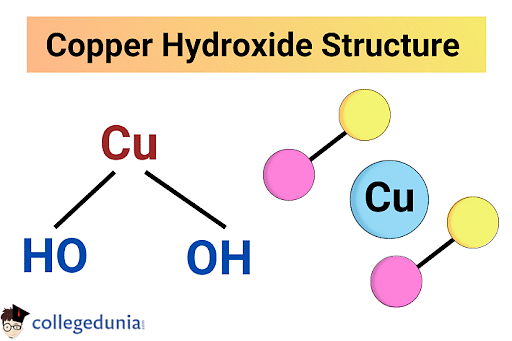
Copper Hydroxide Structure
Read More:
Production of Copper Hydroxide
[Click Here for Sample Questions]
Copper Hydroxide can be produced in the following ways:
(I) Copper Hydroxide is produced from Copper (II) Sulfate by reacting its dilute solution and sodium hydroxide. The output of this method has a lot of impurities like water and sodium hydroxide.
| 2NaOH(aq) + CuSO4(aq) \(\to\) Cu(OH)2(s) + Na2SO4(aq) |
(II) Copper Hydroxide can also be produced by the electrolysis of water with the anode as copper.
(III) Copper Hydroxide is rarely found as a pure mineral and is mostly found combined with CO2 as basic Copper (II) Carbonate, i.e. the mineral malachite. Spertinite is the mineral of Copper Hydroxide.
| 2NaOH(aq) + CuSO4(aq) \(\to\) Cu(OH)2(s) + Na2SO4(aq) |
Properties of Copper Hydroxide
[Click Here for Sample Questions]
Here are the Physical and Chemical properties of Copper Hydroxide:
Physical Properties of Copper Hydroxide
The physical properties of Copper Hydroxide are listed below:
| Physical Properties of Copper Hydroxide | |
|---|---|
| Odour | Fishy Odour |
| Appearance | Blue/Bluish Green Solid |
| Covalently-Bonded Unit | 3 |
| Heavy Atom Count | 3 |
| Hydrogen Bond Acceptor | 2 |
| Solubility | Insoluble in Water |
Chemical Properties of Copper Hydroxide
Here are the chemical properties of Copper Hydroxide:
- Copper(II) Hydroxide reacts with a solution of ammonia to form a deep blue solution of tetraamine copper complex ion ([Cu(NH3)4]+2), but the hydroxide is reformed when the solution is diluted with water.
- Copper(II) Hydroxide is mildly amphoteric in nature so it dissolves in slightly concentrated alkali forming [Cu(OH)4]2-.
- Copper(II) Hydroxide catalyzes the oxidation of ammonia solutions in the presence of dioxygen, producing copper ammine nitrites such as Cu(NO2)2(NH3)x.
(I) Copper Hydroxide reacts with sulfuric acid to form copper sulfate and water.
| Cu(OH)2 + H2SO4 \(\to\) CuSO4 + 2 H2O |
(II) Copper Hydroxide reacts with nitric acid to form copper nitrate and water.
| Cu(OH)2 + 2HNO3 \(\to\) Cu(NO3)2 + 2H2O |
Uses of Copper Hydroxide
[Click Here for Sample Questions]
Copper Hydroxide is used for a wide variety of applications as follows:
- It is used in the production of rayon, as copper (II) hydroxide in ammonia solution, known as Schweizer’s reagent, can dissolve cellulose.
- It is extensively used in the aquarium industry as it possesses the ability to kill external parasites like flukes, marine ich, brook, and marine velvet without harming the fish.
- Copper (II) Hydroxide is widely used as an alternative to the Bordeaux Mixture, which is a fungicide and nematicide.
- Cu(OH)2 is often used in the ceramic industry as a colorant.
- A mixture of copper hydroxide and copper sulfate is used in insecticides and pesticides.
- Cu(OH)2 is combined with latex paint to make a product that helps in controlling the root of potted plants.
- It is even used as an effective biocide as a wood preservative.
Check More:
Things to Remember
- Copper Hydroxide is an inorganic and strongly basic compound with the formula Cu(OH)2.
- It is a pale blue precipitate produced when sodium or potassium hydroxide is added in excess to copper salt.
- It has a foul smell and is insoluble in water.
- Copper Hydroxide is made of OH- and Cu2+ ions.
- Copper Hydroxide crystals were formed by the X-crystallography method.
- It is found naturally in minerals like azurite, malachite, and brochantite.
- It is hardly found in uncombined form due to its low reactivity with carbon dioxide.
- Copper Hydroxide is used as an insecticide, fungicide, and pesticide.
- It is widely used in the aquarium industry as it possesses the ability to kill external parasites.
Sample Questions
Ques. Explain the Occurrence of Copper Hydroxide. (3 Marks)
Ans. Copper (II) Hydroxide is a hydroxide of Cooper that is rarely found in an uncombined form.
- It is found in several copper minerals, especially azurite, malachite, antlerite, and brochantite.
- Azurite and malachite are carbonates whereas antlerite and brochantite are sulfates.
- Copper (II) Hydroxide is rarely found as an uncombined mineral due to its slow reaction with carbon dioxide in the atmosphere to form a basic Copper (II) Carbonate.
Ques. What are the Uses of Copper Hydroxide? (3 Marks)
Ans. Some important uses of Copper Hydroxide are:
- Copper Hydroxide is used in the production of rayon.
- It is used to treat fish in the aquarium industry by killing external parasites, flukes, marine ich, brook, and marine velvet.
- It is also used as a colorant in the ceramic industry.
- It is used in pesticides and insecticides along with copper sulfate in the form of a mixture.
Ques. What are the health effects associated with Copper Hydroxide? (3 Marks)
Ans. Copper (II) Hydroxide is an extremely hazardous substance, and proper care should be undertaken while handling it.
- Excess inhalation of its vapor could lead to cough and shortness of breath.
- Prolonged skin contact could result in irritation and allergies.
- It’s even dangerous for the eyes and could result in damage to eye tissue.
- It is always advised to handle Cu(OH)2 with utmost care and under expert supervision while wearing safety glasses.
- However, if it still contacts any part of the body, that area should be rinsed thoroughly with clean water and immediate medical assistance must be taken.
Ques. What is the Color of Copper Hydroxide? (2 Marks)
Ans. The color of Copper Hydroxide is pale greenish-blue or bluish-green. The typical color of Copper Hydroxide is blue, however, when it is a "stabilized" copper hydroxide, which is a mixture of copper(II) carbonate and hydroxide, it is found to be greener in color.
Ques. Explain the Organic Reactions of Copper Hydroxide. (3 Marks)
Ans. Copper Hydroxide is involved in various organic reactions as follows:
- Copper (II) Hydroxide is used for organic synthesis. For this purpose, it is prepared on-site by mixing a soluble copper (II) salt and potassium hydroxide. It is sometimes used in the synthesis of aryl amines.
- Copper (II) Hydroxide also converts acid hydrazides to carboxylic acids at room temperature. This helps in avoiding any reaction with fragile functional groups while the synthesis of carboxylic acids is taking place.
Ques. Briefly describe the History of Copper Hydroxide. (3 Marks)
Ans. Copper (II) Hydroxide has been known to man since copper smelting was introduced in 5000 BC. Although alchemists were the first to manufacture it. This was done by mixing solutions of copper sulfate (blue vitriol) and NaOH or KOH (Iye) solutions. Its manufacturing began on an industrial scale during the 17th and 18th centuries to use in pigments in blue verditer and Bremen green. These pigments were utilized in ceramics and paintings.
Ques. What is the nature of Copper Hydroxide? (1 Mark)
Ans. Copper Hydroxide is strongly basic in nature. However, the low solubility of Copper Hydroxide makes this hard to observe directly.
Ques. What is the use of Copper Hydroxide in agriculture? (2 Marks)
Ans. Copper Hydroxide is a widely used fungicide-bactericide approved for both organic and conventional agricultural production of vegetable crops for the mitigation of diseases.
Ques. How does Copper Hydroxide help in farming? (1 Mark)
Ans. Copper Hydroxide can kill bacteria, oomycetes, and algae. It even prevents fungal spores from germinating.
Ques. State the problems caused by the Ingestion of Copper Hydroxide. (3 Marks)
Ans. Ingestion of Copper Hydroxide leads to a slightly toxic reaction but it isn’t that severe and fatal. It can cause the following problems:
- Nausea
- Vomiting
- Salivation
- Gastric Pain
- Diarrhea
- Capillary Damage
- Liver and Kidney Damage
For Latest Updates on Upcoming Board Exams, Click Here: https://t.me/class_10_12_board_updates
Check-Out:



Comments