



Content Writer
Delta modulation is the conversion of analog to digital and vice versa. Modulation is the technique of transforming data into waves by adding information to a carrier signal. A signal is said to have a stable waveform if its amplitude and frequency remain consistent. By altering the frequency, phase, amplitude, and polarization of optical signals, electrical signals, and even quantum signals, one can add information to the carrier.
For improved sampling, a signal's sample rate must be greater than the Nyquist rate. The step size will be very small if this sampling period in Differential PCM is significantly lowered since the sample-to-sample amplitude difference will be as small as 1-bit quantization.
Read more: Wave function
| Table of Content |
KeyTerms: Delta modulation, Sampling interval, Quantization, Delta demodulator, Adaptive delta modulation, Granular noise, Slope overload.
Delta Modulation
[Click Here for Sample Questions]
Delta modulation is the term given to the form of modulation in which the sampling rate is significantly higher and the step - size following quantization is of a lower value Δ.
Delta Modulation, often known as 1-bit DPCM scheme, is a condensed version of the DPCM technology. The signal correlation will increase when the sampling interval is decreased.
Read more:
| Relevant Concepts | ||
|---|---|---|
| Magnetic Declination | Electromagnetic waves | Semiconductor diode |
| Radioactive decay | Lenz Law | Ideal gas law |
Features of Delta Modulation
[Click Here for Sample Questions]
The features of Delta Modulation are as follows:
- To utilize the signal correlation to its fullest potential, an oversampled input is used.
- Quantization's design is simple.
- The input sequence exceeds the Nyquist rate by a wide margin.
- The quality is average.
- The modulator and demodulator have simple designs.
- output waveform approximated by a staircase.
- The step-size, i.e., Δ\ Delta is extremely small.
- The user has control over the bit rate.
- This requires easier implementation.
Principle of Delta Modulation
[Click Here for Sample Questions]
The modulator is created by translating the difference between the input signal and the integral of the earlier steps through a quantizer. The simplest way to implement a quantizer is to use a comparator called 0 (two levels quantizer), whose output depends on whether the input signal is positive or negative and outputs 1 or 0. The demodulator is only an integrator in a feedback loop whose output changes with each 1 or 0 received. In and of itself, the integrator functions as a low-pass filter.
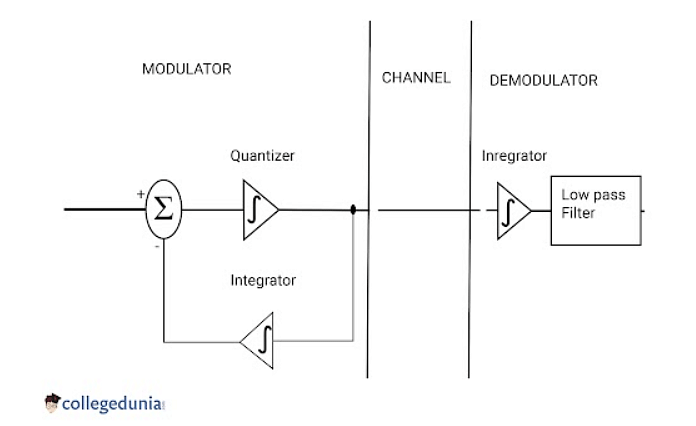
Block diagram of Delta modulator
Transfer Properties
[Click Here for Sample Questions]
The two sources of noise in delta modulation are
- "Granularity," which happens when the step size is too high,
- "Slope overload," which happens when the step size is too small to match the original waveform.
However, a 1971 study reveals that slope overload is less disturbing than granularity based purely on SNR measures.
Block Diagram of Delta Modulator
[Click Here for Sample Questions]
According to the above diagram, the delta modulator consists of two summer circuits, a delay circuit, and a 1-bit quantizer. The waveform produced by the delta modulator approximates a staircase. The waveform's step size is indicated by the delta (Δ). The output quality of the waveform is average. To attain a high signal-to-noise ratio, DM needs to alter oversampling methods. In oversampling techniques, the analogue signal is sampled at a rate that is many times faster than the Nyquist rate.
A delta-modulated signal must be transmitted with a certain amount of bandwidth, measured in bits per second. The sampling frequency and this signal's sampling frequency are identical. The bandwidth required to send the modulated signal can be calculated using the formula given below.
The required bandwidth to transmit the modulated signal = ffs samples/seconds x 1 bit/sample = ffs bits/second
Where,
ffs is the frequency of sampling signal
Delta Demodulator
The delay circuit, low pass filter, and summer of the delta demodulator are coupled as shown in the diagram below. The demodulator receives no presumed input because the prediction circuit has been eliminated.

Block diagram of Delta demodulator
A low pass filter is incorporated into the circuit to improve out-of-band signals and reduce noise. Granular noise, which is also known as the step-size inaccuracy, is eliminated at the transmitter. The modulator output and demodulator input are equal when there is no noise.
Advantages and Disadvantages of Delta Modulation
[Click Here for Sample Questions]
Delta modulation exhibits both advantages and disadvantages. They are:
Advantages of Delta Modulation
The advantages of delta modulation are as follows:
- Design is basic and easy.
- A 1-bit quantizer is used.
- Modulator and demodulator design is simple.
- The quantization design for delta modulation is relatively simple.
- The user can create the bit rate.
Disadvantages of Delta Modulation
The disadvantages of delta modulation are as follows:
- Slope overload distortion, a sort of noise, is visible when the delta value is small.
- Granular noise, a form of noise, appears when the value of the delta is high.
Read more:
| Relevant Concepts | ||
|---|---|---|
| Nuclei | Bandwidth of a signal | Noise pollution |
| Difference between analog and digital signals | Pulse amplitude modulation | Modulation and demodulation |
Adaptive Delta Modulation
[Click Here for Sample Questions]
A more advanced kind of delta modulation is adaptive delta modulation. Granular noise and slope overload distortion are the two types of noise that are present in delta modulation, as known. To lessen this kind of noise, an adaptive delta modulation approach was created. The method described here reduces the delta modulation technique's slope inaccuracy. Both slope overload and granular error are completely eliminated by this process. During the demodulation procedure, an LPF is utilized to lessen quantized noise (low pass filter).
Advantages of Adaptive Delta Modulation
Here are a few advantages of adaptive delta modulation. They are:
- The performance of adaptive delta modulation is very high.
- The use of correction circuits in radio design and error detection is reduced by this method.
- Due to the variable step size's wide range of values, dynamic range is great.
- Granular error and slope overload error are not present.
- Slope error is decreased.
Applications of Delta Modulator
[Click Here for Sample Questions]
Modern uses for delta modulation include, but are not limited to, reproducing old-school synth waveforms.
- As FPGAs and game-related ASICs become more widely available, sample rates may now be readily controlled to prevent slope overload and granularity issues.
- The sampling rate of the C64DTV, for instance, was 32 MHz, which offered adequate dynamic range to mimic the SID output at tolerable levels.
Things to remember
- Modulation is the technique of transforming data into waves by adding information to a carrier signal.
- Delta modulation is the conversion of analog to digital and vice versa
- Granular noise and slope overload distortion are the two types of noise that are present in delta modulation.
- The modulator output and demodulator input are equal when there is no noise.
- An adaptive delta modulation approach was created to overcome noise in delta modulation.
- The signal correlation will increase when the sampling interval is decreased.
Sample Questions
Ques. Mention delta modulation error? (2 marks)
Ans. There are two errors that occur during delta modulation
- Slope overloading
- Granular Noise
Ques. Why is an integrator used in delta modulation? (2 marks)
Ans. A delta modulator encodes the fluctuations in voltage at each sample period. To get the correct voltage, differencing must be undone, which is an accumulative summation also known as integration.
Ques. What is granular noise in delta modulation? (2 marks)
Ans. Granular noise happens when the step size is too big compared to the tiny changes in the input signal. Due to the enormous step size, even very little changes in the input signal result in significant variations to the staircase signal.
Ques. How is adaptive delta modulation beneficial in reducing errors? (1 mark)
Ans. As the input signal strength changes, so does the step size in adaptive DM; lowering the step size lowers the threshold level and reduces quantizing noise.
Ques. What type of quantization technique is used in delta modulation? (1 mark)
Ans. Delta modulation requires the use of oversampling techniques, in which the analogue signal is sampled at a rate several times greater than the Nyquist rate, in order to produce a high signal-to-noise ratio.
Ques. What is the bandwidth of delta modulation? (2 marks)
Ans. A delta modulator produces a bit stream of samples at a relatively high rate (for example, 100 kbit/s or more for a speech bandwidth of 4 kHz), with the value of each bit depending on whether the amplitude of the input message sample has increased or decreased in comparison to the previous sample.
Ques. How many bits are employed in delta modulation? (1 mark)
Ans. One bit PCM code is utilized to comprehend digital transmission of analog signals.
Ques. What is delta modulation with an example? (2 marks)
Ans. The technology of delta modulation is mostly utilized for the transmission of voice data. Analog-to-digital and digital-to-analog signal conversion can be demonstrated in this technique. Example: A simple method of using DPCM is delta modulation (DM).
Ques. What is the working principle of delta modulation? (2 marks)
Ans. The basis of delta modulation is a comparison between the most recent and previous sample values. Depending on the difference, the step signal's amplitude will either increase or decrease. Bit 1 is produced when the amplitude is increased because the step size is increased by one step.
Ques. What are the three modulation techniques? (2 marks)
Ans. The three types of modulation are
- Amplitude modulation
- Frequency modulation
- Phase modulation
For Latest Updates on Upcoming Board Exams, Click Here: https://t.me/class_10_12_board_updates
Check out:



Comments