



Content Curator
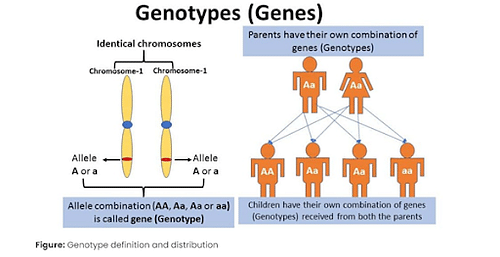
The sound of genotype and phenotype is similar but usually, there is a big difference between these two. A set of genes in DNA that are responsible for unique characteristics or traits are called genotype, whereas the physical characteristics or appearance of an organism is called the phenotype.
Human beings are diploid organisms with two alleles at each genetic position. And among these two alleles, one allele is inherited from each parent. So, the genotype is called the makeup of an organism. On the other hand, the physical characteristics, for example, an organism’s behavior, appearance, development, the color of hair, eyes, and height, etc are referred to as phenotype.
| Table of Content |
Keyterms: Genotype, Phenotype, Gene, DNA, RNA, Diploid organisms, Mutation, Allele, Recessive allele, Dominant allele
Definition of Genotype
[Click Here for Sample Questions]
The term ‘genotype’ means the genetic composition of an organism. Genotype consists of heritable genes. It is represented with the alphabetical symbol Bb, here ‘B’ means dominant allele and ‘b’ means recessive allele. The genotype will be the same throughout the entire life of an individual unless it is affected by mutations.
Definition of Phenotype
[Click Here for Sample Questions]
The term ‘phenotype’ means all the characteristics that are observable and measurable of an individual.
Phenotypes are referred to, to find out the differences in DNA sequences between individuals in various features like height, eye color, hair color, etc. An individual’s phenotypes are based on two factors -the genome expression or genotype and how it interacts with the environmental factors.

Differences Between Genotype And Phenotype
[Click Here for Sample Questions]

Differences Between Genotype And Phenotype
The key differences between genotype and phenotype are the following:
| Basic Comparison | Genotype | Phenotype |
|---|---|---|
| Definition | A set of genes in DNA that are responsible for unique characteristics or traits are called genotype. | The physical characteristics or appearance of an organism is called phenotype |
| Observable | Genotypes are present within an organism’s chromosomes. | Phenotypes are observable characteristics and they can be seen on an individual’s body. |
| Inherited | Genotypes are partially inherited. | Phenotypes are non-inherited |
| Affected by | Genetic compositions can affect genotypes. | On the other hand, an organism’s genotype can affect phenotype. |
| Consists of | It consists of an organism’s hereditary characteristics. | It consists of different characteristics of an organism, for instance, an individual’s development, physiological and biological properties, and behavior, etc. |
| Determined by | The process of genotyping in various scientific methods like PCR determined genotypes. | By observing an individual, phenotypes can be easily determined |
| Relation | Same genotypes usually result in the same phenotypes. | But the same phenotype may not obtain from the same genotype. |
| Changes | It remains the same throughout the entire life of an individual. | It may change throughout an individual life. |
| Examples | Genotype examples seen in different organisms for instance are the homozygous allele for height, the heterozygous allele for height, and the homozygous allele for eye color. | Phenotype examples are seen in different organisms for instance are eye color, blood group, and hair color, etc. |
Factors Affecting Genotype And Phenotype
[Click Here for Sample Questions]
The environment where an individual lives and the internal environment of a person’s body for instance metabolism and hormones can affect the genotype of a person. On the other hand, the genotype of a person can affect phenotype.
| Genotype in Biology | Phenotype in Biology |
|---|---|
| It helps to determine the limitations of an individual and heredity potentials from birth to adulthood. | The phenotype of an individual means its observable characters. |
| Examples: In a peas plant, its flowers possible genotype may be red-white, red-red and white-white | Examples: Length of a fox’s tail, the sound of our voice, individual’s shoe size, etc. |
Also Read:
Sample Questions
Ques. What are the various types of genotypes? (1 mark)
Ans. The various types of genotypes are homozygous dominant (PP), homozygous recessive (pp), and heterozygous (Pp).
Ques. Are alleles different from genotypes? (1 mark)
Ans. Yes, alleles are variants of genes. Whereas genotypes are genes having certain characteristics.
Ques. What is the relation between genotype and phenotype? (1 mark)
Ans. Phenotype means the physical appearance of an individual. Similarly, an individual’s phenotype is determined by genotype.
Ques. Are genotypes heterozygous or homozygous? (1 mark)
Ans. Genotypes can be both heterozygous or homozygous.
Ques. How to identify a genotype? (1 mark)
Ans. With the help of Punnett square, we can identify genotypes.
For Latest Updates on Upcoming Board Exams, Click Here:https://t.me/class_10_12_board_updates
Do Check Out:



Comments