



Education Journalist | Study Abroad Lead
Incomplete Dominance and Codominance are types of genetic inheritance patterns. In Codominance, no allele masks the expression of the other. Both alleles are expressed fully in the phenotype. Incomplete Dominance is a state where dominant alleles do not hide the recessive allele's effect. In incomplete dominance, both alleles lead to a different phenotype.
- Dominance in genetics involves the relationship between alleles of a gene.
- Genes exist as pairs of alleles, either similar (homozygous) or dissimilar (heterozygous).
- Codominance results in expressed patches of both alleles.
- Incomplete dominance shows a blending of dominant and recessive traits.
In incomplete dominance, when two different traits mix, they don't dominate the other. They compromise to create something in between. For example – a red flower and a white flower mix to make a pink flower.
In codominance, traits don't hide. It is like having a red and a blue car. Instead of getting a purple car, we get a car that's both red and blue together. Both traits are strong and show up together. An example is having both A and B blood types at once.
So, incomplete dominance is like blending traits, and codominance is like showing off both traits at the same time.
| Table of Content |
Key terms: Dominance, Codominance, Incomplete Dominance, allele, inheritance, gene interaction, phenotype, partial dominance, blood
Difference Between Incomplete Dominance and Codominance
[Click Here for Sample Questions]
The differences between Incomplete Dominance and Codominance are as follows –
| Incomplete Dominance | Codominance |
|---|---|
| Gene interaction in which both alleles result in a different phenotype. | Gene interaction in which no allele can block the expression of the other. |
| No allele is completely dominant. | Two alleles neither act as dominant nor recessive over another allele. |
| Both the alleles blend but only one of the two is shown in the offspring. | The allele mixes and shows the traits in the offspring. |
| A hybrid results in the formation of a new phenotype | A hybrid does not result in the formation of a new phenotype |
| Example – Snapdragon flowers (pink color), | Example – Blood group ABO |
What is Codominance?
[Click Here for Sample Questions]
Codominance is a genetic concept in which both alleles of a gene are fully expressed in the phenotype. In codominance, neither allele is dominant or recessive, contributing equally to the phenotype.
- Unlike incomplete dominance, codominance results in a clear expression of both alleles.
- Both alleles remain present, forming a mixture that adds phenotypic expression.
- Incomplete dominance leads to a blending of traits, while codominance results in distinct expressions.
- Example of Codominance: Inheritance of blood types in humans – ABO blood group system involves three alleles: A, B, and O.
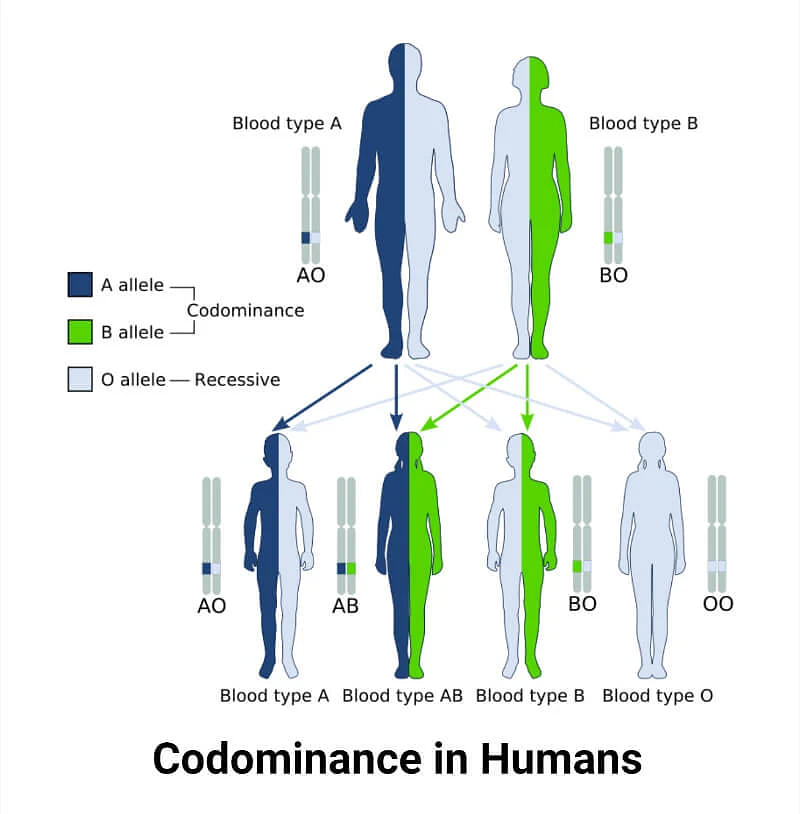
Codominance
Read More:
| Chapter Related Topics | ||
|---|---|---|
| Colour blindness | Thalassemia | Hemophilia |
| Autosomes and allosomes | Non mendelian inheritance | Behavioural genetics |
What is Incomplete Dominance?
[Click Here for Sample Questions]
Gene interaction where both alleles are partially expressed, resulting in an intermediate phenotype.
- Neither allele is totally dominant, leading to a combination of both.
- Offspring of parents with curly and straight hair exhibit wavy hair due to incomplete dominance.
- The common genetic phenomenon leads to variation in traits in various organisms.
- Example: In roses, red (dominant) allele and white (recessive) allele result in pink flowers in heterozygotes

Incomplete Dominance
Things to Remember
- Dominance refers to the relationship between alleles of a gene.
- Here, one allele masks the expression of the other.
- Incomplete dominance results in a blend of traits, while complete dominance shows a clear dominance of one allele.
- In incomplete dominance, neither allele is fully dominant, whereas in complete dominance, one allele is entirely dominant.
- Examples of incomplete dominance include pink snapdragon flowers, while complete dominance is seen in pea plant flower colour.
- Genetic disorders related to incomplete dominance often involve a mix of normal and mutant alleles, creating varied symptoms.
- Complete dominance follows a simpler Mendelian inheritance pattern, with a dominant-recessive relationship.
Also Read:
Sample Questions
Ques: What is the difference between Incomplete Dominance and Codominance? (2 Marks)
Ans: In incomplete dominance, neither allele is fully dominant. It results in a blended phenotype between the two homozygous phenotypes.
Codominance, on the other hand, involves both alleles being fully expressed in the heterozygous phenotype, producing a distinct combination of both traits.
Ques: What are the examples of Incomplete Dominance and Codominance? (2 Marks)
Ans: Rose is one of the examples of Incomplete Dominance where the allele for red colour is dominant over the allele for white colour where the allele for red colour is dominant over the allele for white colour. Individuals with blood group ABO is an example of Codominance. Here, A and B are not dominant over each other but dominant over O.
Ques: What are the characteristics of Incomplete Dominance and Complete Dominance? (3 Marks)
Ans: Incomplete Dominance
- Neither allele is completely dominant over the other.
- The heterozygous phenotype is intermediate between the phenotypes of the two homozygous genotypes.
- Examples: Flower color in snapdragons (red x white = pink).
Complete Dominance
- One allele is completely dominant over the other.
- The heterozygous phenotype is the same as the phenotype of the dominant homozygote.
- Examples: Eye color in humans (brown x blue = brown)
Ques: How does Incomplete and Complete Dominance work? (2 Marks)
Ans: Incomplete Dominance: In incomplete dominance, neither allele of a gene is completely dominant over the other. This means that both alleles can produce a functional gene product.
Complete Dominance: In complete dominance, one allele of a gene is completely dominant over the other. This means that only the dominant allele can produce a functional gene product.
Ques: Give the similarities between incomplete and codominance. (2 Marks)
Ans. The similarities between incomplete dominance and codominance are:
- Both alleles of the gene are expressed in the phenotype of the heterozygous organism.
- In both of them, both alleles are able to produce a functional gene product.
- The regulatory region of the gene is able to respond to both alleles.
Ques: Give a codominance example in humans. (2 Marks)
Ans. Blood type is determined by three alleles: A, B, and O.
- The A and B alleles are codominant, which means that people with the AB blood type have both A and B antigens in their red blood cells.
- This is because both the A and B alleles are able to produce a functional gene product, which is responsible for producing the antigens in the red blood cells.
- The regulatory region of the gene for blood type is able to respond to both alleles, allowing both alleles to be expressed in the phenotype.
Ques: How does the F2 generation ratio differ in incomplete dominance and codominance? (1 Mark)
Ans. In incomplete dominance, the F2 generation exhibits a ratio of 1:2:1 for the phenotypes, while in codominance, the ratio reflects a clear expression of both alleles without blending.
Ques: Can the genetic patterns occur in animals as well as plants? (1 Mark)
Ans. Yes, both incomplete dominance and codominance can be observed in various organisms, including animals and plants, influencing traits like coat color, flower color, and blood types.
Ques: What are some of the implications of codominance and incomplete dominance? (2 Marks)
Ans. Codominance and incomplete dominance can have a variety of implications for organisms, including:
- It increases genetic diversity by allowing for more than just two possible phenotypes for a given gene.
- It leads to the development of new phenotypic traits that are not possible with complete dominance.
- It can be involved in genetic disorders, such as sickle cell anemia, which is caused by an incompletely dominant allele of the gene for hemoglobin.
Ques: What are some of the advantages and disadvantages of codominance and incomplete dominance? (2 Marks)
Ans. Codominance
- Advantages: Increased genetic diversity, new phenotypic traits, adaptation to changing environments
- Disadvantages: Reduced fitness, increased susceptibility to disease
Incomplete dominance
- Advantages: Increased genetic diversity, adaptation to changing environments, reduced susceptibility to disease
- Disadvantages: Reduced fitness, increased susceptibility to disease
For Latest Updates on Upcoming Board Exams, Click Here: https://t.me/class_10_12_board_updates
Check-Out:



Comments