



Education Journalist | Study Abroad Lead
Difference between primary cells and secondary cells lies in their ability to be reused and the reactions that take place within them. The electric component which can be used for the conversion of chemical energy into electric energy is called a cell or a battery. A cell is a small unit and a combination of many cells is called a battery. A battery can be divided into two types: primary and secondary cells. The common difference which can be seen in both the cells is that a primary battery can be used once only, whereas a secondary battery can be used multiple times by recharging it.
Read Also: Chemistry: Notes, Periodic Table, Chemical Reactions, Study Guides
| Table of Content |
Key Takeaways: Battery, Primary Cell, Secondary Cell, Anode, Cathode, Oxidation, Reduction, Fluid, Energy, Cell
Primary Cells
[Click Here for Sample Questions]
Primary cells are also called non-rechargeable batteries. Once these batteries are exhausted they will stop working. Even though these cells can be used only once, they are very useful. The reason for this is that the dischargeable rate of these cells is slow when compared to secondary cells. Therefore, these cells have long-term utilisation. These cells are also called dry cells as they do not have any fluid within them. The reactions that occur within these cells are irreversible. Some of the applications of primary cells include their use in pacemakers for heart patients, military campaigns as they need cells that have low discharge rates.
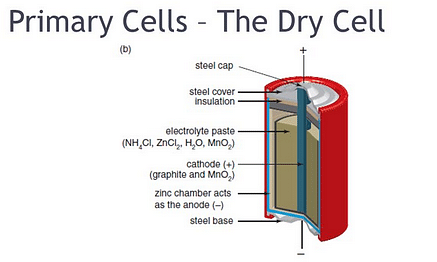
Primary Cell
One of the common examples of primary cells is Leclanche cells. In this cell, Zinc is present at the anode and porous graphite at the cathode. The reaction that takes place in the cell is given below:
At Anode:
Zn(s) → Zn2+ (aq) + 2e
At Cathode:
2NH4+ (aq) + 2e → 2NH3 (g) + H2 (g)
Discover about the Chapter video:
Current Electricity Detailed Video Explanation:
Read Also:
| Related Articles | ||
|---|---|---|
| Types of Battery | Difference Between Cell and Battery | Fuel Cell |
Secondary Cells
[Click Here for Sample Questions]
Secondary cells can be used more than once, as they are rechargeable. If they have stopped working you can simply recharge them. The reactions that take place in these cells are reversible. A charger is provided for the charging process. These cells are used for specific functions, therefore the user should know their uses before using them.

Primary Cell and Secondary Cell
These cells have both cathode and anode, just like the primary cells. The reduction process occurs in the cathode region whereas the oxidation process occurs in the anode region. One of the common examples of a secondary battery is a lead storage battery. The reaction that takes place in it are given below:
Cathode: PbO2 (s) + HSO4- (aq) + 3H+ (aq) + 2e → PbSO4 (s) + H2O (l)
Anode: Pb(s) + HSO4- (aq) → PbSO4 (s) + H+ (aq) + 2e
Difference Between Primary Cells & Secondary Cells
[Click Here for Sample Questions]
The main differences between primary and secondary cells are:
| Primary Cells | Secondary Cells |
|---|---|
| Rechargeable | Non-rechargeable |
| Irreversible reactions occur | Reversible reactions |
| Cheap in price | Costly |
| Can be used only once | Can be used more than once |
| Produce current immediately | Needs to be charged |
| Have a lower self dischargeable rate | Have a higher self dischargeable rate |
| Have smaller lifetime | Have a higher lifetime |
Read More: Difference between articles in Chemistry
Things to Remember
- Cell is a small unit used for the conversion of chemical energy into electrical energy.
- Combination of cells forms batteries.
- Cells can be divided into primary and secondary cells.
- Primary cells are reusable whereas secondary cells are not.
- The anode is where oxidation takes place and at cathode reduction takes place.
Read More:
Sample Questions
Ques. What are the types of cells? (1 mark)
Ans. There are two types of cells: primary cells and secondary cells. The primary cells cannot be reused whereas you can recharge and use secondary cells more than once.
Ques. What are Leclanche cells? Write the reactions taking place in them? (3 marks)
Ans. Leclanche cells are the example of primary cells, that means they cannot be reused. The cells have zinc at the anode and porous graphite at the cathode. Electrolyte which is present in the cell is ammonium chloride, zinc chloride, and manganese oxide. The chemical reaction which takes place in this cell is as follows:
Anode: Zn(s) → Zn2+ (aq) + 2e
Cathode: 2NH4+ (aq) + 2e → 2NH3 (g) + H2 (g)
Ques. Write the reaction which takes place in the lead storage battery. (2 marks)
Ans. The reaction taking place are as follows:
Cathode: PbO2(s) + HSO4-(aq) + 3H+ (aq) + 2e → PbSO4(s) + H2O(l)
Anode: Pb(s) + HSO4–(aq) → PbSO4(s) + H+(aq) + 2e
Ques. What is the process that takes place during the recharging of the lead storage battery? (3 marks)
Ans. During this process, the reactions are reversed. PbSO4 is converted into Pb and PbO2 at anode and cathode respectively.
Anode: PbSO4(s) + H+ (aq) + 2e → Pb(s) + HSO4- (aq)
Cathode: PbSO4(s) + H2O(l) → PbO2(s) + HSO4- (aq) + 3H+ (aq) + 2e
Ques. What is the difference between primary and secondary cells? (2 marks)
Ans. The main difference between the two types of cells is that primary cells cannot be used more than once. The rate of discharge in the primary cells is also slow. Primary cells are cheaper and produce current immediately.
Ques. What is a primary cell? (2 marks)
Ans. Primary cells are also known as dry cells and they can be used only once. You have to throw them off as they cannot be recharged. They are short-lived but they are preferred as they have a comparatively slow discharge rate. They are cheaper and can be used for many purposes.
Ques. What is a secondary cell? (2 marks)
Ans. Secondary cells are reusable and have chargers. They are used for the long term but their dissociation rate is fast. They can be recharged multiple times. They are expensive and can be used for specific purposes.
Ques. What are anode and cathode? (1 mark)
Ans. Anode is negatively charged where oxidation takes place whereas cathode is positively charged where reduction takes place.
Ques. What is the reaction that takes place during the discharging of nickel-cadmium cells? (1 mark)
Ans. Cd (s) + 2Ni(OH)3 (s) → CdO (s) + 2Ni(OH)2 (s) + H2O (l)
For Latest Updates on Upcoming Board Exams, Click Here: https://t.me/class_10_12_board_updates
Check-Out:



Comments