



Education Journalist | Study Abroad Lead
Rows and columns are widely used in arranging data in Matrices, Determinants, Spreadsheets, Periodic tables, DBMS (Database Management System) etc. With the help of rows and columns approach, it is easier to do a comparison between any elements, categories, cells and many more. Apart from this, this approach makes data more readable and attractive.
Also Read: Properties of determinants
| Table of Content |
Key Terms: Rows, Columns, Metrices, Determinants, Rows, Columns, Horizontal lines, Periodic tables, Database Management System
Row
[Click Here for Sample Questions]
The horizontal line of any table, spreadsheets, matrices and determinants is called a Row. The collection of multiple horizontal lines are called Rows. Rows are the series arrangement of any objects or data. The orange line in the below image indicates the Row.

Row Example in a Table
For understanding more clearly Rows, let us consider some real-life examples:
- Series of chairs in the Auditorium.
- Number of trees arranged in horizontal lines.
- Apples arranged in a box.
- Buses standing at the bus stop.

Row of Chair
Discover about the Chapter video:
Determinants Detailed Video Explanation:
Also Read:
| Related Articles | ||
|---|---|---|
| Minors and Cofactors of determinants | Types of Matrices | Applications of Determinants and Matrices |
Column
[Click Here for Sample Questions]
The vertical line of any table, spreadsheets, matrices and determinants is called Column. The collection of multiple vertical lines are called Columns. Columns are the parallel arrangement of any objects and data. The red line in the below image is indicating the Column.

Column Example in the Table
For understanding more clearly Rows, let us consider some real-life examples:
- Number of students standing in Vertical lines in the Assembly
- Zebra crossing on the roads
- Railroad tracks
- Racing tracks

Queue
When the row and column intersect with each other, a cell is formed. The intersection of rows and columns are called Cells. Also, the collection of cells in series is called rows. The collection of vertical cells is called Columns. The last cell of the table in the horizontal direction is the last row of the table. The last cell of the table in the vertical direction is called the last column of the table.
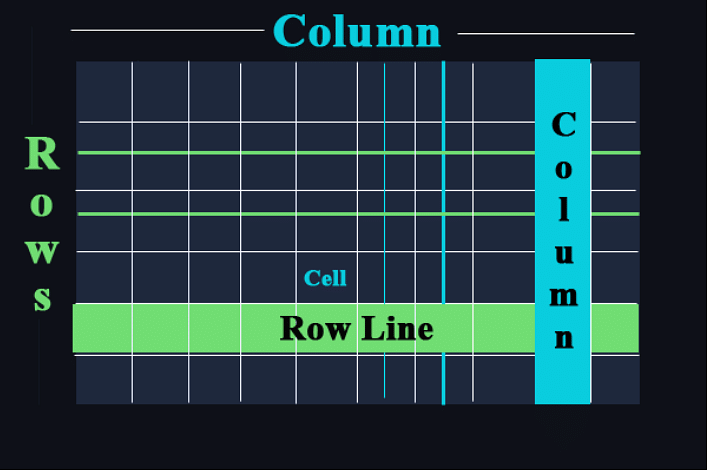
Combined example of Rows and Columns
Read More: Determinants of a matrix
Key Differences Between Rows And Columns
[Click Here for Sample Questions]
Rows and Columns are differentiated on the basis of various factors as tabulated below.
| S.No. | Factors | Rows | Columns |
|---|---|---|---|
| 1. | Definition | The horizontal lines of any table, spreadsheet, DBMS, Matrices, Determinants etc. are called Rows. | The Vertical lines of any table, spreadsheet, DBMS, Matrices, Determinants etc. are called columns. |
| 2. | Approach | Rows follow the left to the right approach for the arrangement of data. | Columns follow the top to bottom approach for the arrangement of data. |
| 3. | Headings | Number system is used to indicate row’s headings | Alphabets are used to indicate column’s headings |
| 4. | Array | In the array, [a]i*j, i denotes the rows of the array | In the array, [a]i*j, j denotes the columns of the array |
| 5. | Matrix | The horizontal arrays are called Rows | The vertical arrays are called Columns |
| 6. | DBMS | The collection of rows which contain fields are known as records. | The collection of columns which contain characters are known as fields. |
| 7. | Result | The total of the data is indicated at the extreme right corner of the same row | The total of the data is indicated at the bottom of the same column |
Apart from this, in the case of Determinant, there are some key similarities for both the rows and columns. Such as:
- The value of Determinant is zero when any two rows or columns are identical or proportional.
- The sign of Determinant changes when we interchange any two rows or two columns.
- If any row or column is multiplied by any constant value ’k’ then the value of the determinant is also multiplied by the same constant value ‘k’.
- If each element of any row or column of a determinant is equimultiples to the corresponding elements of the other rows and columns, then the value of the determinant remains the same.
Also Read: Singular Matrix, Invertible matrix
Things to Remember
- The horizontal arrangement of the elements, objects and data is called Row.
- The vertical arrangement of the elements, objects and data is known as Column.
- Cells are formed with the intersection of rows and columns.
- A stub is used to represent Row.
- A caption is used to describe Column.
Also Read:
Sample Questions
Ques. What do you mean by rows and columns in an Array? Explain with the help of an example. [2 marks]
Ans. The collection of horizontal lines are called rows. A row is denoted as ‘i’. The collection of vertical lines are called columns.The column is denoted as ‘j’.
For example, Consider an array of [a]i*j=3*3. It means in this case an array has 3 rows as well as 3 columns.
[a]3*3 = \([ \begin{matrix} a_{11} & a_{12} & a_{13} \\ a_{21} & a_{22} & a_{23} \\a_{31} & a_{32} & a_{33} \end{matrix} ]\)
Ques. How do the data store in the table and its representation? [2 marks]
Ans. In the table, data is stored in the form of rows and tables. The stub in the table describes the row while the caption describes the column. In the row, data is arranged from left to right. On the other hand, data is arranged from top to bottom. The representation of data in the table is as follows:
| Index | Mathematics | Physics | Chemistry |
|---|---|---|---|
| Student ‘A’ | 52 | 45 | 57 |
| Student ‘B’ | 40 | 47 | 55 |
| Student ‘C’ | 57 | 34 | 52 |
Ques. What is a Determinant and how is it evaluated? [2 marks]
Ans. A determinant is the collection of elements in the form of matrices. Basically, a matrix that contains elements in the form of rows and columns is called a determinant. Only square matrices have determinants. A determinant is denoted as del(A) or |A| or Δ, where A is a Matrix. A determinant is equal to the subtraction of the corresponding elements. Let us consider an example:
if [A] = \([ \begin{matrix} a_{11} & a_{12} \\ a_{21} & a_{22} \\ \end{matrix} ]\)
then its determinant is,
|A| = | a11 a22 - a21 a12 |
Ques. Evaluate | 2 4 -1 4 | [2 marks]
Ans. We have given matrix of 2*2 = | 2 4 -1 4 |
The determinant of given matrix is = 2(4) - 4(-1) = 4 + 4 = 8
Ques. Evaluate the determinant |A|= \([ \begin{matrix} 1 & 2 & 4 \\ -1 & 3 & 0 \\ 4 & 1 & 0 \end{matrix} ]\) [2 marks]
Ans. We have given matrix [A]= \([ \begin{matrix} 1 & 2 & 4 \\ -1 & 3 & 0 \\ 4 & 1 & 0 \end{matrix} ]\)
In this matrix, the third column has two elements and is zero, so it is easy to expand the array by third column C3 .
After expanding and evaluating with C3 ,
|A| = 4 (-1 - 12)-0 +0
|A| = 4 (-13)
|A| = -52
Ques. If any two rows or columns are interchanged, then the sign of Determinant changes according to property 2 of determinant. Verify this statement. [3 marks]
Ans. Let us consider a determinant |A|= \([ \begin{matrix} a_1 & a_2 & a_3 \\ b_1 & b_2 & b_3 \\ c_1 & c_2 & c_3 \end{matrix} ]\)
Expanding the given determinant using the Row Method, expanding through the first row.( Also, it can be expanded using Column Method, we will get the same result)
We get,
|A| = = a1 (b2 c3 – b3 c2 ) – a2 (b1 c, – b3 c, ) + a3 (b1 c2 – b2c1 )
Now, Interchanging first and third rows, then the new determinant obtained is given by
|A|=Δ=| c1 c2 c3
b1 b2 b3
a1 a2 a3 |
Expanding along third Row R3, we get,
Δ1 = a1 (c2 b3 – b2 c3 ) – a2 (c1 b3 – c3 b1 ) + a3 (b2 c1 – b1 c2 )
= – [a1 (b2 c3 – b3 c2 ) – a2 (b1 c3 – b3 c, ) + a3 (b1 c2 – b2 c1 )]
Clearly Δ1= – Δ
Hence, property 2 is verified.
Ques. To solve the system of equations x-y+2z=1, 2y-3z=1, 3x–2y+4z=2,
Use Product \([ \begin{matrix} 1 & -1 & 2 \\ 0 & 2 & -3 \\ 3 & -2 & 4 \end{matrix} ]\) \([ \begin{matrix} -2 & 0 & 1 \\ 9 & 2 & -3 \\ 6 & -1 & -2 \end{matrix} ]\) [5 marks]
Ans. Given, \([ \begin{matrix} 1 & -1 & 2 \\ 0 & 2 & -3 \\ 3 & -2 & 4 \end{matrix} ]\) \([ \begin{matrix} -2 & 0 & 1 \\ 9 & 2 & -3 \\ 6 & -1 & -2 \end{matrix} ]\)
Now, Multiply the given matrices,
\([ \begin{matrix} 1 & 0 & 0 \\ 0 & 1 & 0 \\ 0 & 0 & 1 \end{matrix} ]\)
In Matrix form, the given system of equation x-y+2z=1, 2y-3z=1, 3x–2y+4z=2 written as below,
\([ \begin{matrix} 1 & -1 & 2 \\ 0 & 2 & -3 \\ 3 & -2 & 4 \end{matrix} ]\) \([ \begin{matrix} x \\ y \\ z \end{matrix} ]\) = \([ \begin{matrix} 1 \\ 1 \\ 2 \end{matrix} ]\)
\([ \begin{matrix} x \\ y \\ z \end{matrix} ]\) = \([ \begin{matrix} -2 & 0 & 1 \\ 9 & 2 & -3 \\ 6 & 1 & -2 \end{matrix} ]\) \([ \begin{matrix} 1 \\ 1 \\ 2 \end{matrix} ]\)
\([ \begin{matrix} x \\ y \\ z \end{matrix} ]\) = \([ \begin{matrix} -2 & 0 & 2 \\ 9 & 2 & -6 \\ 6 & 1 & -4 \end{matrix} ]\)
\([ \begin{matrix} x \\ y \\ z \end{matrix} ]\) = \([ \begin{matrix} 0 \\ 5 \\ 3 \end{matrix} ]\) [x [-2+0+2
Compare the values with x,y,z coefficients, then
x=0 , y=5 , z= 3
Ques. Show that the matrix [ A]= \([ \begin{matrix} 2 & 3 \\ 1 & 2 \\ \end{matrix} ]\) satisfies the equation A2- 4A + I = O,
Where I is 2*2 identity matrix and O is 2*2 zero matrix. Using this equation find A-1. [3 marks]
Ans. Given, [A]= \([ \begin{matrix} 2 & 3 \\ 1 & 2 \\ \end{matrix} ]\)
A2 = A. A = \([ \begin{matrix} 2 & 3 \\ 1 & 2 \\ \end{matrix} ]\)\([ \begin{matrix} 2 & 3 \\ 1 & 2 \\ \end{matrix} ]\)
A2 = \([ \begin{matrix} 7 & 12 \\ 4 & 7 \\ \end{matrix} ]\)
4A = 4 \([ \begin{matrix} 7 & 12 \\ 4 & 7 \\ \end{matrix} ]\)
4A = \([ \begin{matrix} 8 & 12 \\ 4 & 8 \\ \end{matrix} ]\)
Now, A2- 4A + I = O
\([ \begin{matrix} 7 & 12 \\ 4 & 7 \\ \end{matrix} ]\) - \([ \begin{matrix} 8 & 12 \\ 4 & 8 \\ \end{matrix} ]\) + \([ \begin{matrix} 1 & 0 \\ 0 & 1 \\ \end{matrix} ]\) = \([ \begin{matrix} 0 & 0 \\ 0 & 0 \\ \end{matrix} ]\)
Therefore, A2- 4A + I = 0,
then,
A2- 4A = -I
Multiplying both sides with A-1 (|A|≠0)
A.A(A-1) - 4A. A-1 = - I. A-1
A.(A.A-1) - 4I = - A-1
A.I - 4I = - A-1
A-1 = 4I - A
A-1 = \([ \begin{matrix} 4 & 0 \\ 0 & 4 \\ \end{matrix} ]\) - \([ \begin{matrix} 2 & 3 \\ 1 & 2 \\ \end{matrix} ]\)
A-1 = \([ \begin{matrix} 2 & 3 \\ -1 & 2 \\ \end{matrix} ]\)
Ques. Without expanding, prove that Δ= \([ \begin{matrix} x+y & y+z & z+x \\ z & x & y \\ 1 & 1 & 1 \end{matrix} ]\) [3 marks]
Ans. Given, \([ \begin{matrix} x+y & y+z & z+x \\ z & x & y \\ 1 & 1 & 1 \end{matrix} ]\)
Using Row Method, Applying R1 → R1 + R2 to Δ, we get
Δ= \([ \begin{matrix} x+y+z & y+z+x & z+x+y \\ z & x & y \\ 1 & 1 & 1 \end{matrix} ]\)
Since, the elements of R1 and R3 are proportional, then Δ = 0.
For Latest Updates on Upcoming Board Exams, Click Here: https://t.me/class_10_12_board_updates
Check-Out:



Comments