



Education Journalist | Study Abroad Lead
Thermoplastic and Thermosetting Plastic are two types of polymers that can be differentiated based on their molecular bond and reaction to heat. Thermoplastic is a plastic polymer material that is easily mouldable or pliable at a particular temperature. Upon cooling down, the solidification of thermoplastic happens. Thermosetting plastic is a polymer that turns rigid in an irreversible manner when it comes in contact with heat. They cannot be remoulded or reprocessed upon reheating. Though thermoplastics and thermosetting plastic sound similar, they are completely different compounds with different properties as well as uses.
| Table of Contents |
Key Takeaways: Polymers, Thermoplastic, Thermosetting Plastic, Polymerization, Molecular Bond, Temperature, Plastic, Thermoset, Heat Resistance, Chemical Resistance
What is Thermoplastic?
[Click Here for Sample Questions]
Thermoplastic is a plastic polymer that is mouldable into different shapes at a particular temperature, can be softened and melted by the application of heat and can be processed in the heat-softened state. They can be bent easily and have high tensile strength and high shrink resistance.
In a thermoplastic, long polymer molecules are joined to one another by weak bonds that easily break apart when the plastic is heated and quickly reform again as it cools down. There is no negative impact on the physical properties during the remoulding and recycling of thermoplastics.
Examples of thermoplastics are given below:
- Polystyrene
- Teflon
- Acrylic
- Nylon

Thermoplastic
Read More: Chemical Bonding and Molecular Structure
What is Thermosetting Plastic?
[Click Here for Sample Questions]
A thermosetting polymer is also known as a thermoset or thermosetting plastic. Thermosetting plastics have strong cross-link binding the polymer chains. These polymers harden during the moulding process and cannot be re-softened with heat. At the initial stage, the polymer is a liquid or soft solid. They do not melt when heated, but typically decompose and do not reform upon cooling. The plastics are soft at low temperatures and then permanently set by the application of heat.
Thermosetting plastics cause the improvement of the mechanical properties of the material. Basically, this results in the enhancement of heat resistance, chemical resistance, and structural integrity of the material. Thermosetting plastics are very handy for sealed products as they are highly resistant to deformity.
Examples of thermosetting polymers are as follows:
- Vulcanized Rubber
- Bakelite
- Polyurethane
- Epoxy Resin
- Vinyl Ester Resin

Thermosetting Plastic
Read More: Covalent Bond
Difference Between Thermoplastic and Thermosetting Plastic
[Click Here for Sample Questions]
Thermoplastic and Thermosetting PLastic are often confused with each other, but, both are different compounds. The important points of the difference between thermoplastic and thermosetting plastic are as follows:
| Parameter | Thermoplastic | Thermosetting Plastic |
|---|---|---|
| Synthesis | The synthesis process of thermoplastic can be done using addition polymerization | The synthesis process of thermosetting plastic can be done using condensation polymerization. |
| Tensile Strength | Their tensile strength is low. | They have high tensile strength. |
| Melting Point | The melting point of these plastics are low. | The melting point of thermosetting plastic is high. |
| Bonds | Thermoplastics have secondary bonds between the molecular chains and they are joined with weak bonds. | Thermosetting plastics have primary bonds between molecular chains and they are joined with strong cross-linked bonds. |
| Molecular Weight | They have lower molecular weight as compared to thermosetting plastics. | They have high molecular weight than thermoplastics. |
| Processing | Thermoplastics are processed by injection moulding, extrusion process, blow moulding, thermoforming process, and rotational moulding. | Thermosetting plastics are processed by reaction injection moulding and compression moulding. |
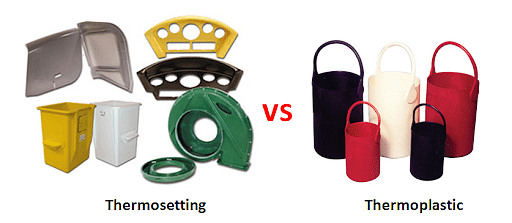
Thermoplastic VS Thermosetting Plastic
Read More: Polymerization
Things to Remember
- Polymers are classified into two different plastics. They are Thermosetting plastics and Thermoplastics.
- Thermoplastic is defined as a plastic polymer material that can become mouldable or pliable at a particular temperature, whereas thermosetting plastic is a polymer that becomes rigid in an irreversible manner on the application of heat.
- Thermosetting plastics have strong cross-link binding the polymer chains. The plastics are soft at low temperatures and then permanently set by the application of heat.
- Thermoplastics tend to become softer on the application of heat and can get more fluid.
- Thermoplastics have a lower molecular weight as compared to thermosetting plastics.
- The melting point of thermoplastics is low while the melting point of thermosetting plastics is high.
Sample Questions
Ques. Mention the points of difference between thermosetting plastics and thermoplastics. (3 Marks)
Ans. The synthesis process of thermoplastic can be done using addition polymerization. The synthesis process of thermosetting plastic can be done using condensation polymerization. The melting points of thermoplastic are low while the melting point of thermosetting plastic is high. Thermoplastic has a low tensile strength while thermosetting plastics have high tensile strength. Thermoplastics have a lower molecular weight as compared to thermosetting plastics.
Ques. What is thermoplastic? (3 Marks)
Ans. Thermoplastics tend to become softer on the application of heat and can get more fluid. Here the curing process becomes irreversible due to which there is no formation of the chemical bond. The remoulding and recycling can take place easily without getting any impact on the physical properties of the material. Thermoplastics are less brittle and tougher as compared to thermosets or thermosetting plastics. So they provide good damage control and resistance.
Ques. What is thermosetting plastic? (3 Marks)
Ans. Thermosetting plastics have strong cross-link binding the polymer chains. The plastics are soft at low temperatures and then permanently set by the application of heat. These polymers harden during the moulding process and cannot be re-softened with heat. They have high molecular weight than thermoplastics. The melting point of thermosetting plastic is high.
Ques. What are the uses of thermosetting plastics and thermoplastics? Give examples of thermoplastics and thermosetting plastic? (3 Marks)
Ans. Thermosetting plastics are used for applications in the automotive, appliance, electrical, lighting, and energy markets. Thermoplastics are used for the construction industry, such as for vinyl siding, drainpipes, gutters and roofing sheets.
Following are the examples of thermoplastics:
- Polystyrene
- Teflon
- Acrylic
- Nylon
Examples of thermosetting plastics are:
- Vulcanized rubber
- Bakelite
- Polyurethane
- Epoxy resin
- Vinyl ester resin
- Fiberglass.
Ques. What is addition polymerization in thermoplastics? (3 Marks)
Ans. Addition polymerization, in which monomers react to form a polymer without the formation of by-products. There are different techniques for addition polymerization. They are
- Bulk Polymerization
- Solution Polymerization
- Suspension Polymerization
- Emulsion Polymerization
Ques. What is condensation polymerization? Write a few characteristics of it. (3 Marks)
Ans. Condensation polymerization is a form of step-growth polymerization in which monomers and/or oligomers react with each other to form larger structural units while releasing smaller molecules as a by-product such as water or methanol. An example of a condensation reaction is the esterification of carboxylic acids with alcohol. Characteristics of condensation polymerization are:
- In this, the molecules should have one functional group like alcohol, amine, carboxylic acid groups.
- In this, smaller molecules sometimes make to formation of larger molecules.
- It considered some mixed properties of both the functional groups or molecules.
- Once the monomers get added with one reactive cluster, the average molecular weight of monomers gets decreases.
Ques. Explain polymers and monomers. (3 Marks)
Ans. Polymers are large molecules, or macromolecules, that are composed of small repeating singular molecular structural units called monomers. These repeating molecular units are joined together chemically through covalent bonds. Examples of polymers are polythene, nylon-66, bakelite, rubber, etc.
Monomers are a single atom or molecular fragment which form a larger macromolecule known as a polymer when bonded together with identical and similar types of monomers. The monomers bond together in order to form polymers through the process of polymerization.
Check-Out:



Comments