



Content Writer
The difference between Unicellular and Multicellular Organisms is based on the number of cells. Every living organism on the planet is composed of cells, which help in the functioning of organisms.
- The combination of cells helps in the formation of organs, tissues, and entire organisms.
- In our ecosystem, both unicellular and multicellular organisms make up a huge part.
- They can be found everywhere around us.
- Each of the organisms has a specialised structure or organelles.
- As we know, unicellular organisms contain only a single cell, whereas multicellular organisms consist of multiple cells.
Reproduction occurs in the form of binary fission in the case of single-celled organisms, while multi-cell organisms reproduce by gamete fusion.
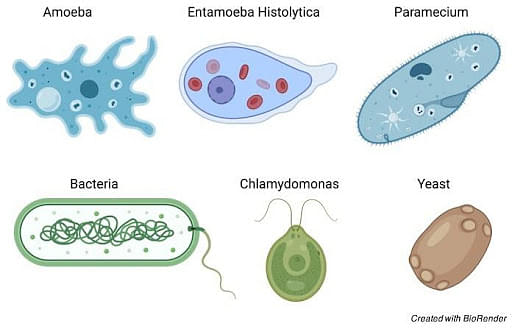
- Amoeba and bacteria come into the category of unicellular organisms.
- Humans and animals come into the category of multicellular organisms.
Key Terms: Difference between Unicellular and Multicellular Organisms, Organisms, Multicellular Organisms, Unicellular Organisms, Bacteria, Protozoa, Cells, Reproduction, Gamete Fusion, Prokaryotic Organisms
Unicellular Organisms
[Click Here for Sample Questions]
Unicellular organisms are those organisms that consist of a single cell. It is solely because of this reason that they are also called single-celled organisms.
- These organisms perform functions such as feeding, locomotion, waste elimination, and reproduction.
- Research from the fossils shows that they date back to almost 3-4 billion years ago when they first came into existence.
- They are known to be the oldest form of life and are classified under two major categories.
- These are the prokaryotic and the eukaryotic organisms.
Unicellular organisms make sure to reside together in groups so as to survive well. They are much different in composition and functions from multicellular organisms.
- Eukaryotes are larger than prokaryotes and have a stronger membrane
- It is not easy to see these organisms simply with the naked eye, as they have a microscopic nature.
- These organisms produce asexually.
- Unicellular organisms allow nutrients to enter and exit the body by the process of diffusion.
Read More:
| Chapter Related Articles | ||
|---|---|---|
| Microbiology | Antibodies | Plant Cell |
| Microbes in Human Welfare | Ecology | Recombinant DNA Technology |
Multicellular Organisms
[Click Here for Sample Questions]
Multicellular organisms are totally opposite from unicellular organisms. They consist of more than one cell. The traces of these were found almost 3-3.5 billion years ago.
- These organisms are very large in comparison to unicellular organisms and have a longer lifespan.
- They are produced especially through the division of cells or by clustering of many cells.
- Multicellular organisms are mostly eukaryotes in nature.
The arrangement of cells is complicated here. However, they possess a much greater efficiency than unicellular organisms. These are microscopic because we can easily see them with the naked eye.
- Reproduction is carried out sexually in these organisms.
- Cells of the organisms are produced by mitotic division.
Example of Multicellular OrganismsExample: Human beings, animals and plants are multicellular, whereas some exceptions are still there. Slime moulds are known to share a joint nature of both uni and multicellular organisms.
|

Difference between Unicellular and Multicellular Organisms
[Click Here for Sample Questions]
The difference between Unicellular and Multicellular Organisms are as follows:
| Unicellular organisms | Multicellular organisms |
|---|---|
| Unicellular organisms are organisms which consist of a single cell in their mechanism. | Multicellular organisms are organisms which are made up of multiple cells. |
| These are small and very minute in size. | These organisms are larger in size as compared to unicellular organisms. |
| Unicellular organisms are microscopic in nature. | These organisms are macroscopic in nature. |
| A unicellular organism may take any shape, or it is irregular and cannot be determined. | Multicellular organisms are well defined. |
| They constitute a simple body organisation. | These organisms are complexly organised. |
| The cell in whole is exposed to the outside environment. | Just the outer areas of the cell are exposed. |
| If the cell is injured, the organism suffers death. This is because they are made of a single cell. | If one cell is injured, it does not cause death, as they are made of multiple cells. |
| It consists of organisms which are both of prokaryotic and eukaryotic nature. | It has only those organisms whose cell type is of a eukaryotic nature. |
| They have a shorter lifespan. | They have a longer lifespan. |
| Division of labour can be seen taking place at the organelle level. | Division of labour is witnessed in the cellular, tissue, organs, and organ system level. |
| Mostly asexual reproduction takes place. However, sexual reproduction also happens to some extent by conjugation. | Both sexual and asexual reproduction takes place in the case of multicellular organisms. |
| No cell differentiation takes place. | Cell differentiation takes place here. |
| Unicellular organisms may be present in the form of autotrophs or heterotrophs. | Multicellular organisms can be both autotrophs and heterotrophs. |
| These are less efficient. | The efficiency is very high here. |
| These have a greater affinity towards regeneration. | Here, the affinity for regeneration is extremely low. |
| Examples - Bacteria, yeast, paramoecium, amoeba | Examples - Human beings, plants, animals, birds, etc. |
Read More:
| Class 11 Biology Related Concepts | ||
|---|---|---|
| Microbes in Industrial Products | Gram-negative bacteria | Human Health and Diseases |
| Pathogens | Infectious Diseases | Rancidity |
Things to Remember
- The difference between Unicellular and Multicellular Organisms depends upon the cellularity of organisms.
- Unicellular and multicellular organisms constitute a major part of our habitat.
- The cell function of each of these are different as organelles are associated with different activities.
- Unicellular organisms have been mainly classified as two important types, that is prokaryotic and eukaryotic.
- The prokaryotes don't have a nucleus and need the help of flagella to move.
- Multicellular organisms can be seen with the naked eye, in contrast to the case of unicellular organisms.
- The latter have a whip-like structure attached to their body, which enables movement.
- They can be found everywhere, starting from hot to humid and cold regions.
Sample Questions
Ques. How do unicellular organisms reproduce? (2 marks)
Ans. Unicellular organisms reproduce asexually with the help of binary fission. In this process, a single cell also known as the parent cell is present, where it divides and thereby gives rise to two individual daughter cells. For example, bacteria, and amoeba. Yeast is known to reproduce by budding.
Ques. What is cytoplasm? What is its function in biology? (3 marks)
Ans. The fluid-like substance present inside a cell is known as the cytoplasm. It is among the important elements of a cell structure. It is solely concerned with joining the nucleus with the cell membrane.
- The cytoplasm is associated with providing help in metabolic activities.
- Apart from this, the jelly-like substance present inside it is made of water and salt, and embeds the whole cell.
- It also assists in the breaking down of waste.
- The cytoplasm is crucial as it is responsible for maintaining the shape of the cell.
Ques. How are unicellular and multicellular organisms similar in nature? (3 marks)
Ans. Both, unicellular as well as multicellular organisms are similar in nature upon certain cases. These are given as,
- Unicellular and multicellular organisms witness life functions like reproduction and metabolism in the form of cells.
- Both of them consist of plasma membrane and cytoplasm.
- They consist of RNA and DNA material which shows how different they are from us in many ways
Ques. What are the features of a multicellular organism? (3 marks)
Ans. Multicellular organisms are organisms with multiple cells. They have unique characteristics which make them different from the rest. For an instance,
- They can be easily seen to the naked eye
- Multicellular organisms are usually eukaryotes
- They have a regular structure
- These organisms have longer lifespan
- They have high efficiency
Ques. How can you identify prokaryotes? (3 marks)
Ans. Prokaryotes don't have a nucleus in them which is why they can be easily identified. They are very tiny in structure and make use of flagella for movement from one place to another.
- Their cell wall facilitates in maintaining the normal shape of the cell and preventing insufficient hydration.
- Ions and molecules are transported to different parts of the cell because of the presence of prokaryotes.
- They use pili to exchange genetic material during reproduction.
- Archaebacteria, and eubacteria are good examples of prokaryotes.
Ques. What are known as eukaryotes? (2 marks)
Ans. A eukaryote is bound to the nucleus with the help of a membrane. The DNA material is known to be present inside the nucleus. These may be plant or animal cells and are larger than prokaryotes. For example, protozoa is a eukaryotic.
Ques. What is the difference between unicellular and multicellular? (3 marks)
Ans. There are many points of differences between unicellular and multicellular organisms. For example, the former keeps on regenerating, whereas the latter loses its ability to regenerate after some time.
- The former possesses greater efficiency as compared to the latter.
- Unicellular organisms cannot be seen with the naked eye as they are microscopic.
- On the other hand, multicellular organisms are macroscopic which is why they can be seen easily with the naked eye.
Ques. Name some characteristics of unicellular organisms? (3 marks)
Ans. Some important characteristics of unicellular organisms are as follows,
- They reproduce asexually
- These are either eukaryotes or prokaryotes
- Their whip-like structure helps them move
- They feed or draw important nutrients with the help of diffusion
Ques. Define respiration in unicellular? (2 marks)
Ans. Respiration is known as a metabolic process through which the cells present inside a living organism get energy by taking in oxygen and giving out carbon dioxide with the breakdown of organic substances. Unicellular organisms are known to respire both aerobically and anaerobically. They are able to do this by the process of diffusion along the surface area of the skin.
Ques. What is the difference between prokaryotes and eukaryotes? (3 marks)
Ans. The difference between prokaryotes and eukaryotes are as follows:
| Prokaryotes | Eukaryotes |
|---|---|
| Prokaryotes does not have any type of nucleus. | Eukaryotes consists of nucleus. |
| DNA is found in the nucleoid region. | DNA is found in the nucleus. |
| It consists of double-stranded and circular DNA. | It consists of double-stranded linear DNA. |
Ques. What are the functions of unicellular organisms? (3 marks)
Ans. The functions of unicellular organisms are as follows:
- The unicellular mode of reproduction is faster in comparison to multicellular organisms.
- They can easily adapt to the changing environment.
- These organisms have the same metabolism and nutritional requirements.
- They take the help of flagella to be able to move around.
For Latest Updates on Upcoming Board Exams, Click Here: https://t.me/class_10_12_board_updates
Check-Out:



Comments