



Education Content Expert
Displacement Reaction is defined as a chemical reaction wherein a more reactive element displaces a less reactive element from its compound.
- In other words, the atoms of the more reactive metal push their electrons onto ions of the less reactive metal.
- Both metals, as well as non-metals, participate in these displacement reactions.
- There are two types of displacement reactions namely Single displacement reaction and Double displacement reaction.
Displacement Reaction Equation is given as
| A + B-C → A-C + B |
Key Terms: Displacement Reaction, Reactivity Series, Single Displacement Reaction, Double Displacement Reaction, Elements, Metals
What is a Displacement Reaction?
[Click Here for Sample Questions]
A displacement reaction is a chemical reaction where a more reactive element displaces a less reactive element in a compound. The reactivity of the elements is decided by the reactivity series.
A displacement reaction can be represented as:
A + B-C → A-C + B
In the given reaction, A replaces B from compound BC.
Here, A and B have to be either,
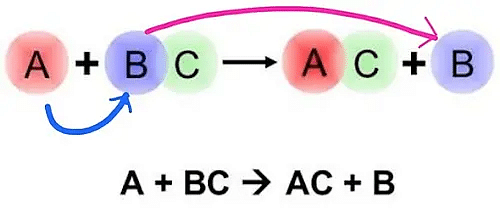
Displacement Reaction
Example of Displacement Reaction: Fe + CuSO4 → FeSO4 +Cu
There are two types of displacement reactions:
- Single Displacement Reaction
- Double Displacement Reaction
Displacement reactions are beneficial and are used in many everyday activities. Some of the important uses of this reaction are electroplating, thermite welding, steel making, acid digestion etc.
Single Displacement Reaction
[Click Here for Previous Years' Questions]
A single displacement reaction is a type of oxidation-reduction reaction where one ion or element replaces another element/ ion from its compound. The single displacement reaction can take place both in metal and non-metal.
The basic representation of the single displacement reaction is as follows:
X + Y-Z → Z+ X-Y

Single Displacement Reaction
Examples of Single Displacement Reactions in Metals
- If a zinc strip is placed in a blue copper sulphate solution, the Zn metal will replace the Cu metal, and the blue colour of the solution will disappear. The Zinc strip will get deposited with brown Cu metal.
Zn + CuSO4 → ZnSO4 + Cu
- When a copper strip is placed in a silver nitrate solution after some time, silver crystals are seen on the copper strip, and the solution starts becoming blue.
Cu+ 2AgNo3 → 2Ag + Cu (NO3)2
- The reaction between copper sulphate and iron. As iron is more reactive than copper, it replaces copper from the copper sulphate solution, and the blue colour of the solution is lost.
Fe + CuSO4 → FeSO4 + Cu
- The reaction between copper chloride and lead will be as
Pb + CuCl2 → PbCl2 + Cu
| Chapter-Related Topics | ||
|---|---|---|
| Oxidation and Reduction | Redox Reactions | Types of Redox Reactions |
| Difference Between Oxidation and Reduction | Oxidizing Agent | Redox Titration |
Examples of Single Displacement Reactions in Non-metals
- When chlorine in its gaseous form is added to sodium bromide solution, it replaces bromine as it is more reactive than bromine and the colour of the solution changes from brown to blue.
Cl2+ 2 NaBr → 2NaCl + Br2
- Alkali metals (group 1 of the periodic table) and some alkali earth metals (group 2) displace hydrogen from water. Sodium metal displaces hydrogen from water and leads to the formation of sodium hydroxide.
2Na + 2H2O → 2NaOH + H2
Ca + 2H2O → Ca (OH)2 + H2
Double Displacement Reaction
[Click Here for Sample Questions]
A double displacement reaction takes place when two iconic components of a compound switch positions with each other.
A double displacement reaction can be represented as follows:
| AB + CD → CB + AD |
In the given representation, A has switched position with C and similarly C with A.

Examples of Double Displacement Reactions
- When sodium sulphate solution is mixed with barium chloride solution, white precipitation of barium sulphate is formed instantly.
BaCl2 + Na2SO4 → BaSO4 + 2NaCl
- The reaction between silver nitrate and sodium chloride is also a double displacement reaction represented as
AgNO3 + NaCl à AgCl + NaNO3
Reactivity Series
[Click Here for Previous Years Questions]
The reactivity series is also known as the activity series, and it is the arrangement of metals according to their reactivity. The more reactive metals are placed higher in the reactivity series. The reactivity series allows us to decide if a metal will displace another metal from its compound.
The reactivity series of metals is as follows:
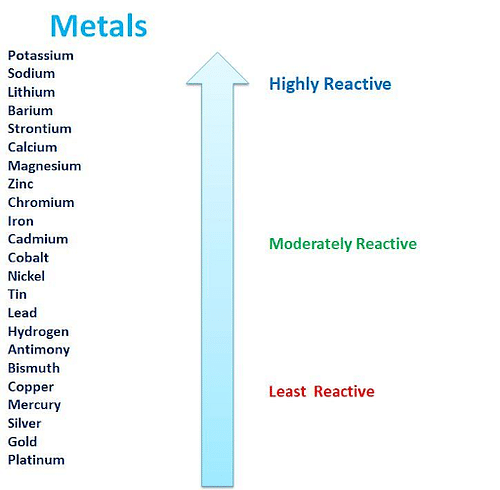
Reactivity Series
The high reactivity of metals is based on electronic configuration. Even though the reactivity series only consists of metals, other non-metal elements such as halogens and hydrogen also participate in displacement reactions.
Example: 2NaBr + Cl2 —> 2NaCl + Br2
The reactivity of halogens is as follows: F2 > Cl2 > Br2 > I2.
Uses of Displacement Reaction
[Click Here for Sample Questions]
Displacement reactions occur on a large scale in day-to-day life and have some significant applications which are listed below:
Thermite Welding
A mixture of aluminium (Al) and ferric oxide (Fe2O3) is used to weld railway joints together. The reaction is as follows:
2Al + Fe2O3 → Al2O3 + 2Fe
Extraction of Iron
Iron can be extracted from its ore by reaction with Carbon.
3C + 2Fe2O3 → 4Fe + 3 CO2
Extraction of Metals
A displacement reaction can also extract various other metals, such as chromium.
3C + 2Cr2O3 → 4Cr + 3CO2
Acid Neutralisation
Our stomach produces HCl acid, which leads to indigestion. Antacids consist of a base that leads to a displacement reaction.
Mg (OH)2 + 2 HCl → MgCl2 + 2 H2O
Things to Remember
- A displacement reaction occurs when a more reactive element displaces a less reactive element.
- Both metals and non-metals are involved in displacement reactions.
- There are two types of displacement reactions- Single Displacement reaction and Double Displacement reaction.
- In a single displacement reaction, one element replaces another element from its compound.
- In a double displacement reaction, a part of two ionic compounds is exchanged making two new components.
Previous Years’ Questions
- Which metal displace hydrogen from acids… (JIPMER 2000)
- Which of the following reactions is the metal displacement reaction… (NEET 2001)
- In the following decomposition reaction…
- Which of the following is a redox reaction… (NEET 1995)
- The oxide, which cannot act as a reducing agent, is… (NEET 1995)
- Hot concentrated sulphuric acid is a moderately strong oxidizing… (NEET 2016)
- Alkali metals have negative reduction potential and… (KCET 2013)
- The average oxidation state of sulphur in… (KEAM)
- Which of the following is not an example of a redox reaction…
- Copper becomes green when exposed to moist air for a long… (JEE Main 2014)
Sample Questions
Ques. The reaction in which an element displaces another element from its compound is called ________? (1 Mark)
Ans. Displacement reaction.
Ques. Why does a displacement reaction take place? (2 Marks)
Ans. A displacement reaction takes place when a more reactive element replaces a less reactive element. In a displacement reaction, a metal will be replaced by a metal and a non-metal by a non-metal. The reactivity is decided based on the reactivity series.
Ques. What will happen if copper sulphate solution is kept in a silver vessel? (2 Marks)
Ans. If CuSO4 is kept in a silver container, no reaction will occur as copper is more reactive than silver, and a displacement reaction will not be feasible.
Ques. Explain a neutralisation reaction. (3 Marks)
Ans. A neutralisation reaction is a displacement reaction in which an acid and base react to give salt and water. This reaction takes place in our stomach when we take antacids to relieve indigestion. Examples of this reaction are as follows:
HCl + NaOH → NaCl + H2O
The reaction that takes place in our stomach is as follows:
Mg (OH)2 + 2HCl → MgCl2 + 2H2O (Magnesium hydroxide is a common compound used in antacids.)
Ques. Explain the double displacement reaction with an example. (3 Marks)
Ans. A double displacement reaction takes place when in an aqueous solution, the ions of two separate compounds are exchanged.
For example, when sodium sulphate solution is mixed with barium chloride solution, white precipitation of barium sulphate is formed instantly. The reaction is as follows:
BaCl2 + Na2SO4 → BaSO4 + 2NaCl
Ques. List an example of a single displacement reaction. (3 Marks)
Ans. When chlorine (gaseous form) is added to the solution of sodium bromide, the chlorine displaces bromine and takes its place. It happens because chlorine is more reactive than bromine, thus, it displaces bromine from sodium bromide. As a result, the solution turns blue. Here is the reaction for the same:
Cl2(aq) + 2NaBr(aq) → 2NaCl(aq) + Br2(aq)
(Chlorine + Sodium Bromide → Sodium Chloride + Bromine)
Ques. What is the reaction between HCl and metals? (2 Marks)
Ans. Metals react with HCl to produce hydrogen gas. This method is also used to produce hydrogen in laboratories. Only a few metals that are very less reactive, such as gold and silver, do not react with HCl.
Zn + 2HCl → ZnCl2 + H2
Ques. What reaction occurs when potassium iodide solution is added to a lead nitrate solution? (2 Marks)
Ans. A double displacement reaction occurs when a potassium iodide solution is added to a lead nitrate solution. A yellow precipitate of lead iodide is immediately formed.
Pb (NO3)2 + 2KI → PbI2 + 2KNO3
Ques. Why does the colour of copper sulphate solution change when zinc metal is dipped inside? (2 Marks)
Ans. When zinc metal is placed in blue copper sulphate solution, the Zn metal being more reactive will replace the Copper metal from its solution causing the blue colour to disappear.
Zn + CuSO4 → ZnSO4 + Cu
Ques. List some applications of Displacement reactions. (3 Marks)
Ans. There is a wide range of applications for displacement reactions which are as follows:
- Displacement reaction is used in thermite welding wherein aluminium displaces iron from its oxide.
- The reaction process is also used to extract metals and make steel. In the manufacturing of steel, carbon displaces iron from its oxide.
- The reaction is also used in acid indigestion and flame photometry.
Ques. What do you understand by Reactivity Series? (3 Marks)
Ans. Reactivity series, also known as activity series, is defined as a series of metals based on their reactivity level from highest to lowest reactivity. The reactivity of metals is due to their incomplete outer orbitals or their electronic configuration. As metals tend to lose electrons, they form positively charged ions. Metals that have high atomic numbers are more reactive as their electrons are far from the positively charged nucleus. Thus, they can be removed easily.
Do Check-Out:



Comments