



Education Journalist | Study Abroad Lead
Disposable income is widely known as net pay which means the savings left with a person after paying income tax. It is formulated by subtracting the income tax from the personal income. It is given by the formula,
Disposable income = Personal income – Personal income taxes
In this article, we will cover some examples of disposable income and learn the fluctuations and importance of disposable income.
| Table of Content |
Keyterms: Disposable income, Income, Tax, Income Tax, Fluctuations, Net pay, GDP, Economy
What is Disposable Income?
[Click Here for Sample Questions]
The economic term 'disposable income' suggests the amount available for household consumption, savings, and spending after accounting for income tax. Disposable Income is called net pay.

Disposable Income
Formula of Disposable Income
[Click Here for Sample Questions]
The formula of disposable income is depicted as follows:
Disposable income = Personal income – Personal income taxes
Or
DPI = PI – PIT
Explanation of formula: Through the formula, we get the idea that disposable income is calculated by subtracting the personal tax from the personal income. This shows that from the entire amount earned by a person all the taxes that he or she pays are deducted to calculate disposable income.
For example, the total income earned by the Sehgal family is 2,00,000 INR and the effective tax rate is 10%. So, disposable income, in this case, would be 180,000. The answer is calculated by using the formula of disposable income: Personal Income - Personal Income Tax (200,000 - 20,000 [10% of 200,000]).
Economists use this formula to calculate the dependence on the current economic situation. The formula is used to anticipate the economy of the country. As per the demand, you can adjust the spending. Disposable income has a great impact on the GDP of a country as it fluctuates.
Also Read: Discount Formula
What Leads To Fluctuation In Disposable Income?
[Click Here for Sample Questions]
The unstable economy leads to fluctuation in GDP which ultimately leads to shifting in disposable income. It depends on spending by people in the boom or recession phase. For example, in times of crisis people will ultimately spend a lesser amount which will lead to a direct impact on the country's economy.
Importance of Disposable Income
[Click Here for Sample Questions]
Disposable income has a direct impact on a country's economy as spending of citizens on different products.
- Disposable income reveals how much purchase can be made by the consumers during a particular point in time.
- Disposable income tells how much saving is possible after all expenditure from the consumer's end. Thus, measuring their household income.
- The country's economy is dependent on disposable income.
- Other statistical information can be drawn out with the help of disposable income. Few statistical information includes Marginal propensity to consume (MPC), Marginal Propensity to Save (MPS), personal saving, and discretionary income.
Things To Remember
- Disposable income is calculated using personal income and personal income tax.
- Disposable income is of high importance to accountants as future savings, money to spend on goods, and a country's economy can be easily measured.
- Disposable income reveals how much purchase can be made by the consumers during a particular point in time.
- It is given by the formula,
Disposable income = Personal income – Personal income taxes
- Economists use this formula to calculate the dependence on the current economic situation.
Also Read:
Sample Questions
Ques: Calculate disposable income, National disposable income, private income, and personal income based on the following information: (5 marks)
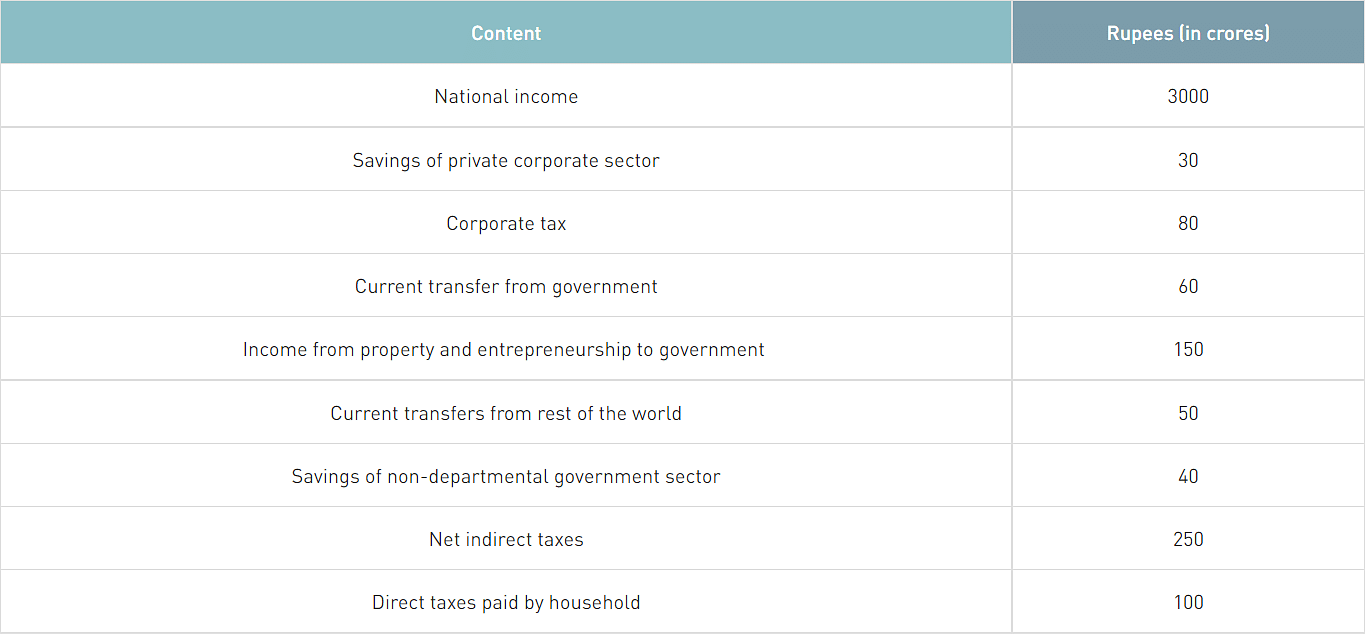
Ans: 1) Private income= National Income- (Income from property and entrepreneurship to government + Savings of non-departmental government sector) + (Current transfer from government + Current transfers from rest of the world)
= 3000 - (150+ 40) + (60 + 50)
=Rs. 2920 crores
2) Personal Income= Private Income - Savings of private corporate sector - Corporate tax
= 2920 - 30 - 80
=Rs. 2810 crores
3) Personal Disposable Income = Personal Income - Direct taxes paid by household
= 2810 - 100
= Rs 2710 Crores
4) National Disposable Income = National Income + Current transfers from rest of the world + Net indirect taxes
= 3000 + 50 + 250
=Rs 3300 Crores
Ques: Calculate personal disposable income and private income on basis of given data: (3 marks)

Ans: Personal Disposable Income = Personal income – Direct tax
= 1225 – 25
=Rs. 1200 Crores
Private Income = Personal income + Saving of private corporate sector + Corporate tax
= 1225 +12 + 23
=Rs. 1260 Crores
Ques: Estimate gross disposable income from the following data: (5 marks)
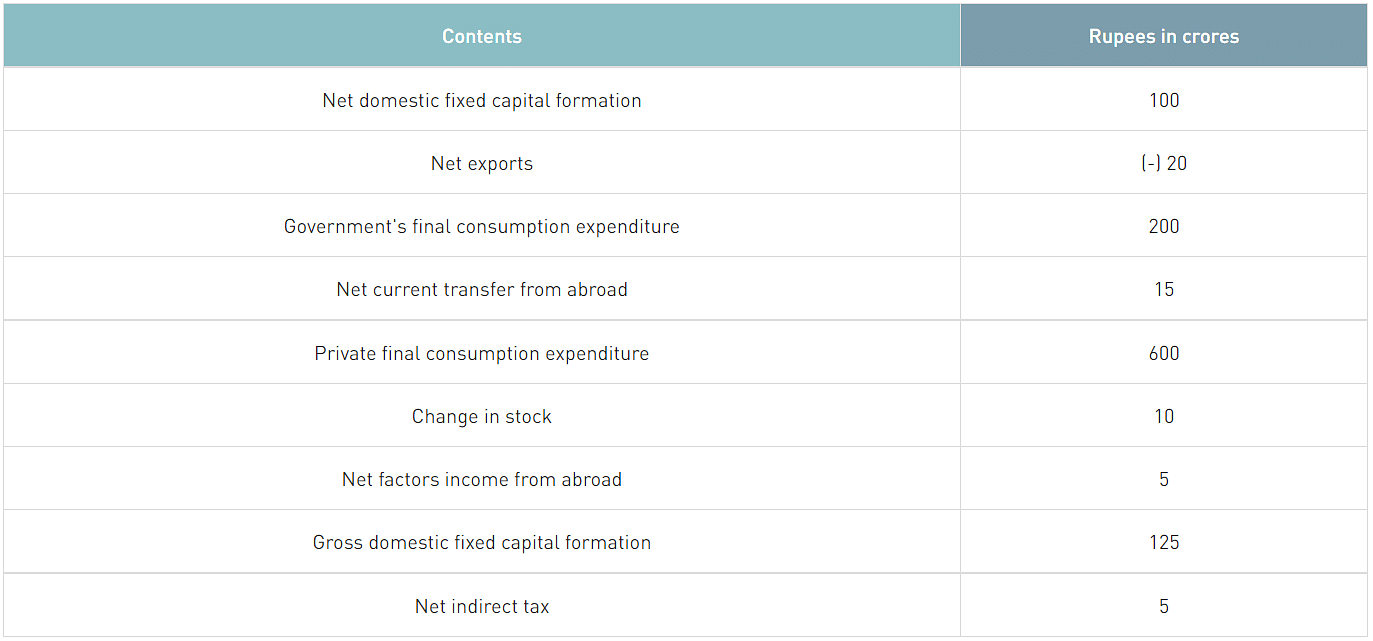
Ans: Gross National Disposable Income (GNDI) = Net National Income* + Net indirect tax + Net current transfers from abroad + Depreciation
= 890 + 05 + 15 + 25
= 935 crores
So, the answer is 935 crores
*Net National income= Net disposable income** + (Net factor income from abroad – Net indirect tax)
= 890 + 5 – 5
= 890 crores
**Net disposable income= Government final consumption expenditure + private final consumption expenditure + net domestic fixed capital formation + net exports
=200 + 600 + 100 + 10 + (-) 20
= 910 – 20 = 890
= 890 crores
Ques: Below is given data based on which you need to find out personal disposable income. (5 marks)

Ans: Personal Disposable Income = Personal Income* – Direct personal taxes
= 1275 – 40
= Rs 1235 Crores
* Personal Income = Private Income – Corporate Tax – Savings of private corporate sector
= 1315 -15 -25
= Rs 1275 crores
**Private Income = National income –Income from property and entrepreneurship accruing to Government – Savings of non-departmental government enterprises + National Debt Interest + Current transfer from government administrative departments + Current transfers from rest of the world
= 1300 – 35 – 5 +10 + 30 + 15
= Rs. 1315 crores
For Latest Updates on Upcoming Board Exams, Click Here: https://t.me/class_10_12_board_updates
Check-Out:



Comments