



Content Curator
Electrical resistance is the force that reduces the flow of current in an electrical circuit. When electrons move inside a conductor, they collide with the heavy metal ions of the conductor. This collision acts as an opposition to the flow of current and is termed as resistance. Resistance is measured in ohm (Ω).
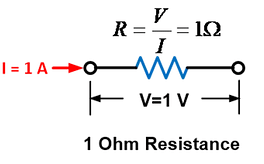
Electrical resistance
Depending upon the degree of resistance offered, materials are broadly classified into two categories:
- Conductors - Conductors are the materials that provide very little resistance and allow current to flow easily. For eg. silver, copper etc.
- Insulators - The materials that offer high resistance and restrict current flow are called insulators. For eg. rubber, paper, wood etc.
Check Also: NCERT Solutions for Class 12 Physics
Very Short Answer Questions [1 Mark Questions]
Ques. A wire of resistivity ρ is stretched to double its length. What will be its new resistivity?
Ans. The resistivity does not depend upon the length of the wire. Hence, it will remain the same when the wire is stretched.
Ques. A resistance R is connected across a cell of emf ε and internal resistance r. A potentiometer now measures the potential difference between the terminals of the cell as V. Write the expression for ‘r’ in terms of ε, V and R. [CBSE Delhi 2011]
Ans. The relation is given below;
r = (ε/V - 1) R
Ques. Graph showing the variation of current versus voltage for a material GaAs is shown in the figure. Identify the region of negative resistance.

Ans. DE is the region of negative resistance.
Ques. Two conductors, one having resistance R and another 2R, are connected in turn across a DC source. If the rate of heat produced in the two conductors is Q1 and Q2 respectively, what is the value of Q1/ Q2?
Ans. Since, Q = (V2/R) t
therefore, Q1/Q2 = R2/R1 = 2R/R = 2
Ques. A carbon resistor is marked in red, yellow and orange bands. What is the approximate resistance of the resistor?
Ans. The approximate resistance of the resistor is 24 x 103 ohm (± 20%).
Ques. How does the heat produced in a resistor depend on its resistance when
(i) a constant current is passed through it
(ii) a constant potential difference is applied across its ends?
Ans. (i). When I = constant; heat produced (H) ∝ Resistance (R)
(ii). When potential difference (V) is constant, the heat produced (H) ∝ 1/R
Ques. A cell of emf E and internal resistance r is connected across an external resistance R. Plot a graph showing the variation of P.D. across R, versus R. [NCERT Exemplar]
Ans. The graph is given below:

Short Answer Questions [2 Marks Questions]
Ques. V – l graph for a given metallic wire at two temperatures is shown. Which of these is at a higher temperature?

Ans. At high temperatures, the resistance of a metallic wire is more and its conductance is low. Hence, (2) is at higher temperature i.e. T2 > T1
Ques. A cell of emf ‘E’ and internal resistance ‘r’ is connected across a variable resistor ‘R’. Plot a graph showing the variation of terminal voltage ‘V’ of the cell versus the current ‘l’. Using the plot, show how the emf of the cell and its internal resistance can be determined. [CBSE AI 2014]
Ans. The graph is as follows:

When I = 0, V = E
The internal resistance can be found using the formula;
V = E - Ir
When V = 0,
E = Ir
r = E/I
Ques. In a potentiometer arrangement for determining the emf of a cell, the balance point of the cell in an open circuit is 350 cm. When the resistance of 9 Ω is used in the external circuit of the cell, the balance point shifts to 300 cm. Determine the internal resistance of the cell. [CBSE AI, Delhi 2018]
Ans. Here, L1 = 350 cm, L2 = 300 cm, R = 9 Ω, r = ?
Now,
r = (L1 - L2 / L2) R
r = (350 - 300 / 300) 9
r = 1.5Ω
Ques. Two bulbs are rated (P1, V) and (P2, V). If they are connected (i) in series and (ii) in parallel across a supply V, find the power dissipated in the two combinations in terms of P1 and P2. [CBSE Delhi 2019]
Ans. Resistances of the two bulbs, R1 = V2/P1 and R2 = V2/P2
(i). Net resistance in series, Rs = R1 + R2
Rs = V2/P1 + V2/P2
Rs = V2(P1 + P2 / P1P2)
(ii). Net resistance in parallel, RP = R1R2 / R1 + R2
RP = (V2/P1 V2P2) / (V2/P1 + V2/P2)
RP = V2 / (P1 + P2)
Ps = V2/RP = V2 / V2(P1 + P2 / P1P2) = P1P2 / P1 + P2
PP = V2/RP = V2 / (V2 / P1 + P2) = P1 + P2
Read More:
Long Answer Questions [3 Marks Questions]
Ques. A circle ring having negligible resistance is used to connect four resistors of resistances 6R , 6R , 6R and R as shown in the figure. Find the equivalent resistance between points A & B.

Ans. Rearrange the above diagram,

6R, 6R and 6R are in parallel
1/Rs = 1/6R + 1/6R + 1/6R
1/Rs = 3/6R
Rs = 6R/3 = 2R

2R and R are in series,
Rnet = 2R + R
Rnet = 3R
Ques. Find the equivalent resistance between points A and B of an infinite network of resistances, each of 1Ω, connected as shown in figure.

Ans. R = R1 + (R2 R) / (R2 + R)
R = 1 + (1 R) / (1 + R)
R = R2 + R = 1 + R + R
R2 - R - 1 = 0
R = (1 ± \(\sqrt{1 + 4}\) ) / 2
R = (1 ± \(\sqrt{5}\)) / 2
R can never be negative, therefore, R = (1 + \(\sqrt{5}\)) / 2Ω
Ques. Three identical cells, each of emf 2V and unknown internal resistance are connected in parallel .This combination is connected to a 5 resistor. If the terminal voltage across the cell is 1.5 volt, what is the internal resistance of each cell?
Ans. E = 2V, V = 1.5 V, R = 5Ω
Total internal resistance = r/3
r = (E/V - I) R
r/3 = (2/1.5 - 1) 5
r/3 = (2 - 1.5 / 1.5) 5
r = 5Ω
Very Long Answer Questions [5 Marks Questions]
Ques. In the circuit diagram given below, suppose the resistors R1, R2 and R3 have the values 5Ω, 10Ω, 30Ω respectively connected to a battery of 12 V. Calculate
(a) the current through each resistor
(b) the total current in the circuit
(c) the total circuit resistance

Ans. (a). All the resistances are in parallel, the voltage across each of them is the same i.e. 12 V.
I1 = V/R1 = 12/5 = 2.4 A
I2 = V/R2 = 12/10 = 1.2 A
I3 = V/R3 = 12/30 = 0.4 A
(b). Total current = I1 + I2 + I3
I = 2.4 + 1.2 + 0.4
I = 4A
(c). Total circuit resistance = V / Total current
R = 12/4
R = 3Ω
Ques. A battery of emf E and internal resistance r sends a current I1 and I2, when connected to an external resistance of R1 and R2 respectively. Find the emf and internal resistance of the battery?
Ans. I1 = E / R + r
E = I1 (R1 + r) ……(i)
Similarly, E2 = I2 (R2 + r) …..(ii)
From (i) and (ii),
I1 (R1 + r) = I2 (R2 + r)
I2r - I1r = I1R1 - I2R2
R (I2 - I1) = I1R1 - I2R2
r = (I1R1 - I2R2) / (I2 - I1)
EMF (E) = I1 (R1 + r)
E = I1 [R1 + (I1R1 - I2R2) / (I2 - I1)]
E = I1I2 (R1 - R2) / I2 - I1
Ques. A battery of 20 cells each having emf 1.8 V and internal resistance 0.1 Ω is charged by 220 V and the charging current is 15 A. Calculate the resistance to be put in the circuit.
Ans. Etotal = 20 1.8 = 36 V
Internal resistance (rtotal) = 0.1 20 = 2Ω
Enet = 220 V - 36 V
Enet = 184 V
Rnet= rtotal + R
Rnet = 2 + R
I = 15 A (given)
I = Enet / Rnet = 184 / R + 2
15 = 184 / R + 2
15R + 30 = 184
R = (184 - 30) / 15 = 10.27Ω
Check Also:



Comments