



A cell wall is a tough, protective layer that surrounds the cell membrane of many organisms, including plants, fungi, algae, and bacteria. It provides structural support and protection to the cell, helping it maintain its shape and integrity. The cell wall has many other functions such as it acts as a regulator of cell turgor pressure, controller of transport and permeability, a mediator of cell adhesion and communication, support for specialized structures, and a component of defense mechanisms in different types of cells. Its diverse functions are essential for the proper functioning, growth, and adaptation of cells in various organisms.
- Cell wall is also responsible to provide osmotic regulation, and cell-to-cell adhesion.
- It also contributes to environmental adaptation.
- The composition and specific functions of the cell wall vary among different organisms.
| Table of Content |
Key terms: Cell wall, Protective layer, Structural support, Cell membrane, Organisms, Pectin,Lignin, Chitin, Peptidoglycan
Characteristics of Cell Wall
[Click Here for Sample Questions]
Characteristics of the cell wall of various plants and organisms are described below.
Rigid Structure
One of the primary characteristics of cell walls is their rigidity. They are built to withstand mechanical stress and provide structural support to cells. A rigid cell wall allows cells to maintain shape and resist deformation under pressure.
Extracellular Component
Unlike the cell membrane that separates the cell from its surroundings, the cell wall is an extracellular structure. It lies outside the cell membrane and acts as an additional protective layer.
Complex Composition
Cell walls have a complex composition, primarily consisting of polysaccharides. In plants, the primary component is cellulose, a strong and fibrous polysaccharide. Other polysaccharides, such as hemicelluloses and pectins, may also be present. Fungal cell walls contain chitin, while bacterial cell walls can contain peptidoglycan or other unique polymers.
Porous Nature
Cell walls possess a porous nature that allows the exchange of molecules between adjacent cells. Channels and pits in the cell wall help moving water, nutrients, and signaling molecules, enabling cell-to-cell communication and transport.
Variable Thickness
The thickness of cell walls can vary based on the organism and cell type. In plants, the primary cell wall is relatively thin and flexible, allowing cell growth and expansion. The secondary cell wall, that resides inside the primary cell wall, is thicker. It provides rigidity and strength. Fungal cell walls may have multiple layers, including an outer extracellular matrix.
Adhesion Properties
Cell walls are crucial in cell adhesion, allowing cells to stick together and form tissues. In plants, the middle lamella, which is a thin layer between adjacent cells, contains pectins. It acts as an adhesive and cements the cells together. Fungal cell walls also possess adhesion properties that help in forming fungal networks and structures.
Structural Variations
Cell walls exhibit structural variations based on the cell's function and developmental stage. For instance, plant cells undergoing secondary growth may develop lignified cell walls containing lignin. Lignin is a complex polymer that provides additional strength and resistance to decay.
Dynamic Nature
While cell walls are rigid, they are not static structures. They can undergo modifications and remodeling in response to environmental cues and cell development. Enzymes called cell wall-modifying enzymes play a role in modifying the composition and structure of cell walls, allowing cells to adapt to the changing conditions.
Structure and Components of Cell Wall
[Click Here for Sample Questions]
The structure and components of the cell wall can vary depending on the organism. Plant cell walls contain cellulose, hemicelluloses, pectins, lignin, and proteins. Fungal cell walls comprise chitin, glucans, mannans, and glycoproteins. Bacterial cell walls consist of peptidoglycan, lipopolysaccharides (in Gram-negative bacteria), teichoic acids (in Gram-positive bacteria), porins, and other proteins. These components provide structural integrity and protection and play essential roles in each organism's cellular functions.
Plant Cell Walls
The primary components of plant cell walls include:
Cellulose
Cellulose is the most ample polysaccharide in plant cell walls. It forms long, linear chains of glucose molecules organized into bundles called microfibrils. Cellulose provides tensile strength and rigidity to the cell wall.
Hemicelluloses
Hemicelluloses are a group of polysaccharides that surround cellulose microfibrils. They contribute to the overall structure and flexibility of the cell wall. Different types of hemicelluloses, such as xylans, mannans, and glucans can be present in varying proportions.
Pectens
Pectens are a group of complex polysaccharides that provide gel-like properties to the cell wall. They contribute to cell adhesion and help regulate cell wall porosity. Pectins also play a role in cell-to-cell communication and signaling.
Lignin
Lignin is a complex polymer that provides rigidity, strength, and hydrophobicity to the secondary cell wall. It plays two important roles such as filling the spaces between cellulose microfibrils and increasing the cell wall's resistance to the mechanical stresses and microbial attacks.
Proteins
Cell walls also contain various proteins contributing to their structure and function. Some proteins help in cell wall synthesis, modification, and degradation, while others have enzymatic activities or play roles in signaling and defense responses.

Plant cell wall
Fungal Cell Walls
Fungal cell walls have a different composition than plant cell walls. The main components of fungal cell walls include:
Chitin
Chitin is the primary component of fungal cell walls. It is a tough, nitrogen-containing polysaccharide that forms a rigid framework. Chitin provides strength, rigidity, and protection to fungal cells.
Glucans
Fungal cell walls also contain glucans, which are glucose polymers. These include β(1,3)-glucans and β(1,6)-glucans, which contribute to the structural integrity and stability of the cell wall.
Mannans
Some fungi contain mannans, which are mannose-based polysaccharides. Mannans contribute to the overall architecture of the fungal cell wall and play a role in cell adhesion and recognition.
Glycoproteins
Fungal cell walls often contain glycoproteins covalently linked to carbohydrates. These glycoproteins play diverse roles, including cell adhesion, signaling, and host-pathogen interactions.
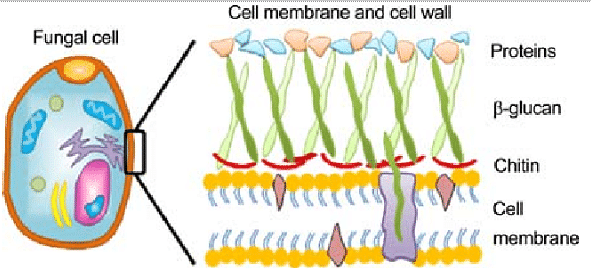
Fungal cell wall
Bacterial Cell Walls
Bacterial cell walls can be classified into two main types: Gram-positive and Gram-negative cell walls. The components of bacterial cell walls include:
Peptidoglycan
Peptidoglycan is the primary component of bacterial cell walls. It is a mesh-like structure comprising sugar chains (glycan strands) cross-linked by short peptides. Peptidoglycan provides strength, rigidity, and shape to the bacterial cell wall.
Lipopolysaccharides (LPS)
Gram-negative bacteria have an outer membrane that contains lipopolysaccharides (LPS). LPS consists of lipid A, core oligosaccharides, and O-antigen chains. LPS plays a role in providing structural integrity, protection against host defenses, and modulating immune responses.
Teichoic Acids
Gram-positive bacteria have teichoic acids, polymers of glycerol or ribitol linked by phosphate groups. Teichoic acids play a role in cell wall maintenance, regulation of ion movement, and adherence to surfaces.
Porins
Porins, which are protein channels that enable the passage of chemicals into and out of the cell, are found in the outer membrane of gram-negative bacteria. They support the control of nutrient absorption and the permeability of the cell wall.
Periplasmic Space
Gram-negative bacteria have a periplasmic gap between their inner and outer membranes. A range of proteins, including those involved in digesting nutrients and creating cell walls, are found in this area.
Capsules and S-Layers
Some bacteria can have additional structures on the outer surface of their cell walls.
- Capsules are gelatinous layers composed of polysaccharides or proteins.
- It provides protection and helps bacteria to evade host immune responses.
- S-layers are crystalline protein or glycoprotein layers that provide additional protection to the cell wall.

Bacterial Cell Walls
It's important to note that while the components mentioned above are standard in bacterial cell walls, variations can exist depending on the specific bacterial species and strains.
Functions of Cell Wall
[Click Here for Sample Questions]
The cell wall performs various essential functions in different types of cells, including plant cells, fungal cells, and bacterial cells. Here are the critical functions of the cell wall:
Structural Support
One of the primary functions of the cell wall is to provide structural support and rigidity to the cell. In plants, the cell wall, especially the secondary cell wall, gives strength and shape to the plant cell, allowing it to withstand mechanical stress and maintain its structural integrity. Similarly, in fungi and bacteria, the cell wall provides strength and rigidity, helping the cells maintain their shape and withstand external pressures.
Protection
The cell wall acts as a protective barrier, shielding the cell from external threats and environmental stresses. It provides a physical barrier that prevents the entry of pathogens, toxins, and harmful substances. The cell wall also helps protect against mechanical damage and osmotic stress by maintaining cell shape and preventing cell rupture.
Regulation of Cell Turgor Pressure
The cell wall plays an important role in regulating cell turgor pressure in plant cells. The cell wall restricts the expansion of the cell, maintaining a balance between the inward pressure exerted by the cytoplasm and the outward pressure exerted by the cell wall. This regulation of turgor pressure is essential for plant growth, cell expansion, and maintaining the overall structure of plant tissues.
Transport and Permeability Control
The cell wall regulates the passing of substances into and out of the cell. It acts as a selectively permeable barrier, allowing the passage of specific molecules while restricting the entry of others. In plant cells, the cell wall has plasmodesmata, small channels that connect adjacent cells, allowing the exchange of water, nutrients, and signaling molecules. In bacteria, porins in the cell wall allow the selective transport of molecules across the outer membrane.
Cell Adhesion
The cell wall plays a vital role in cell adhesion, allowing cells to stick together and form tissues and organs. In plants, the middle lamella, which contains pectins, cement adjacent cells together. The cell wall also facilitates cell-cell communication and signaling by providing a scaffold for the attachment of receptors and signaling molecules.
Support for Specialized Structures
In plants, the cell wall supports specialized structures such as xylem and phloem vessels. These vessels transport water, nutrients, and sugars throughout the plant. The secondary cell wall in xylem cells contains lignin that provides strength and rigidity to withstand the pressure exerted by water transport.
Defense Mechanisms
The cell wall participates in defense mechanisms against pathogens and pests. In plants, the cell wall can undergo reinforcement and produce defensive compounds in response to pathogen attacks. Fungal and bacterial cell walls also contribute to defense by preventing the entry of antimicrobial substances and evading host immune responses.
Also Read:
| Related Articles | ||
|---|---|---|
| Prokaryotic cell | Reproduction in Plants | Cell Wall and Cell Membrane |
| Cell envelope | Difference between Cell and Tissue | Cell organelles |
Things to Remember
- The cell wall is a tough, protective layer that covers the cell membrane.
- It provides structural support, protection, and osmotic regulation.
- Cell walls are made up of polysaccharides like cellulose, hemicelluloses, and pectins.
- Some additional components of the cell wall depending on the organism are chitin and peptidoglycan.
- Cell walls play a crucial role in cell adhesion.
- The cell wall acts as a selectively permeable barrier and facilitates cell-to-cell communication.
- Secondary walls provide additional strength to xylem and phloem vessels.
- Fungal cell walls primarily consist of chitin, glucans, and mannans.
- Bacterial cell walls have peptidoglycan as the primary component.
- Lipopolysaccharides are present in Gram-negative bacteria.
- Teichoic acids are present in Gram-positive bacteria.
Sample Questions
Ques. What is the cell wall? (1 mark)
Ans. The cell wall is a rigid, protective layer that surrounds the cell membrane of many organisms, including plants, fungi, algae, and bacteria. It provides structural support and protection to the cell.
Ques. What are the characteristics of cell walls? (5 marks)
Ans. Cell walls possess several essential characteristics for their functions in different organisms. These characteristics include rigidity, extracellular location, complex composition, porosity, variable thickness, adhesion properties, structural variations, and dynamic nature.
Firstly, rigidity is a fundamental characteristic of cell walls. They are built to withstand mechanical stress and provide structural support to cells. A rigid cell wall allows cells to maintain shape and resist deformation under pressure.
Cell walls are extracellular components, meaning they lie outside the cell membrane. The cell wall acts as an additional protective layer. It provides a physical barrier that shields the cell from external threats and environmental stresses.
The complex composition of cell walls is another significant characteristic. In plants, the primary component of cell walls is cellulose, a muscular and fibrous polysaccharide. Other polysaccharides, such as hemicelluloses and pectins, may also be present, contributing to the overall structure and function of the cell wall. Fungal cell walls contain chitin, while bacterial cell walls can contain peptidoglycan or other unique polymers.
Cell walls possess a porous nature, allowing for the exchange of molecules between adjacent cells. Channels and pits in the cell wall ease the movement of water, nutrients, and signaling molecules, enabling cell-to-cell communication and transport.
Cell walls also have adhesion properties, which are crucial in cell-to-cell adhesion. In plants, the middle lamella, a thin layer between adjacent cells, contains pectins that act as an adhesive, cementing the cells together. Fungal cell walls also possess adhesion properties that help form fungal networks and structures.
Structural variations in cell walls exist based on the cell's function and developmental stage. For example, plant cells undergoing secondary growth may develop lignified cell walls containing lignin, a complex polymer that provides additional strength and resistance to decay.
Ques. What are the cell wall components in plants, fungi, and bacteria? (2 marks)
Ans. The components of the cell wall vary depending on the organism. In plants, cell walls contain cellulose, hemicelluloses, pectins, lignin, and proteins. Fungal cell walls comprise chitin, glucans, mannans, and glycoproteins. Bacterial cell walls contain peptidoglycan, lipopolysaccharides, teichoic acids, porins, and other proteins.
Ques. What is the primary function of the cell wall? (5 marks)
Ans. The primary function of the cell wall is to provide structural support and protection to the cell. It serves as a rigid outer layer that maintains the shape and integrity of the cell, allowing it to withstand mechanical stresses and changes in osmotic pressure. The cell wall also plays several other essential roles:
- Structural Support: The cell wall shapes cells and provides mechanical strength. It prevents the cell from collapsing under its internal pressure and supports the overall structure of the organism. In plants, the cell wall allows them to stand upright.
- Protection: The cell wall acts as a barrier, protecting the cell from external threats such as physical damage, pathogens, and environmental fluctuations. It serves as the first line of defense against microbial attacks.
- Osmotic Regulation: The cell wall aids in controlling the flow of solutes and water into and out of the cell. It establishes a semi-permeable barrier to regulate the osmotic balance and stop excessive water absorption or loss.
- Cell-to-Cell Communication: The cell wall contains channels and pores that exchange molecules and signals between neighboring cells. It facilitates intercellular communication, coordination, and transport of nutrients, hormones, and signaling molecules.
- Growth and Development: The cell wall plays a crucial role in cell growth, expansion, and differentiation. It provides a framework for cell expansion during development, allowing cells to elongate and differentiate into specialized cell types.
- Storage and Supportive Functions: In some organisms, the cell wall can store reserves of nutrients, such as starch in plants. In addition, particular cell walls, like the wood in trees, provide long-term structural support and enable the growth of large organisms.
Ques. How does the cell wall protect the cell? (1 mark)
Ans. The cell wall acts as a protective barrier by preventing the entry of pathogens, toxins, and harmful substances. It also protects against mechanical damage and osmotic stress by maintaining cell shape and preventing cell rupture.
Ques. What role does the cell wall play in cell-to-cell adhesion? (2 marks)
Ans. The cell wall is crucial in cell adhesion. It allows cells to stick with the neighboring cells and form tissues. In plants, pectin containing middle lamella joins the adjacent cells together. Fungal and bacterial cell walls also possess adhesion properties that facilitate cell-cell interactions.
Ques. How does the cell wall contribute to transport and permeability control? (2 marks)
Ans. The cell wall regulates the movement of substances. In plants, plasmodesmata in the cell wall exchange water, nutrients, and signaling molecules between adjacent cells. Bacterial cell walls contain porins that control the selective transport of molecules across the outer membrane.
Ques. What are the additional functions of the cell wall? (2 marks)
Ans. Besides structural support and protection, the cell wall also plays roles in regulating cell turgor pressure, supporting specialized structures (such as xylem and phloem in plants), mediating cell adhesion and communication, and participating in defense mechanisms against pathogens and pests.
For Latest Updates on Upcoming Board Exams, Click Here: https://t.me/class_10_12_board_updates
Do Check Out:



Comments