



Education Journalist | Study Abroad Lead
A first order reaction is a reaction that proceeds at a rate proportional to the concentration of one of the reactants. So, as the concentration doubles, the reaction rate also doubles.
- The concentration of other reactants will not have any effect on the rate of reaction.
- Thus, the Order of Reaction for a first-order reaction is always one.
- A first-order reaction is a chemical reaction where the rate varies, depending on the concentration changes of only one reactant.
- The rate of a first-order reaction is affected by both temperature and reactant concentration, in return which is affected by time.
The differential rate expression for a first-order reaction is expressed as:
⇒ Rate = -d[A]/dt = k[A]1 = k[A]
Here,
- ‘k’ = rate constant of the first-order reaction
- ‘[A]’ = concentration of the first-order reactant ‘A’.
- d[A]/dt = change in the concentration of the first-order reactant ‘A’ in the time interval ‘dt’.
Related Links
- Appearing for JEE Main, Download JEE Mains PYQ for all sabjects
- Appearing for NEET, Download NEET PYQ for all subjects
Key Terms: Rate of Reaction, Chemical Reactions, Order of Reactions, Reactant, Rate Constant, Rate of a Chemical Reaction, Pseudo First-Order Reaction
What is a First Order Reaction?
[Click Here for Sample Questions]
First Order Reaction can be defined as:
“A chemical reaction in which reaction rate is linearly dependent on the concentration of one reactant. In a first-order reaction, the rate of reaction varies on the basis of changes in the concentration of only one of the reactants.”
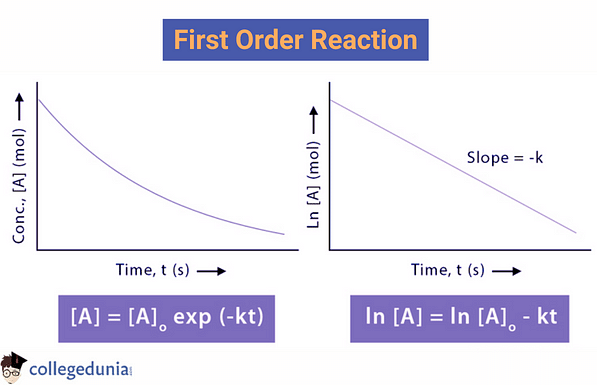
Key Points to note about First Order Reaction are
|
Also check:
Pseudo First-Order Reaction
[Click Here for Previous Year Questions]
Pseudo-first-order reactions are not first-order but seem to be first-order because of the higher concentrations of the reactant(s) in comparison to other reactants.
- The order of a chemical reaction can be expressed as the product of the powers of the reactant concentrations in the rate law expression.
- Based on the reactant concentration, reactions can be divided as first-order, second-order, pseudo-first-order, etc.
- Accurate concentrations of every reactant is required to calculate the reaction rate.
- It might result in a high cost for the experiment in case one or both the required reactants are expensive.
- The Pseudo-1st-order reaction, wherein the 2nd order reaction is treated like a 1st order reaction, is done to avoid more difficult, expensive experiments and calculations.
Zero, First, and Second-order Reactions
The rate of a zero-order reaction is typically constant. The concentration of one of the reactants is seen to impact the rate of a first-order reaction. Thus, the square of a reactant’s concentration or the product of the concentrations of two reactants helps to determine the second-order reaction rate.
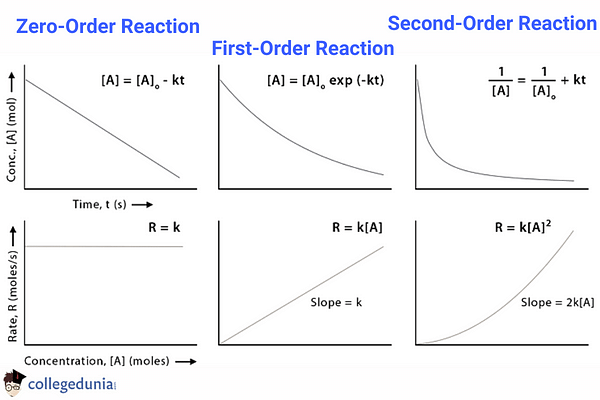
Zero, First, and Second-order Reactions
The differences between the zero, first, and second-order reactions are tabulated below:
| Type | Zero Order | First Order | Second Order |
|---|---|---|---|
| Meaning | In a Zero-order reaction, the reaction rate is constant over time and independent of the concentration of the reactant. | In a First-order reaction, the reaction rate is proportional to the first power of the reactant’s concentration. | In a Second-order reaction, the reaction rate is proportional to the second power of the reactant’s concentration or product of two reactants’ concentration. |
| Rate Equation | R = constant | R = k [A] | R = k [A]2 or R = k [A] [B] |
| Concentration | [A] = kt | [A] = [A]o exp (-kt) | 1 / [A] = 1 / [A]o + kt |
| Half-life | [A]o / 2k | 0.693 / k | 1 / k[A]o |
| Example | Nitrous oxide Decomposition | Hydrogen peroxide Decomposition | Nitrogen dioxide Decomposition |
Examples of First Order Reaction
[Click Here for Previous Year Questions]
First Order Reaction examples are listed below:
- Decomposition of Nitrogen Pentoxide (N2O5): 2N2O5 → 2NO2 + ½ O2
- Decomposition of ammonium nitrate in aqueous solution: NH4NO2 → N2 + 2H2O
- Decomposition of H2O2 in aqueous solution: H2O2 → H2O + ½ O2
- Hydrogenation of ethane: C2H4 + H2 → C2H6
- Hydrolysis of diazo derivatives: C5H5N = NCl + H2O → C6H5OH + N2 + HCl
Characteristics of First-order ReactionSome characteristics of First-order Reaction are:
|
Differential Rate Law for a First Order Reaction
[Click Here for Sample Questions]
A differential rate law is used to describe a chemical reaction at a molecular level. The differential rate expression for a first order reaction can be expressed as:
Rate = -d[A]/dt = k[A]1 = k[A]
Where,
- k is the rate constant denoted by s-1.
- [A] denotes the concentration of the first-order reactant ‘A’.
- d[A]/dt denotes the change in the concentration of the first order reactant ‘A’ in dt time interval.
Integral Derivation Of First Order Reaction
[Click Here for Previous Year Questions]
Integrated rate expressions can be used to calculate the value of the rate constant of a reaction experimentally. To obtain the integrated derivation of the rate expression for a first-order reaction, the differential rate law for the first-order reaction can be rearranged as follows.
Step 1: For any reaction, A → products
Let,
[A]0 - Initial Concentration of A
[A]t - Concentration of A after time t
Step 2: The Integrated rate equation for a First order reaction is:
Rate = \(\begin{array}{l}\frac{-d[A]}{dt} = k[A]\end{array}\)
→ d[A]/dt = - k[A] …(i)
Step 3: Integrating this equation,
\(\begin{array}{l}\int_{[A]_0}^{[A]}\frac{d[A]}{[A]} = -\int_{t_0}^{t}kdt\end{array}\)
\(\begin{array}{l}\int_{[A]_0}^{[A]}\frac{1}{[A]}d[A] = -\int_{t_0}^{t}kdt\end{array}\)
We get,
ln[A] – ln[A]0 = -kt
ln[A] = -kt + ln[A]0 (or) ln[A] = ln[A]0 – kt
Step 4: Raising both the side of the equation to the exponent ‘e’ (since eln(x) = x), the equation can be written as follows:
\(\begin{array}{l}e^{ln[A]} = e^{ln[A]_0 – kt}\end{array}\)
Therefore,
\(\begin{array}{l}[A] = [A]_0 e^{-kt}\end{array}\)
This expression is the integrated form of the first-order rate law.
Step 5: loge[A] = -kt + loge[A]0
→ k = 1/t . loge([A]0/[A])
→ loge = 2.303 log10
→ k = 2.303/t log10 ([A]0/[A]) …(ii)
Graphical Representation of a First Order Reaction
[Click Here for Sample Questions]
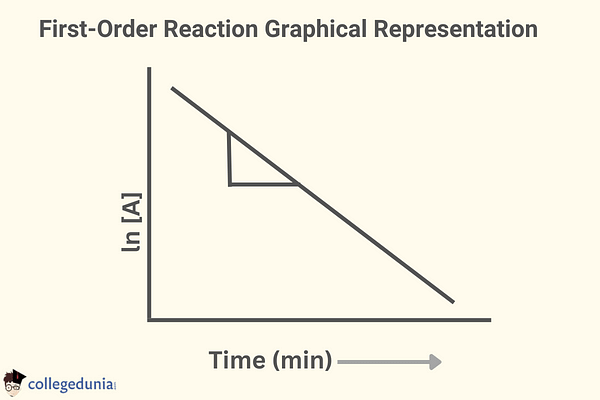
Comparing Eq (ii) with the equation of a straight line i.e y = mx+c and thereby on plotting Eq(ii), we get a graph where slope = k/2.303
For first-order reactions, the equation ln[A] = -kt + ln[A]0 is identical to a straight line (y = mx + c) with slope -k. This line can be plotted as follows.
Rate Constant
[Click Here for Previous Year Questions]
Rate of a reaction is the change in concentration with time. For any reaction whose concentration is expressed in terms of moles/litre and time in seconds.
Rate of reaction = mol L-1 sec-1
For any First order reaction, the rate is expressed as:
| Rate = k[A] |
⇒ mol L-1 sec-1 = k (mol L-1)
⇒ k = sec-1
Thus the rate constant units (k) for the First-order reaction is sec-1
Half-Life Period of First Order Reaction
[Click Here for Sample Questions]
Half-time or half-life of a first-order reaction is the time taken to reduce the concentration of the reactant to half of its initial value. It is denoted by t1⁄2
For first-order reaction, we know that, k = 1/t . loge([A]0/[A])
At half life period, t = t1⁄2 and [A] =[A]0/2
On substituting, k = 1/ t1⁄2. loge{[A]0/([A]0/2)}
→ t1⁄2 = 0.693/k
Half-Life Period Of First Order Reaction: Important FAQsQues: What is the formula for half-life period reaction? Ans: The Half-life of a first-order reaction doesn’t rely on the concentration of the reactant. It is a constant and is related to the rate constant for the reaction: t1/2 = 0.693/k. Ques: Calculate the half-life of the first-order reaction if time is required to reduce concentration. Ans: Concentration gets reduced to 25%. This implies that it takes two half-lives to reduce the concentration of reactant from 0.8 M to 0.2 M in a first-order reaction. |
Things to Remember
- In a first-order reaction, the concentration of only one reactant affects the rate of reaction.
- The order of reaction for any first-order reaction is one.
- The unit of rate constant (k) for First-order reactions is sec-1.
- The half-life period of a first-order reaction is given by t1⁄2 = 0.693/k.
- In a first-order reaction, the rate constant does not depend upon the concentration of the reactant. The half-life period for a first-order reaction is constant.
- If a reaction is overall first order with respect to one of the reactants, the rate of reaction is proportional to the amount of that reactant. For example, Nuclear Decay.
Also check:
Sample Questions
Ques. What is an example of first-order reaction? (1 mark)
Ans. The hydrolysis of aspirin is an example of a first-order reaction.
Ques. Is first-order reaction linear? (1 mark)
Ans. A first-order reaction is a reaction that moves forward at a rate depending linearly on only one reactant concentration.
Ques. The half-life of a first-order reaction was found to be 10 min at a certain temperature. What is its rate constant? (1 mark)
Ans. We know that,
t1⁄2 = 0.693/k
→ k = 0.693/ t1⁄2 k
→ k = 0.693/600
= 0.00115 s-¹
Ques. A first-order reaction has a rate constant 1.15 10-3s-1. How long will 5 g of this reactant take to reduce to 3g? (2 marks)
Ans. Initial amount = 5 g
Final concentration = 3 g
Rate constant = 1.15 10-3s-1
We know that for a 1st order reaction,
t = (2.303/k)log[R0]/[R]
(2.303/1.15X10-3)log[5]/[3]
(2.303/1.15X10-3) X 0.2219
= 444.38 s
= 444 s
Ques. Time required to decompose SO2Cl2 to half of its initial amount is 60 minutes. If the decomposition is a first-order reaction, calculate the rate constant of the reaction. (2 marks)
Ans. Time required to decompose SO2Cl2 to half of its initial amount (t1⁄2) = 60 minutes
Formula for t1⁄2 of First order reaction, t1⁄2 = 0.693 k
∴ k = 0.693 t1⁄2
By putting the value t1⁄2 in the equation
k = 0.693x60
k = 0.01155 min-1
Ques. If the decomposition of Nitrogen oxide follows a First order reaction,
2N205→ 4NO2 + O2
(i) Calculate the rate constant for a 0.05M solution if the instantaneous rate is 1.5x10⁻⁶mol L-1sec-¹
(ii) What concentration of N205 would give a rate of 2.45 x 10⁻⁶mol L-1sec-1? (2 marks)
Ans. (i) Rate = K[N205]
K = Rate/[N205]
K = 1.5x10⁻⁶/ 0.05
K = 3 x 10⁻⁶
(ii) [N205] = Rate/ K
On substituting the values,
[N205] = 2.45 x 10⁻⁶/3 x 10-5
[N205] = 0.82 M
Ques. For a reaction R → P, half-life (t1/2) is observed to be independent of the initial concentration of reactants. What is the order of reaction? [Delhi 2017] (2 Marks)
Ans. For first order reaction:
t3/4 = \(\frac{2.303}{k} log 4\)
\(= \frac{2.303}{2.54 \times 10^{-3}sec^{-1}} \times\) 0.6020
= 545.8 sec
=9.09 minutes
Ques. Define the following terms:
(a) Pseudo first-order reaction.
(b) Half-life period of reaction (t1/2). [Delhi 2014] (2 Marks)
Ans. (a) Those reactions which are not truly of the first order but under certain conditions become first-order reactions are called pseudo first order reactions.
(b) The time taken for half of the reaction to complete is called the half-life period.
Ques. What is a first-order reaction? (2 marks)
Ans. A first-order reaction is a chemical reaction for which the rate of the reaction is entirely dependent on the concentration of just one reactant. In such reactions, if the concentration of the reactant is doubled, then the rate of reaction is also doubled. Similarly, if the concentration of the first-order reactant is increased five-fold, there will be a 500% increase in the reaction rate.
Ques. What is the relation between half-life and the rate constant for a first-order reaction? (2 marks)
Ans. The half-life of a chemical reaction is the time needed for the concentration of the reactants to reach half of their initial value. For first-order reactions, the relation between the reaction half-life and the reaction rate constant is given by:
t1/2 = 0.693/k
Where ‘t1/2’ is the half-life of the reaction and ‘k’ is the rate constant.
Ques. How does pressure affect the rate of reaction? (2 marks)
Ans. If the pressure of gaseous reactants is increased, there exist more reactant particles for a certain volume. Therefore, more collisions will take place and so the reaction rate is increased. The higher the pressure of reactants, the faster the rate of a reaction will be.
Ques. Why are first-order reactions never completed? (2 marks)
Ans. First-order reactions are never completed as when the concentration of reactant decreases, the rate of reaction decreases at a very large amount and therefore the reaction keeps going on and never reaches zero concentration.
Ques. Calculate the half-life of a first-order reaction from their rate constants given below:
(i) 200 s-¹ (ii) 2 min-¹ (iii) 4 years-¹ (3 marks)
Ans. According to question the unit of rate constant is time-1
(i) Half life (t1⁄2 ) = 0.693 k
→ 0.693 x 200 s-1 = 3.47 s
(ii) Half life, (t1⁄2) = 0.693 k
→ 0.693 x 2 min-¹ = 0.35 min
(iii) Half life (t1⁄2 ) = 0.693 k
→ 0.693 x 4 years-¹ = 0.173 years
Ques. The rate constant of a first order reaction increases from 2 × 10⁻² to 6 × 10⁻² when the temperature changes from 300 K to 320 K. Calculate the energy of activation. (Given: log 2 = 0.3010, log 3 = 0.4771, log 4 = 0.6021) [CBSE 2019 C] (3 Marks)
Ans. \(log\frac{k_2}{k_1} = \frac{E_a}{2.303 R} [\frac{1}{T_1}-\frac{1}{T_2}]\)
\(log \frac{6 \times 10^{-2}}{2 \times 10_{-2}} = \frac{E_a}{2.303 \times 8.314 J K^{-1}mol^{-1} } [\frac{1}{300}-\frac{1}{320}]K^{-1}\)
\(log3 = \frac{E_a}{19.15 J mol^{-1}}[\frac{320-300}{300 \times 320}]\)
\(0.4771 = \frac{E_a}{19.15 J mol^{-1}} [\frac{20}{300 \times 320}]\)
Ea = 43855 J mol-1
Ques. Derive the integrated rate equation for the rate constant of a first-order reaction. [Comptt. All India 2017] (5 Marks)
Ans. In a first-order reaction, the reaction rate is directly proportional to the concentration of the reactant.
Let us consider the reaction:
A → Products
The instantaneous reaction rate can be expressed as:
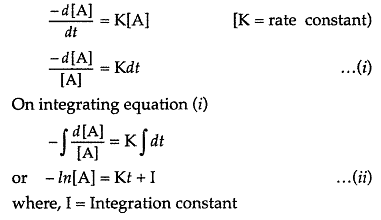
If t = 0 and [A] = [A]0, where [A]0 is the initial concentration of the reactant.
Then equation (ii) becomes -ln[A]0 = I ……………. (iii)
Substitute the value of I in equation (ii)
-ln[A] = Kt – ln[A]
ln[A]0 – ln[A] = Kt

This is termed an integrated rate equation for the first-order reaction.
For Latest Updates on Upcoming Board Exams, Click Here: https://t.me/class_10_12_board_updates
Also check:



Comments