



Education Content Expert
Ionic Compounds are neatly packed crystalline solids with ions of opposite charges. They are also known as electrovalent compounds. It can be said further that, the compounds which are held by ionic bonds are categorized as ionic compounds. Formation of Ionic Compounds usually takes place when there is a reaction between metals and non-metals. Elements need to gain electrons or lose electrons in order to attain their nearest inert gas or noble gas configuration. Here, metals lose electrons and non-metals gain electrons to form octet which helps them to attain stability.
Read More: NCERT Solutions for Class 10 Science
| Table of Content |
Key Terms: Ionic Compound, Ionic Bond, Electron, Sodium Chloride, Metals, Non-metals, Atoms, Electrostatic Force, Cations
Formation of Ionic Compounds
[Click Here for Sample Questions]
Ionic Compounds are formed when metals react with non-metals. Ionic bonds (which form ionic compounds) are basically the electrostatic force of attraction between two oppositely charged atoms. The ionic bond is formed between an anion and a cation. A metal and a non-metal are bonded with the electrostatic force of attraction with each other, due to which the bond between them is known as chemical bonds.
Example of Ionic Compound
Sodium Chloride (NaCl), a common salt, is a well-known example of Ionic Compounds. During the formation of Sodium Chloride, sodium is metal while chlorine is a non-metal. Sodium (metal) reacts with chlorine (non-metal) to form sodium chloride.
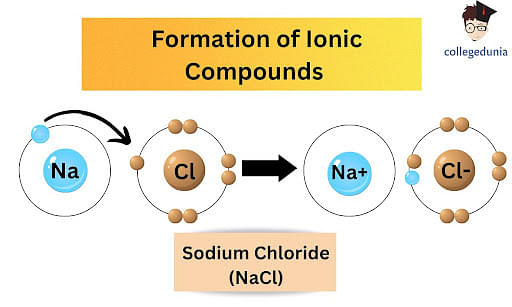
Formation of Ionic Compounds (Sodium Chloride)
- Here, the atomic number of sodium (Na) is 11 so its electronic configuration will be – 2, 8, 1.
- As per the electronic configuration, there is only one electron in the outermost shell of sodium. Hence, sodium will donate electrons and form a sodium ion, i.e. – Na+.
- On the other hand, the atomic number of chlorine is 17 with electronic configuration – 2, 8, 7.
- Here, chlorine is having 7 electrons in its outermost shell and will need one more electron to become stable or form an inert gas configuration.
- Chlorine will take one electron from a sodium atom and convert it into a negatively charged chloride ion i.e. – Cl-.
- So, when sodium reacts with chlorine, it donates its outermost electron to the chlorine.
- Due to electrostatic forces, the oppositely charged elements are held together to form sodium chloride or NaCl.
Read More:
Cations and Anions
[Click Here for Previous Year's Questions]
The structure of Ionic compounds is based on the sizes of their cations and anions.
Cation
- The number of electrons is less in comparison to the protons forming a positive charge.
- In order to form a cation, an element will have to lose one or more electrons and become a ‘+’ which is the sign to indicate a cation.
- For example, Mg2+ is a cation.
Anion
- The number of electrons in an anion is more in comparison to the number of protons forming a negative charge.
- An element, in order to form an anion, will have to lose one or more electrons and become ‘-’ a sign used for denoting them.
- For example, O2- is a anion.

Cations and Anions
Read More: Difference between Cations and Anions
Structure of Ionic Compound
[Click Here for Sample Questions]
Ionic compounds have structures with are based on the relative sizes of the anions and the cations. The ionic compounds are strongly held due to the strong electrostatic attraction between the oppositely charged ions (positive and negative ions).
The forces acting in between the positive and negative ions are what hold them in proper structure. As they are held so tightly, in order to break the bonds, a lot of energy will be required. Hence, these ionic compounds will eventually have a high melting point as well as a high boiling point.
Properties of Ionic Compounds
[Click Here for Previous Year's Questions]
Here are the important properties of ionic compounds:
- Physical Properties: Ionic compounds are generally hard to break due to the strong force of attraction between the negative and positive ions. However, when applied pressure, they break into pieces. Hence, they are considered brittle.
- Solubility: Ionic compounds are soluble in polar solvents such as water. In non-polar solvents like petrol, gasoline, etc their solubility tends to decrease.
- Melting and Boiling Points: Ionic compounds require a lot of energy to break the ionic bonds. Hence, these compounds have high boiling and melting points.
- Conduction of Electricity: In a solid state, Ionic compounds do not conduct electricity as the movement of ions is not possible. But, when in a molten state, they act as good conductors as the ions move freely as there remain no more electrostatic forces between the ions.
Read More: Factors Affecting Solubility
Ionic Character Formula
[Click Here for Sample Questions]
Ionic Character can be explained as a magnitude of charge separation among the polar covalent bonds. It shows the difference between the electronegativity of the two atoms.
Δχ = χB − χA
With the increase in electronegativity, an increase in ionic character and bond polarity takes place.
Applications of Ionic Compounds
[Click Here for Previous Year's Questions]
A few of the applications of the Ionic compounds are given below:
- Sodium Chloride (NaCl) is used in ordinary tablets.
- Magnesium Hydroxide [Mg (OH)2 ] is used to treat acidity as antacids.
- Sodium Fluoride (NaF) is used in toothpaste.
- Sodium Bicarbonate (NaHCO3) is used as baking soda for making cakes, idlis, etc, and also for cooking purposes.
- Potassium Phosphate (K2 PO2) is used as an additive in food.
- Magnesium sulphate (MgSO4) is required for water purification.
- Other than that, ionic compounds like boric acid and oxides are also used for preserving wood.
- Ionic compounds like gibberellic acid are used for growth regulators.
- Ionic compounds are also used in paint pigmentation as they are resistant to organic solvents.
Read More:
Things to Remember
- Ionic Compounds are defined as crystalline solids formed by neatly packed ions of opposite charge which are held together by ionic bonds.
- The ionic bonds are formed due to the electrostatic forces between the elements.
- The positively charged ions are known as cations and are denoted by the symbol ‘+’. The negatively charged ions are known as anions and are denoted by the symbol ‘-’
- Ionic compounds are brittle in nature, are water soluble, have high melting and boiling points, and they are good conductors of electricity while in a molten state.
- The ionic character formula of an ionic compound is Δχ = χB − χA.
- Ionic compounds have structures based on the sizes of their cations and anions.
- Ionic compounds are usually very helpful in our day-to-day activities.
Previous Years’ Questions (PYQs)
- Ionic compounds are formed most easily with…
- Sodium chloride is an ionic compound whereas hydrogen chloride… (KEAM)
- HCL gas is covalent and NaCl is an ionic compound… (KCET 2016)
- Lattice energy of an ionic compound depends upon… (EAMCET 2009)
- In crystals of which of the following ionic compounds… (NEET 1998)
- The compound which contains both ionic and covalent bonds is… (JEE Advanced 1979)
- Most favourable condition for ionic bonding are… (BHU UET 2007)
- Among the following, the compound that contains ionic,... (KCET 2009)
- Ionic bonds are directional in nature whereas covalent bonds are…
- Which one of the following molecules is polar… (JEE Main 2013)
- Which one of the following examples exhibit transient existence… (JKCET 2007)
- Which of the following pair have identical bond order… (KEAM)
Sample Questions
Ques. Is MgO an ionic compound? (2 Marks)
Ans. Mg loses two electrons to form an octet. An oxygen atom will gain two electrons to form an octet. Due to attraction in opposite charges between the ions the final formula of magnesium oxide is MgO.
Ques. What is an ionic compound? (2 Marks)
Ans. Ionic compounds are those compounds that are made up of ions. These ions are atoms that gain or lose electrons, leading to a net positive or negative charge. Metals tend to lose electrons, thus, have a net positive charge and are cations whereas Non-metals tend to gain electrons, creating a net negative charge of anions.
Ques. What makes ionic compounds stable? List the two parts of an Ionic Compound. (2 Marks)
Ans. The electrostatic force in between the oppositely charged atoms in the ionic compounds is what makes it stable. Ions with the exact charges will repel each other.
Ionic compounds are made up of positive and negatively charged particles. The positively charged ions are cation. The negatively charged ions are anions.
Ques. What is an example of the Ionic bond? (2 Marks)
Ans. An ionic bond is formed when a positively charged ion with a negatively charged ion and the transfer of one electron to another. A chemical compound, Sodium Chloride, is an example of an ionic compound. Sodium is metal whereas chlorine is non-metal. Sodium reacts with chlorine in order to form sodium chloride.
Ques. Is heat able to break the ionic bonds? (2 Marks)
Ans. Ionic compounds consist of both positive and negative charges which are called ionic compounds. In order to break this force, it requires a lot of heat, hence, ionic compounds have higher melting and boiling temperatures.
Ques. Is energy released in an ionic bond? (2 Marks)
Ans. While breaking the ionic compounds, extra energy is removed from the ions. Due to heat, the extra energy is released because of the breaking of the ions.
Ques. Can an Ionic compound be liquid? (2 Marks)
Ans. An ionic compound in case dissolved or melted in water is able to exist as liquid too. For example- if NaCl (salt) is dissolved in water, the electrolyte in the molten state in fuel cells is formed.
Ques. What are some examples of Ionic compounds? (3 Marks)
Ans. There are a lot of ionic compounds around us. Ionic Compounds include
- Hydroxides,
- Sulphides,
- Oxides,
- Salts,
- The majority of the inorganic compounds.
Ques. Which Ionic bond holds water together? (2 Marks)
Ans. Hydrogen bonds formed between hydrogen and oxygen atoms of the water molecules. The attraction between the water molecules creates a bond in hydrogen atoms forming an ionic bond.
Check-Out:



Comments