



Education Journalist | Study Abroad Lead
Grignard reagent is an extremely strong chemical compound that occupies a vital space in organic chemistry. It is used to produce alcohol by a reaction of the reagent with aldehydes and ketones. Grignard reagent can be prepared from haloalkanes and aryl halides. It bonds carbon atoms and has polar carbon-magnesium bonds. The preparation and reaction mechanism of the Grignard reagent requires the presence of dry ether which will be discussed in-depth in this article.
| Table of Content |
Key Terms: Optical isomers, Isomers, componds, stereoisomer, chiral atom, carbon, atom, alcohol, Grignard reagent, haloalkanes, aryl halides
What is Grignard Reagent?
[Click Here for Sample Questions]
The Grignard reagent is an organometallic compound named after French chemist Victor Grignard. It is represented by R-Mg X. The R is the carbon compound belonging to the alkyl group making it an organic compound while Mg is magnesium which is a metal. The X in the representation is a halide. Therefore, it is alkyl magnesium halide.
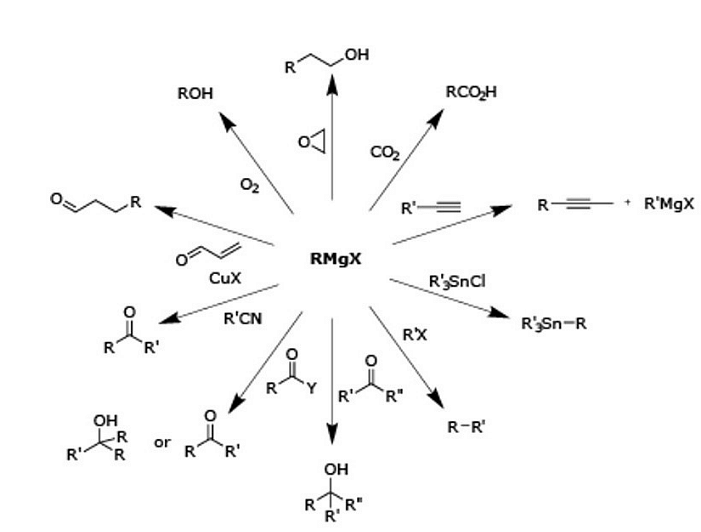
Grignard Reagent
The organometallic bond is the covalent bond while the bond between Mg and X is ionic. Examples of Grignard reagents are Methylmagnesium Bromide - CH3-MgBr, Ethylmagnesium Bromide - Et-MgBr and Phenylmagnseium Bromide - C6H5-MgBr.
The Grignard reagent is highly reactive. This is because the electron pair of Magnesium is shifted to -R which makes it partially negative and Mg becomes partially positive. Therefore, a polarity is created in the bond. During the reaction process, the bond breaks between R and Mg and -R becomes highly reactive due to the presence of a negative charge.

Reaction of Acetaldehyde with Grignard Reagent
The Grignard reagent is also known as a strong nucleophile since it donates electron pairs to electrophiles during the chemical bond.
Read More:-
| Chapter Related Concepts | ||
|---|---|---|
| Ester Hydrolysis | Fehling Test | Iodoform Test |
| Hell-Volhard-Zelinsky Reaction | Friedel-Crafts acylation reaction | Butyric Acid |
Preparation of Grignard Reagent
[Click Here for Sample Questions]
Grignard reagent can be prepared by taking alkyl halides or aryl halides. When the reaction of alkyl halide is done with Magnesium in presence of dry Ether which will act as a solvent, it must be noted that the solvent must be dry as the Grignard reagent is highly unstable in water or the presence of moisture.

Preparation of Grignard Reagent
Tetrahydrofuran can also be used as an alternative solvent for the synthesis of the reaction. In the reaction, the magnesium halide part of the reagent and the Grignard reagent act as a carbanion. The quality testing of the Grignard reagent is done via titration in which methanol is used.
It must be kept in mind that the reaction with the Grignard reagent can be exothermic when carried out on a large scale.
Reaction Mechanism
[Click Here for Sample Questions]
The haloalkanes or aryl halides with sp3 or sp2 hybridised carbon atoms when reacted with Magnesium metal give Grignard reagent which is an organometallic compound. Represented by R-Mg-X, where R is an alkyl or aryl group while X is a halogen, the Grignard reagent easily forms a carbon-carbon bond of 1°, 2°, and 3° alkyl halides which then varies in the reactivity.
The first step in the reaction mechanism is the reaction of alkyl or aryl halides with Magnesium.
The reaction will lead to a change of electrophilic alkyl halide into nucleophilic carbanion molecules. The reagent in the reaction attacks the electrophilic carbon in the polar bond of the carbonyl group.

Reaction Mechanism
In the reaction mechanism, the solvent plays a crucial role. The reaction gets completed when alcohol is produced after the addition of Grignard reagent in the carbonyl group.
In the case of halogens, the reactivity decreases in the order I > Br > Cl > F, therefore organoflourides are not used to synthesize Grignard reagents. The polar bond between carbon and magnesium reacts easily with the carbon of ketones, aldehydes and esters.
The reaction mechanism of Grignard reagent to Aldehyde and Ketones happens due to the polarization of the bond between carbon and magnesium which is the result of electronegativities of both carbon and magnesium.
Important Reactions of Grignard Reagent
[Click Here for Sample Questions]
The following are some of the important reactions of Grignard Reagent.
- Reaction with Aldehydes
In this reaction, the Grignard forms a carbon-carbon bond which results in the formation of alkoxide, a conjugate base. To get alcohol, an acid must be added towards the end.

Reaction with Aldehyde
- Reaction with Ketones
The reaction will be the same as aldehydes wherein a carbon-carbon bond is formed and acid is added in the end to obtain tertiary alcohol.

Reaction with Ketones
- Reaction with Esters
The reaction process with ester remains the same as with aldehydes. The carbon-carbon bonds break and a new carbon-carbon bond is formed. The result is the formation of alcohol from alkoxides.
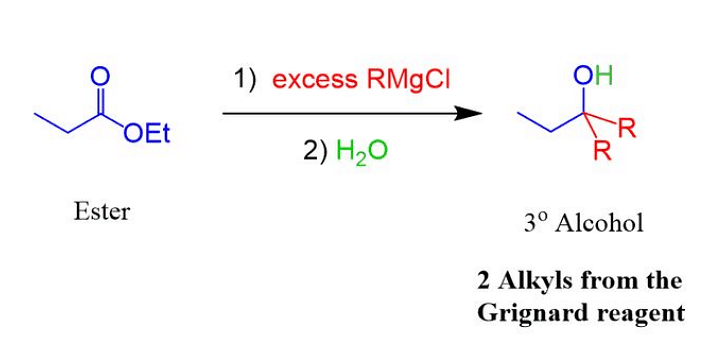
Reaction with Ester
- Reaction with Acid Halides
The same process happens in the case of acid halides too. The reaction takes place as:

Reaction with Acid Halides
- Reaction with Epoxides
Grignard reagents react to epoxides to form carbon-carbon bonds. The reaction is the same as the SN2 reaction as it gets added to the less substituted end of the epoxide. After the addition of acid, alcohol is obtained.

Reaction with Epoxides
- Reaction with Carbon Dioxide
Grignard reagents react to carbon dioxide to form carboxylates. The reaction is similar to aldehydes or ketones. The carboxylates are converted to carboxylic acids once an acid (HNO3) is added.

Reaction with CO2
Things to Remember
- The Grignard reagent is used to prepare alcohol by a reaction of the reagent with aldehydes and ketones.
- It is represented by R-Mg X where R is the carbon compound belonging to the alkyl group making it an organic compound while Mg is magnesium which is a metal. The X in the representation is a halide. Therefore, it is alkyl magnesium halide.
- Examples of Grignard reagents are Methylmagnesium Bromide (CH3-MgBr), Ethylmagnesium Bromide (Et-MgBr) and Phenylmagnesium Bromide(C6H5-MgBr).
- Grignard reagent can be prepared by the reaction of an alkyl halide with Magnesium in presence of dry Ether which acts as a solvent.
- The reaction mechanism follows the reaction of alkyl or aryl halides with Magnesium which changes the electrophilic alkyl halide into nucleophilic carbanion molecules and the reagent in the reaction attacks the electrophilic carbon in the polar bond of the carbonyl group.
- The reaction mechanism of Grignard reagent to Aldehyde and Ketones is the result of the polarization of the bond between carbon and magnesium due to the electronegativities of both carbon and magnesium.
- The Grignard reagent reacts with aldehydes, ketones, esters, acid halides, epoxides to give alcohol while it reacts with carbon dioxide to give carboxylic acid.
Read More:-
Sample Questions
Ques. What is Grignard reagent? (2 marks)
Ans. The Grignard reagent is an organometallic compound that acts as a strong base in chemical reactions. It is used to prepare alcohol. It has a carbon-magnesium bond present that forms carbanions in chemical reactions. The molecular formula for the Grignard reagent is RMgX where R is the carbon compound belonging to the alkyl group making it an organic compound while Mg is magnesium which is a metal. The X in the representation is a halide. Therefore, it is alkyl magnesium halide.
Ques. Give an example of a Grignard reagent in a chemical reaction. (2 marks)
Ans. An example of a Grignard reagent can be when ethyl iodide is treated with an ethereal solution of magnesium, we obtain ethyl magnesium iodide. This ethyl magnesium iodide is also known as a Grignard reagent. The reaction can be represented as:

Ques. What happens when the Grignard reagent is reacted with carbon dioxide?(2 marks)
Ans. When the Grignard reagent is added to carbon dioxide, it forms carboxylates. The reaction is similar to aldehydes or ketones. The carboxylates are converted to carboxylic acids once an acid (HNO3) is added. The representation of the reaction is as follows:

Ques. How can alcohol be synthesized using the Grignard reagent? (5 marks)
Ans. The synthesis of alcohol can be done using the Grignard reagent as it adds to Carbonyl Compounds to give primary, secondary and tertiary alcohols. A primary alcohol is obtained by reacting Grignard reagent R-MgX with Formaldehyde. The reaction can be represented as:

To obtain secondary alcohol, the reagent has to react with aldehyde and the reaction can be represented as:

The tertiary alcohol is synthesized by using a ketone with Grignard reagent.
Ques. What is the limitation of the Grignard reagent? (3 marks)
Ans. The major limitations of the Grignard reagent are as follows:
- They react readily with protic solvents such as water or with functional groups with acidic protons like alcohols and amines. This changes the yield and protonolysis and the oxidation process affects the reaction.
- Atmospheric moisture also changes the yield of the Grignard reagent. Hence, it is important to ensure that humidity is not present while carrying out the process. The use of ultrasound can be done to activate magnesium metal which in turn can absorb the moisture present in the reaction environment.
- Grignard reagents do not readily form a carbon-carbon bond by reacting with alkyl halides by the SN2 mechanism.
Ques. What is the reaction of Grignard reagent with epoxides? (2 marks)
Ans. Grignard reagents react to epoxides to form carbon-carbon bonds. The reaction is the same as the SN2 reaction as it gets added to the less substituted end of the epoxide. After the addition of acid, alcohol is obtained.

Reaction with Epoxides
Ques. Write the reactions of Williamson synthesis of 2-ethoxy-3-methylpentane starting from ethanol and 3-methyl pentane-2-ol. (2 marks)
Ans: In Williamson’s synthesis, the alkyl halide should be primary. Thus, the alkyl halide should be derived from ethanol and the alkoxide ion from 3-methyl pentane-2-ol. The synthesis is as follows

Ques. Explain why propanol has a higher boiling point than hydrocarbon, butane? (2 marks)
Ans: The molecules of butane are held together by weak van der Waal’s forces of attraction while those of propanol are held together by stronger intermolecular hydrogen bonding.

Ques. Alcohols are comparatively more soluble in water than hydrocarbons of comparable molecular masses. Explain this fact. (2 marks)
Ans: Alcohols can form hydrogen bonds with water and by breaking the hydrogen bonds already existing between water molecules. Therefore, they are soluble in water.

On the other hand, hydrocarbons cannot form hydrogen bonds with water and hence are insoluble in water.
Ques. What is meant by the hydroboration-oxidation reaction? Illustrate it with an example. (2 marks)
Ans: The addition of diborane to alkenes to form trialkyl boranes followed by their oxidation with alkaline hydrogen peroxide to form alcohols is called hydroboration-oxidation. For example,

For Latest Updates on Upcoming Board Exams, Click Here: https://t.me/class_10_12_board_updates
Check-Out:



Comments