



Education Journalist | Study Abroad Lead
Niobium is also called columbium. In the Periodic Table of Elements, Niobium is placed in the fifth group between Vanadium and Tantalum. The name was derived in the honor of Niobe, the daughter of Greek king Tantalus. Tantalum and Niobium metal look very similar. It is greyish and shiny in appearance. It is well-known for its superconductivity and anticorrosive properties.
| Table of Content |
Keyterms: Niobium, Columbium, Periodic table of elements, Tantalum, Vanadium, Crystal, Melting point, Superconductors, Electron
Physical Properties of Niobium
[Click Here for Sample Questions]
- Niobium is ductile, greyish, and also lustrous.
- The electronic configuration of Niobium is Kr4d45s1 and has electrons in the outer shell.
- It maintains body-centered cubic crystal form throughout absolute zero temperature to the melting point.
- It is soft and ductile in its purest form.
- Niobium comprises three-element type II Superconductors.
- The superconductivity varies from moderate to high, depending on the purity of Niobium.
- It contains paramagnetic properties.

Fig. Niobium
Also Read:
| Related Articles | ||
|---|---|---|
| Group 18 Elements | Periodic Properties Of Elements | Vapour Pressure |
| Melting and Boiling Point | Dispersion Forces | Critical Pressure |
Chemical Properties of Niobium
[Click Here for Sample Questions]
- Niobium turns blue to green when exposed to air or other elements at room temperature.
- The atomic number of Niobium is 41.
- It has a relatively high melting point and can go up to 2,468 °C
- It has high superconductivity properties and is anti-corrosive.
- It gets layers of dielectric oxides when in contact with air.
- Niobium’s chemical properties are quite similar to Tantalum.
- Niobium and its compounds are considered toxic.
- It comprises one stable isotope in the earth’s crust.
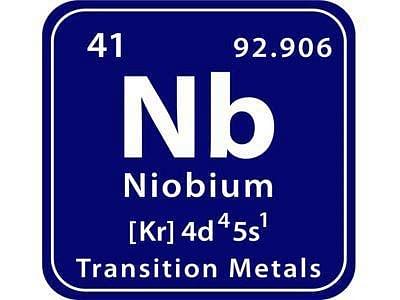
Fig. Chemical properties of Niobium
Isotopes of Niobium
[Click Here for Sample Questions]
- Niobium consists of stable Isotope 93Nb.
- More than 32 isotopes have been synthesized to date.
- 92Nb is the most stable with a half-life of 34.7 million years.
- 113Nb is the least stable isotope of Niobium.
Important Facts
[Click Here for Sample Questions]
- It is one of the common minerals found on earth, and in the form of pyrochlore mineral.
- Niobium is mined from the mineral columbite where Tantalum is also present.
- While Niobium is obtained from ore, it is in the form of Niobium Pentoxide. It is dissolved in Hydrofluoric acid, thereby obtaining complex Niobium compounds. They are then reduced by metallic sodium.
- Due to high plasticity, it is easy to make Niobium foil.
- Niobium can be easily anodized. This means, its surface can be colored in many ways by controlling the thickness of the oxide film on the surface of the metal.
- Around 25 isomers of Niobium have been discovered, having atomic masses ranging from 84 to 104.
- The melting point of Niobium pentafluoride is 79°C and it is a white solid.
- The melting point of Niobium pentachloride is 203.4°C and it is yellow.
Uses of Niobium
[Click Here for Sample Questions]
- About 90% of the world’s Niobium is consumed for iron and steel production in ferroniobium form.
- Niobium is widely used in medical diagnostic magnetic resonance imagers and also nuclear magnetic resonance instruments for spectral lines because of its superconductivity.
- It is also used in the production of spacecraft engines, rockets, and heat resistance components in the aerospace industry.
- Niobate ceramic is used for creating capacitors, lithium niobate, and potassium niobate. These are crystals that are used for optoelectronics and electronics.
- Niobium is also used to make cookers, brake pads, and heaters.
- Gold and silver along with Niobium are used to make commemorative coins.
Things to Remember
- It is not typical for elements in the 5th group of the periodic table to have electrons in the outer shell, except for Niobium.
- The electronic configuration of Niobium is Kr4d45s1 and has electrons in the outer shell.
- Niobium comprises three-element type II Superconductors.
- It has a relatively high melting point and can go up to 2,468 °C
- Niobium consists of stable Isotope 93Nb.
- It is one of the common minerals found on earth, and in the form of pyrochlore mineral.
Read More:
Sample Questions.
Ques. What is a distinguishing feature of metallic solid? (1 Mark)
Ans. High electrical and thermal conductivity due to the presence of free electrons is a distinguishing feature of metallic solid.
Ques. What is Niobium? (2 Marks)
Ans. Niobium is a metal found in the fifth group of periodic tables between Vanadium and Tantalum. It is the 34th most commonly found metal in the earth’s crust. It is greyish, ductile, and lustrous metal. Because of Niobium’s superconductivity, they are used for making alloys that are heat resistant. It also has paramagnetic properties. The electronic configuration of Niobium is Kr4d45s1.
Ques. write the chemical properties of Niobium.(2 Marks)
Ans. Niobium turns blue to green when exposed to air or other elements at room temperature. It has a relatively high melting point and can go up to 2,468 °C. It has high superconductivity properties and is anti-corrosive. It gets layers of dielectric oxides when in contact with air. Niobium’s chemical properties are quite similar to Tantalum. Niobium and its compounds are considered toxic. It comprises one stable isotope in the earth’s crust.
Ques. What are the uses of Niobium? (3 Marks)
It is also used in the production of spacecraft engines, rockets, and heat resistance components in the aerospace industry. Niobate ceramic is used for creating capacitors, lithium niobate, and potassium niobate. These are crystals that are used for optoelectronics and electronics. Niobium is also used to make cookers, brake pads, and heaters. Gold and silver along with Niobium are used to make commemorative coins.
Ques. Niobium crystallizes in a body-centered cubic structure. If the density is 8.55 gcm–3, then the atomic radius of niobium, (given that its atomic mass is 93 u) is:
(A) 49.8 pm
(B) 150.1 pm
(C) 143.1 Å
(D) 143.1 pm (4 Marks)
Atomic mass (M) = 93u = 93 g/mol
We know, Avogadro number, N = 6.022 × 10²³
given lattice is body - centered cubic,
so, number of atoms per unit cell (z) = 2
we know,
=> 8.55 = (2 × 93)/(a3 × 6.023 × 1023)
=> 8.55 × a3 × 6.023 × 1023 = 186
=> a3 = 186/(8.55 × 6.023 × 1023)
=> a3 = 36.124 × 10-24
=> a = 3.3057 × 10⁻⁸ cm
for BCC unit cell, radius = \(\frac{\sqrt{3}a}{4}\)
= (√3 × 3.3057 × 10^-8)/4
= (1.732 × 3.3057)/4 × 10-8
= 1.431 × 10⁻⁸ cm = 1.431 × 10⁻¹⁰ m
= 1.431 A°
Hence, the atomic radius of Niobium is 1.431A°.
For Latest Updates on Upcoming Board Exams, Click Here: https://t.me/class_10_12_board_updates
Check-Out:



Comments