



Education Journalist | Study Abroad Lead
Inflation rate formula is an integral economic indicator that helps in measuring the increase of price in certain products, over some time. Policymakers and economic institutions consider inflation as a significant factor that harms the economic growth, leading to a decrease of purchasing power of the public, though the money supply to the economy increases beyond the optimum level. The inflation rate formula thus helps the concerned authorities to understand the relative level of change in price and take effective steps to keep it under control. A controlled inflation rate will ensure a high standard of living and optimum purchasing power for every kind of consumer.
Read More: GDP
| Table of Content |
Key Takeaways: Inflation, CPI, Money supply, Purchasing Power, Deflation, Economy
Inflation
[Click Here for Sample Questions]
Inflation is a situation in which the cost of a group of products appears to increase when compared to that of a period before that. When the cost of the price keeps on increasing, the requirement for money increases, and substantial to that, many economic problems occur.
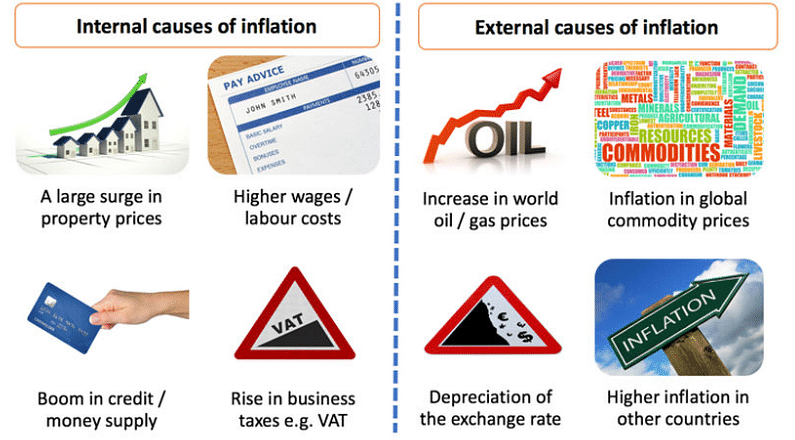
Causes of Inflation
In terms of macroeconomics, inflation is the situation in which the supply of money into the economy increases beyond the optimum level, creating an abundance of money in the economy. This situation harms a nation’s economy from three perspectives:
- Reduction in the value of money in the foreign exchange market.
- Increase price of commodities making it costly to live.
- Reducing the purchasing power of the currency.
These three situations are inter-connected. When we have more flow of funds into the economy, the cost will increase in the speculation that everyone will have more than enough money during those times. This is one of the reasons why things become costly during festival season. The price increase happens simultaneously with the increase of people’s income. This reduces the purchasing power of our currency i.e. your salary might have increased from Rs.1000 to Rs.1, 500. But at the same time, you would be asked to pay Rs.15 for what you bought for Rs. 10.
Also Read: Disposable Income Formula
Inflation: Need For Calculation
[Click Here for Sample Questions]
Inflation is an economic indicator of some flaws in the structure of the economy. In the long run, inflation will reduce economic growth and will make it difficult for common people to live. It will adversely affect the living standard of the common man.
Most often, the government will be forced to take necessary steps to bring down the inflation rate. The dearness allowance provided to the employees to reduce the effect of inflation on them is a classical example of government intervention in this area. When the economy is facing inflation, the government of a country, together with other economic institutions (like the central bank) take the following measures to reduce the flow of money supply in the economy:
- Sell Gilt securities (securities issued by government bodies) to collect money from the public.
- Increase the rate of public lending to collect money in the form of increased interest liability.
- Increase the rate of interest at which the central bank lends money to other banks.
To operate these measures, the government should be aware of the rate of increase in the price of different commodities. Thus, calculation of the Inflation rate is an inevitable task for the government to take necessary measures.
Consumer Price Index (CPI)
[Click Here for Sample Questions]
Consumer price index (CPI) is a measure of change in the price level of a basket of commodities purchased by households when compared with that of a base year. Here the ‘basket of commodities’ refers to the group of products that a household buys for their daily purpose. In other words, CPI is the cost of living index that denotes the change in the price level of commodities that the common man purchases, over a period of time.
CPI is often relied on as a component to measure the inflation rate. The annual relative change denotes the direction of inflation in an economy.
Inflation rate formula is given by,
Inflation rate = (change in price / previous year price) x 100
Where change in price = current year price – previous year price
Inflation being an increase in the price, the current year price would be always more than that of a previous year price. The comparison would be made by taking a year’s CPI as the base price (most often, 100) and assessing the change in the price.
Things to Remember
- Inflation refers to the increase in the supply of money into the economy beyond the expected limit, which creates an unfavorable imbalance.
- Inflation causes a reduction in the purchasing power of the currency, making the cost of living high and unaffordable to common people.
- The central bank and government of a country take effective steps like open market operation and interest rate adjustments to bring down inflation in the economy.
- CPI (Consumer Price Index) is often relied on by different economic bodies to calculate the inflation rate on an annual basis.
- Inflation rate = (change in price / previous year price) x 100 is a general formula to calculate the inflation rate, where a price change denotes the difference between the current year's price and the previous year's price.
- Deflation is a situation opposite to that of inflation: price of commodities goes on decreasing, which is referred to as a negative form of inflation.
Also Read:
Sample Questions
Ques. How does inflation differ from deflation? (2 marks)
Ans. Inflation is the condition in which the flow of money supply into the economy is above the equilibrium level, leading to an increase in the volume of money in an individual’s hands, decreasing the purchasing power and a substantial increase in the price of different commodities.
On the other hand, deflation is the condition in which the money supply to the economy decreases below the optimum level, which may lead to falling in the commodities market.
Ques. State some reasons why inflation becomes harmful to the economy? (2 marks)
Ans. Following are the effects of inflation on the economy:
- Inflation leads to an increase in money supply to the economy at a rapid rate, which will reduce the value of our currency in the forex market.
- The growth of the economy will be redirected when the money with the public is beyond the general limit.
- The price of commodities will increase at a high rate.
- The investment mentality among people will increase which may increase the chance to be cheated.
Ques. State the role that CPI has with Inflation rate calculation. (2 marks)
Ans. CPI or the consumer price index is the index of change in the cost of living for a normal human being. In simple words, it is an economic measure that shows the change in the level of price of consumer goods.
CPI is often relied on as a measurement to calculate the inflation rate, as inflation is calculated commonly on the change in the price of household goods. The basket of household goods are mostly affected by the
Ques. Describe the components of the inflation rate formula. (2 marks)
Ans. Inflation rate = (change in price / previous year cost ) x 100
The component that helps in finding are as follows:
- Current year price: when a basket of commodities is chosen to understand the inflation rate, the current market price of the commodity should be known.
- Previous price: the previous year's price is the price of the base year with which the price change is compared. Most probably, it would be 10 years back i.e. if the current year is 2022, the price of the basket of commodities in 2012 would be taken as the previous price.
- Change in price: change in the price refers to the difference between the current price and the previous price.
- Note that, in most formulas, the CPI is used instead of price, which would also draw a similar conclusion.
Ques. The Cost of one-kilo rice was quoted as Rs 43 in 2010. In 2020, the cost will rise to Rs. 45. Then what would be the inflation rate in 2020 for rice? (2 marks)
Ans. Given, the cost of 1Kg rice in 2010 = 43
Cost of 1Kg rice in 2020 = 45
Inflation rate = (change in cost / previous year cost) x 100
Therefore, inflation rate = (45-43 / 43) x 100
= 4.65%
Ques. In 2000, the CPI of a basket of products showed a rise of 3% from its price in 1999, which was Rs. 300. If the price was Rs. 340 in 2010, calculate the inflation on the basket of products during the period. (2 marks)
Ans. Given,
The CPI of a basket of products in 2010 = 340
CPI of a basket of product on 2000 = 300 + 9 = 309
Inflation rate = (change in CPI / previous year CPI) x 100
Therefore, inflation rate = (340-309 / 309) x 100 = 10.03%
Ques. The inflation rate of alcohol products is marked as 25.7% from 2011 to 2021. What would be the price of the product in 2021, if the price in 2011 is marked as Rs. 150? (2 marks)
Ans. Given, the rate of alcohol in 2011 = 150
Let the rate of alcohol in 2021 be ‘X’
Inflation rate = (change in cost / previous year cost) x 100
Therefore, 25.7 = (X-150 / 150) x 100 = 188.5
Therefore, the rate of alcohol products in 2021 is Rs.188.5
Ques. The government of India suggested the related authorities take necessary steps to control the rising price of meat products. They were asked to suggest moderate measures if the inflation rate is below 25% and to take strict measures if the rate was above 25%. If the price increased from Rs.450 per kg to Rs.540 per kg within 10 years, then should the authority take a moderate or strict measure? (3 marks)
Ans. Given, the previous cost of 1Kg meat = 450
Current Cost of 1Kg meat = 540
Inflation rate = (change in cost / previous year cost) x 100
Therefore, inflation rate = (540- 450/ 450) x 100 = 20%
Here, the rate of inflation is 20%, which is below 25%. Therefore, the authorities can take a moderate measure.
Ques. The inflation rate of two different products is 25% and 35% respectively. If the price of the products were Rs.345 and Rs. 435 respectively, find which among them is the most expensive in the current price. (3 marks)
Ans. Given,
The previous price of product 1 = 345
The previous price of product 2 = 435
Inflation rate = (change in cost / previous year cost) x 100
That means for the product 1,
25 = (current price -345 / 345) x 100
Therefore,
Current price of product 1 = 431.25
Similarly, the current price of product 2 can be found as below,
35 = (current price – 435 / 435) x 100
That is, the current price of product 2 = 587.25
The second product is the most expensive, at the current price (Rs. 587.25)
Ques. In 1987, the CPI of a basket of products was priced at Rs.30. If the price was Rs. 40 in 1977, calculate the rate of change in the price. Is the change deflation or inflation? Mention. (3 marks)
Ans. Given, the price of 1977 = 40
Price on 1987 = 30
Rate of change in price = (change in cost / previous year cost) x 100
Therefore, 38 = (30-40 / 30) x 100
= - 33.33 %
Since then there is a negative trend in the growth, it is deflation.
For Latest Updates on Upcoming Board Exams, Click Here: https://t.me/class_10_12_board_updates
Check-Out:



Comments