



Education Journalist | Study Abroad Lead
Integration of Trigonometric Functions comprises the fundamental simplification techniques that use different trigonometric identities which can be written in an alternative form that are more amenable to integration. Integration can be carried out of two types of integrals namely Definite Integrals and Indefinite Integrals. Definite integrals are the integrals which have a start and an end value, whereas, Indefinite Integrals do not have a start and an end value. The integration of a function f(x) is given by F(x) and can be represented as ∫f(x)dx = F(x) + C.
| Table of Content |
Key Terms: Integration, Trigonometric Functions, Definite Integrals, Indefinite Integrals, Anti-Derivative, Trigonometric Identities
Read More: Application of Integral
Integration
[Click Here for Sample Questions]
Integration is a mathematical approach wherein we join and set up things back. Mathematically speaking, Integration is defined as the process to find the area under the curve. It can be represented in the given manner:
∫f(x) dx
Where ∫ is the symbol for Integration, f(x) is the integrand and 'x' is the coordination variable.
Integration should be possible of two types of integrals, in particular,
- Definite Integrals
- Indefinite Integrals
Definite integrals are those integrals which have a beginning and end value. This implies that the curve that is being examined is within an interval a,b. Indefinite Integrals are those integrals which don't have a beginning and an end value.
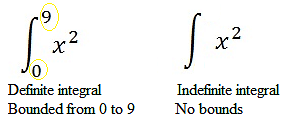
Definite and Indefinite Integrals
There are different approaches to integrating a function. These ways are
- Integration by Substitution
- Integration by Parts
- Integration of Trigonometric Functions
- Integration of Some Particular Functions
- Integration by Partial Fractions
Integrals Detailed Video Explanation
Read More:
Integration of Trigonometric Functions
[Click Here for Previous years Questions]
While integrating a function, on the chance that trigonometric functions are present in the integrand we can utilize trigonometric identities to simplify the function in order to make it simpler for integration.
The integration of a function f(x) is given by F(x) and can be represented as:
∫f(x)dx = F(x) + C
Where,
- R.H.S. of the equation refers to the integral f(x) with respect to x.
- F(x) is the anti-derivative or primitive.
- f(x) is the integrand.
- dx is the integrating agent.
- C is the constant of integration or arbitrary constant.
- x refers to the variable of integration.
Read More: Integral Calculus Formula
Formulas for Integration of Trigonometric Functions
[Click Here for Sample Questions]
Given below is a list of the formulas used for the integration of trigonometric functions:
- ∫sin x dx = – cos x + C
- ∫cos x dx = sin x + C
- ∫tan x dx = ln|sec x| + C
- ∫sec x dx = ln|tan x + sec x| + C
- ∫cosec x dx = ln|cosec x – cot x| + C = ln|tan(x/2)| + C
- ∫cot x dx = ln|sin x| + C
- ∫sec2x dx = tan x + C
- ∫cosec2x dx = -cot x + C
- ∫sec x tan x dx = sec x + C
- ∫cosec x cot x dx = -cosec x + C
- ∫sin kx dx = -(cos kx/k) + C
- ∫cos kx dx = (sin kx/k) + C
Read More: List of Integral Formula
Things to Remember
- In the Integration of Trigonometric functions, we use the basic simplification techniques to simplify the function to make it simpler for integration.
- The techniques involve the use of different trigonometric identities, that can be written in an alternative form, to make the integration simpler.
- The integration of a function f(x) is given by F(x) and it is shown as ∫f(x)dx = F(x) + C.
- In the above equation, R.H.S. of the equation means integral of f(x) with respect to x, F(x) is called anti-derivative or primitive, f(x) is called the integrand, C is called constant of integration or arbitrary constant, dx is called the integrating agent, and x is the variable of integration.
Previous Year Questions
- The Large Hand Of A Clock Is 42 Cm Long How Much D
- The Minimum Value Of 3cosx 4sinx 8 Is
- The Minimum Value Of 2 Cosec 2 Is
- The Minimum Value Of Sin X Cos X Is
- The Minute Hand Of A Clock Is 10 Cm Long How Far D
- The Minute Hand Of A Watch Is 1 5 Cm Long How Far
- The Period Of 2 Is
- The Period Of The Function 2x 3 3x 2 Is
- The Principal Value Of 1 3 2 Is
- The Principal Value Of 1 2 3 Is
- The Value O 3 Cot 76 Cot 16 Cot 76 Cot 16 Is
- The Value Of 1 2 3 179 Is
- The Value Of 1 7 6 Is
- The Value Of 12 84 156 132 Is
- The Value Of Cos 12 Cos84 Cos 156 Cos 132 Is
- The Value Of 2 48 2 12 Is
- The Value Of 2 1 X 1 X At X 1 5 Is
- The Value Of 2 7 4 7 6 7 Is Equal To
- The Value Of Cos 20 Cos 40 Cos 60 Cos 80 Is Equal
- The Value Of Cos 9 Sin 9 Is
Sample Questions
Ques. Determine the integral of the following function: f(x) = cos3x. (3 Marks)
Ans. Let us consider the integral of the given function as,
I = ∫ cos3 x dx
It can be rewritten as:
I = ∫ (cos x) (cos2x) dx
Use trigonometry identity: cos2x = 1 – sin2x as,
I = ∫ (cos x) (1 – sin2x) dx
= ∫ cos x – cos x sin2x dx
= ∫ cosx dx – ∫ cosx sin2x dx
= sin x – ∫ sin2x cos x dx. (Since, ∫ cos x dx = sin x + C) ……(1)
Let, sin x = t, then, cos x dx = dt
Substitute t for sin x and dt for cos x dx in the second term of the above integral.
I = sin x – ∫ t2 dt
= sin x – t3/3 + C
Again, substitute back sin x for t in the given expression.
Hence, ∫ cos3x dx = sin x – sin3x / 3 + C.
Ques. If f(x) = sin2 (x) cos3 (x) then determine ∫ sin2(x) cos3(x) dx. (3 Marks)
Ans. Let us consider the integral of the given function as,
I = ∫ sin2(x) cos3(x) dx
Use trigonometry identity: cos2 x = 1 – sin2x as,
I = ∫ sin2x (1 – sin2x) cos x dx
Let sin x = t then,
dt = cos x dx
Substitute these in the above integral as,
I = ∫ t2 (1 – t2) dt
= ∫ t2 – t4 dt
= t3 / 3 – t5 / 5 + C
Lastly, Substitute back the value of t in the above integral as follows
Hence, I = sin3x / 3 – sin5x / 5 + C.
Ques. Let f(x) = sin4(x) then find ∫ f(x)dx. i.e. ∫ sin4(x) dx. (3 Marks)
Ans. Let us consider the integral of the given function as,
I = ∫ sin4(x) dx
or
I = ∫ (sin2(x))2dx
Use trigonometry identity: sin2(x) = (1 – cos (2x)) / 2 as,
I = ∫ {(1 – cos (2x)) / 2}2 dx
= (1/4) × ∫ (1+cos2(2x)- 2 cos2x) dx
= (1/4) × ∫ 1 dx + ∫ cos2(2x) dx – 2 ∫ cos2x dx
= (1/4) × [ x + ∫ (1 + cos 4x) / 2 dx – 2 ∫ cos2x dx ]
= (1/4) × [ 3x / 2 + sin 4x / 8 – sin 2x ] + C
= 3x / 8 + sin 4x / 32 – sin 2x / 4 + C
Hence, ∫ sin4(x) dx = 3x / 8 + sin 4x / 32 – sin 2x / 4 + C.
Ques. Find the integral of the function f (x) defined as, f (x) = 2x cos (x2 – 5) dx. (3 Marks)
Ans. Let us consider the integral of the given function as,
I = ∫ 2x cos (x2 – 5) dx
Let (x2 – 5) = t ……(1)
Now differentiate both sides with respect to x as,
2x dx = dt
Substituting these values in the above integral,
I = ∫ cos (t) dt
= sin t + C ……(2)
Put the value of equation (1) in equation (2) as follows,
I = sin (x2 – 5) + C
Hence, this is the required integration for the above-given function.
Ques. Determine the value of the given indefinite integral, I = ∫ cot (3x +5) dx. (3 Marks)
Ans. The given integral can be written as,
I = ∫ cot (3x +5) dx
= ∫ cos (3x +5) / sin (3x +5) dx
Let, t = sin(3x + 5) so,
dt = 3 cos (3x+5) dx
Therefore,
cos (3x+5) dx = dt/3
And
I = ∫ dt / 3 sin t
= (⅓ ) ln | t | + C
Now, replace t by sin (3x+5) in the above expression.
I = (⅓ ) ln | sin (3x+5) | + C
This is the required integration for the given function.
Ques. Calculate the following integral: ∫x2 sinx3 dx. (3 Marks)
Ans. ∫x² sin³x = ∫ sinx³ x² dx
Set u = x³ and du = 3x²dx or du/3 = x² dx, then we have:
= ∫x² sinx³dx
= ∫sinu du/3
= 1/3 * ∫sinu du
= 1/3 *(-cosu) + C
= 1/3 *(-cosx³) + C
Ques. Evaluate: ∫sin5 (x) dx (3 Marks)
Ans. Using the reduction formula, we have
∫sin5(x) dx=− ⅕ sin⁴(x) cos(x) + ⅘ ∫sin3(x) dx.
Using the reduction formula again, we have
∫sin5(x) dx = - ⅕ sin⁴(x) cos(x) +⅘ ∫sin3(x) dx
= -⅕ sin⁴(x) cos(x) + ⅘ ( - ⅓ sin³(x) cos(x) + ⅔ ∫sin(x) dx)
= - ⅕ sin⁴x cosx - 4/15 sin²x cosx - 8/15 cosx + C
For Latest Updates on Upcoming Board Exams, Click Here: https://t.me/class_10_12_board_updates
Check-Out:



Comments