



Exams Prep Master
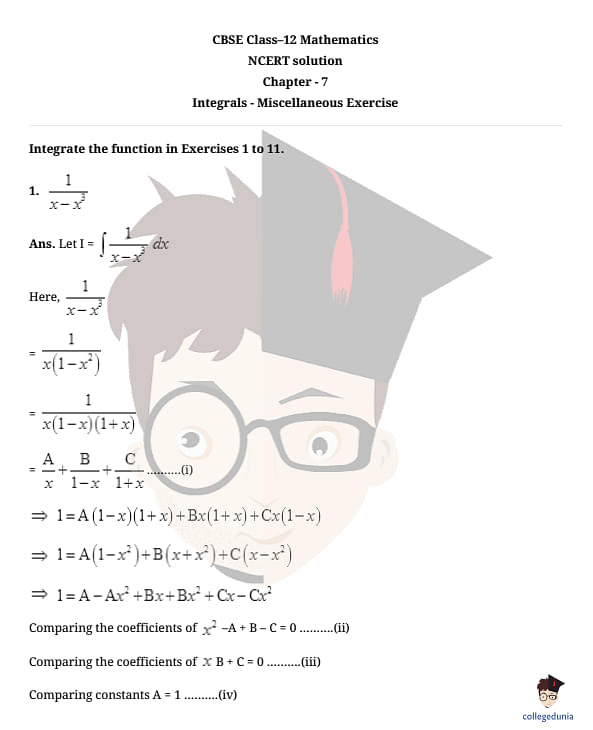
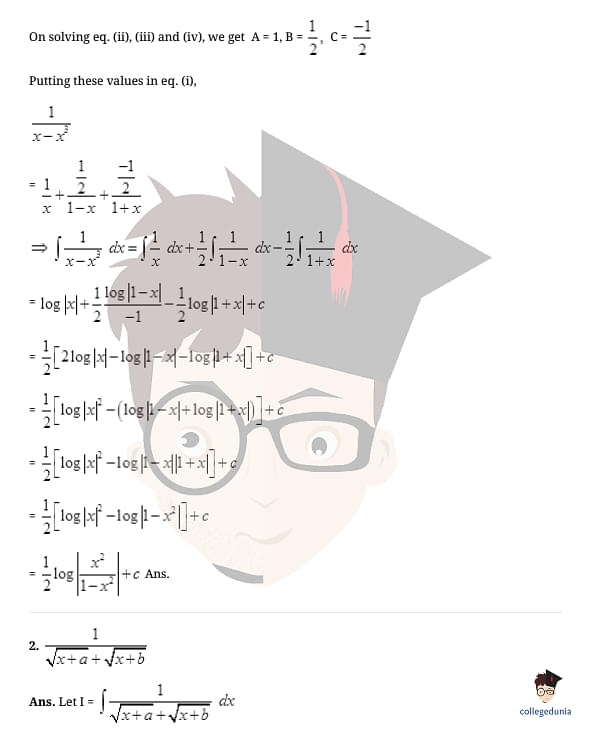
NCERT Solutions for Class 12 Maths Chapter 7 Integrals Miscellaneous Exercise is covered in this article. This exercise of Chapter 7 is based on all the topics that are taught in the chapter; Integration as an Inverse Process of Differentiation, Methods of Integration, Integration by Partial Fractions, Integration by Parts, Definite Integral, Fundamental Theorem of Calculus, Evaluation of Definite Integrals by Substitution.
- NCERT Solutions for Class 12 Maths Chapter 7 will carry a weightage of around 6-18 marks in the CBSE Term 2 Exam 2022.
- NCERT has provided a total of 44 problems and solutions based on the important topics of the exercise.
Download PDF NCERT Solutions for Class 12 Maths Chapter 7 Integrals Miscellaneous Exercise


NCERT Solutions for Class 12 Maths Chapter 7: Important Topics
Important topics covered in Integrals Chapter are:
- Double Integral
- Continuous Integration
- Properties of Definite Integral
- Line Integral
- Integrals of Particular Function
Also check: NCERT Solutions for Class 12 Maths Chapter 7 Integrals
Other Exercises Solutions of Class 12 Maths Chapter 7 Integrals
| Exercise 7.1 Solutions | 22 Questions |
| Exercise 7.2 Solutions | 39 Questions |
| Exercise 7.3 Solutions | 24 Questions |
| Exercise 7.4 Solutions | 25 Questions |
| Exercise 7.5 Solutions | 23 Questions |
| Exercise 7.6 Solutions | 24 Questions |
| Exercise 7.7 Solutions | 11 Questions |
| Exercise 7.8 Solutions | 6 Questions |
| Exercise 7.9 Solutions | 22 Questions |
| Exercise 7.10 Solutions | 10 Questions |
| Exercise 7.11 Solutions | 21 Questions |
| Miscellaneous Exercise Solutions | 44 Questions |
Chapter 7 Integrals Topics:
CBSE Class 12 Mathematics Study Guides:



Comments