



Education Journalist | Study Abroad Lead
We all somehow resemble our ancestors in many ways. This is because the genes of a person are passed down to their future generations. The chromosomes present in the nucleus of a living cell is responsible for the transmission of the transmission of the inherent characters. The chromosomes are made of several types of biomolecules. One of the several type of Biomolecules is Nucleic Acid.
| Table of Content |
Key Terms: Nucleic Acid, Organic chemistry, chromosomes, DNA, RNA, nucleotides, polynucleotides
Nucleic Acids
[Click Here for Sample Questions]
Nucleic acids are explained as the long-chain polymeric molecules, where the monomer (the repeating unit) is referred to as the nucleotides. Thus many times nucleic acids are being referred to as polynucleotides. The two main kinds of nucleic acids are-
- Deoxyribonucleic acid (DNA)
- Ribonucleic acid (RNA)
Both DNA and RNA are responsible for inheritance and transmitting some characteristics from one generation to the next.

DNA & RNA
Deoxyribonucleic Acid (DNA)
Chemically, DNA is made up of pentose sugar, phosphoric acid, and some cyclic bases that have nitrogen in it. The sugar moiety inside DNA molecules is β-D-2-deoxyribose. The cyclic bases having nitrogen in them include adenine (A), guanine (G), cytosine(C), and thymine (T). These bases and their arrangement in the molecules of DNA play a vital role in storing information from one generation to the next one. DNA has a double-strand helical feature where the strands are complementary to each other.
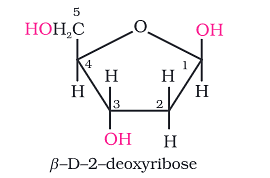
Deoxyribonucleic Acid (DNA)
Ribonucleic Acid (RNA)
The RNA molecule is also made up of phosphoric acid, pentose sugar, and some cyclic bases containing nitrogen. RNA has β-D-ribose in it, in the form of the sugar moiety. The heterocyclic bases present in RNA include adenine (A), guanine (G), cytosine(C), and uracil (U). In RNA the fourth base is different from that of DNA, and the RNA has a single strand that many times folds back. This results in the creation of a double helix structure.

Ribonucleic Acid (RNA)
Three kinds of RNA molecules having different functions include:
- Messenger RNA (m-RNA)
- Ribosomal RNA (r-RNA)
- Transfer RNA (t-RNA)
Each of the nucleotides consists of these three parts:
- A pentose sugar
- A nitrogenous base
- A phosphate group
The nitrogenous base and a pentose sugar are called as a nucleoside.
Read More:
| Chapter Related Concepts | ||
|---|---|---|
| Carbohydrate Metabolism | RNA and DNA | |
| Cellulose | Nucleotide and Nucleoside | Sucrose |
Roles played by DNA and RNA in cells
[Click Here for Previous Year Questions]
Nucleic acids, the macromolecules are made out of small units called nucleotides. They appear in two naturally occurring varieties including DNA and RNA. DNA is defined as genetic material found in living organisms. Many viruses use RNA, instead of DNA, as their genetic material, but they are not considered to be alive.
DNA in cells
In eukaryotes, like plants and animals, DNA is present inside the nucleus. The nucleus is a specialized, membrane-bound vault inside the cell, also it is present in certain other types of organelles(like mitochondria and the chloroplasts of plants). In prokaryotes, similar to bacteria, the DNA is not enclosed in a membranous envelope but is present in a particular cell region called the nucleoid.
In eukaryotes, DNA is mostly broken up in long, linear pieces named chromosomes; however, in prokaryotes like bacteria, chromosomes are smaller in size and mostly circular. Chromosomes include thousands of genes and every chromosome provides instructions regarding making a particular product required by the cell.
From DNA to RNA to proteins:
Many genes encode protein products, which means they encode some sequence of amino acids needed in the preparation of a particular protein. Before the same information can be used for protein synthesis, a copy of RNA(transcript) of the gene is made. This kind of RNA is being known as a messenger RNA (mRNA) as it passes on the information between DNA and the ribosomes, molecular machines that read mRNA sequences and use the same information in building Proteins. This progression from DNA to RNA to protein is being referred to as the “central dogma” of molecular biology.

From DNA to RNA to proteins
One thing to note here is that not all genes encode protein products.
Nucleotides
[Click Here for Sample Questions]
Both, DNA and RNA are polymers and are made up of monomers referred to as nucleotides. When these monomers are combined it results in a chain explained as a polynucleotide (poly = "many"). Each nucleotide is made up of three different parts including a nitrogen-containing ring structure named as a nitrogenous base; five-carbon sugar, and one phosphate group. The sugar molecule holds a central position in the nucleotide, with the base attached to one of its carbons and the phosphate group (or groups) attached to another.

Nucleotides
- Nitrogenous bases
The nitrogenous bases of nucleotides are referred to as organic (carbon-based) molecules made up of nitrogen-containing ring structures. All nucleotides in DNA include one of four possible nitrogenous bases like adenine (A), guanine (G) cytosine (C), and thymine (T).
Both, Adenine and guanine are purines and their structures include two fused carbon-nitrogen rings. However, Cytosine and thymine are pyrimidines and have a single carbon-nitrogen ring. RNA nucleotides also include adenine, cytosine, and guanine bases, but in place of thymine, they have another pyrimidine base named uracil (U).
In terms of molecular biology, the nitrogenous bases are notified by their one-letter symbols, A, T, G, C, and U.
DNA consists of A, T, G, and C; however, RNA includes A, U, G, and C.

Nitrogenous bases
- Sugars
Along with having different bases, both DNA and RNA nucleotides also have some slightly different sugars. The sugar in DNA having 5 carbons is called deoxyribose, while in RNA, the sugar is ribose. Both of them are quite the same in structure, and just have a single difference, the second carbon of ribose belongs to a hydroxyl group, while the equivalent carbon of deoxyribose belongs to hydrogen. The carbon atoms of a nucleotide’s sugar molecule are numbered as 1′, 2′, 3′, 4′, and 5′ (1′ is read as “one prime”), the sugar is placed centrally, having its base attached to its 1′ carbon and the phosphate group (or groups) attached to its 5′ carbon.

Sugars
- Phosphate
Nucleotides might belong to one phosphate group, or a chain of up to three phosphate groups, attached to the 5’ carbon of the sugar. In many written texts, chemistry sources recommend the term “nucleotide” only for the single-phosphate case, but in terms of molecular biology, the broader definition is considered. In a cell, a nucleotide about to be added to the end of a polynucleotide chain will have a series of three phosphate groups. When the nucleotide joins the growing DNA or RNA chain, they start losing two phosphate groups. In a chain of DNA or RNA, all the nucleotides will have one phosphate group.

Structure of Nucleotides
Also Read:
Previous Year Questions
Ques: Name the four bases present in DNA. Which one of these is not present in RNA? (All India 2009, 2 Marks)
Ans: The four bases present in DNA are :
(i) Adenine (A)
(ii) Guanine (G)
(iii) Cytosine (C)
(iv) Thymine (T)
In RNA, Thymine (T) is absent. In RNA, Uracil (U) is present in place of Thymine.
Ques: What are essential and non-essential amino acids in human food? Give one example of each type. (Delhi 2009, 2 Marks)
Ans: Amino acids which cannot be synthesized by the body are called essential amino acids.
Example : Valine, leucine etc. Therefore they must be supplied in diet.
Amino acids which can be synthesized by the body are called non-essential amino acids. Therefore, they may or may not be present in diet.
Example : Glycine, alanine etc.
Ques: State clearly what are known as nucleosides and nucleotides. (Delhi 2009, 2 Marks)
Ans: Nucleoside : A nucleoside contains only two basic components of nucleic acids i.e. a pentose sugar and a nitrogenous base. During their formation 1-position of the pyrimidine or 9-position of the purine moiety is linked to C1 of the sugar (ribose or deoxyribose) by a β-linkage.

Nucleotides : A nucleotide contains all the three basic components of nucleic acids, i.e. a phosphoric acid group, a pentose sugar and a nitrogenous base. These are formed by esterification of C5‘ – OH of the sugar of the nucleoside with phosphoric acid.

Ques: Name the bases present in RNA. Which one of these is not present in DNA? (Delhi 2009, 2 Marks)
Ans: The four bases present in RNA are :
Purines – Adenine (A) and Guanine (G)
Pyrimidines – Uracil (U) and Cytosine (C)
Uracil is not present in DNA.
Ques: Write the main structural difference between DNA and RNA. Of the four bases, name those which are common to both DNA and RNA. (All India 2012, 2 Marks)
Ans:
| DNA | RNA |
|---|---|
| The sugar present in DNA is 2-deoxy-(-) ribose. | The sugar present in RNA is D-(-) ribose. |
| It has cytosine and thymine as pyrimidine bases. | It has cytosine and uracil as the pyrimidine bases. |
| It has a double α-helix structure. | It has a single α-helix structure. |
The base which are common to both DNA and RNA are :
- Adenine (A)
- Guanine (G)
- Cytosine (C)
Ques: Amino acids may be acidic, alkaline or neutral. How does this happen? What are essential and non-essential amino acids? Name one of each type. (All India 2010, 3 Marks)
Ans: Amino acids can be broadly classified into three classes i.e. acidic, alkaline and neutral amino acids depending on the number of —NH2 group and — COOH group.
Acidic amino acids : The a-amino acids such as aspartic acid, asparagine and glutamic acid which contain two -COOH groups and one -NH2 group are called acidic amino acids.
Alkaline or Basic amino acids : The a-amino acids such as lysine, arginine and histidine which
contain two -NH2 groups and one -COOH group, are called basic amino acids.
Neutral amino acids : The a-amino acids such as glycine, alanine, valine etc. which contain one -NH2 and one – COOH group, are called neutral amino acids.
Essential amino acids : Amino acids which cannot be synthesized by the body are called essential amino acids.
Example : Valine, leucine etc. Therefore they must be supplied in diet.
Non-essential amino acids : Amino acids which can not be synthesized by the body are called non-essential amino acids. Therefore, they may or may not be present in diet.
Example : Glycine, alanine etc.
Ques: What are the different types of RNA found in cells of organisms ? State the functions of each type. (Comptt. Delhi 2012, 3 Marks)
Ans: Different types of RNA found in the cell are :
- Messenger RNA (mRNA): It carries the message of DNA for specific protein synthesis.
- Ribosomal RNA (rRNA) : It provides the site for protein synthesis.
- Transfer RNA (t-RNA): It transfers amino acids to the site of protein synthesis.
Ques: (i) Write the structural difference between starch and cellulose.
(ii) What type of linkage is present in Nucleic acids?
(iii) Give one example each for fibrous protein and globular protein. (All India 2016, 3 Marks)
Ans: (i) Starch contains the β-D-glucose as its monomer units while Cellulose contains β-D- glucose as its monomer units.
(ii) In Nucleic Acids Phosphodiester linkages are present
(iii) Globular protein : All Enzymes and Hormones like insulin.
Fibrous protein : Keratin in skin.
Sample Questions
Ques: What is the role of Nucleic Acids? ( 2marks)
Ans: Nucleic acids play an important role in the transmission of inherent characters from parent to offspring. Moreover, they are responsible for the synthesis of protein in the bodies. DNA fingerprinting is a method considered by forensic experts aiming to determine paternity. It is also while tracking criminals and played an essential role in studies related to biological evolution and genetics.
Ques: Name the types of nucleic acids? ( 2marks)
Ans: The two types of nucleic acids are
- DNA (deoxyribonucleic acid)
- RNA (Ribonucleic acid)
Ques: State the name of the two types of sugars that are present inside nucleic acids? ( 1 marks)
Ans: Two types of sugars present in nucleic acids include RNA (D – ribose) and DNA (D – deoxyribose)
Ques: Explain Nucleic Acids? ( 1 marks)
Ans: Nucleic acids are explained as biologically important polymers present inside all living cells. Another name of these acids is polynucleotides as they are repeating structural units is nucleotides.
Ques: State the types of Nitrogenous bases? ( 1 marks)
Ans: There are two types of Nitrogenous bases whose names include Purines and Pyrimidines.
For Latest Updates on Upcoming Board Exams, Click Here: https://t.me/class_10_12_board_updates
Check-Out:



Comments