



Content Writer
Organic Chemistry is a branch of chemistry that studies the structure, properties, composition, reactions, and preparation of carbon-containing compounds.
- Most of these compounds are made of carbon and hydrogen.
- The organic compounds containing carbon and hydrogen are called hydrocarbons.
- They may also include other type of elements.
- It includes nitrogen, oxygen, halogens, phosphorus, silicon, and sulfur.
- Organic chemistry concentrates on the qualities, construction, and responses of these natural compounds.
- Synthesis of polymers and other natural products are compounds used for human advancements.
- These compounds are hydrophobic in nature, which forms specialized molecular crystals.
- Organic chemistry is used in the field of cosmetics.
- The cosmetic industry seeks to address skin problems by using organic compounds.
- They examine how cosmetics products interact with the skin under different environmental conditions.
Key Terms: Organic Chemistry, Organic Compounds, Hydrocarbons, Isomerism, Aromatic Compounds, Acyclic Compounds, Aliphatic Compounds, Structural Isomerism, Stereoisomerism, Carbon-containing Compounds
What is Organic Chemistry?
[Click Here for Sample Questions]
Organic chemistry is a subset of science managing mixtures of carbon. Thus, organic science is the science of carbon compounds and is 200-225 years of age.
- Carbon structures bond with themselves to shape long chains of hydrocarbons.
- It can form carbon securities intricately.
- Carbon can form bonds with different components of the intermittent table.
- It includes H, N, S, O, P, and incandescent light.
- The mixtures framed will likewise be called organic compounds.
- Lipids, DNA, proteins, and sugars have a place in the classification of organic mixtures.
- These compounds are fundamental for the food of lives.
Essential Force Theory
Essential Force Theory was proposed by a Swedish researcher named Berzelius in 1780. As indicated by this hypothesis, to make an organic compound, you want to have a living framework like a plant or creature.
- Natural atoms were regularly secluded from nature, plant material, creatures, or whatever other living organic entities.
- This hypothesis was accepted to be in existence for a long time.
Example of What is Organic ChemistryExample: CH4, methane, and CH3-CH3 ethane. Example: Polymers like polyethylene are straight chains where many CH2 are connected together |
Organic Chemistry Synthesis
Later in the year 1828, researcher named Frederich Wohler played out a way-breaking examination to negate a hypothesis which expressed that living organic entities are important to deliver natural mixtures.
- The investigation included blending NH4Cl + KCNO to get NH4CNO.
- After warming the subsequent compound, Urea was acquired.
- Urea is the primary lab incorporating organic compounds.
- This demonstrated that there is no need of living life forms to orchestrate organic compounds.
- In 1885, Kolbe was engaged with the amalgamation of acidic corrosive (CH3COOH) otherwise called vinegar in the laboratory.
- In 1856, Berthelot tested to combine methane (CH4) from Aluminum Carbide (Al4C3) to develop hydrolysis.
Read more:
Importance of Organic Chemistry
[Click Here for Sample Questions]
Organic Chemistry is pertinent in various regions of our lives which are as follows:
Medicines
Aspirin which is a migraine medication and Ibuprofen is a pain reliever, both are natural mixtures. Different models incorporate paracetamol. It produces markets drugs used for medications and medical devices for humans or animals.
Food
Starch which is sugar is a natural compound and a constituent of rice and different grains. It is the wellspring of energy.
Clothing
Nylon, Polyester, and Cotton are types of natural compounds.
Fuels
Gasoline, Petrol and Diesel are natural mixtures utilized in the car business at large.
Structural Representation of Organic Compounds
[Click Here for Previous Year's Questions]
Various structures by which organic compounds can be represented in the field of organic chemistry are as follows:
Complete Structural Formula
Full primary conditions show every one of the iotas in a particle, the sorts of bonds that tight spot them, and how they are interconnected.
Dense Structural Formula
The condensed primary recipe is utilized to save space; underlying equations are advantageously truncated as consolidated primary equations.
Bond Line Structural Formula
A bond-line structure is a less jumbled drawing than a dense primary recipe. Even so, to comprehend the improved bond-line structure, the peruser needs to intellectually add a lot more elements to grasp the general construction.
Read more: Combustion Reaction
Reagents in Organic Chemistry
[Click Here for Sample Questions]
Reagents are compounds that are added to organic products to bring a particular change in the final organic compounds. The general reactions used in organic chemistry are as follows:
Substrate + Reagent → Product
Reagents are divided into two categories, which are as follows:
Electrophiles
Electrophile is a type of electron-deficient organic reagent which will attack the negative of the molecule or loves electrons. They are positively charged species with empty orbitals.
Example of ElectrophilesExample: H+, NO2+, CH3+, Cl+ |
Nucleophiles
Nucleophile is a type of electron-rich organic reagents which will attack the positive side of the substrate or love the nucleus. They are charged negatively with lone pair of electrons.
Example of NucleophilesExample: H–, CH3–, and Cl–. |
Types of Reactions in Organic Chemistry
[Click Here for Sample Questions]
There are six types of reactions in organic chemistry which are as follows:
Substitution Reaction
Substitution Reaction is a type of reaction in which organic compound is substituted by another organic compound which can be represented as follows:
R-X + Y → R-Y +X
- Where R-X is the substrate
- Y is the reagent (which can be electrophilic or nucleophilic)
- X is called the leaving group.
Substitution Reaction is further divided into four categories which are as follows:
- Nucleophilic Substitution ( SN1, SN2, SNi)
- Electrophilic Substitution (SE)
- Nucleophilic Aromatic Substitution (SNAr)
- Addition Reactions
Elimination Reaction
Elimination Reaction is a type of reverse addition reaction where a molecule of HX is removed from substrate. It is further classified into three categories which are as follows:
- Oxidation and reduction reactions
- Pericyclic reactions
- Molecular rearrangements
Example from Elimination ReactionExample: CH3CH2Cl → CH2=CH2 + HCl |
Addition Reaction
Addition Reaction is a type of reactions in organic chemistry when two different type of reactants combines to form a new product. It does not undergo loss of energy.
Example of Addition ReactionExample: HCl + CH2=CH2→ CH3CH2Cl |
Radical Reaction
Radical Reaction is a type of reaction that involves addition of halogen compound to a hydrocarbon to form a halogenated product.
Cleavage of Bonds
[Click Here for Sample Questions]
Each organic compound formed in organic chemistry undergoes a reduction and addition of bonds to create final products. There are two types of cleavage bonds in organic chemistry, which are as follows:
Heterolytic Cleavage
In heterolytic cleavage, bonds between the elements are broken unequally in such a way that a shared pair of electrons is created for each element. One atom has a positive charge, and the other has a negative one.
Homolytic Cleavage
In homolytic cleavage, bonds between the elements are broken equally in such a way each atom participating in the reaction will receive a single electron. It will form free radicals.
- Homolytic Cleavage uses fish-hook arrows in the reaction.
Resonance Effect
[Click Here for Sample Questions]
Resonance Effect is a type of effect in which the polarity is produced after the interaction of two π-bonds or between a π-bond and a lone pair of electrons which are present on an adjacent atom.
- It is also known as a mesomeric effect.
- The symbol used for indication is R or M.
- The resonance effect is categorised into two classes, which are as follows:
Positive Resonance Effect
Positive Resonance Effect is a type of effect in which the transfer of electrons takes place from an atom or group attached to the conjugated system.
Negative Resonance Effect
Negative Resonance Effect is a type of effect in which the transfer of electrons takes place towards an atom or group attached to the conjugated system.
Classification of Organic Compounds
[Click Here for Sample Questions]
Organic Compounds are classified into three categories, which are as follows:
Acyclic Compounds
Organic mixtures are delegated open-chain compounds, and the shut chain intensifies as far as the carbon chain. It is also named organic compounds, acyclic, open chain, or aliphatic compounds.
- The compound is also known as Cyclic, Closed Chain, or Ring Compound.
Sweet-smelling Compounds
Plants and miniature organic entities have a restrictive course to benzene-ring compounds. The extraordinarily greater part of the sweet smell intensifies in nature in this manner.
- They are delivered by plants and microorganisms.
- Creatures are reliant upon plants for the overwhelming majority of fragrant mixtures, either straightforwardly or indirectly.
Heterocyclic Aromatic Compounds
In the 20th century, the first inorganic heteroaromatic compound was delivered to the lab. A portion of these heterocyclic fragrant mixtures is vital in biochemical cycles, drugs, and agrochemicals.
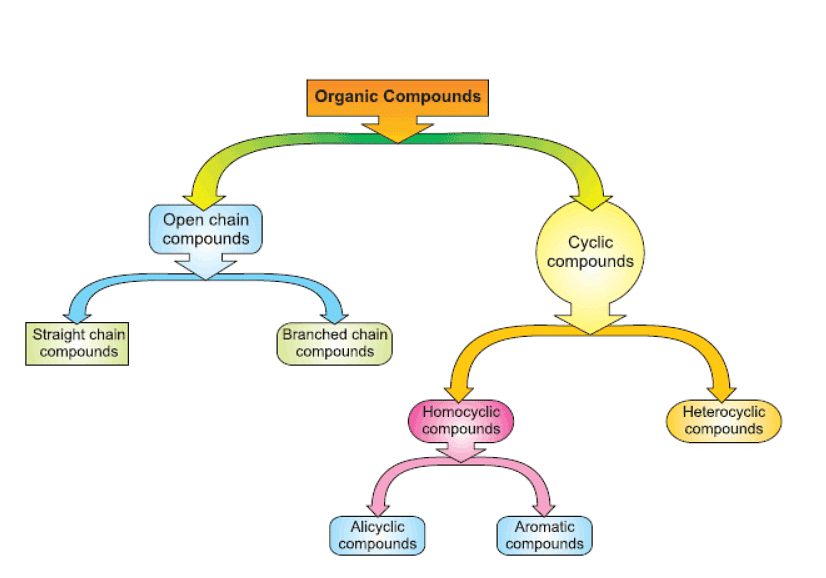
Classification of Organic Compounds
Isomerism
[Click Here for Previous Year's Questions]
Isomerism is a phenomenon where at least two mixtures have a similar synthetic equation yet have different underlying recipes and various properties. This is chiefly a result of various primary or spatial plans.
- Isomers are the mixtures displaying unique peculiarities.
- It is divided into two categories, which are as follows:
Structural Isomerism
Structural Isomerism emerges because of various plans of particles inside the atom. Two particles are primary isomers on the off chance that they share a similar subatomic recipe.
Stereoisomerism
Stereoisomers are isomeric particles with similar sub-atomic equations and arrangements of reinforced iotas, yet they are disparate in the 3D directions of their molecules in space.
- Stereoisomerism might be of two sorts: mathematical (or cis-trans) isomerism and optical (or d-l or perfect representation) isomerism.
Fundamental Concepts of Organic Reaction Mechanisms
[Click Here for Sample Questions]
The fundamental concepts of organic reaction are as follows:
Shapes of Carbon Compounds
Tetravalent carbon atoms are the building blocks of structural organic chemistry. The four hydrogen atoms, with four carbon atoms, form a structure known as a tetrahedron.
Functional Groups
Functional groups were introduced as a useful method for organizing this vast number of compounds because chemical reactions occur in the functional group, and compounds with the same functional group undergo similar reactions.
Homologous Series
The Homologous Series is a series of organic compounds in which every succeeding member differs from the previous one.
Methods of Purification of Organic Compounds
[Click Here for Previous Year's Questions]
There are different methods used for the purification of organic compounds, which are as follows:
Simple crystallization
Crystallization is one of the best decontamination procedures for solids. Straightforward crystallization includes the choice of the dissolvable and arrangement of the arrangement.
Fractional crystallization
Fractional crystallization is utilized for the decontamination of a solitary substance sullied with little amount of pollution.
Sublimation
Sublimation is an incredible strategy for refining moderately unstable natural solids on scales ranging from milligrams to many grams.
Simple Distillation
Simple distillation is the method involved with changing a fluid into its fume, moving the fume somewhere else, and recuperating the fluid by gathering the fume.
Fractional Distillation
Fractional refining is the partitioning technique of a combination into segments or parts of its material. Synthetic mixtures are confined by warming them to a temperature at which at least one piece of the blend disintegrates.
Important Topics for JEE MainAs per JEE Main 2024 Session 1, some important topics included in the chapter Organic Chemistry are as follows:
Here is list of a number of questions asked from topics of organic chemistry:
Some memory based important questions asked in JEE Main 2024 Session 1 include:
(i) Alicyclic (ii) Aromatic (iii) Antiaromatic (iv) Acyclic
|
Read more:
Things to Remember
- Organic Chemistry is the study of the construction, responses, and readiness of carbon-containing compounds.
- A covalent bond, also called a molecular bond, is a chemical bond that involves the sharing of electron pairs between atoms.
- An isomer of a molecule has the same number of atoms of each element but has a different arrangement of atoms.
- Urea is the primary lab organic compound formed.
- Students preparing for organic chemistry class 11 can practice Important Questions on Organic Chemistry.
- NCERT Solutions For Class 11 Chemistry Chapter 12: Organic Chemistry Some- Basic Principles and Techniques are also available for practice.
Previous Years’ Questions
- The correct statement regarding electrophile is… (NEET 2017)
- Which of the following is an electrophile?
- Among the following the strongest nucleophile is…
- Strongest nucleophile is…
- The most reactive nucleophile among the following is…
- Which of the following can behave as both electrophile and nucleophile…
- The correct set of reagents for the following conversion is…
- Electrophilic reagents are…
- The reagents used in the conversion are… (DUET 2008)
- 2-butene shows geometrical isomerism due to… (NEET 2000)
- Complete combustion of 1.80g of an oxygen containing compound… [JEE Main 2021]
- Example of electrophile is… (AMUEEE 2011)
Sample Questions
Ques: What is meant by organic compounds? (3 marks)
Ans: Organic compound, one of a large class of chemical compounds in which one or more carbon atoms are covalently paired with other elements, or atoms, most commonly hydrogen, oxygen, or nitrogen.
- Organic molecules are utilized in various ventures in human culture, including food, drugs, fills, and working, to give some examples.
- Alkanes incorporate synthetic substances like propane, octane, and methane.
- These are normally utilized as oils for things like fuel in the vehicle and warming/cooking oil in the home.
Ques: What organic compounds are used in medicine? (2 marks)
Ans: Compounds used as medicinal products are most usually organic compounds, sometimes divided into large groups of small organic molecules (e.g., atorvastatin, fluticasone, clopidogrel) and “biologics” (infliximab, erythropoietin, insulin glargine), the latter more widely used as protein medicinal products.
Ques: Why are organic compounds useful? (3 marks)
Ans: Organic compounds are fundamental since they contain carbon in every living organic entity. They are the essential parts that move the world in a considerable lot of cycles. For instance, the carbon cycle which includes trading carbon in photosynthesis and cell breath among plants and creatures.
- Some types include gasoline, plastics, detergents, colorants, food additives, natural gas, and drugs.
- Soap and detergent are two different examples of organic chemistry, although both are used for washing.
Ques: Give a brief description of the principles of the following techniques taking an example in each case: (a) Crystallisation (b) Distillation. (4 marks)
Ans: (a) Crystallization: In this cycle, the polluted strong is broken up in the base volume of a reasonable dissolvable. The solvent contaminations pass into the arrangement while the insoluble ones remain behind. The hot arrangement is then separated and permitted to cool undisturbed till crystallization is finished. The precious stones are then isolated from the mother alcohol by filtration and dried.
Model: crystallization of sugar.
(b) Distillation: The activity of refining is utilized for the decontamination of fluids from non-unpredictable pollutants. The sullied fluid is bubbled in a carafe and the fumes so shaped are gathered and consolidated to offer back unadulterated fluid in another vessel. Straightforward natural fluids, for example, benzene toluene, xylene, and so on can be cleansed.
Ques: Describe the method, which can be used to separate two compounds with different solubilities in a solvent? (3 marks)
Ans: Fractional crystallization is utilized for this reason. A hot-soaked arrangement of these two mixtures is permitted to cool, the less dissolvable compound solidifies out while the more solvent remains in the arrangement.
- The precious stones are isolated from the mother alcohol.
- The mother alcohol is again focused and the hot arrangement is again permitted to cool when the gems of the subsequent compound are obtained.
- These are again separated and dried.
Ques: What is the difference between distillation, distillation under reduced pressure and steam distillation? (2 marks)
Ans: Distillation is utilized in the event of unstable fluid blended in with non-unpredictable pollution.
- Refining under decreased pressure: This strategy is utilized to filter such fluids which have extremely high limits and which disintegrate at or beneath their edges of boiling over.
- Steam refining is utilized to cleanse steam unstable fluids related to water-immiscible impurities.
Ques: Explain: (A) Name a suitable technique of separation of the components from a mixture of calcium sulphate and camphor.
(B) Which type of compounds are purified by steam distillation?(2 marks)
Ans: (A) Sublimation, Because camphor can sublimate whereas CaSO4 does not.
(B) Steam is volatile and insoluble in water.
Ques: What is the difference between elimination and substitution reaction? (4 marks)
Ans: The difference between elimination and substitution reaction are as follows:
| Elimination Reaction | Substitution Reaction |
|---|---|
| Elimination reaction is a type of reaction in which atoms are replaced in pair or alone from a molecule. | Substitution reaction is a type of reaction in which one organic compound is replaced by another organic compound. |
| It occur at high temperature. | It occur at low temperature. |
| Elimination Reaction is divided into two categories of E1 and E2. | Substitution Reaction is divided into two categories of SN1 and SN2 |
| Example: Dehydrohalogenation | Example: Nitration |
Ques: Explain Carbene? (3 marks)
Ans: Carbenes is a type of neutral compounds that consists of six electron in the outermost shell of electron. These compounds are electron deficient compounds. Carbenes are classified on the basis of spin which are as follows:
- Single Carbene: Single Carbene is a type of carbene in which electrons are present in different state of orbitals. It consists of opposite spin.
- Triple Carbene: Triple Carbene is a type of carbene in which pair of electrons are present in different state of orbitals. It consists of same spin.
Ques: What is the difference between carbanion and carbocation? (3 marks)
Ans. The difference between carbanion and carbocation are as follows:
| Carbanion | Carbocation |
|---|---|
| Carbanion is a type of anion in which negative charge is present on carbon atom. | Carbocation is a type of cation in which positive charge is present on carbon atom. |
| It is sp3 hydridize. | It is sp2 hydridize. |
| They are dimagnetic in nature. | They are paramagnetic in nature. |
Ques. Explain Electromeric Effect? (3 marks)
Ans. Electromeric Effect is also known as E-Effect which is a temporary effect. It consists of multiple bonds including double or triple bonds in the presence of attacking reagent. It is divided into two categories which are as follows:
- Positive Electromeric Effect: It is a type of effect in which π−electrons of the multiple bond are transferred to that atom to which the reagent gets attached.
- Negative Electromeric Effect: It is a type of effect in which π - electrons of the multiple bond are transferred to that atom to which the attacking reagent does not get attached.
Do Check Out:



Comments